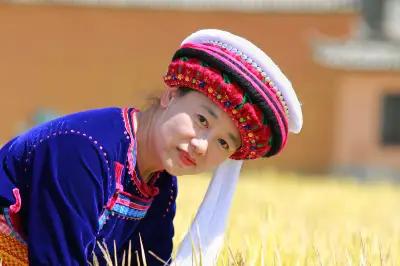
A Life Called Dali: Dali in Autumn Is Like a Beautiful Painting
South of the colorful clouds—Yunnan—is a beautiful and graceful place. And Dali Ancient City is like a maiden veiled in mystery, silently beckoning visitors from near and far. In autumn, Dali looks like a breathtaking oil painting. Dali Ancient City captivates travelers perhaps partly because of Jin Yong’s martial arts novel Demi-Gods and Semi-Devils, evoking an air of romance like wind, flowers, snow, and moon. In Dali, 'wind, flowers, snow, and moon' does not refer to nostalgic love affairs, but to the wind of Xiaguan, flowers of Shangguan, snow on Cangshan Mountain, and the moon over Erhai Lake. East of Cangshan lies a mirror-like lake—Erhai. Its scenery is so lovely it seems like a graceful girl singing softly beneath the clouds, over the shimmering lake, leaving you enchanted. Dali wears a classic look, carries the crisp autumn of the highlands, and possesses the gentle, old-world charm of a demure lady. Come along and discover a different Dali over five days and four nights.
By Cangshan and Erhai, wind, flowers, snow, and moon
Next, Dali will transform into a scene straight out of a comic book! Dali is a small town I keep coming back to. Every autumn, this is the most beautiful season. By Erhai Lake, the redwood trees turn red, and seagulls return. Every day, puffy white clouds dot the blue sky like cotton candy reflected in the water. Cycling slowly along Erhai, you breathe fresh air, pass roadsides bursting with flowers, and watch sunlight dance on the lake like pearls bouncing on silk.
Don’t miss the white blossoms floating on Erhai’s surface—this flower is called ottelia acuminata, starry little dots of exquisite beauty. The temperature is just perfect. Rent a bicycle and slowly soak in the scenery; just be sure not to miss these photo spots. Come to Dali this autumn and check them off your list.
A few Erhai must-visit spots:
1. Longkan Pier: ideal for sunrise and sunset. Flocks of seagulls wheel overhead, and the redwoods glow crimson.
2. Small slope by the Caicun canal: on the right-hand canal bank on the way to Caicun, you can capture a Miyazaki animation vibe.
3. S-Bend in Panxi Village: often crowded; sunrise or sunset visits are better—stunning and less busy.
4. The flower sea by Erhai: truly reminiscent of a Monet painting. Flowers bloom on the water’s surface, not far from the Lonely Tree.
5. Lonely Tree at Langqiao: Langqiao itself is photogenic, and the Lonely Tree nearby is an absolute favorite.
Chongsheng Temple Three Pagodas, magnificent
When you think of Dali’s iconic landmarks, Chongsheng Temple Three Pagodas come to mind. Enter from the side gate into the pagoda area. The three pagodas stand in a triangular layout, backed by the majestic Cangshan Mountain, forming a fresh picture of green hills and ancient pagodas. The Three Pagodas consist of a main pagoda and two smaller ones to the north and south. The main pagoda stands in front, with the two smaller octagonal brick pagodas slightly behind, each ten stories high, both 70 meters from the main pagoda.
Chongsheng Temple was first built during the Nanzhao period of the Tang Dynasty, burned down in the Xianfeng era of the Qing, but the three pagodas survived intact. It wasn’t until April 2005 that the temple was completely rebuilt, ending nearly a century of 'pagodas without a temple'. Behind the pagodas, the temple complex is dense, symmetrically laid out, and imposing. Amid lingering Buddhist chants, climb the steps and visit the Nanzhao-era giant bell, the Rain Copper Guanyin Hall, Chongsheng Temple, the Hall of Heavenly Kings, Guanyin Hall, and the Grand Buddha Hall.
At the top stands the Grand Buddha Hall, modeled after the Taihe Hall in the Forbidden City. Resplendent and majestic, it perfectly captures the extraordinary grandeur of a royal temple.
When traveling in Dali, don’t forget to visit Chongsheng Temple Three Pagodas. The architecture follows a central axis, a feast of symmetrical beauty. And the weather this season is simply glorious—cloudless blue skies every day; even a casual snap looks wonderful.
Xizhou Ancient Town, golden rice fields in harvest season
Dali in autumn is impossibly beautiful. On my second day, the sky was cloudless, autumn rhythm like poetry. Between Cangshan and Erhai lies such a rice field—Xizhou Rice Fields. We arrived worried that the golden fields might already be gone, only to realize how lucky we were. Just the last patch of golden rice remained unharvested, allowing me to witness that beautiful seaside field. The scene looks like something out of a Miyazaki film: golden paddies against gray-tiled red walls, under a blue sky with white clouds. One click of the shutter and you have a masterpiece. You can only feel this beauty when you're there.
With perfect sunshine and a gentle breeze, the vast golden fields ripple like waves under the blue sky, harmonizing with the scattered traditional Bai houses, pouring deep autumn affection into this place. It adds a layer of serenity, peace, and harmony to this secluded ancient town.
Strolling along Xizhou’s streets, the grey-tile-and-white-wall local architecture captivates you on both sides. Deep courtyards, weathered winding flagstone roads, and mostly local elders sitting by shops—compared to Dali Ancient City, Xizhou still preserves centuries of tradition. You’ll also find many young people who escaped the hustle of Dali Ancient City, quietly running their own little shops with an air of detachment. I think Xizhou is more suited for a slow-paced life.
Step into the Xizhou Jiangzhi Ji Museum, where you’ll find many local artworks, and a Jia Ma printmaking art gallery where you can try hands-on printmaking. The exhibition space covers art and craftspeople from all over Dali. From content to space design, it’s a pure treat. Those who appreciate fine detail can bask in a moment of rest. The Folk Art Center has three halls. On the ground floor of the Jia Ma Printmaking Art Gallery, there’s a cultural creative center and a café; you can also experience making Jia Ma prints.
In autumn, Xizhou dresses everything in brilliant gold, waking up the world and its people, stirring poetic charm in everyday life, and evoking the romance of wind, flowers, snow, and moon. While autumn lingers, why not pause your busy pace and meet a golden slice of leisure in Xizhou? Spend a vacation in this 'town of joy'.
Shuanglang Ancient Town, the prime scenery of Canghai
By Erhai Lake and beside Cangshan Mountain hides a little town that shuns the world, wrapped in wind, flowers, snow, and moon. This is Shuanglang Ancient Town, the number one scenic spot of Cangshan and Erhai. Shuanglang is named for its two curves: Luoshi Curve to the north, Lianhua Curve to the south, with Jinsuo and Yuji Islets nestled between. This is one of travelers’ favorite towns. Many guesthouses sit right on the lakeshore; open a window and you’re practically on Erhai. Naturally, those with better views cost a bit more. But the scenery is truly stunning. Walking along the lakeside path, flowers bloom the whole way—scenery like a painting.
The lake mirrors the sky, layered green mountains reflect in the water, and the 'double islets, double curves' embrace the elegant, folk-flavored Bai township, creating a harmonious natural picture. As the saying goes, 'The beauty of Dali lies in Cangshan and Erhai; the beauty of Cangshan and Erhai is in Shuanglang.' Shuanglang is famed for its unparalleled lake views.
Find a lakeside restaurant. A piano is positioned in the middle of the water, where the lake becomes a clean, bright mirror, like a mirror of the sky. Sunlight filtering through clouds casts a 'divine light over Erhai' with the continuous Cangshan Mountains as a backdrop—truly spectacular.
Many people love the vibe of Shuanglang. Enjoy afternoon tea here, bathed in autumn sunlight, cozy and leisurely. Admire Erhai scenery while sipping a drink. You can sit by the lake quietly with a cup of coffee, watching clouds drift over the mountains and the blue-sky-crystal-water view—like poetry and painting. It’s a must-visit spot in Dali. Even more, people adore the town’s blend of authentic character and modern flair, nestled between mountains and water—beauty beyond words.
Cangshan Nature Image Museum, feel the charm of nature
By the time we reached the Nature Image Museum on the mountainside, evening had fallen. This is personal museum of photographer Xi Zhinong. The ground floor is an exhibition area, mainly photography shows about natural scenes—plants, animals, and more. It has become a niche Dali destination and a great place for kids, praised for its atmospheric library and open-air terrace, a spot every visitor strongly recommends. If you’re bringing children, do visit; there are many exhibits about animals and plants, a wonderful way for kids to learn about nature.
The museum’s open terrace also provides an art venue closer to nature, easy to blend in. From the terrace, you can take in a panoramic view of Erhai. There’s a café too; when you’re tired, sit down and savor a cup of coffee.
Shaxi Ancient Town, the last surviving market town on the Tea Horse Road
In Dali, there is an ancient town with little excessive commercialization, still retaining its original ecology. This is Shaxi Ancient Town, hailed as 'the sole surviving market town on the ancient Tea Horse Road'. In autumn, the town looks like an oil painting. It’s nothing like those cookie-cutter towns elsewhere. Here are age-old stone-paved roads, curling kitchen smoke, gurgling streams, and a rustic, deep, and tranquil original style.
The old opera stage is the heart of Shaxi, still well-preserved after over 600 years. In front of it, people sit in twos and threes under the trees, basking in the afternoon sunlight—a true enjoyment of life. Walking the flagstone road, you can almost hear horses’ hooves echoing. Along the sides, there are art shops and cats strolling leisurely. Autumn is the most beautiful season in Shaxi. Standing on Yujin Bridge, you see leaves on both sides of the stream turned yellow. Under the blue sky and white clouds, the town is tranquil, like a hidden paradise. The moment you arrive, you feel like staying.
In Beilong Village near Shaxi, there’s a rural library called Librairie Avant-Garde, converted from an old granary. From outside, it’s a mud-brick building; inside, it’s clean, bright, and full of books. Worth a visit if you have time. Shaxi Ancient Town isn’t large; strolling for about one to two hours covers it all. The buildings and streets radiate from the ancient opera stage. Across from the stage, Xingjiao Temple is the only surviving Ming-dynasty Buddhist temple of the Bai people—well worth seeing.
I have a soft spot for Shaxi because it hasn’t been overly commercialized. Life here is unhurried; even shop owners run their businesses casually, following their own likes. Some shops open late in the morning and close early at night.
When visiting Shaxi, you can wander aimlessly or just sit and daydream. Many shops are tiny. Try the amazing specialty coffee or the irresistible Bai cuisine—you won’t want to stop picking up your chopsticks.
Shaxi Ancient Town is such a laid-back place. You can settle down to read a book or just sit and soak up the sun. Better travel here early, before it changes.
Fengyu Town’s Instagram-famous spot: Sky Rice Paddy Theater
About a two-hour drive from Shaxi lies Fengyu Town in Eryuan County. Step into the Sky Rice Paddy Theater in Fotang Village, surrounded by old pear trees. When I visited, some rice still stood unharvested. The golden paddy glowed brilliantly in the sunlight. Here, besides the pear orchard, there are guesthouses, one called Tuibutang, hidden in the hillside. The moment I entered, I was surprised by a swimming pool. The guesthouse is built against the mountain, a standalone villa, far from urban noise, offering extra tranquility.
Walking into Fotang Village, the place feels especially serene. Entering a local old house, there’s Zengzeng's Bookhouse, renovated from an old building. It provides a space for village children to read books and listen to teachers tell stories. An elderly person beside the entrance greeted us with a warm, kind smile. In the courtyard, there’s a café. Order a cup of coffee, sit in the sunshine—how pleasant that is.
In the old pear orchard, the theater blends into the golden rice fields. Descending from the top via steps, you enter the lower space and wander among the elevated columns, as if time and space interweave. We had lunch right there—with such stunning scenery! We also visited Tianma Thatched Cottage, Light Art Museum, and other spots.
We had lunch beneath the Sky Rice Paddy fields and for the first time ate a dish made of ottelia acuminata—the very flower that blooms on Erhai Lake. And of course, you can’t miss Dali’s mushrooms; we had hotpot, and it was absolutely delicious.
Weishan Ancient Town, the site of the original Nanzhao Kingdom
Weishan Ancient City was once the capital of the ancient Nanzhao Kingdom. The city was built in the Ming Dynasty, with over 600 years of history, about a one-and-a-half-hour drive from Dali. This ancient town isn’t overly commercialized, and the food here is very tasty. The streets form a standard '井'-shaped grid centered on Gongchen Tower, with a total of 25 streets. Houses on both sides of the main north-south axis still preserve the architectural styles of the Ming and Qing dynasties.
From above, a straight central axis divides the city into north and south. There are more local residents than tourists. Walking on the flagstone roads, you’re flanked by antique buildings. Xinggong Tower and Gongchen Tower are the town’s landmarks; climb Xinggong Tower for a panoramic view of Weishan. As dusk falls and lights come on, the ancient city glows beautifully—well worth a look.
Weishan Ancient City preserves simple folk customs and deep cultural heritage. Coupled with a mild climate, this has shaped the residents’ calm and unhurried nature. People pass through the old city gateways and walk along the ancient streets, year after year. The lively scene seems frozen in time—this is a living, breathing ancient town. The nighttime view is also a big attraction; when you’re here, don’t forget to stroll the old streets in the evening—there’s plenty of tasty street food, too.
Tie-dye is a thousand-year-old craft passed down among the people of Weishan. The unique traditional technique employs exquisite handwork: patterns are drawn on linen or cotton, then meticulously stitched along the outlines. The fabric is tightly sewn and dipped into dye vats. Each dyeing deepens the color. After repeated dips, it’s removed, rinsed, dried, and unstitched, revealing a beautiful handicraft. In 2003, Weishan was named 'the hometown of Chinese folk tie-dye art' by the Ministry of Culture. As you walk through Weishan’s streets, a series of relief murals and wall paintings about tie-dye showcase this precious cultural heritage.
Ersi (rice cake noodles) is a Yunnan specialty snack made mainly from rice. Its eating method is similar to Yunnan’s other famous snack, mixian (rice noodles), but the texture differs. Mixian is smooth and springy; ersi is soft, chewy, and fragrance lingers. When in Weishan, you absolutely must not miss ersi.
Wenhua Academy, savor a most classically elegant academy
Weishan Wenhua Academy was originally the Jade Emperor Pavilion, the largest-scale structure among Qing-dynasty buildings in Weishan, first built in the Ming Dynasty and rebuilt in the first year of the Guangxu period (1875). It later served as a primary school, then Weibao Middle School and Wenhua Middle School. Today, the Kuixing Pavilion, library, and some wing rooms survive, and the whole complex is well preserved. It’s right inside Weishan Ancient City, just a short walk away.
Entering the gate, you’re greeted by small bridges, running water, rockeries, bamboo groves, green grass, and colorful flowers, as if stepping into a poetic Jiangnan garden. The exquisitely carved architecture and lingering scholarly aura bear witness to the profound literary tradition of this land.
Although the Jade Emperor Pavilion and Wenhua Academy buildings are Qing-era constructions, their magnificent scale, rigorous layout, superb craftsmanship, and intricate carvings are exceptionally well preserved—rare in Dali Prefecture and even the whole province. Every visitor is awed by the architecture and the displayed books and documents.
The Jade Emperor Pavilion, built in the Ming and rebuilt in the Guangxu period, is a masterpiece of Qing architecture in Weishan. The Weishan company plans to utilize its 'four entries, three courtyards' and wing-room layout to develop Wenhua Academy into a classically elegant cultural center integrating ancient book collections, displays of historical documents, rare volumes, various reading areas, and movable-type printing experiences. A must-check-in spot in Weishan.
These brief five days and four nights showed me a different Dali beauty. Autumn is Dali’s most beautiful season. 'Wind, flowers, snow, moon' epitomizes Dali’s scenery—Xiaguan wind, Shangguan flowers, Cangshan snow, Erhai moon. Dali’s charm is just as lovely as its name suggests. Dali is where dreams begin, a comforting home for the soul. Unlike noisy big cities, here there are blue skies and white clouds, making it one of the most livable places on earth. If you’ve stayed too long in one city, head west to Dali, savor Cangshan and Erhai, wind, flowers, snow, and moon.