In the Poetry of Wind, Flowers, Snow and Moon, Dali Is a World Apart | A 5-Day, 4-Night Dali Itinerary
“Gather the courage that time has crushed, let your feet be stained with fragrant earth” – Hao Yun’s song echoes in my ears, and before I know it, the plane has touched down at Dali Airport. The city of wind, flowers, snow and moon – here we come. My memories of Dali from years ago: three dusty souls, just off the Tiger Leaping Gorge high trail, checking into a guesthouse in Dali Ancient Town. A barbecue in the old quarter was enough to soothe our tired bodies, and our journey slowed right down in Dali. That’s the magic of Dali – once you’ve been here, it never leaves your memory, your thoughts, your heart. Dali, it’s been too long! In the autumn of 2022, I finally returned to this place that has haunted my dreams. Autumn in Dali – the sky is blue, the lake is blue, and it’s exceptionally warm. The time itself feels warm: Cangshan stands proud and lofty, Erhai is poetic and full of affection, the ancient towns are at ease and unhurried, and the food is a comfort. Dali is that kind of place you long for and can’t bear to leave. In the poetry scroll of wind, flowers, snow and moon, Dali is already a world apart.
About the itinerary:
Day 1: Fly from Shanghai to Dali, check into Dali Ancient Town Wucaiyun Huayuan Hotel, dinner at Wuxiangjian · Linwu Niaoming Hotel.
Day 2: Self-drive around Erhai, cycle a section of the Dali Erhai Ecological Corridor (Yangnanxi to Caicun), visit Xizhou Ancient Town, afternoon tea in Shuanglang, then tour the Cangshan Nature Image Museum.
Day 3: Drive to Shaxi Ancient Town, check into Jianchuan Yundu Shaxi Bieyuan, lunch at Chujian Shaxi Private Kitchen, afternoon wander through the old town, dinner at Shaxi Huotang Renjia.
Day 4: Fengyu Art Village – Tuibu Tang, Tianma Caotang, Zengzeng’s Book House, Sky Rice Paddy Theater, Light Art Museum. In the afternoon, head to Weishan Ancient Town, check into Liang’s Grand Courtyard, dinner at the celebrated chef Kun Shifu’s restaurant.
Day 5: Half-day exploring Weishan Ancient Town, return to Dali in the afternoon to visit the Chongsheng Temple Three Pagodas, depart in the evening.
Itinerary highlights:
Loop Erhai: cycling, ancient towns, exhibitions, afternoon tea.
Ancient towns: Xizhou, Shaxi, Weishan.
Accommodation: boutique hotels and guesthouses throughout.
Food: my favorite eats in Shaxi and Weishan.
Dali Erhai Ecological Corridor – the most beautiful cycling
Dali’s Erhai Ecological Corridor is the ultimate sightseeing route around Erhai, stretching 129 kilometers. If you have the stamina, you can cycle all 129 km for a full Erhai experience, weaving through wetlands big and small, stopping anytime for photos and play. We chose a shorter section, about 4.5 kilometers. Along the ride, Cangshan soars majestically, Erhai exudes a lyrical charm – a beauty of the highest order, a romance unique to Dali. Groves of native red dawn redwoods have become the most eye-catching travel photography hotspots. Near Panxi Village in Dali Town, there’s a stunning S-bend: white-walled, grey-tiled Bai houses on one side, the rippling sapphire Erhai on the other. Every snapshot is sure to stir envy in your social feeds. With Cangshan as witness and Erhai as oath, cycling around the lake feels like reuniting with an old friend you haven’t seen for ages – joyful, familiar, and full of goodness. As the saying goes, “Where affection remains, time is tender; where love lingers, the years stay warm.”
Xizhou Ancient Town – sightseeing and exhibitions
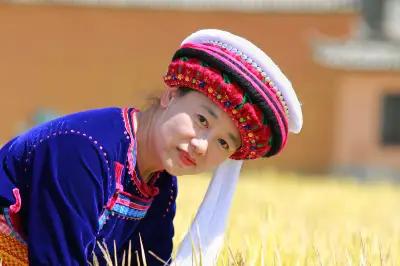
Xizhou Ancient Town, an old settlement at the foot of Cangshan and beside Erhai, is most famous for its autumn pastoral scenery. If you arrive just before harvest, you’ll meet a golden Xizhou of rippling wheat and fragrant rice paddies. If, like us, you come after the harvest, then simply explore the old town itself. With the jingle of horse-drawn carts, we threw ourselves into its embrace. It’s a centuries-old Bai minority town, far from the city’s clamor, quietly blooming with its own distinct beauty beside Erhai. To me, Xizhou is a serene place, its simple folkways giving it a feeling of half bustling life, half poetry. Inside the town, a Jiama woodblock print art gallery is an art paradise brimming with creative energy. Before coming here, I knew nothing about Jiama. Stepping into the humble museum and seeing over 300 exquisite Jiama woodblock prints and installations, I gained a deep understanding of Jiama’s history, origins, and crafting techniques. This mysterious, ancient folk art, long absent, has returned – an intangible cultural heritage that is truly a precious spiritual treasure for Dali and the Bai people.
Shuanglang Ancient Town – a delightful afternoon tea
They say Shuanglang is the most beautiful spot along Erhai, and also the most laid-back. The town preserves complete historical and cultural streets from the Ming and Qing dynasties, along with hundreds of typical traditional Bai residences from that era. It boasts eighteen scenic sights like Golden Shuttle Brocade, Jade Ji Red Lotus, Maitreya Smiling at the Sky, Stone Girl Herding Geese, Tiger’s Mouth Watching the Tide, Green Rooster about to Leap, the Bell of Zhengjue Monastery, Red Mountain Sacred Site, Luo Shi Frolicking in the Water, Island Leaning on an Ancient Banyan, Lotuses Reddening Everywhere, Giant Python Rushing to the Sea, and Tortoise and Snake Face Off. We came to Shuanglang more to enjoy its easy leisure. The lakefront is thick with cafés, restaurants, and guesthouses at every budget, each with unique décor and a perfect photo opp. For us, the right way to unwind in Shuanglang was a quiet, high-spec afternoon tea, so we went to Pusu Designer Seaview Hotel. Every corner was so photogenic. We settled in, lazily soaking up the sun; we played music to salute the endless blue; we gave thanks, because it stole moments of time and gentled the years.
Cangshan Nature Image Museum – a temple of art
The Cangshan Nature Image Museum was founded by renowned wildlife photographer Xi Zhinong, the creator of the NGO “Wild China.” Though newly opened, it already displays works by many nature-photography masters – from vegetation to wildlife, from wide-angle to macro, from pro DSLR to mobile photography. There are so many creatures we’ve never seen, and it’s because of them that our natural environment stays in a virtuous cycle. After touring the exhibits and hearing Teacher Xi’s introduction, I couldn’t help but admire his dedication and expertise. He is truly working on the front lines to collect, collate, study, showcase, and promote China’s natural imagery, while awakening public concern for biodiversity. We yearn for an ideal living environment; let’s also give nature an ideal habitat.
Shaxi Ancient Town – the place where you just want to do nothing
It’s no exaggeration to say that a day in Shaxi might be the most “I just want to lie flat” place I’ve encountered in recent travels. Shaxi Town lies in the southeast of Jianchuan County, 32 kilometers from the county seat, positioned between the Dali, Lijiang, and Shangri-La tourist areas. Long ago, Shaxi was a key post on the Tea Horse Road. Today, walking into Shaxi Ancient Town again, the bustle of the old caravan route is gone, but legendary tales still drift in the wind. It holds the deepest poetry of passing time: quiet, unadorned streets, ancient, weathered stone bridges, a historic opera stage … whitewashed walls and grey tiles all tell of bygone days. There are too many must-see spots in Shaxi. Step into the opera stage on Sifang Street, bathed in sunlight as if clad in golden armor – simple and ancient, yet now with an added layer of poetic charm. Along the old lanes are buildings and city gates with an exotic flavor; though history has faded, they’ve given rise to atmospheric little shops. Just sitting at a doorway and playing with a friendly dog brings boundless joy. The old stone bridge, gracefully poised, has become an essential frame for Shaxi’s autumn. One idle afternoon, we went to Sanyi Café for a dirty coffee. On the Sanyi terrace, sunlight glittered, the breeze was just right, Cangshan spread green before our eyes, and beneath our feet lay the time-worn Shaxi. Sitting there felt as if time had forgotten everything, yet it was right in front of us – the best refuge for an unsettled heart. This cup, to Shaxi!
Fengyu Town – the art village lives up to its name
Fengyu Town, in Eryuan County at the head of Cangshan and source of Erhai, is not just an old town – if that’s all you know, you’re really out of touch. Today’s Fengyu has become a giant open-air art museum. Every mountain slope and field corner in Fengyu is artistic. At Tuibu Tang we watched clouds drift, at the Sky Rice Paddy Theater we could enjoy art performances, and at Zengzeng’s Book House we read books while sipping tea. But what surprised me most was the Light Art Museum – a wooden structure like a granary, built to showcase the art of a beam of light, shifting with the sun. Truly simple yet far from simplistic. Fengyu is such an art village: small and beautiful, remote and pure, original and creative, rustic yet cosmopolitan. Its vision is to turn this lovely village into a valley of art, a valley of courses, a valley of brand launches, becoming “China’s largest open-air art museum” and a “top international destination for immersive getaways.”
Weishan Ancient Town – a food paradise
Weishan, at the source of the Red River, is a city rich in local historical and cultural flavor. It is the birthplace of the Nanzhao Kingdom. The ancient town was first built during the Yuan Dynasty, rebuilt with city walls in the Ming Dynasty, and has preserved its appearance for over 600 years. The streets radiate from the Gongchen Tower in a standard grid pattern: 25 streets, 18 lanes, totaling 14 kilometers. Buildings mostly retain a Chinese-style structure, with those along the main north-south axis fully preserving Ming and Qing architectural styles. The orientation is about 15 degrees southwest, an optimal local design to compensate for the poor light in “four courts and five skylight” layouts. But Weishan is famous for more than its timeworn streets – the food here is among the best in the Dali area. Eat a refined meal at celebrated chef Kun Shifu’s restaurant, full of his strong personal imprint and original Yunnan creations. Or head to the night market for grilled chicken feet, grilled erkuai, and a dazzling array of candied fruits, fresh juices, and cross-the-river erkuai rice noodles. Weishan’s food embodies the nostalgia of Weishan people, and is the warmest part of being a passerby here. Strolling the old streets, time has worn away the town’s former splendor but left generations living poetically. In the gentle flow of days and nights, we can find the quiet beauty of history and the liveliness of the present. And from the distinctive flavors of Weishan, we can feel something real: the simple, bustling life, the most comforting thing for the human heart!
Chongsheng Temple Three Pagodas – Dali’s landmark
At the foot of Cangshan stands Chongsheng Temple, a millennium-old relic, once the royal temple of the Dali Kingdom. In front of the temple are the Three Pagodas: one large, two small, with flanking pavilions. The main pagoda, Qianxun Pagoda, is called “Wenbi Pagoda” by locals. Behind it stretches the vast monastic complex of immense historical and artistic value. From afar, the three pagodas stand in a tripod, majestic and imposing, eternally guarding the land. The temple buildings behind are well-ordered, golden and resplendent, constituting one of the most magnificent and ancient structures in southern China – left for future generations to witness their vicissitudes and glory.
About accommodation:
Dali Ancient Town Wucaiyun Huayuan Hotel
A boutique hotel near Dali Ancient Town with an excellent location, convenient transport, and a private parking lot. It’s just over 700 meters from the South Gate of Dali Ancient Town, and only a 10-minute drive to attractions like the Chongsheng Temple Three Pagodas, the Tianlong Babu Film City, and the Cangshan Grand Cableway. The hotel comprises five courtyard buildings in the local Bai style of green tiles and stone walls, beautifully integrated with landscaped gardens. All guestrooms feature custom-made solid-wood furniture in natural tones, environmentally friendly, stylish, and minimalist. Address: 60 Luyu Road, Dali Ancient Town.
Jianchuan Yundu Shaxi Bieyuan
A peaceful courtyard guesthouse in Shaxi Ancient Town. The buildings here, with their century-old history, are especially precious. The ancient locust tree at the gate, silently watching dawn and dusk, has witnessed over three hundred years of change. The owner restored this old residence to let us discover Shaxi’s most original appearance in the ancient lanes, and to immerse in the ancient culture through every flower and blade of grass at Yundu. On the natural pondside terrace, you can enjoy tea and philosophy with friends. On the rooftop stargazing platform, watch the stars wheel while reflecting on life’s flavors. The dream of doing nothing in perfect contentment comes true at Yundu. Address: 106 Sideng Street, Shaxi Ancient Town.
Liang’s Grand Courtyard
In Weishan Ancient Town, the old courtyard houses are the soul of the city. Grey tiles, white walls, inked murals on screen walls – all exude classic elegance. Liang’s Grand Courtyard, Fan’s Residence, Liu’s Residence, Xu’s Mansion… each has its own story. These grand compounds are must-visit spots in the old town, and though many have become guesthouses or restaurants, you can still step inside to explore. Liang’s Grand Courtyard is now a guesthouse, renovated while retaining the original structure. It has three successive courtyards, a quiet retreat in the city: a front yard, a central accommodation area, and a rear garden – all full of the opulent atmosphere of old Weishan mansions. Room facilities are excellent, and I chose the main building’s principal room, which is huge – perfect for a family to enjoy comfortably. There are also high-end boutique rooms, superior king rooms, superior twin rooms, and family rooms to meet different needs. Address: 6 Dashuigou Street, Nanzhao Town.
About food:
Dali City recommendation: Wuxiangjian · Linwu Niaoming Hotel
It’s a hotel, but also a hidden café and restaurant gem in Dali. Step along the cobblestone path at the entrance, pass through a series of white arches, and you’ll arrive in a garden straight out of The Wizard of Oz. Behind it is Wuxiangjian · Linwu Niaoming, drenched in Instagram-worthy aesthetics. Our first night’s dinner in Dali was in this romantic garden, course after course of fine Western dishes – a taste of Dali’s difference.
Shaxi Ancient Town recommendations:
Chujian Shaxi Private Kitchen: A must-visit to sample Shaxi flavors. For years it’s been the emblem of Shaxi cuisine on the old street, always packed, welcoming travelers from all over China. Through food, we come to know Shaxi, taste Shaxi, and understand it more deeply.
Shaxi Huotang Renjia: Don’t miss the caravan-style fired-tang cauldron, a Shaxi specialty. The restaurant is very authentic. A claypot chicken soup is pre-simmered over charcoal for 2-3 hours, ready in advance. When guests sit down, the charcoal is quickly reheated with a blowtorch, wild mushrooms are added to the broth, and it continues to cook over the fire. An iron plate around the charcoal is used for grilling meat. The ritual: first sip the soup, then eat the wild mushrooms, then savor the grilled pork belly – and slowly grill away. It warms you from body to soul.
Weishan Ancient Town recommendations:
Kun Shifu’s restaurant: Kun Shifu is in Weishan Ancient Town, the former Nanzhao capital south of Dali. While Dali basks in fame, Weishan remains tranquil and understated – yet Kun Shifu’s reputation extends far beyond word-of-mouth; important institutions invite him to showcase his skills. He prizes creativity, and as he serves each dish, he explains the entire preparation process. Many ingredients and cooking methods were new to us. Full of sincerity and his deep passion for Yunnan cuisine, it was a feast for our palates.
All kinds of Weishan street snacks: Don’t miss the night market in Weishan Ancient Town – grilled chicken feet, grilled erkuai, and a whole street of dazzling candied fruits, fruit juices, cross-the-river erkuai rice noodles… Weishan’s food is the nostalgia of its people and the warmest part of being a passerby here.
This is a Dali of vibrant colors.
This is a Dali steeped in ancient charm.
This is also an artistic and trendy Dali.
This is the Dali that lingers forever in the depths of memory.