Popular Dali Travel Itinerary: Self-Drive the West and East Lines of Erhai Lake, Admire the Magnificent 'Sea Village Scenery'
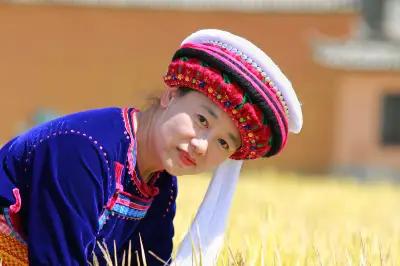
'Drying Autumn Harvest' is a special agricultural custom that has lasted for a thousand years, a beautiful scenic line every autumn, with Wuyuan in Jiangxi being the most famous nationwide.
In Yunnan, autumn doesn't need to be sun-dried, especially in Dali, because it is laid out brilliantly for all to see. Dali's autumn is everywhere—by Erhai Lake, on Cangshan Mountain, in the fields...
From late autumn to early winter, Dali is richest in an autumn flavor, with scenes of harvest all around. If you've chased flowers and snow but not yet autumn, now is the perfect time to 'chase autumn'!
Dali's autumn is by Erhai Lake, and a self-drive along the west line 'loop the lake' reveals a different autumn palette!
The self-drive along the west line of Erhai Lake starts from Dali Ancient Town (Longkan Wharf). The scenery along the west and east lines is not quite the same.
The fishing villages along the west line are more densely clustered. Longkan Wharf, Fanxi S-bend, and Haishe Park are all situated along the lakeside road of the west loop. The fields richest in autumn flavor appear in vast expanses near Xizhou Ancient Town in the Haixi area.
The self-drive along the west line is divided into two segments: the first from Longkan Wharf to Xizhou Ancient Town; the second from Xizhou Ancient Town to Butterfly Spring and then Nanzhao Style Island.
Because motor vehicles are prohibited on the entire west lakeside road, the first segment from Dali Ancient Town (Longkan Wharf) to Haishe Park can be explored by cycling, while the stretch from Xizhou Ancient Town via Butterfly Spring to Nanzhao Style Island (Shuanglang) can be done by car.
If you choose not to cycle the first segment, you can also take the Dali-Lijiang Highway and stop at each scenic spot along the way.
Depart from the ancient town, drive towards the Longkan Wharf parking lot, park your car, and then walk to Longkan Wharf to explore.
The short 25-kilometer journey from Longkan Wharf to Haishe Park encompasses the most magnificent 'sea village scenery' of Erhai's west shore.
The ecological corridor follows the meandering lakeside, with exquisite Bai-style dwellings and guesthouses on one side and Erhai Lake just a stone's throw away on the other.
Walking along this corridor in the early morning, soft golden sunlight spills onto the water, skims across to light up the houses on the bank, and wakes the people still sleeping inside.
This is when Erhai's play of light and shadow is most complex—bright and dark patches intersect, distant mountains and the lake mingling light and shade. The warm sun gliding over the water stretches the shadows of trees along the shore long and far.
In the evening, more visitors gather on the ecological corridor. They came here in the morning to wait for sunrise, and now at dusk they come to admire the afterglow.
The sunset's glow gradually dims; the distant mountains are reduced to silhouettes, the trees to shadows. Lights along the shore begin to brighten, tiny sparks in a sea of starlight, as if stars have fallen into Erhai Lake. Wave after wave of visitors are drawn here.
Here you can feel the cool breeze and the soft water. The corridor is brightly lit, and people stroll along it, quietly experiencing the romance of a 'night walk with lanterns.' In houses by the shore, visitors savor warmth and leisure under the lights. Everything is enviable and longed for.
Having seen the tranquil morning at Longkan Wharf and a corner of the ecological corridor, retrace your steps and drive straight to Xizhou Ancient Town.
The road from Longkan Wharf to Xizhou Ancient Town unfolds like an immense, real-life pastoral landscape painting. Green mountains drift alongside, the car glides between fields. The farmland is neatly arranged, crops and floral seas enhancing each other.
The houses in the open countryside remain unchanged through the seasons; only the crops in the fields transform. In spring, rapeseed flowers cover the fields; summer brings emerald-green rice paddies and lotus ponds; autumn turns them into golden rice fields; winter is the fallow season.
Driving into Xizhou Ancient Town, you'll find its beauty intense and pure.
Wandering through its narrow and wide alleys, standing before houses that blend ethnic and classical styles, explore them one by one.
Go through streets and lanes to see handmade tie-dye, taste Dali's special milk fan popsicle, study various ancient buildings, and then enter the rice fields of Xizhou to feel the joy of harvest rolling in the waves of rice!
Leaving Xizhou Ancient Town, head to the next destination—Butterfly Spring.
Butterfly Spring sits at the foot of Cangshan's Yunlong Peak, not far from Xizhou. Nestled among mountains and residences, it's easy to reach by following navigation.
Butterfly Spring is vast. I see it in three layers: the outer parking lot, the second layer of bamboo and cherry blossom forests, and the core layer where the spring pool lies, the most enchanting part of the park.
Pass through layers of woods to reach the ancient Butterfly Spring archway; the most beautiful scenery is right ahead. Step closer and dense forests, mountains, springs, and a lake all appear before your eyes.
First view Butterfly Spring itself, then visit Lover's Lake to watch performances, and explore the Butterfly Museum and the Butterfly World by the lake.
Butterfly Spring is a crystal-clear, azure-blue pool that never dries up year-round. Its name comes from a poignant love legend and the spectacle of butterflies dancing here.
However, it has been many years since the wonder of springwater gushing with butterflies was seen. Today, you can only imagine the spectacle through written words. Butterfly Spring is now more of a symbol.
Nearby Lover's Lake has instead become the most worthwhile sight. It is the most scenic and lively spot in Butterfly Spring Park.
The lakeside path is not wide, but its seclusion is its charm. Sunlight filters through the canopy, casting dappled specks. Visitors love to stroll along the lake, quietly enjoying the landscape.
In the middle of the lake is a small island, and in front of it, a floating stage hosts performances of Bai ethnic songs and dances, such as 'Playing Strings at Your Door' and 'Wandering Three Souls.'
The lake water is fresh and cool; geese, ducks, and fish glide about, sometimes swimming to the shore to interact with people.
On the east and west banks stand the Butterfly World and the Butterfly Museum, respectively. Both exhibits showcase the same creature, yet one is alive, the other preserved.
Butterfly World is where butterflies are bred. Temperature and humidity are artificially controlled, and the environment mimics their natural habitat, allowing various species to reproduce here. Stepping inside, you enter a world alive with fluttering butterflies.
The Butterfly Museum, on the west bank of Lover's Lake, is the country's largest and most comprehensive butterfly specimen museum.
Upon entering, the first thing you see is the museum's treasure—a giant 'Nanzhao Butterfly Gathering' mosaic made entirely of butterfly specimens. It vividly depicts the grand and lively butterfly festival on the 15th day of the fourth lunar month.
Following the guided route, you can see butterflies from all over the world, rare and common alike, making you want to become a 'butterfly chaser' yourself.
Beyond sightseeing, Butterfly Spring Park also offers playful activities, such as the visually dazzling 'shouting spring' and squirrels in the woods that you can feed.
After leaving Butterfly Spring Park, bypass Shangguan Town, and you'll arrive at Shuanglang Ancient Town and Nanzhao Style Island.
Shuanglang Ancient Town is small, but a phrase best sums it up: 'Small as a sparrow, yet complete in all its parts.' It not only has all the lakeside beauty and delicacies by Erhai, but does them exceptionally well.
Nanzhao Style Island lies in Erhai Lake, just a few dozen meters by ferry from the Shuanglang Ancient Town pier.
Surrounded by water on all sides, Nanzhao Style Island is separated from Yuji Island—home to Shuanglang Town—by a narrow strait. From the island, one side faces the mountains, one side the water, one side scenic views, and one side a fishing village. Every direction offers a different landscape.
The island is cloaked in tall trees, veiling its true appearance from afar. Once you set foot on it, the previously hidden scenes unfold before you.
The seaside comprehensive beach lies beneath a cliff, right by the water's edge. Here you can play in the water or rest. Every summer, it is the most popular resting spot.
Following the boardwalk that loops around Nanzhao Style Island, you'll encounter the Erhai Moon Viewing Platform, Nanzhao Palace, Benzhu Square, and the Shamyimu Group Sculptures. The entire walk is shaded by trees, so no need to worry about the sun.
Erhai Moon Viewing Platform is said to be the best place to admire one of Dali's four sights—the 'Moon.' When the moon is full, its clear radiance blankets the entire water surface, as if stars from the sky have fallen onto the water—an unforgettable beauty.
Benzhu Square offers a deep insight into the heroes revered by the Dali people. Some are legendary, others historical; what they share is significant contributions to Dali. Thus, a square was built here to honor their deeds.
Nanzhao Palace stands back-to-back with Benzhu Square. Its overall white architecture blends Tang-dynasty and ethnic styles, making it eye-catchingly unique.
Inside, the palace exudes royal grandeur. The caisson ceiling in the main hall, for instance, is designed after ancient imperial buildings, not to mention the unmistakable royal architectural elements throughout. That majestic aura is not found in all structures.
Passing through a grove, you reach an excellent spot for a distant, front-facing view of Shuanglang's townscape. Buildings rise at the water's edge, one Bai-style traditional dwelling after another, each distinct and with its own charm.
Circling around to the front of Nanzhao Style Island brings you to the Shamyimu Group Sculptures. This sculpture group has a strong artistic atmosphere and is well worth seeing, but the story behind it is even more compelling—it tells the creation myth believed by the Dali people.
After spending about two hours exploring Nanzhao Style Island, you can choose to stay in Shuanglang Ancient Town and devote the remaining time to Shuanglang itself, delving into the depths of its alleys to fully experience its cultural vibe.
This small town is brimming with both liveliness and an artistic flair. Here, you see how life and distant dreams, reality and ideals, balance each other.
Wandering its streets, you'll find surprises everywhere—a cluster of flowers, a tree, appearing just right.
Vines climb the walls, flowers bloom freely by the roadside, and everyone lives earnestly here. Such a scene of daily life is truly beautiful.
The self-drive along the west line of Erhai Lake offers scenery that is the soul of the lake loop road. It takes you to see Dali's most representative landscapes and to feel the warmest, most genuine ethnic customs, letting you drift in the dreamscape that Dali creates!
Editor: Yiyun Yan, One Jing
Photography: Yiyun Yan
Note: Please credit the source when reprinting this article. Unauthorized commercial use of the images is prohibited.