On the Road: Dali in Winter
On November 24, 2022, we once again boarded a flight to Kunming, this time under special circumstances—during the COVID-19 pandemic! Amid doubts, multiple nucleic acid tests, and an uncertain future, we still set off. I wrote this travelogue to commemorate the entire process of pandemic restrictions going from strict to relaxed, which we happened to experience firsthand.
Nov 24: Tianjin – Kunming
Nov 25: Kunming – Dali – Tengchong
Nov 25–26: Tengchong Ginkgo Village
Nov 27–30: Tengchong (Heshun Ancient Town, Tengchong hot springs, etc.)
Dec 1–3: Tengchong – Dali – Wuliang Mountain Cherry Blossom Valley (Weishan Ancient Town)
Dec 4–7: Wuliang Mountain Cherry Blossom Valley – Dali Erhai Lake
Dec 7–9: Dali – Kunming
Dec 10: Kunming – Tianjin
Since it was just the two of us traveling, we only made a rough plan, thinking we'd take it easy and stop where we felt like. We didn't book round-trip flights, wanting to stay flexible. It was this decision that gave us the upper hand during this trip full of twists and turns, although my negligence later cost us quite a bit—more on that later.
The actual itinerary:
Nov 24: Tianjin – Kunming (3-hour flight)
Nov 25: Kunming – Dali – Tengchong (Ginkgo Village) (first leg: high-speed train; second leg: nearly 4 hours self-drive)
Nov 25: Tengchong – Dali Ancient Town (Dali Ancient Town)
Nov 26: Dali (Cangshan National Geopark) – Shaxi Ancient Town (over 2 hours’ drive)
Nov 27–28: Shaxi Ancient Town (old town, Heihui River, Librairie Avant-Garde)
Nov 28: Shaxi Ancient Town – Haishé Park (Zhoucheng)
Nov 29: Haishé Park – Shuanglang Ancient Town (Xizhou Ancient Town, Shuanglang Ancient Town)
Nov 30: Shuanglang Ancient Town
Dec 1: Shuanglang Ancient Town – Dali Ancient Town (self-drive along Haidong Highway)
Dec 2: Dali Ancient Town – Weishan Ancient Town – Wuliang Mountain Cherry Blossom Valley (first leg: nearly 2 hours, mostly mountain roads; second leg: over 1 hour highway, few mountain roads)
Dec 3: Wuliang Mountain Cherry Blossom Valley – Dali Caicun (over 3 hours’ drive)
Dec 4–5: Caicun (cycling along the Haixi ecological corridor)
Dec 5: Dali – Kunming – Dongchuan Red Land Scenic Area (Luoxiagou) (nearly 4 hours: 2 hours highway, 2 hours mountain roads)
Dec 6: Dongchuan Red Land Scenic Area – Kunming Dianchi Lake (over 3 hours, a few mountain roads, mostly highway)
Dec 7–8: Old town of Kunming (public transport)
Dec 9: Kunming – Tianjin
The journey begins:
November 24
At 10 p.m., we boarded the flight to Kunming. Earlier in the day, due to mass nucleic acid screening, we hadn't taken an individual test. By 7 p.m., our result still hadn't appeared on the Tianjin Digital Epidemic Prevention app. Feeling anxious, we took a taxi to the airport. Chatting with the driver, we learned that if we first checked the nucleic acid test result on the Jinxinban app and then checked the Digital Tianjin nucleic acid certificate, it might update. We quickly tried it, and miraculously, our test report from the afternoon appeared—it hadn't updated on the Digital Nucleic Acid app but did after being retrieved through Jinxinban. At the airport, after checks of health codes, travel history codes, and nucleic acid certificates, we smoothly reached the boarding gate. The airport was eerily quiet, probably due to the pandemic and the late hour. Most passengers were young; people like us were few and far between.
November 25
We arrived in Kunming at 1 a.m. After landing, we took an on-arrival test and were not required to wait at the airport. We registered on the Yunnan Health mini-program and easily got to the airport hotel for a rest.
We got up at around 8 a.m., took a taxi to Kunming Railway Station, and bought high-speed train tickets on the spot. Three hours later, we reached Dali. After a nucleic acid test upon exiting the station, we went straight to the car rental company without having to wait.
We used our most frequented car rental website. Since we arrived earlier than expected, our reserved car wasn't back yet, and the ones on the lot had overly worn tires—not ideal. We contacted the platform to cancel and found a satisfactory car at a nearby rental agency (Hexie+ Car Rental). Then we drove straight to Tengchong. Despite the hiccup, everything went smoothly.
The midday sun in Dali warmly bathed the car, but inside it felt roasting hot—and this was winter!
After four hours on the highway, we arrived in Tengchong. Though it was a highway, the road was winding. Another nucleic acid test after exiting the highway.
On the 25th alone, we actually had three tests. It took nearly another hour of mountain and village roads (40 kilometers) to reach Ginkgo Village, and we finally got there at dusk.
Accommodation: Pinxing Time Inn (booked on Ctrip) – large room, a big courtyard, but squat toilets; slightly inconvenient if you're not used to them.
November 26
We got up at around 7 a.m.; the sky was still dusky. In this mountainous area, sunrise comes late and mornings are chilly—a thin down jacket was necessary. The ginkgo yellow is a highly seasonal sight, so based on past experience, these days should draw crowds of visitors.
Ginkgo Village, in the deep autumn of “trees tinged with fall, hills touched by cold,” is a serene, dreamy place, the foremost ginkgo kingdom under heaven. Golden leaves whirl around every house, stunningly beautiful. It lets your soul drift freely among the gold; as you walk, you marvel at the trees blazing like liquid gold. The village is awash in yellow, the thick fallen leaves giving autumn a tangible form.
Early morning, the village was still peaceful. Walking along the paths, you could see almost every household running a guesthouse; with gates open, visitors could wander in, admire, and take photos.
The sun gradually rose, its golden light spilling into every corner. Looking closely, in the wispy smoke from cooking chimneys, Tyndall effects were visible in the air. We walked excitedly, gazing, capturing moments with our cameras. Everything was so beautiful! Little did we know what awaited us.
At Ginkgo Square, we suddenly realized it wasn't crowded as many travel guides described; instead, it was very scattered—strange. Was today special? By 10 a.m., we returned to the guesthouse for breakfast, and bad news came: all tourists had to leave Tengchong that day; the city was going into silent lockdown! Nothing could be more disheartening. We had come all this way just to see the ginkgoes and soak in the hot springs. We'd only seen the ginkgoes for three hours; forget the rest. The owner drove us to take a nucleic acid test, and we bid a reluctant farewell, driving back toward Dali. We arrived in Dali around 4 p.m.
Accommodation: Dali Light Luxury Landscape Guesthouse (Rongya Ju) (booked on Ctrip, very close to Sanyue Street, etc. The guesthouse is quite far from the main road; without a car, hauling luggage is inconvenient).
The courtyard of our guesthouse was surprisingly huge, with a large ginkgo tree. Time seemed to shuttle between spring and autumn. We visited a farmhouse courtyard—the movie Swordsmen was filmed in this very courtyard, an ordinary farmyard.
We drove nearly 800 kilometers for just three hours of sightseeing. To say we weren't regretful would be a lie.
In the evening, we strolled around Dali Ancient Town. Seeing the town gate reminded me of bringing my son here in the 1990s. Back then, he was shorter than me; now he's a father of two. Oh, time! I took a photo at the same gate where we once posed, sent it to my son via WeChat, and he replied, “I vaguely remember us taking a picture there.”
November 27: Morning at Cangshan – Afternoon arrival at Shaxi Ancient Town
The snow on Cangshan is a symbol of Dali. Usually, people admire it from afar; not many tourists actually climb it. Locals go more often. Currently, Cangshan had no snow. After a quick search, we learned Cangshan is a national geopark with three cableways: Ximatan Cableway, Gantong Cableway, and Zhonghe Cableway. Ximatan was too high, Zhonghe too low; we chose Gantong Cableway.
With no tourist crowds, there was no queue. From the cable car, you can see Erhai Lake. At the terminal, we climbed further to see the Zhenlong Chessboard, Qingbi Stream, and finally reached the Cangshan Grand Canyon Viewing Platform. Then we chose a way down. You could take the cable car or hike. For hiking, there were two options: return past the chessboard and descend to Jizhao Nunnery and then Gantong Temple; or follow the Jade Belt Road first, which is 4.5 kilometers long, then descend. We chose the first option and hiked down.
Along the way, brooks gurgled under green shade. Because we walked a long canyon path, overall it wasn't too strenuous. Time flew as we strolled and snapped photos. We missed the vegetarian meal at Jizhao Nunnery! The succulents there were more than I'd ever seen. After a pot of tea at the nunnery, we continued down to Gantong Temple. That concluded our Cangshan tour. Cableway and entrance fee: 85 yuan per person—one of the few admission fees on this trip.
Since it was still around midday, we impulsively decided to go to Shaxi Ancient Town. My interest in Shaxi began with a photograph. Even though I knew it was post-processed, I was so struck that I wanted to see the real thing.
While refueling at a gas station, we happened upon a McDonald's and bought meals for two, eating lunch on the road. Three hours later, we arrived at Shaxi.
Shaxi Ancient Town lies within Jianchuan County, between Dali and Lijiang, and driving there from Dali is not easy. Soon after leaving Dali, you pass through a village with extremely narrow roads that make you wonder if you're lost. Following the navigation out of the village, the mountain switchbacks begin. The roads are narrow, the bends sharp, and the sunlight glaring into your eyes. After crossing that mountain, more village lanes appear. Many roads were still under construction, so we kicked up dust all the way; amid swirling yellow earth, we arrived at Shaxi Ancient Town! Near the town, the roads improved and the dust vanished. Perhaps it's precisely because it's hard to reach that Shaxi has been preserved.
Xu Xiake once described Shaxi as a land rich in grain. Part of Jianchuan, an important node on the Tea Horse Road, Shaxi is the only surviving ancient market on that route. You can imagine its past bustling with horse caravans and merchants; now it has retreated into quiet seclusion among the mountains, becoming a sanctuary for travelers who just want to zone out.
The photo that drew me captured the Heihui River right next to Shaxi. We hurried there in the evening, but still missed the sunset's afterglow.
Walking along the atmospheric lanes, finding food became a priority. We chose a mushroom hotpot place and warmed ourselves up thoroughly. After consecutive days of driving and climbing, we felt a bit tired, so we went to bed early, eager to see the scenery that had brought me here.
In the evening, we queued for a nucleic acid test; the line was quite long.
Accommodation: Jiuzhi Zhiyue Inn (booked on Ctrip) – the owner was a very artsy young woman.
November 28: Shaxi Ancient Town
Before dawn, when the sky was barely pale, we got up and rushed to the Heihui River. On Yudai Bridge, we saw the morning mist. As the sun rose slowly, its rays fell on the riverbanks and treetops—the scenery was beyond words. You truly had to see it with your own eyes. In that instant, we felt all the hard journey was worth it.
Morning at Heihui River, the sun gradually climbing, the century-old Yujin Bridge.
During the day, we lazed around Shaxi: strolling, eating, napping! In the afternoon, on the inn owner's recommendation, we visited the Librairie Avant-Garde. This was our second Avant-Garde bookstore; they are usually situated in remote villages, each with its own character. We read for a bit and drank local Yunnan coffee, finding it slightly sour. The day passed leisurely.
Before leaving Shaxi, seeing no one at the testing tent, we took another nucleic acid test.
The grand stage of Shaxi Ancient Town.
November 29: Shaxi Ancient Town – Erhai Haishé Park (Zhoucheng)
Returning from Shaxi, we originally planned to stay one night in Xizhou Ancient Town. We drove around Xizhou but found the accommodation disappointing. So we randomly tapped a spot along Erhai on the navigation, which led us to a natural village with no place to stay. We then pointed to the Haishé Park area, and sure enough, there were guesthouses. The good thing about traveling during the pandemic was the lack of crowds—you'd never be without a room. We found a guesthouse right by Erhai. The room was tiny, but you could watch the sunrise from it. Not wanting to drive anymore, we took it despite its size.
After a short rest, we headed straight to Zhoucheng. Zhoucheng is small, just one street entirely dedicated to tie-dye; many shops offer hands-on experiences. We chose the Tie-Dye Museum to learn about the history, and it unexpectedly had an experience center too. Possibly a bit pricier, but we didn't have to go elsewhere, so we made a freeform tie-dyed tablecloth. The dyer taught me how to roll, bind, and stitch the fabric. After completion, it was dyed in natural indigo, rinsed, unstitched, rinsed again, and spun dry.
Before us lay a uniquely imaginative tablecloth. Overjoyed, we found it magical. Though the master did most of the work, the sense of accomplishment was overwhelming. I hope to do it again, next time doing everything myself!
In the evening, back at Erhai, Haishé Park was under renovation, so we couldn't enter. Strolling along the lake, we found this stretch very pristine, with few man-made marks. Trees, wetlands, and seagulls were all in their natural state, with only the long, winding ecological corridor showing human touch. A few people cycled leisurely; everything was quiet. After nightfall, it was quite dark around.
November 30: Haishé Park – Shuanglang
After watching the sunrise, we drove about ten minutes to Xizhou Ancient Town. Xizhou and Zhoucheng are on opposite sides of the road, very close. In winter, Xizhou lacks spring's flower seas, summer's rice paddies, and autumn's golden hues, so it loses a lot of charm. Strolling through the old town, visiting a few traditional residences, having coffee and cheesecake—there wasn't much else to do. We decided to head to Shuanglang.
We snapped a photo of the Instagram-famous corner building. Not many tourists; many shops were closed.
It took a little over an hour to reach Shuanglang. The weather was really hot. My husband braved the scorching sun to find accommodation along Erhai.
This time we didn't book online. When he returned, we checked in directly.
Guesthouses by Erhai in Shuanglang don't have parking; you have to use the public lot, which is expensive—over 50 to nearly 60 yuan per night. Next time, we'd better choose places with parking.
Shuanglang, a small fishing village on the eastern shore of Erhai, is far from the city's hustle, exceptionally peaceful. It was also a must-pass stop on the Southern Silk Road. Its alleys paved with cobblestones and bluestones are weathered yet bright, hard to tell if washed by the sea or etched by time. Rows of old houses are deeply ancient, with low eaves and high stone corners, quietly and stubbornly standing.
Many lanes in Shuanglang lead directly to the lake, creating a wonderful atmosphere. Everyone's experience differs, and favorite spots vary, but it's hard not to fall for Shuanglang. It's a mature resort area, where architecture and style are on par with international standards, much like a vacation destination abroad! Lakeside views are pleasant, food and lodging are convenient, and during this special period, there seemed to be slightly more visitors here.
Note: Visits to Yang Liping's Sun Palace and Moon Palace in Shuanglang require advance booking. We overlooked this; when we remembered, the next day's slots were already full, so we didn't get to see them.
Before dinner, we hurriedly took a nucleic acid test.
On the town's streets, we saw a very beautiful flower. I even held it for a photo. But after returning home, while watching a documentary, I discovered it was a datura flower—it has anesthetic effects, so better not touch it lightly. Good heavens!
Accommodation: Dengfenglai Inn (right by Erhai, you could see Nanzhao Island from the balcony; the breakfast provided was good).
December 1: Shuanglang – Haidong Highway – Dali
Today we started looping Erhai. In the morning, we bought tickets for Nanzhao Style Island; at the ticket office, they told us that in December, Dali's scenic spots were free for tourists from Tianjin—what luck, since yesterday we would have had to pay! Nanzhao Style Island is reached by a short ferry from Shuanglang; it's tiny and doesn't take long to explore. The scenery was nice; we took photos and went back by 10 a.m. After doing all the sightseeing we wanted, we took another nucleic acid test and drove out of Shuanglang, starting our Haidong Highway journey.
When touring Erhai, it's suggested to go clockwise so that you're always on the right side of the road and don't need to cross traffic often.
Our first stop on Haidong Highway was a famous Instagram spot: an abandoned wall. It was actually quite hard to find. First, we saw a sign for the Guanyin Temple at Luwo Mountain. We climbed up to check, but that wasn't it—still, the view was good.
Continuing on, we spotted a street vendor selling coffee. After passing the stalls, we turned right, drove about 50 meters, and saw a gap in the highway fence. We climbed down a steep path, and after a short walk, the abandoned wall appeared. Further in, there's a cave and a lone tree—the scenery here was exceptional! We were lucky to have clouds in the sky, making the photos look like a staged backdrop.
Second stop: Wase Pier, with its jumbled trees and relaxed locals!
Third stop: Little Putuo Island. Seagulls soared; parking cost us 10 yuan, though we stayed less than 15 minutes. From a distance, the attraction felt a bit overhyped. We bought snacks and skipped lunch.
Fourth stop: Luoquan Peninsula. Haidong Highway strongly resembles Australia's Great Ocean Road.
Fifth stop: Dali's Santorini—this was the biggest letdown of the trip. Don't believe guides that say it's like Santorini; it's just a hotel, and hotels must maintain privacy for their guests. So don't treat it as a tourist spot. All facilities are for guests, not sightseers. Unless you're staying there, skip it.
We originally planned to spend a night on Jinsuo Island, but the fifth stop left us in a bad mood, plus Jinsuo requires a boat with your car left on the opposite shore. A travel buddy had been in Dali for many days, so we just went to where she was staying. We had dinner together, chatted, and had a pleasant time.
Accommodation: Dali Yixiang Qiuju Inn (the cheapest on this trip at 72 yuan/night, right by the road—very convenient).
December 2–3: Dali – Weishan Ancient Town – Wuliang Mountain – Dali
After more than an hour of mountain roads, we arrived at Weishan Ancient Town. Weishan is the birthplace of the Nanzhao Kingdom, even more rustic and authentic. A local saying goes: “Eat in Weishan, play in Dali.” True enough: we tried their rice cakes, sweet boiled peanuts, and roasted tea—all excellent. For lunch, we had “one-strand noodles”—a whole bowl, and indeed a whole pot, consists of one continuous noodle. It tasted great. Walking the streets, volunteers reminded us to wear masks properly; the pandemic had recently worsened.
We saw a testing station and took yet another test. Since coming to Yunnan, we'd been tested almost daily to facilitate lodging and sightseeing. Most places required a 48-hour nucleic acid test.
From Weishan, we got on the highway and exited at the Wuliang Mountain Cherry Blossom Valley exit, about an hour later. We arrived at the No.1 viewing platform. The Cherry Blossom Valley's viewing area is accurately described as Area No.1, a large zone with many paths to different platforms. Area No.2 is the scene captured in that famous photo—the view of No.2 from No.1. In the afternoon, we walked around No.1, scouting for the next morning.
On December 3, we set out early, again to Area No.1, to photograph the sea of clouds and sunrise. Following the road, when we saw a row of public buildings, we turned left and up the hill. There's a guesthouse called “Home of Photography,” the best spot for shooting the cloud sea, with a viewing deck. Because we spent time looking for it, we missed the sunrise but captured the sea of clouds! In the morning light, the cherry blossoms looked very different from their daytime colors.
After the clouds, we took photos of blossoms along the road, already close to their normal daytime hue.
The petals here are unique, very different from Japanese sakura—denser and more vividly colored.
In Area No.2, the tea plants are more orderly; if you like portraits or tea plantation scenery, you might prefer it.
A huge regret: the next day, my husband's photos from Cherry Blossom Valley were lost. We suspect that while importing them to the computer, we unplugged the memory card, causing incomplete transfer. When we returned, thinking it was done, we formatted the camera memory. Now the morning photos are all mine. My heart aches every time I think about it. In all our years of travel, this was our first major blunder.
We chose Yunnan in winter mainly to see the ginkgoes and cherry blossoms—highly seasonal spectacles. Heaven wasn't kind: the ginkgoes were cut short by the pandemic, and the cherry blossoms were lost through our own carelessness.
Accommodation near Cherry Blossom Valley is very basic; the only guesthouse in the scenic area is the one at the cloud-sea photography spot, another on the road to Area No.2, and a row of farmhouses near the Area No.1 entrance. Otherwise, you have to go down the mountain.
December 3–5: Cherry Blossom Valley – Dali – Erhai Caicun
Returning from Wuliang Mountain to Dali, we returned the car and took a taxi to Caicun, settling by Erhai. The Haixi (West Erhai) tour officially began.
The scenery of Haixi and Haidong differs greatly. First, the way of touring: Haidong is by car; Haixi's ecological corridor only allows walking and cycling. Second, Haidong's highway hugs the coast, with water on one side and mountains on the other, while Haixi has villages on one side, then wetlands, then the lake. Thus, Haixi is delicate; Haidong is grand.
We rented bikes because we were staying in Caicun and planned to ride toward Langqiao—16.8 km one way, 33.6 km round trip. Bikes cost 10–20 yuan per person for the day. We set off after breakfast (around 9 a.m.) and returned to Caicun around 4 p.m., taking about 7 hours. We took it slow, stopping often, had lunch in Panxi Village, and didn't feel overly tired. The next day we headed to Longkan Pier.
We paused at almost every village and lakeside. The wetlands and Erhai views were unforgettable. Morning and evening light on the water and trees, seagulls swirling around, and the Instagram-famous trees were indeed very photogenic—many young couples were taking wedding photos there.
I’d been to Dali before, but this was my first time with such ample leisure to observe and enjoy Erhai. Truly memorable. Perhaps because the scenery was too captivating, we forgot to take a nucleic acid test—setting the stage for what came next.
Accommodation: Tinger Guesthouse (really right by Erhai, very clean; downside: after getting out of the taxi, it's nearly 600 meters on foot, not convenient with suitcases).
There were “S”-curved bays everywhere, the famous tree at Longkan Pier, and morning at Caicun Pier.
December 5: Dali – Kunming – Dongchuan District
We took a high-speed train back to Kunming, arriving around 1 p.m. After a test at the station, we rented a car and headed to Dongchuan District, planning to stay there and go up the mountain the next morning. Nearly two hours on the highway brought us to Dongchuan. At the hotel, our nucleic acid test was already 49 hours old, showing “72 hours” on the travel code. We explained to reception that we had tested at Kunming station at 1 p.m., but the result hadn't come out yet. They stressed that under the latest requirement, a 24-hour test was mandatory and we couldn't check in.
By this second half of the trip, we no longer booked ahead; we just arranged upon arrival. We first found a supermarket to buy fruit and snacks. By the way, Yunnan's fruit is incredibly sweet. After eating, we decided to go straight up the mountain. We saw another testing point and took a test.
We selected a hotel at Luoxiagou on the navigation and pressed on. The sky was growing dark; the sun sets early in the mountains, and the winding roads were very hard to drive. After more than an hour, just before it got pitch black, we reached the hotel. The reception was very accommodating: they said a test was needed, but since it was late, we could wait in the lobby for the result before checking in. They added that recent test results were slow and authorities were frequently inspecting guest registrations; with the test checkpoint on the road removed, they couldn't be lax. We had no choice but to wait.
There were no other guests—just us and two female staff. They made us two bowls of rice noodles for dinner.
Providence smiled: at around 7 p.m., our test result came through. We checked in. The wind howled at night; with just four of us in a huge hotel, it was a bit eerie. Too many tourists is annoying, but too few is also unsettling.
Accommodation: Liuzhu Shiguang Boutique Inn (for a scenic-area inn, it was quite good—large rooms, acceptable hygiene).
December 6: Dongchuan Red Land – Dianchi Lake
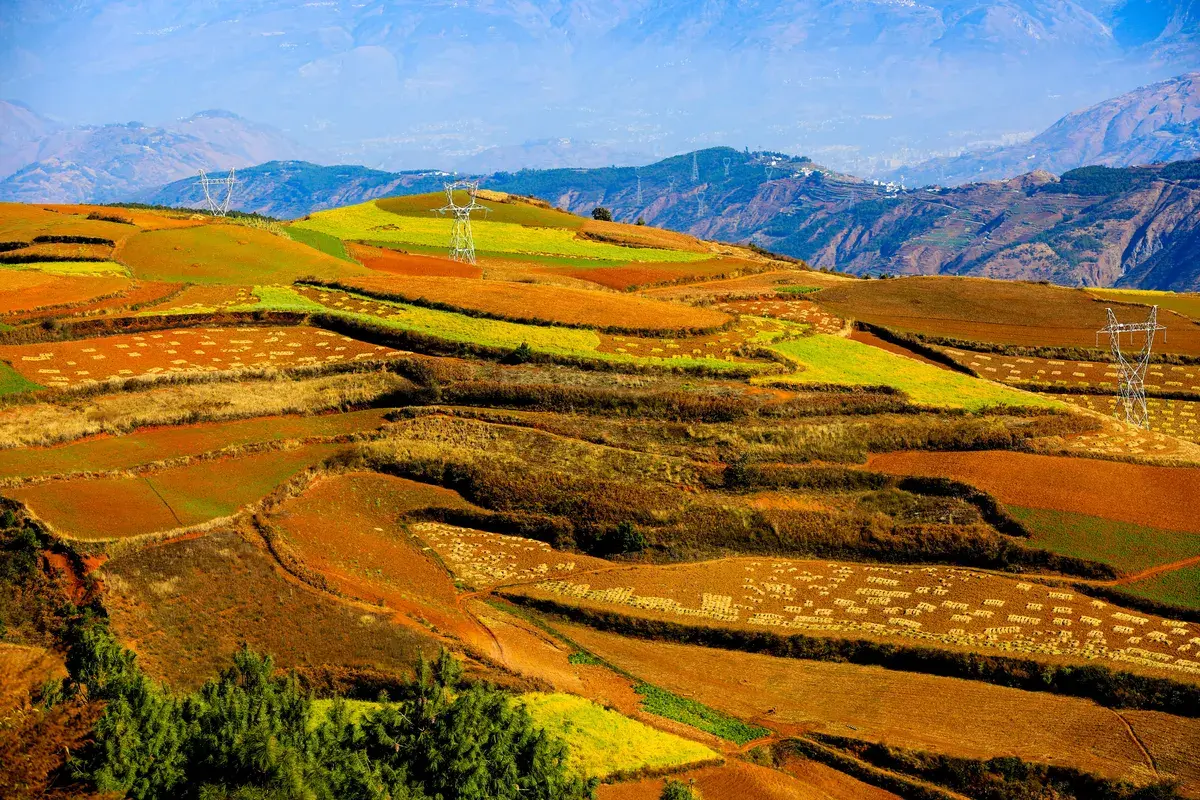
Early morning, just 200 meters from the inn was a sightseeing boardwalk with not a soul, just us. The wind was strong; we quietly waited for sunrise. Mist among the mountains obscured the view, and we worried the scenery would be diminished. As the sun slowly crested the peaks, large clouds occasionally blocked the light, but the fields and village of Luoxiagou unfolded before us in the sunshine—magnificent. The wisdom of Chinese laborers was on full display.
After returning from Luoxiagou and having breakfast, we chose two more spots: Jinxiu Garden and Lopu'ao.
Regarding the layout of the Dongchuan Red Land scenic area: in practice, coming from Kunming, you should absolutely not go to Dongchuan District; it's a detour and involves long mountain roads. Instead, head directly to the scenic area, stay a night at a key spot that interests you for sunrise or sunset, or even go early and return late. Most of the journey is highway with just a bit of mountain road, much more convenient.
In the afternoon, we returned to Kunming.
Winter in Kunming calls for Dianchi Lake, so choosing nearby was a no-brainer. We stayed at Dianchi Xuyuan Guesthouse; I highly recommend it. It's right by the lake; step out of the community's small gate, cross the road, and you're on the Dianchi viewing promenade. Sunshine Coast.
Here, we finally saw people, and there were seagulls galore! Buying some bread, we had up-close interactions with them; everyone was beaming. Nature gives so well.
The nucleic acid test from Dongchuan was terribly slow, only coming out that afternoon, which conveniently eased our subsequent travels.
December 7–9: Kunming
On the 7th, before returning the car, we went to Haigeng Park and then Haihong Wetland Park. There were fewer seagulls than at our guesthouse, the wind was strong, and the scenery was optional.
Since having no car would be inconvenient, we decided to stay in central Kunming for easier mobility. We found a place near Kunming Old Street. Based on two days of exploring, staying near Cuihu Lake would also have been convenient.
We first visited the Military Academy, but the Southwest Associated University site was closed. Then we went to the distant Kunming City Museum. For the rest, we zipped around Kunming on shared bikes.
At this time, pandemic policies changed dramatically: almost all testing stations were dismantled. On the 8th, while wandering, we spotted one still open and quickly took a test—they were about to close; we and one other person were the last three at that station. We felt that might be our final test. And from the 8th onward, nobody checked health or travel codes anymore.
We visited the Dazhuan Farmers Market, Nie Er's former residence, walked the old town, and ate plenty. Again, Yunnan's fruit is so sweet, especially a kind of small pineapple—the sweetest I've ever had. I bought three bags on the way home, originally to share with friends, but unexpected pandemic issues at home forced us to lie low, and we ended up eating all the fruit ourselves (fresh fruit doesn't keep).
You see this building in every photo of Kunming. I always wondered why it's so thin and curved. Only after arriving did I learn it's part of the War of Resistance Memorial Hall. Shaped like a wine glass, the monument stands at the center, and the curved building forms the rim. So I took a photo, too, as a memento.
Accommodation: Kunming Yuebo Siheyuan Hotel (a guesthouse converted from an old building; excellent location, though old-house comfort is a bit lacking).
December 9: Kunming – Tianjin
Heading to the airport today, everything felt like three years ago. Nobody checked your health code, travel code, or test report. In a daze, we returned home.
The regrets of this trip: Tengchong unexplored, lost photos, and the flight tickets—book at least 4–5 days in advance. While traveling, we kept seeing return fares hover around 300 yuan, so we didn't book promptly. When we tried to reserve the 9th on the 6th, the price had jumped to over 1,000 yuan—a huge pitfall.
We rented cars in both Dali and Kunming, very smoothly. Especially the Dali rental company: when returning, we couldn't find a car wash and offered to pay for cleaning, but they refused any fee.
This trip mainly featured natural scenery, with very few admission fees, plus we lucked into free entry for Tianjin tourists. Our second self-drive trip in Yunnan, like the first, felt great and is worth returning for. See you next time!