Hidden in the Deep Mountains: Shaxi Ancient Town – the Only Millennial Survivor on the Ancient Tea Horse Road
Located in the southeast of Jianchuan, Dali, Yunnan Province, this area lies at the southeastern fringe of the Three Parallel Rivers Nature Reserve, perfectly sandwiched between the Dali Scenic Area and the Old Town of Lijiang.
Shaxi has been named a Yunnan Provincial Historic and Cultural Town, a National Historic and Cultural Town, and a Yunnan Tourism Town. Right now, there’s no entrance fee to the ancient town. It isn’t very large, with a population of roughly 25,000.
Shaxi Ancient Town feels like the Lijiang Old Town of thirty years ago – I used to think so, and it still holds true. Shaxi remains a place untouched by excessive commercialisation. As you wander its peaceful lanes, you get that poetic dream of faraway places.
Once an important staging post on the Ancient Tea Horse Road, Shaxi gradually faded from memory as the route declined. Yet this very neglect preserved its original character, allowing the town’s thousand-year-old soul to survive intact.
On the east side of Sideng Street, just outside the old town, the Yujin Bridge lies quietly across the Black Hui River. In the days of the caravans, this was the only way in and out of Shaxi. Standing on the bridge and gazing along the river, you can glimpse your own poetry and distant horizons.
Built during the Kangxi reign of the Qing Dynasty, Yujin Bridge is steeped in history. It was a vital link for the local Bai people heading to the fields and markets, and a key bridge on the southern branch of the Tea Horse Road connecting to Dali.
It is a single-arch stone bridge: 35.4 metres long, 5 metres wide, with a clear span of 12 metres and an arch rising 6 metres. Stone balustrades run along both sides, and the flagstones of the deck are pitted with hoof prints worn by countless horse caravans. On the north and south faces of the arch, two carved dragon heads gaze upstream and downstream.
The bridge’s story begins in the Ming Dynasty, when a wooden bridge stood here. In 1639, the great traveller Xu Xiake crossed it and recorded in his diary: “The stream of Shaxi flows to the east, with a wooden beam spanning it from side to side, very long.” Over the years, floodwaters repeatedly washed the wooden bridge away, cutting off both banks and bringing hardship – “the people had many grievances.” During the Qianlong period of the Qing, the locals rebuilt it in stone. At the time, Mr. Shi Lifei of Zhaozhou, who was running a school in Jianchuan, wrote a couplet for the bridge: “When stone becomes a bridge, no longer shall we sing ‘No Ferry for You’; the ford truly is jade, now we understand the water has a source.” Thus came the name Yujin (Jade Ford) Bridge.
The bridge has been repaired many times over the centuries, most notably in 1931 when the people of Shaxi, Jianchuan County, Dali, jointly funded a complete reconstruction. This ancient bridge is not just a traffic nexus; it has also witnessed local customs, folk life and economic change.
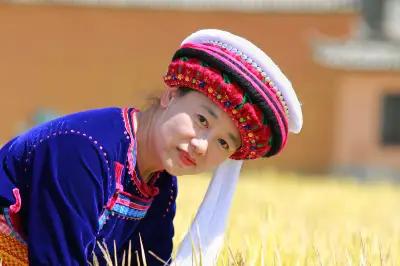
While many historic towns have been commercialised and their original residents moved to cities, Shaxi still has a strong Bai and other minority population living much as they always have – “rising with the sun to work, resting at sunset.” For a visitor like me, this was a wonderfully pleasant surprise!
Shaxi enjoys a mild, spring-like climate all year round. Here you have the grandeur of mountains and the gentle charm of bridges over flowing streams. There is no big-city noise or hurry, just peace and calm, as if time itself stands still. The pace of life is slow and comfortable, allowing you to set aside worries and simply savour unadulterated beauty.
It’s as though a brilliant pearl is set in the Yunnan landscape. Little known it may be, but its beauty and allure cannot be hidden. The flagstone lanes, white walls and grey-tiled roofs, the sound of horse hooves – everything seems to whisper old tales. Strolling through the narrow alleys, you can almost hear history’s echo and feel the passage of centuries.
Thanks to the hit TV series Meet Yourself, Shaxi has suddenly gained popularity in recent years. Visitors flock here to take photos at locations that appeared in the show. I’ve walked every corner of Shaxi, and I still miss the lazy sunshine, the perfect weather, and those bright morning rays.
Thread through a few lanes to reach a small square in the centre of the old town – the ancient stage. Even from its weathered façade, you can imagine the days when gongs and drums resounded. The horse stables stand right beside it, where muleteers once rested for the night. The unassuming square in front of the stage is Sideng Street, the only surviving market fair on the entire Ancient Tea Horse Road.
Sideng Street lies in the middle of the Shaxi basin, on a gentle slope at the northern tip of Aofeng Mountain on the west bank of the Black Hui River – a true feng shui treasure. From the Ming Dynasty onwards, the booming tea-horse trade transformed Sideng into a market square centred on Xingjiao Temple and the Kuixing Pavilion with its attached stage, surrounded by buildings that combined shops in front and workshops at the back.
Sideng is the only surviving market on the Tea Horse Road, with an intact theatre, inns, temples and gate towers that made it a remarkably complete trading post linking Tibet and South Asia. In 2002, it was listed among the 101 World Monument Watch sites, placing it alongside Egypt’s Valley of the Kings, Italy’s Pompeii and China’s Great Wall. With stubborn vitality, this listing rekindled an appreciation for civilisation and conscience, drawing global attention back to Shaxi, a town of profound history long buried in dust.
Sideng Street has weathered the storms of the Tea Horse Road and kept its ancient soul unspoiled. For many, it is an emotional heartland. Drawn by the austere beauty evoked in the poetic line “ancient road, west wind, bony horse,” people have long cherished a longing for that bygone era. Now the “west wind” and the “bony horse” are long gone, yet Sideng has distilled into a painterly quietude in the flow of time – its weathered streets transformed into a kind of splendour.
Walking along Sideng Street, you first notice the old buildings lining both sides. Most are traditional Bai dwellings: brick-and-timber structures with upturned eaves and layered rooflines. Through them, you can easily picture the town’s appearance over its thousand-year history. Yet modern touches blend in seamlessly – cafés, handicraft shops and other fashionable little stores breathe new life into the ancient setting.
The ancient stage is the most distinctive building on Sideng Square. It sits on the same axis as the halls and gate of Xingjiao Temple to the west, splitting the square into northern and southern halves – a physical demarcation of different business zones. The main structure is the Kuixing Pavilion; the stage is merely an ancillary function. It is where the local Bai people venerate Kuixing, the god of literature, and the building rises three storeys, with the stage at the front and a high pavilion at the back.
The architecture is intricate, with twelve upturned corners that seem poised for flight. Despite restorations, its original character is largely intact. The stage and Xingjiao Temple echo each other from afar. During ethnic festivals, Bai people from all around dress in their festive best, play three-stringed lutes shaped like dragon heads, gather on the square, and sing and dance on the stage. Crowds surge, worshippers pray inside the temple – a scene filled with joy and auspiciousness. The liveliest event is the annual “Tai Zi Hui” on the 8th day of the second lunar month. It is said that in Shaxi, a time-honoured rule persists: no one can truly call themselves a Shaxi native unless they have performed on this ancient stage.
Xingjiao Temple stands on Sideng Street in Shaxi Town, Jianchuan County. It was first built in the 13th year of the Yongle reign of the Ming Dynasty (1415) and comprises a main hall, middle hall, temple gate, and stage, covering an area of 6,240 square metres.
The temple is a three-courtyard complex. The first courtyard includes the gate tower, south wing, a courtyard skylight, Guanyin Tower, and north wing. The second courtyard consists of the middle hall and north-south wings. The third contains the main hall, north-south wings and a side courtyard. The main hall, middle hall, Guanyin Tower, gate and stage are all aligned on a single east-west axis spanning 120 metres, with a north-south width of 52 metres. Xingjiao Temple faces east, while the stage faces west.
The Yunnan-Tibet Tea Horse Road took shape between the late 6th and early 7th centuries. Trade in Yunnan tea and salt for Tibetan horses, medicinal herbs and furs gave rise to this vital corridor, which became an overland international route from Dali to Lijiang, Zhongdian, Lhasa and on to India, holding historical significance comparable to the Southern Silk Road. Sideng Street was a crucial hub on that route, where lines of mule caravans passed daily and brought unprecedented economic and cultural prosperity. Traces of that prosperity can still be seen today.
Shaxi Ancient Town is a beautiful place where history intertwines with modernity, and nature harmonises with culture. It may not be as famous as Lijiang or Dali, but its allure is no less. If you’re tired of urban noise and rush and long for somewhere to truly unwind, Shaxi is an ideal choice.
Wandering the town, you can follow the footsteps of history and feel the spirit of the caravan culture; you can admire gorgeous natural scenery and marvel at nature’s magic; you can savour local delicacies and experience everyday life; and you can share wonderful moments with family and friends, creating lasting memories.
If you yearn to escape the clamour and busyness of the city and find a place to relax and refresh, Shaxi Ancient Town is your perfect answer! Here you can rediscover the beauty and simplicity that time has forgotten; here you can enjoy comfort and inner peace; and here, together with your loved ones, you can craft memories you’ll never forget.