First Encounter with Dali
Heeded the wind's call and went where I wanted to go—Dali.
Different people have different feelings when they encounter the same city. For me, my first encounter with Dali was different from the bustling other tourist spots; this city, forever bathed in sunshine, possesses a simple, serene beauty.
Every moment of the six-day journey has become a unique memory of Dali. Erhai Lake, the ancient city, Cangshan Mountain—everything in sight was beautiful.
My first encounter with Dali began at Erhai Lake. Cycling along the Erhai Ecological Corridor and experiencing the ecological beauty of harmonious coexistence between humans and nature was the highlight of our trip.
A taxi from our hotel, Pullman Dali Xiaguan Junfa, cost just over 10 yuan to reach the Yangnanxi Service Station of the Erhai Ecological Corridor. Our cycling route: Yangnanxi Service Station → Xindi Coffee → Longkan Pier → Cai Village → S-Curve → Langqiao (Gallery Bridge) → Haishe Ecological Park. The whole route hugs the coast, stretching 46 kilometers.
The Erhai Ecological Corridor features wide, clean cycling paths and convenient shared bikes. Since we had two children with us, we opted for electric bicycles, which cost 20 yuan per hour. The route is long, so you need to change bikes midway, otherwise you won't make it to the finish.
Cycling along Erhai Lake, under the gentle sunshine, the azure waters shimmered. In the distance, Cangshan Mountain loomed through drifting clouds, truly a scene of 'vast mirror-like waters reflecting the sky, surrounded by emerald screens of mountains year-round.'
The Erhai Ecological Corridor stretches along the shoreline, passing through forests, meadows, fields, and villages, with stunning scenery all the way. Both sides of the corridor are planted with abundant vegetation, creating a veritable green corridor that attracts numerous egrets and wild birds.
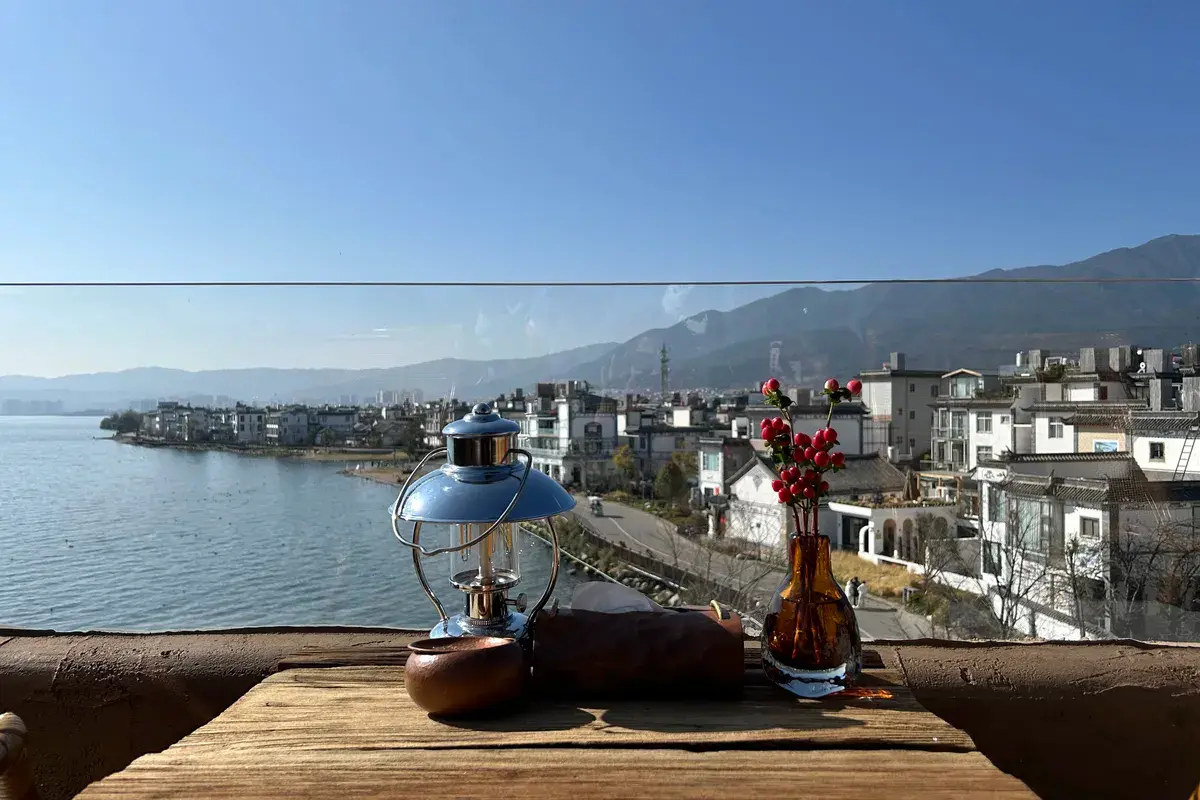
We cycled to the popular Xindi Coffee, which boasts a perfect 'facing the sea' angle—the second-floor seats directly overlook Erhai Lake. Sitting there, slowly sipping coffee or juice, admiring the vast lake and sky, the distant Cangshan and nearby old trees, it felt as if my heart was swaying with the ripples.
During the ride, we came across many stretches of forest by the water. On sunny days, Erhai Lake is a deep azure, and the nearby forests are a delicate, light green—absolutely beautiful.
Of the check-in spots listed on the cycling route, I personally only recommend Xindi Coffee and Langqiao. You can see seagulls at many seaside spots, but Longkan Pier and S-Curve were almost overcrowded, far inferior to the casual scenery along the Erhai cycling path.
Erhai Langqiao (Gallery Bridge) is a lesser-known yet romantic photo spot.
The last stop of our Erhai ride was Haishe Ecological Park. It was much quieter than we expected, with very few visitors. It turned out the park limits the number of people, and after 12 noon, you can only exit, not enter. The park is not large, surrounded by the lake on three sides. The most famous sights are the Couple Tree and Butterfly Spring, making it a favorite shooting location for photography enthusiasts. We missed the entry time, so we'll have to make up for it next time.
Xizhou is about 3–4 kilometers from Haishe Ecological Park, an ancient town near Dali Ancient City. It has over two hundred old residences from the Ming and Qing dynasties, as well as intangible cultural heritage passed down through generations.
Wandering through Xizhou's streets and alleys—Zhengyi Gate, Sifang Street, Corner Tower, Xilin Court, Xizhou Rice Fields, Yan Family Compound—every spot had its own unique beauty.
Many stone archways at Sifang Street.
Xizhou's landmark: the Corner Tower.
The afternoon tea at Xilin Court was wonderful.
In winter and spring, Xizhou's rice fields are lush, as if in summer.
The Yan Family Compound was once the top-ranked among Xizhou's four great families. This mansion exudes an antique aura, yet it's elegant and at the same time exudes a casual, free-spirited charm.
The Yan Family Compound has perfectly preserved the Bai ethnic architectural style. It consists of a 'three houses, one screen wall' courtyard and a 'four houses, five skylights' courtyard. The labyrinthine complex retains wood and stone carvings from the Republican era, still bearing exquisite charm despite the passage of time.
Spending half a day strolling here, soaking up the historical depth of this millennia-old town, the faint sounds of Bai ethnic Dabenqu singing, the distant tinkling of horse bells, delightful little shops, rustic corners, and beautiful fields—all made me feel the trip was worthwhile.
On our third day in Dali, we went for lunch at Yunhe Yi Sea View Manor, which we had booked three days in advance. This is a restaurant-estate combining views of Cangshan Mountain and Erhai Lake, outdoor camping, lawn parties, family fun, and Instagram-worthy spots. Across the vast lawns and gardens, there are private dining rooms shaped like boats and pumpkin carriages, plus huge slides and swings. The culinary highlight is wild mushroom hotpot.
After lunch, we rented a car and headed to Weishan Ancient Town, staying that night at the Yunxi Jinshi Hotel.
Weishan Yunxi Jinshi Hotel, a single hotel that sustains a town, was converted from a Jinshi (imperial scholar) residence. It has four courtyards named after the seasons, with exquisite landscaping and just 16 guest rooms. It is widely recognized as the runner-up for local charm hotels and the champion for ancient town hotels across Dali's 12 administrative districts. The hotel's back garden is home to alpacas, peacocks, deer, rabbits, piglets, and swings and sandpits for children.
Weishan Ancient Town lies about 70 kilometers south of Dali Ancient City. It was the ancient Nanzhao capital and birthplace of Nanzhao culture, now a national-level historical and cultural city. Founded in the 23rd year of the Hongwu reign (1390), it has 25 streets and 18 lanes laid out in a neat grid. The ancient buildings are numerous, finely crafted, and distinctively ethnic in style—it's one of China's best-preserved Ming-Qing architectural complexes, with high historical, cultural, and architectural value.
The majestic Gongchen Tower and Xinggong Tower are the town's iconic landmarks.
This quiet, beautiful, ancient town has few tourists. Its old streets, alleys, and courtyards are serene, gentle, and harmonious, like an unspoiled paradise, simple and pure.
Strolling through Weishan Ancient Town, every brick and tile bears the imprint of history.
Looking down the streets from near to far, the low old houses, the orderly gray-black tiles, and the half-open shops all exude the charm of the old lanes.
Weishan tie-dye is renowned as the 'Home of Chinese Folk Tie-Dye Art.' The Nanzhao Yi people's handcrafted tie-dye technique, passed down for a thousand years, is unique and exquisite. Completing a piece with the children—drawing, stitching, tying, and dyeing—was both fun and deeply meaningful.
Stepping into the Nanzhao Museum, it felt like traveling back to the ancient Nanzhao era.
'Su Laosan One Noodle' is the most famous local specialty. Due to limited quantities, they close after 12 noon. During Spring Festival, I heard people queued for over two hours and still missed out.
'Lao Er Restaurant' is housed in a heritage-listed old residence. The food is good, and it draws many diners.
After lunch, we drove back to Dali and checked into the Hilton Dali Resort & Spa. Facing Erhai Lake and adjacent to Cangshan Mountain and Dali Ancient City, it was very convenient.
As dusk fell, I slowly walked into the long-awaited Dali Ancient City, watching the crowds and the local life—a mix of everyday bustle and vibrant energy. This might be the best imprint of time.
This ancient city, steeped in gentle time and history, backs onto the majestic, verdant Cangshan Mountain in the west and faces the rippling Erhai Lake in the east.
With imposing gate towers and sturdy walls, the city has a grid layout where diverse cultures blend and coexist.
The charm and allure of the old town, set against the unchanging landscape, holds endless appeal.
Walking on the bluestone slabs that have weathered countless years, I felt transported to another realm. Small bridges over flowing streams, enchanting night scenes, an elegance like blue-and-white porcelain, a leisure like a thatched cottage—my heart turned pure and transparent.
On the morning of our fifth day in Dali, we headed straight to Cangshan Mountain.
Cangshan is one of Dali's four iconic sights, representing the 'snow' of the 'wind, flowers, snow, moon' quartet. Lying west of Erhai Lake, it is exceptionally scenic, named for its verdant slopes and white summit. The snow on its main peak is a magnificent sight and one of Dali's four great scenes. The mountain's clouds shift unpredictably, creating shapes like 'husband-watching cloud' and 'jade belt cloud.' From the summit, you can overlook the stunning views of Erhai Lake and Dali.
There are three routes up Cangshan: Ximatan Cableway (the main cableway), Gantong Cableway, and Zhonghe Cableway. With children, we chose the Gantong Cableway. The plan was to enjoy the seclusion of Cangshan Grand Canyon and the tranquility of Gantong Temple and Jizhao Nunnery at the mountain foot.
From the cable car, gazing into the distance, the mountain was steep with jagged rocks and thick green trees.
We strolled along the trails, admiring the bizarre peaks, strange rocks, alpine meadows, and primeval forests of Cangshan. We visited Qingbi Stream, the Big Chessboard, and Cangshan Grand Canyon.
After getting off the cable car, we took a small path up the mountain; about 30 minutes later we reached Jizhao Nunnery and Gantong Temple. Jizhao Nunnery is hailed as 'China's most beautiful nunnery,' famous for its flowers, drawing daily visitors who come for photos, vegetarian meals, and blessings. Due to a child feeling unwell, we couldn't go, so I'm using borrowed photos.
Shuanglang Ancient Town sits on the northeast shore of Erhai Lake, encircled by mountains on three sides and facing the lake. To experience Erhai up close, Shuanglang is a must-visit. When we arrived, it was already afternoon, with perfect sunshine.
Like many ancient towns, Shuanglang is heavily commercialized, with shops repeated often.
Wandering through the backstreets is the way to truly get to know Shuanglang. Some small lanes leading straight to Erhai Lake are very pretty.
That day was sunny. Waves layered upon the Erhai Lake swayed gently; the sound of them lapping against the shore was so soothing—everything was at its most beautiful.
A pleasant route is to follow the small path next to a Dali Western restaurant toward Nanzhao Love Island. Looking across the water at the island, it felt a bit like Darling Harbour in Sydney.
The Moon Palace and Sun Palace, created by dancer Yang Liping, are nestled by the mountains and water with enchanting scenery. Unfortunately, you need to book a day in advance (and might not get a spot), and they don't accept reservations for people over 60 or children under 8. To enter, you must spend at least 128 yuan per person. We had wanted to visit this art palace, but had to give up due to age discrimination.
On our last day in Dali, we checked in at a place with wind—Fengyangyi.
Fengyangyi is an ancient village on the Tea Horse Road near Dali. The whole village is rustic and quiet, with honest folkways, retaining its original ancient appearance. It's a secluded paradise away from the city's hustle. Here, you can feel that serenity and beauty, as if in another world.