From Prehistory to Modern Times: Exploring Spanish Art with Bao Bao
Spain is a country worth visiting again and again. It has 49 UNESCO World Heritage sites, 17 Intangible Cultural Heritage items, and abundant natural resources. Historically ruled by the Phoenicians, Greeks, Carthaginians, Romans, Visigoths, and Moors, Spain has been a crossroads of civilizations for centuries, giving rise to diverse cultures and arts. Each of its 17 autonomous communities has its own unique characteristics.
I love multicultural diversity, especially European civilization. After visiting Spain twice, I remain deeply captivated by the history and culture behind this country.
For my third trip to Spain, I am particularly looking forward to embarking on an artistic journey through Spain, exploring seven types of art in seven cities. So, I've done some research and hope to share and discuss it with you here.
I will organize Spanish art chronologically, from prehistory to modern times, sharing them one by one. At the end of the article, there will be a route map!
Feel free to leave comments and exchange ideas with me. I'd love to meet like-minded friends. ^-^
On my second visit to Barcelona, I went to the Picasso Museum in the Gothic Quarter because I wanted to see his early works. We know more about Picasso's later works, but before Cubism, he created delicate portraits that could rival Raphael's. Some of these can be found at Barcelona's holy mountain, the Museu de Montserrat. He once said, "It took me four years to paint like Raphael, but a lifetime to paint like a child." Among Picasso's works, the ones that impressed me most were the series of bull sketches, which we can call "The Transformation of a Bull."
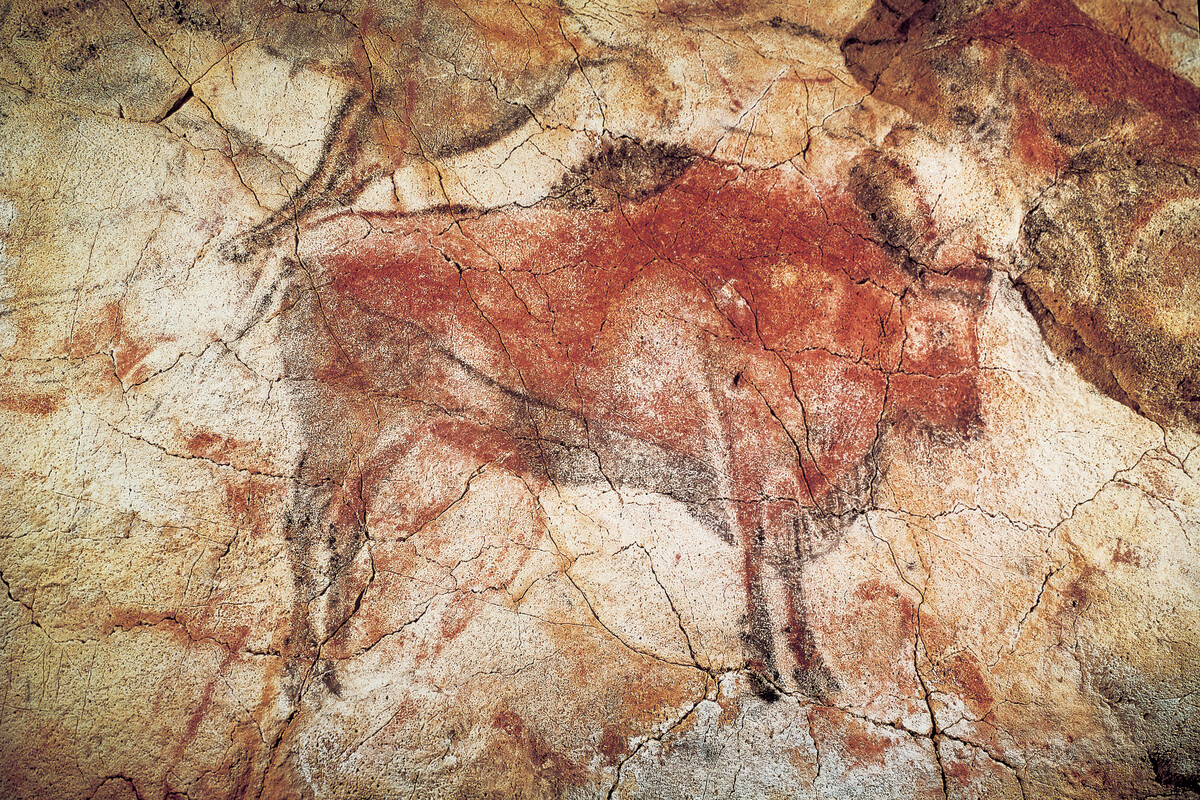
In his drawings, the bull evolves from complex to simple, finally reduced to a few lines that capture the bull's form. It resembles the bison in the Altamira cave in northern Spain. It is said that after visiting that cave, Picasso famously remarked, "We have invented nothing!"
Even without Picasso's story, I am deeply drawn to the bison in the Altamira cave. Such unadorned art is fascinating.
Spain is one of Europe's oldest countries. In Atapuerca, near Burgos in the north, the oldest human fossils in Europe (1.2 million years old) were excavated. Further north, in the Cantabrian Mountains near the coast, the earliest art of the Iberian Peninsula was discovered: the cave paintings of Altamira (Cueva de Altamira).
Cueva de Altamira
In 1875, María, the young daughter of archaeologist Marcelino Sanz de Sautuola, accidentally saw the paintings in the cave. Archaeologists found that the large Altamira cave contains over twenty Paleolithic animal figures, including fifteen bison, three wild boars, three female deer, two horses, and one wolf. One of the bison, the first discovered, is painted on the ceiling of the main chamber and is over 20,000 years old, dating to the late Upper Paleolithic period (Magdalenian culture). The bison are painted in ochre, black, and brown, vivid and accurate.
Cueva de Altamira
Art evolves from simple to complex and back to simple—Picasso's lifelong work perfectly illustrates this process. For art lovers, I can think of no reason not to love the Altamira cave paintings. Prehistoric humans used the simplest tools and pigments to depict natural creatures perfectly within the natural cave, without complex techniques or emotional overlay, faithfully recording what they saw. This kind of art is truly moving.
Cueva de Altamira
Seeing the actual cave paintings requires luck. To protect the site, only five lucky visitors per week are allowed a 37-minute tour. To go, you must win a lottery for approval.
Museo Nacional y Centro de Investigación Altamira
Next to the Altamira cave, a replica cave called "Neocueva" is open for visits, but photography is not allowed inside.
After the Iron Age, foreign peoples began migrating to the Iberian Peninsula: Celts moved to the north and northwest, forming a special tribe with the native Iberians—the Celtiberians; Phoenicians founded the city of Gadir (modern Cádiz) in the south; Greeks settled along the Mediterranean coast. Starting in the 6th century, the Phoenicians and Greeks were expelled from the western Mediterranean by the Carthaginians, who established prosperous settlements on Ibiza.
Rome, on the Italian Peninsula, grew powerful and began competing with Carthage for control of the Mediterranean around the 3rd century BC. After three Punic Wars, Carthage was destroyed. During the Second Punic War (218 BC), the Romans and Carthaginians used Iberia as a battlefield. In 206 BC, the Romans won a decisive victory at Ilipa near Seville, driving the Carthaginians out of Iberia. By the 1st century BC, Rome had complete control of the peninsula.
The Romans ruled Iberia for 600 years. The first 200 years faced strong resistance from native tribes, but by 50 AD, most Iberians had accepted Roman rule and adopted Roman lifestyles. The Romans brought civilization: Latin, Roman law, municipal government, and the Catholic faith. Even today, Roman structures from over 2,000 years ago still stand on the Iberian Peninsula.
The Roman Empire divided Iberia into three provinces. Lusitania, one of them, roughly corresponds to modern Portugal and southwestern Spain. Its capital was Augusta Emerita, founded by Emperor Augustus after the Spanish campaigns—now Mérida.
Templo de Diana
Templo de Diana
As a fan of Roman history, I've long wanted to visit this city with its many ruins. This ancient Roman city has the most Roman remains in Spain, including an amphitheater, Roman theater, Roman circus, the Roman bridge over the Guadiana River, and the Temple of Diana.
Calzada Romana
Teatro Romano
I'd like to visit Mérida in summer. The International Classical Theater Festival (Festival del Teatro Clásico) takes place in July and August at the Roman theater, featuring classical Greek and modern plays, music, and dance. I look forward to watching a wonderful performance in the Roman theater, reliving the glory of the stage.
Puente Romano
Roman rule was Spain's golden age, but the Pax Romana began to crumble in the 3rd and 4th centuries AD, as tribes crossed the Pyrenees. After a brief Visigothic rule, Germans arrived in the 6th century. In the 8th century, the Moors crossed from Ceuta in Morocco and landed at Gibraltar, beginning 800 years of control.
Southern Spain has the most Moorish cultural heritage. The Moors called this region Al-Andalus (land of the Vandals), from which Andalusia gets its name. Córdoba, Seville, and Granada are the most famous Andalusian cities, attracting many tourists.
Catedral de Jerez de la Frontera
La Giralda, Sevilla
Alhambra de Granada
Like bullfighting, flamenco is a quintessential Spanish art form. Just as Peking opera is to China, you cannot go to Spain without seeing a fantastic flamenco performance.
Flamenco includes baile (dance), cante (song), and toque (guitar playing). It was heavily influenced by the Moors and Jews in Andalusia and absorbed many artistic elements of the Roma (Gypsy) people.
The word "flamenco" comes from Spanish Arabic, meaning "fugitive peasant." After Christian forces defeated the Moors in Andalusia in the 15th century, many Moorish peasants mixed with Roma to avoid forced relocation or conversion to Christianity. They pretended to be Roma to continue their traditions, including singing. Later, persecution by the Catholic Inquisition and restrictive laws forced some Roma, Moors, and Jews to hide in rugged mountainous areas to evade authorities. Over many years, these different cultures merged and grew, forming the flamenco we see today.
Cueva Tarantos, Granada
They shared a life of hardship, and the Gypsies expressed it through their voices, dance, and instruments. Today, we often see singers with furrowed brows, melancholic and indignant expressions, and hoarse voices. Flamenco reflects the Gypsies' poverty and tragic fate, expressed through poetry, music, and dance.
Museo del Flamenco, Sevilla
In flamenco, cante (song) is the most important element. The cantaor (singer) is the core, not a dancer with a long skirt and twirls, but a lone voice crying out. Some describe flamenco as "singing with a broken heart; draining the last ounce of energy from the body; playing the guitar—the ultimate language cannot reach."
The songs of Andalusia are classified as cante jondo (deep song), meaning "deep song," a wild lament for love, sorrow, loss, and religious passion. Cante jondo and flamenco are one, as cante jondo is the blood and soul of flamenco.
Taberna El Pasaje, Jerez de la Frontera
Although flamenco performances can be seen throughout Spain, to experience the most authentic flamenco, visit the small taverns of Seville or the cave taverns on the Sacromonte in Granada or the Albaicín district.
Museo del Flamenco 2.0, Sevilla
Here are some flamenco venues recommended by Bao Bao:
Museo Flamenco Premium: Calle Manuel Rojas Marcos 3, Seville – €37/person
Casa de la Guitarra: Calle Mesón del Moro 12, Seville – €20/person
Casa de la Memoria: Calle Cuna 6, Seville – €22/person
Los Gallos Tablao Flamenco: Plaza de Santa Cruz 11, Seville – €35/person
Casa del Arte Flamenco: Calle Cuesta de Gomérez 11, Granada – €22/person
Tablao Flamenco Albayzin: Carretera de Murcia s/n, Granada – €18/person
Venta El Gallo: Barranco de los Negros 5, Granada – €22/person
Andalusia not only gave birth to flamenco but also to a world-famous literary work. Spanish writer Miguel de Cervantes spent his youth here, and Don Quixote was completed while he was in a prison in Seville. This great writer of the Spanish-speaking world was born in Alcalá de Henares near Madrid. Now, follow me to explore another Spanish city.
1492 was a year of great events in Europe. The most influential for Western Europe was the joint campaign by the Catholic Monarchs Isabella (Queen of Castile) and Ferdinand (King of Aragon) to conquer Granada, completing the Reconquista on January 2, 1492, and expelling the Moors, ushering in Catholic rule.
The Spanish Golden Age (Siglo de Oro) began that year and lasted until 1681, marked by the death of representative writer Pedro Calderón de la Barca. Salamanca, Valladolid, and Alcalá de Henares were the centers of this era.
This period coincided with the rise and prosperity of the Spanish Habsburg dynasty and Spain's Renaissance. Artists like Diego Velázquez and El Greco brought Italian Renaissance styles and created a unique Spanish painting style.
Catedral Magistral
In literature, Miguel de Cervantes Saavedra, Félix Lope de Vega y Carpio, Pedro Calderón de la Barca, and Mateo Alemán were representative figures of the Golden Age.
Palacio Arzobispal
Especially Cervantes, whose Don Quixote is considered the first modern novel and a treasure of world literature. He was born in Alcalá de Henares, near Madrid. This city dates back to Roman times. In 1499, Cardinal Cisneros founded the University of Alcalá here. To this day, the Spanish king and queen present the prestigious Cervantes Prize (Premio Cervantes) in the university's auditorium every year.
Plaza de Cervantes
If you are a fan of Cervantes, you can take the Tren de Cervantes tourist train from Madrid to Alcalá de Henares. During the journey, the train plays short plays recreating Cervantes' time. Upon arrival, you can visit the Museo Casa Natal de Cervantes, a 16th-century building furnished with artifacts and ceramics of the era, giving visitors a glimpse into Cervantes' childhood.
Moving to the 18th century, in 1700, the Spanish Habsburg dynasty's King Charles II died without an heir, sparking the 13-year War of the Spanish Succession. All of Europe fought over the Spanish throne. The result was a new dynasty for Spain—the Bourbon dynasty, with Philip of France becoming King Philip V of Spain.
With the Bourbon dynasty, the Spanish art scene changed dramatically, and the Baroque style flourished. In dance, the jota (La Jota) became popular in 18th-century Spain.
Jota Aragonesa
Jota comes from the Arabic word for "jump" and originated in the northeastern region of Aragon. During the festival of Our Lady of the Pillar (La Virgen del Pilar) in Zaragoza, people enthusiastically gather from all directions to watch the jota. Originally a purely family dance, it later spread nationwide and even inspired Liszt's Spanish Rhapsody.
Jota Aragonesa
The jota is a fast, lively dance in triple time. Dancers hold castanets and raise their arms in circles, with one or two couples dancing, singing, and clicking castanets, accompanied by choral singing, creating a joyful atmosphere. Dancers often wear regional costumes and perform the jota at funerals, weddings, or the birth of a child.
Jota Aragonesa
Jota Aragonesa
The 20th century, from Franco's Spanish Civil War to democratic Spain, is another story too long to cover here. I'll skip this part for now, hoping to discuss it on the public account later.
After Franco's death, Spain gradually transitioned to democracy and actively joined the European Community (predecessor of the EU). Today, it is a constitutional monarchy with a hereditary monarch and bicameral parliament.
Spanish art continues to flourish, with each region having its own character. Barcelona, the city of Gaudí, attracts countless tourists. I've written many articles about Barcelona, so I'll not dwell on it now.
The following two lesser-known cities are among my top destinations for my third visit to Spain (if not for the pandemic, I would have gone in 2020... crying... o(╥﹏╥)o). First is Oviedo, the capital of Asturias.
Oviedo is the capital of Asturias. Those familiar with Spanish history and politics know that Asturias is the title given to the heir to the Spanish throne: Prince or Princess of Asturias. However, more people know this historic city from Woody Allen's film Vicky Cristina Barcelona.
Ciudad de Oviedo
Universidad de Oviedo
Oviedo is a city of statues. There are over 100 quirky sculptures, making it like a huge open-air museum. Besides visiting historical buildings and museums, you can plan your own sculpture-spotting tour.
Don't miss these sculptures:
A standing Woody Allen sculpture with hands in pockets. It sometimes wears glasses, sometimes not, because... the glasses are often stolen. ^-^
Escultura de Woody Allen
"El vendedor de pescado" (The Fish Seller) by José Antonio García Prieto (1996): a fish seller crouching next to a rectangular box full of fish.
El vendedor de pescado
In Plaza Porlier, there is a sculpture by Eduardo Úrculo (1993) depicting a traveler like you and me: a standing man wearing a fedora and coat, surrounded by suitcases, with an umbrella leaning against the cases, as if he just arrived in the city.
Plaza Porlier
Finally, here's a map of 32 sculptures recommended by the Asturias tourism guide. Download it if you want to follow the route!
Another city I'm eager to visit is San Sebastián (Basque: Donostia), a coastal town in the Basque Country of northern Spain.
This modern city has a beautiful coastline, earning it the nickname "Pearl of the Bay of Biscay." Tourists can enjoy panoramic views of the city from Monte Igueldo and Monte Urgull, which flank Playa de La Concha.
Johnny Depp (playa)
Did you know? San Sebastián often tops lists of the world's best dining destinations. As early as 2012, it was named World Capital of Gastronomy, with several three-Michelin-starred restaurants. Don't miss the wonderful Spanish snacks called pintxos (Basque skewers). The streets of the old town are lined with pintxo bars, each chef with their own recipes. Be sure to go "bar hopping" like the Spanish!
Centro Kursaal, San Sebastián
One of Europe's most famous film festivals, the San Sebastián International Film Festival, is held here annually for two weeks in late September.
Catherine Zeta-Jones, Anthony Hopkins, Antonio Banderas, 1998
Pedro Almodóvar, Woody Allen, 2004
Johnny Depp, 2021
Chinese films and actors have won multiple awards at the San Sebastián International Film Festival. For example, Ning Jing won Best Actress in 1994 (24th edition) for Red Firecracker, Green Firecracker; Xu Jinglei won Best Director in 2004 (52nd edition) for Letter from an Unknown Woman; and Feng Xiaogang won the Golden Shell for Best Film in 2016 (64th edition) for I Am Not Madame Bovary.
Lu Quan, Qin Lan, 2019
During the festival, movie stars stay at the Hotel Maria Cristina, a Luxury Collection Hotel. If you book far enough in advance, you might attend the awards ceremony and premieres!
——————————————————————————————————
There is so much more to say about Spanish art, but space is limited. These seven cities I've chosen are carefully selected. If you have more interesting places, feel free to leave a comment!
Finally, here's a travel itinerary map. You can take the Spanish national railway or drive to these seven places. I recommend spending 1–2 days at each destination. The total journey takes about two weeks to complete this Spanish art route.
Travel Directory:
1. Altamira Cave (Cueva de Altamira) – Prehistoric Art
2. Mérida – Ancient Rome
3. Andalusia – Medieval 15th Century
4. Alcalá de Henares – 16th Century Renaissance
5. Zaragoza – 18th Century
6. Oviedo – Modern
7. San Sebastián – Modern
Travel Information:
Hotel Index | Strategy Index | Ticket Index | Website Navigation | Travel Index | Cruise Index | Enterprise Travel Index | Franchise Cooperation | Distribution Alliance | Friendship Links | Corporate Gift Cards | Insurance Agency | Agency Cooperation | Hotel Alliance | Destination and Scenic Area Cooperation | More Cooperation | About Ctrip | About Ctrip | Ctrip News | Contact Us | Join Us | User Agreement | Privacy Policy | Security Center | Ctrip Content Center | Intellectual Property | Trip.com Group Algorithm Disclosure


