Trip to Spain and France (Part 2) - Seville, Cordoba, Malaga, Ronda, Granada
Continuing from: Trip to Spain and France (Part 1) - Madrid and surrounding Segovia, Toledo
Spain has countless reasons to captivate you: the ancient Roman aqueducts, the passionate and unrestrained flamenco, the mystery of the Alhambra, the magic of Gaudí's architecture, and the fusion of diverse cultures that keep you moving forward. And next to it, France—Paris's romance and the treasures of the Louvre enchant your dreams.
We were fortunate on this trip to obtain a 30-day Spanish Schengen visa.
Where did we go in 30 days?
I. Madrid and surrounding Segovia, Toledo (7 days)
II. Andalusia's Seville, Cordoba, Malaga, Ronda, Granada (10 days)
III. Barcelona (5 days)
IV. Paris (9 days)
As the content is lengthy, we will share our travel experiences in four parts according to the regions above.
We purchased tickets online a month in advance for the Seville Alcázar, Cathedral (including rooftop climb), Cordoba Mosque, and Granada's Alhambra. Unfortunately, we had a major regret: we tried to book the Nasrid Palaces inside the Alhambra over a month ahead, but they were already sold out online.
Accommodation in Seville, Cordoba, Malaga, and Granada was booked online in advance.
Since we failed to register with the official Spanish railway Renfe app, we bought train tickets from Madrid's Atocha station to Seville, Cordoba, Malaga, and Granada before departure.
Seville is the fourth largest city in Spain, the capital of the Andalusia autonomous community and Seville province, and the artistic, cultural, and financial center of southern Spain. It was once an important port where Spanish fleets brought large amounts of gold and silver from the New World, transshipped to Europe via Seville. Seville's religious and civil architecture is diverse, recording the city's cultural changes—you can see Gothic, Mudéjar, Renaissance, Baroque, Neoclassical, and Romantic styles among its historical artistic heritage.
On the morning of May 12, we left Madrid for Seville.
Seville Santa Justa Train Station.
Seville Santa Justa Train Station is the central railway station of Seville, built between 1987 and 1991. It is the origin of Spain's first high-speed rail (AVE).
We arrived at our hotel in Seville at noon. The hotel was in the old town, about 200-300 meters from the Seville Cathedral and Alcázar, surrounded by many bars and restaurants. We stayed here for three days.
Murillo Gardens, with the Columbus Monument standing tall inside.
Inside the walls is the University of Seville.
There are many horse-drawn carriages in Seville. You can take a carriage to the Alcázar, Cathedral, and other famous sights, allowing you to travel back centuries.
Plaza de España is located at the edge of María Luisa Park. It is a Spanish Moorish Revival building, constructed for the 1929 Ibero-American Exposition. The square is semicircular, featuring a canal, small bridges, and fountains. This huge semicircular square has a North Tower and a South Tower on each side, symbolizing the Catholic Monarchs Ferdinand and Isabella.
Flamenco was declared a UNESCO Intangible Cultural Heritage of Humanity in 2010. The traditional Romani district of Triana in Seville is a major center for flamenco development. Flamenco is a unique product of the fusion of Gypsy and Andalusian cultures, incorporating elements from India, Jewish, Arab, and Romani traditions—it is a three-in-one art of song, dance, and guitar.
The walls of the square have many alcoves, each representing a different province of Spain.
The Alcázar of Seville was converted from a Moorish palace. Construction began in 1181 and continued for over 500 years, primarily in the Andalusian Moorish-Mudéjar style, but also influenced by the Renaissance. Its gardens blend Moorish, Andalusian, and Christian styles. The Alcázar is also a filming location for Game of Thrones.
Exquisite columns in the Hall of Philip II.
Intricate carvings and arches in the Hall of Ambassadors.
The magnificent dome of the Hall of Ambassadors.
Each column and carving in the Maiden's Courtyard is a precious work of art.
The royal bath in the basement of the palace has a mysterious feel.
The underground passage keeps you warm in winter and cool in summer.
The palace gardens are also a Game of Thrones filming location. A sixteenth-century arcade forms a curve, allowing you to fully enjoy the Islamic-style garden.
Leaving the Alcázar, we were hungry and had some cake and ice cream—they were delicious.
The square is semicircular, composed of a series of painted arches supported by marble columns. Above the arches, there are three floors. The semicircular square includes fountains, various shops, and a section of the Seville city wall about 50 meters long.
In Seville, you must take a stroll along the Guadalquivir River. Not only is the scenery picturesque, but you can also feel the prosperity of the Spanish empire during the Age of Sail.
The Torre Sevilla on the banks of the Guadalquivir is the tallest building in Seville.
At the western end of the Isabel II Bridge in Seville stands a small church, the Church of Our Lady of Carmen, the patron saint of Spanish sailors, fishermen, and the sea.
Church of San Jacinto.
The Torre del Oro is a dodecagonal military watchtower, built in the 13th century to control navigation on the Guadalquivir and protect the precious metals brought back from the Americas.
The Plaza de Toros de la Maestranza is the oldest bullring in Spain, completed in 1765 and still used for bullfighting performances.
Ordering food in Spain is like opening a mystery box—it's hard to understand their menus. Today's dishes were not tasty and were quite expensive.
Seville Cathedral was built between 1401 and 1519 on the site of a former mosque. It is a medieval Gothic cathedral with lavish interior decoration. The cathedral reused some columns and materials from the mosque. Most famous is the Giralda, originally a minaret, later converted into a bell tower, with a statue on top representing faith.
We bought tickets including the rooftop climb for Seville Cathedral. We entered the cathedral and were led by a guide directly to the climb; there was no Chinese explanation.
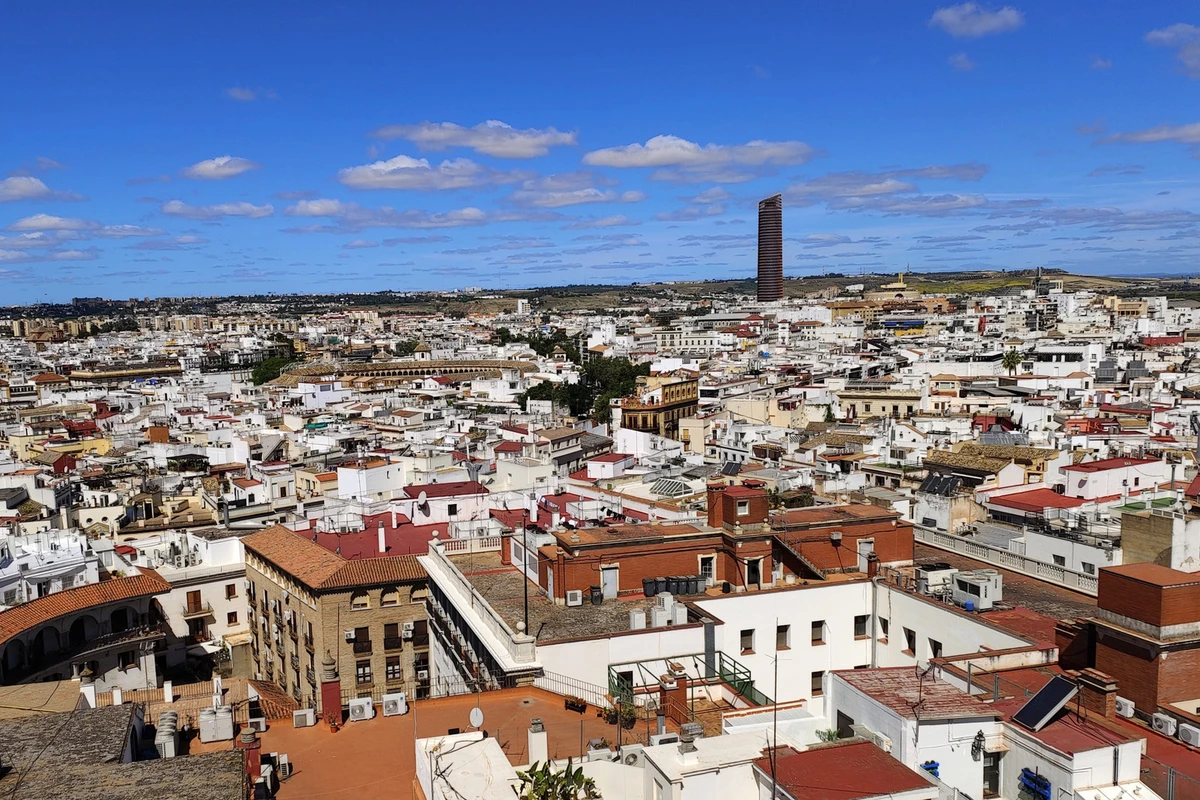
Climbing to the top offered a panoramic view of Seville.
Tomb of Christopher Columbus: The sarcophagus is carried by four bearers representing the kingdoms of Castile, León, Aragón, and Navarre, symbolizing Columbus's greatness in Spain's maritime history.
Exit of Seville Cathedral.
Not far from the cathedral, across the street, is an excellent ice cream shop. We had a cup every time we passed by. After visiting the cathedral, we went to the Metropol Parasol.
Hotel Alfonso XIII is a historic building constructed between 1916 and 1928, officially opened on April 28, 1929, in a Neo-Mudéjar style—a historical version of Arab architecture, richly ornamental.
In front of Hotel Alfonso XIII is a beautiful square. The central fountain was designed and built for the 1929 Ibero-American Exposition. On the large lotus leaf in the middle sits a figure representing the city, supported by naked children riding turtles. The fountain contains various elements of the city: a woman holding a staff symbolizes commerce, and gears represent industry. If Seville FC wins a championship, fans celebrate here.
The University of Seville, founded in the 16th century, is a public university.
A corner of the university library.
Palacio de San Telmo is the seat of the Andalusian government. Construction began in 1682, in Baroque style. Its main facade features a striking Churrigueresque gateway.
The roadside trees are really beautiful.
The Metropol Parasol, completed in 2011, looks a bit like a giant mushroom. It measures approximately 150 meters by 70 meters, about 26 meters high, with four levels, and is touted as the largest wooden structure in the world.
For dinner, we sat down slowly and waited for the light show at the Metropol Parasol.
At 10 p.m., the lights came on.
A crescent moon hung high in the sky, and the cathedral's bell tower shone brilliantly against the lights.
The Alcázar returned to calm.
The cathedral became even more serene and majestic.
Cordoba, located on the banks of the Guadalquivir River, served as the capital of the Umayyad Caliphate. Its old town boasts many unforgettable buildings and ruins. In 1984, UNESCO declared the Cordoba Cathedral a World Heritage site, and in 1994, the heritage was extended to the entire old town.
On the afternoon of the 15th, we left Seville by train for Cordoba, where we stayed for two days.
Gate of the Bridge (Puerta del Puente): During Roman and Muslim rule, there was always a gate connecting the Via Augusta to the city; it was rebuilt in 1572.
Triunfo de San Rafael: The Archangel Raphael is the patron saint of Cordoba.
The Roman Bridge is 331 meters long and 9 meters wide, for pedestrians only. Construction began in the early 1st century AD, when Cordoba was under Roman rule, so it is called the Roman Bridge, also known as the Old Bridge. However, the current bridge is the result of multiple renovations and reconstructions, with most structures dating back to the Arabs' rebuilding in the 8th century. The river under the old bridge is still the most important Guadalquivir River in Andalusia, upstream from Seville.
On the bridge stands a statue of the Archangel Raphael.
Looking east from the old town, the landmark at the bridgehead is the Calahorra Tower, originally built by Muslims to protect the Roman Bridge, expanded in the 14th century. It now houses the Museo de la Vida Andaluza (Andalusian Life Museum).
Looking west toward the old town, the landmarks at the bridgehead are the Cordoba Mosque, the Triunfo de San Rafael, and the Gate of the Bridge.
The Guadalquivir water mills are remnants of medieval architecture, declared Andalusian historical heritage on June 30, 2009.
This restaurant had a nice atmosphere with Spanish style. Somehow, we ordered boiled beef, but they brought fried beef.
The Mosque-Cathedral is a UNESCO World Heritage site and the symbol of Cordoba. The site originally housed a small Visigothic church. After Islamic forces conquered Spain in 711, the church coexisted as a place for both Islam and Christianity. In 784, the current Great Mosque of Cordoba was built on the site. In 1236, when Christian rule was reestablished, the mosque was converted into a Roman Catholic cathedral, and in the 16th century, a Renaissance-style cathedral and nave were further added.
The bell tower and the Courtyard of the Oranges. The bell tower was converted from the mosque's former minaret.
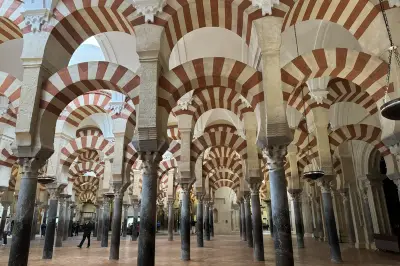
The double-tiered arches, stacked layer upon layer, alternating red and white, create a visual impact. A poet once described these columns as rows of palm trees in an oasis.
Original mosque area.
The fusion of mosque and cathedral culture.
Left: mosque roof; right: cathedral roof.
The exterior of the mosque is also unique, with doors from various periods. This is a door from the mosque period.
Lovely children also came to visit the mosque.
The Alcázar de los Reyes Cristianos (Christian Monarchs' Castle) is a medieval castle that once served as one of the main residences of Isabella I and Ferdinand II, rich in history.
In 1950, during a complete renovation of Cordoba's Plaza de la Corredera, Roman ruins were discovered, unearthing many valuable antiquities.
Mosaic paintings displayed in the castle's exhibition hall, dating back about 2,000 years.
A sarcophagus from the 3rd century AD.
The castle's two most important structures: the Tower of the Lions and the Tower of Homage.
The gardens inside the castle are very distinctive, with clear Mudéjar style. They feature rectangular, orderly pools, meticulously trimmed pines, cypresses, boxwoods, and orange trees, as well as geometrically arranged flower beds—high and low, with open views and symmetrical layout. This architectural style is a unique Spanish garden art, a hybrid formed by blending original Muslim garden art with certain elements of European garden construction.
The Tower of Homage.
From the Tower of the Lions, view the old town—endless scenery.
The Roman Bridge in the distance.
Palacio de Viana was built in the 15th century and was always a noble residence. Its 12 courtyards each have unique features, with orange trees, cypresses, and flowers creating a fragrant garden landscape for all seasons. It also displays furniture, decorations, and weapons from the 16th-18th centuries.
Washboard and washing pool.
Plaza de la Corredera is the largest city square in Andalusia, built in the 17th century, surrounded by four-story buildings in traditional Castilian style.
Enjoying a good meal at a restaurant on the square.
Calleja de las Flores (Alley of the Flowers) is in the Jewish quarter. Compared to Seville, Cordoba's old town is much smaller but very refined.
As the capital of the Costa del Sol, Malaga often evokes images of sun, beaches, and sea, but it is also a tourist destination with rich cultural heritage. The city was founded in the 8th century BC and has many important historical sites that testify to its significance and glorious past. The Malaga beach stretches 14 kilometers continuously.
On the afternoon of the 17th, we said goodbye to Cordoba and took the train to Malaga.
We booked an apartment on Malagueta Beach, just 200 meters from the sea, and stayed here for three days (including one day trip to Ronda).
Alcazaba of Malaga is a palace fortress built by the Hammudid dynasty in the early 11th century. It is one of the best-preserved fortresses in Spain.
Climbing the fortress offers a view of Malaga's port.
At the foot of the Alcazaba lies another important historical site: the Roman Theatre of Malaga, built in the 1st century AD by order of Emperor Augustus. After being abandoned and largely dismantled for the construction of the Alcazaba, its existence was forgotten for centuries until it was rediscovered during 20th-century construction work.
Recharge some energy, then continue to the next stop.
Gibralfaro Castle sits on a hill sloping toward the sea, dominating the entire city. The castle was built in the 11th century and expanded in the 13th-14th centuries to guard land and sea routes, protecting the Alcazaba and the city.
From the Alcazaba, you can take this comfortable green path to Gibralfaro Castle, enjoying views of the city and the entire region along the way.
Climbing to the ancient Gibralfaro viewpoint, you can admire the castle gardens, overlook the entire city and port, and gaze at the distant green mountains.
Unobstructed sea view—you can see the entire Bay of Malaga.
Overlooking the Malaga bullring.
Seagulls share the sea view with you.
Ronda is a small town in the northwestern hinterland of Malaga province. The El Tajo Gorge divides it into two parts, forming the old town to the south and the new town to the north. The town is built atop the gorge, towering and awe-inspiring. Additionally, Ronda is the birthplace of Spanish bullfighting and is called the "city of elopement" by Hemingway.
We took a bus from Malaga to Ronda. Getting off, we followed the crowd and soon arrived at the Puente Nuevo (New Bridge). Built in 1735, the Puente Nuevo spans the El Tajo Gorge, perched on a thousand-foot precipice, connecting the old and new towns of Ronda. Buildings on both sides of the gorge are arranged in close succession, built on cliffs, looking thrilling.
The majestic Puente Nuevo.
When we came down from the New Bridge and tried to view it from another angle, we heard guitar music. Following the sound, we saw an old man playing the guitar. The music was sometimes melodious and gentle, sometimes intense and fast. We stopped and sat down to enjoy it for a while. Finally, we bought a CD of the old man's own guitar performance.
Views of the New Bridge from different angles.
The Puente Viejo (Old Bridge) also spans the gorge, built in 1616, a single-arch brick and stone bridge, shorter and narrower than the New Bridge, now only for pedestrians. It has a viewing platform looking down into the gorge.
Panoramic view of the basin garden from the New Bridge viewpoint.
The first thing that caught our eye was this white church, the Church of the Divine Saviour (Iglesia del Padre Jesús), reportedly built in the 16th century. Its ocher bell tower stands out against the white church background. The surrounding white-walled, yellow-roofed houses are scattered on the hillside. Unfortunately, the road near the church was under repair, so we couldn't get close.
Palacio de Marques de Salvatierra, with a beautiful doorway.
Arco de Felipe V.
The Arab Baths were built in the 13th-14th centuries in Islamic architectural style. Unfortunately, they closed at 3 p.m., so we were shut out. We only took an exterior photo.
Convento de Santa Cruz.
The Church of Our Lady of the Mayor (Iglesia de Nuestra Señora de la Mayor) was originally a Roman temple, later converted into a mosque under Moorish rule. After Ronda was reconquered by the Catholic Monarchs, a church was built on the mosque. It combines architectural styles from different periods; the bell tower and arcades show clear Islamic influence.
Town hall and square.
Plaza de Toros de Ronda was built in 1779, the first bullring in Spain built entirely of stone, with a diameter of 66 meters and a capacity of 5,000 spectators.
Statue of Hercules and the lion at the Socorro car park.
Church of Our Lady of Succor (Iglesia de Nuestra Señora del Socorro) at the Socorro Park square.
Puerta de Almocábar and city walls are located on the east side of Ronda's old town, built during Moorish rule, with a strong Islamic style, mottled and weathered, full of history. We exited the gate and walked along the road beside the wall. There were few tourists here, but the scenery was exceptionally beautiful.
The gates were originally built by the Moors, and later, during the reign of Charles V, the western gate was remodeled. Both the gates and walls are built of stone, thick and solid.
Thick triple gate.
Church of the Holy Spirit (closed for renovation).
Continuing uphill, we reached Ronda's ancient city walls.
Standing on the wall, the rows of white houses in the distance were striking under the sunlight.
Besides the natural gorge barrier, Ronda's old town also has walls and watchtowers. Standing on the castle and looking over the entire town—from the steep gorge to the snow-white houses built on it—one can't help but marvel at nature's craftsmanship and feel the harmony between humans and nature. The town is both peaceful and romantic. If I had a lover, I would elope here with him.
After a full day of fun, we took the bus back to Malaga at 7 p.m.
Malagueta Beach's sand is not very fine, but this area has plenty of sunshine and is in the city center, making it very popular with tourists.
The white clouds in the sky were as beautiful as a painting.
Many luxury cruise ships were moored in Malaga's port.
We planned to stay three days in Malaga (including one day in Ronda), hoping to fully enjoy the charm of the sea and relax with a sunbath. But unexpectedly, the Alcazaba and Gibralfaro Castle offered such mesmerizing sea views that we didn't have time for a sunbath on the beach. A little regret leaves a reason to come again.
In the afternoon, we took the train from Malaga to Granada.
The hotel where we stayed in Granada was my favorite on this trip. It was spacious, had great service, and exuded a strong Spanish atmosphere. It was about 300 meters from the main cathedral. We stayed here for two days.
The hotel's fifth floor has a terrace where you can rest, drink tea, chat, and see the distant snowy mountains and the cathedral dome.
The Alhambra is the palace of the last Muslim dynasty on the Iberian Peninsula—the Nasrid dynasty. Muhammad I began building the Alhambra in 1238, and it continued until 1492 when the Moors were expelled from Spain. During this period, successive rulers left behind exquisite Moorish palaces like the Comares Palace and the Palace of the Lions. In 1527, Charles V added the Palace of Charles V within the Alhambra. In 1984, the Alhambra was inscribed as a UNESCO World Heritage site.
The Mirador de San Nicolás is in the old town. From the viewpoint, you can see the entire Alhambra and the distant Sierra Nevada mountains.
Palace of Charles V: After the end of Moorish rule in Spain, Charles V built a Renaissance-style structure. Today, the Palacio de Carlos V houses the Museo de la Alhambra (Fine Arts Museum) and the Granada Provincial Museum.
Palace of Charles V: Round inside, square outside.
The military defense area of the Alhambra, built by Muhammad I, is the earliest part of the Alhambra.
From the highest point, you can see the Albaicín district.
From the windows of the Palacio del Partal, you can overlook Granada.
Generalife is the summer palace of the Granada sultans, and the oldest surviving Moorish gardens.
With deep regret, we gazed at the Nasrid Palaces from a distance.
The Albaicín district is the old town of Granada, characterized by winding medieval Moorish streets. It was declared a World Heritage site in 1984.
This is the fortress built at the founding of the city for lookout.
Granada Cathedral was built beginning in 1526.
We ate at a restaurant near the cathedral.
This was originally the private residence of a Belgian painter. After the painter's death, all his property, including his paintings, was donated to the Granada government. The museum is free to visit.
We returned to the Mirador de San Nicolás.
Old streets of Granada.
The restaurants here have a strong Moorish style.
Here we ate authentic Spanish churros.
At the black sign opposite the cathedral next to bus stops 33, 21, 11, and 8 is the indication for the airport shuttle to Granada airport. We waited here for the bus to the airport.
1. Tickets for the Seville Alcázar, Cathedral, Cordoba Mosque, and Granada Alhambra must be purchased in advance. Especially the Nasrid Palaces inside the Alhambra—absolutely! Absolutely! Absolutely! Buy tickets in advance. This time, we tried to book the Nasrid Palaces more than a month ahead, but they were already sold out online. Not giving up, we went to the Alhambra ticket office at 6 a.m. to see if any tickets were released on the day. When we arrived, five or six people were already in line. Half an hour later, there were more than fifty. At 8 a.m., tickets went on sale, and the clerk put up a sign saying "All tickets for the Alhambra are sold out." If you don't have a ticket, you've wasted your trip to Granada.
2. Consumption in Andalusia is lower than in Madrid. Credit cards are generally accepted.
3. We didn't buy a transportation card in Andalusia. The cities of Seville, Cordoba, Malaga, and Granada are not very large, and the sights we visited were not far from our accommodations. Only Cordoba and Malaga were farther from the train station, so we took taxis.
4. At the Malaga bus station, there is no staff to buy tickets for Ronda; you can only purchase from self-service machines. Alternatively, you can buy tickets directly from the driver after boarding, but priority is given to passengers with pre-booked tickets. Whether unbooked passengers can board is somewhat uncertain. Fortunately, there are many bus services to Ronda, so usually tourists can get on.
5. Travel safety is important. At the Plaza de España in Seville, we encountered a young couple claiming to be from Dubai. The man was well-built and dressed like a gentleman. He approached my husband and said they only use US dollars in Dubai and had never seen euros. They asked to see what a 100 euro note looked like. Anyone can guess—Dubai, such a wealthy place, has never seen euros? And they were traveling in Europe but hadn't seen euros? The tricks are diverse.
To be continued: Trip to Spain and France (Part 3) - Barcelona
Travel Diary Directory
1. Summary
2. Sneak Peek
3. Preface
4. Seville
5. Murillo Gardens
6. Plaza de España
7. Seville Alcázar
8. Torre del Oro, Bullring
9. Seville Cathedral
10. Metropol Parasol
11. Cordoba
12. Roman Bridge
13. Cordoba Mosque
14. Christian Monarchs' Castle
15. Palacio de Viana
16. Cordoba Street Scenes
17. Malaga
18. Alcazaba of Malaga
19. Gibralfaro Castle
20. Ronda
21. Puente Nuevo
22. Puente Viejo
23. Small Town
24. Puerta de Almocábar and City Walls
25. Malagueta Beach
26. Malaga Port
27. Granada
28. Alhambra
29. Albaicín District
30. Afterwords
Travel Information Hotel Index Attraction Index Ticket Index Website Navigation Travel Index Cruise Index Corporate Travel Index Franchise Cooperation Distribution Alliance Friendly Links Corporate Gift Card Purchasing Insurance Agency Agency Cooperation Hotel Alliance Destination and Scenic Area Cooperation More Cooperation About Ctrip About Ctrip Ctrip Hotspots Contact Us Careers User Agreement Privacy Policy Security Center Ctrip Content Center Intellectual Property Trip.com Group Algorithm Disclosure