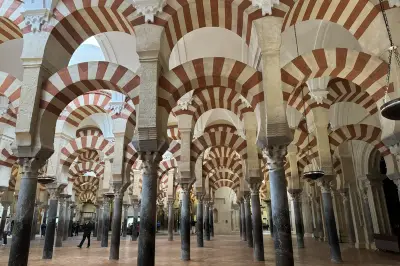
The Pearl of Moorish Civilization – The Alhambra in Granada, Spain
Granada is a city made for strolling and daydreaming. The artistic splendor of its historic monuments and the shimmering beauty of its fountains, ponds, and park waters captivate the eye. The narrow streets of the city stand in stark contrast to its lush gardens. With the religious atmosphere of Holy Week and the cheerful vibe of the cave dwellings in the Sacromonte district, Granada always offers a fresh experience.
In Spanish, the word "Granada" means pomegranate. This ancient city, located in the Andalusia region of southern Spain at the foot of the Sierra Nevada, where the Darro and Genil rivers converge, is renowned for the Moorish masterpiece—the Alhambra—and a wealth of historic landmarks blending Muslim, Jewish, and Christian styles.
Granada is an ancient city that has witnessed the clash and fusion of diverse cultures, as well as over a thousand years of Spanish and European history. The area was first inhabited by the Celtiberians, later developed by the Visigoths into an important religious and military town. In 711 AD, the Moors conquered Granada. In 1013, Granada became an independent sultanate, expanding its territory across the Darro River to the foot of what is now the Alhambra. In 1492, the Catholic Monarchs jointly drove out the Arabs. Legend has it that the Arab leader Muhammad XII (Boabdil), who held out in this last stronghold, surrendered the city's sovereignty to avoid the destruction of the exquisite Alhambra in battle. From then on, the city came under Catholic rule, and Spain began its exploration of the Americas, ushering in its golden age. Today, Granada is a precious cultural heritage and artistic treasure of Spain. The Alhambra complex, the tombs of the Catholic Monarchs Ferdinand and Isabella, the bullring, and other relics attract tourists from around the world each year. According to statistics, Granada receives more tourists than any other city in Spain.
The Alhambra Palace was the palace of the Nasrid Kingdom of Granada built by the Moors in the Middle Ages. Its name comes from Arabic, meaning "Red Fortress." The palace, situated on a hill at the northern end of Granada, is the essence of Arabic architecture. After the Moors were expelled from Spain in 1492, the Alhambra fell into disrepair. In 1828, with funding from Ferdinand VII, architect José Contreras and his son and grandson undertook a long-term restoration and reconstruction over three generations, restoring it to its original appearance. It was designated a UNESCO World Heritage Site.
Victor Hugo once praised the ancient Spanish city of Granada: "No city like Granada spreads out under the clear sky with elegance and a smile, with the shimmering charm of the East." Historically, Granada was the last stronghold of Islamic states in Western Europe, and the still-solemn Alhambra (Red Fortress) stands as a testament to this splendid civilization. The ancient Islam left Granada with a scattered wealth of historical and cultural heritage and mysterious legends, while the unique Andalusian Spanish flavor of the south evokes thoughts of history, art, folklore, and cuisine. Visitors marvel at the coexistence of the old and the new—the winding alleys that take you back in history, the quiet hidden corners that soothe the soul, and the stark contrast with the bustling crowds, bars, and shops.
On the Sun Hill ridge in the southeastern part of Granada lies this palace complex of the ancient Arab kings, mainly built during the reigns of Yusuf I (1333-1354) and his son Muhammad V, together with some parts added by Muhammad I in 1238 to the west. With sturdy towers and strong gates, it forms both a palatial courtyard and a powerful fortress. Perhaps because reddish stone was used in its construction, it is also called the "Red Palace."
The Alcazaba fortress is the oldest part of the Alhambra, predating the palace itself. Entering the Alcazaba, you can smell history. Only a few bastions and towers remain today; climbing to the top offers a panoramic view of the entire Alhambra and Granada, once serving as a defensive watchtower. High and lonely, overlooking the city of pomegranates, there is a sense of solitude and tragedy. In many Spanish cities, the invading Moors always built the palace and castle together. Indeed, only palaces built with castles have been preserved; those without castles became ruins like Medina Azahara.
The Alhambra is built on a mountain base, rising from the rock as if ready to fly. The halls and pavilions are closely arranged, each with its own character. The main hall is incredibly luxurious, consisting of three courtyards and buildings that reflect Arab palace features: the core part was used for judicial and public affairs, and two other sections housed the king's throne and private residence. There are also the Hall of Ambassadors, the Royal Gardens, the Dressing Room, the Baths, and more. Within the Alhambra, there are four main courtyards (or patios): the Court of the Myrtles, the Court of the Lions, the Court of the Daraxa, and the Court of the Raya. The layout of the surrounding buildings around these courtyards is very precise and symmetrical, but the spatial organization of each courtyard complex is relatively free. Among these four, the most famous are the Court of the Myrtles and the Court of the Lions.
After waiting a long time, we finally entered the courtyard. "Decoration" is of significant importance in the Alhambra. In Spanish Islamic gardens, the most meaningful decorative elements include glazed tile skirting boards, wall surfaces, friezes, series of arches adorned with plant motifs, and ceilings decorated with muqarnas (stalactite vaulting). The Court of the Myrtles (Patio de los Arrayanes) is a striking large courtyard and the most important spatial group in the Alhambra, serving as the center of diplomatic and political activities. It is enclosed by marble columns, with a shallow rectangular reflecting pool and a beautiful central fountain. Along the sides of the pool are two rows of myrtle hedges, which give the courtyard its name.
The planting of myrtle hedges dates back to after the Spanish conquest in 1492. In the Court of the Myrtles, one can admire two excellent building facades, the main one being a tower over 40 meters high, from which one can enjoy breathtaking views. The buildings around the Court of the Myrtles are reflected in the pool; the slender columns, elegant arches, and intricate traditional lattice patterns on the corridor walls intermingle with the serene and clear water, making one feel as if in a floating, ethereal sanctuary. Passing through the east side of the Court of the Myrtles, one reaches the Court of the Lions, the center of the sultan's family. In this palace of Muhammad V, four halls surround the very famous courtyard—the Court of the Lions (Patio de los Leones). Columns support a finely carved and exquisite arched gallery. Looking from between the columns into the courtyard, at the center, twelve strong white marble lions support a large water basin (fountain), arranged in a ring around the central basin. Since the Quran forbids the use of animal or human figures as decoration, this use of lion statues to support a fountain is surprising in Arabic art and can be understood as a symbol of sovereignty and victory. The lion figures here also recall the works of ancient Persian sculptors.
The Court of the Lions is a classic Arabic courtyard, divided into four parts by two water channels. Water flows from the lions' mouths and through these channels to the four corridors surrounding the courtyard. The corridors are supported by 124 palm-like columns; the geometric patterns on the arches and corridor ceilings are appropriately scaled and quite exquisite: the arches are carved from stone with fine, meticulous, and intricate workmanship, and the corridor ceilings also demonstrate the highly skilled woodworking of the time. Because the columns are slender, they are often grouped in four, meeting structural needs while adding a sense of layering to the courtyard architecture, making the space richer and more delicate. In such an environment, it is easy to relax and shift one's mindset. In the Court of the Lions, one can also see a cloister similar to that of a medieval monastery. It is divided and organized according to the golden ratio, with all proportions and scales quite classic. Thus, this water system serves both cooling and decorative purposes.
After appreciating several Spanish royal gardens, it is evident that "decoration" holds significant importance in the Alhambra. In Spanish Islamic gardens, the most meaningful decorative elements include glazed tile skirting boards, wall surfaces, friezes, series of arches adorned with plant motifs, and ceilings decorated with muqarnas. Under the influence of these decorative elements, the appearance of the courtyard gallery appears luxurious and dazzling.
Connected to the Red Palace is the Prince's Garden (Generalife). This is an Arabic-style garden with pavilions, towers, winding corridors leading to secluded spots, deep scenery, and clear layers. In addition, there are various shaped pools spraying countless jets of water, which under the sunlight collide into countless glistening pearls. The garden is full of flowers, green trees, and birdsong, refreshing the mind. Climbing the spiral staircase to the watchtower, the highest point of the Alhambra, one can overlook the entire panorama of Granada. Below the hill is Granada, with white houses, all roofs having the same layered tiles as the Alhambra. The architectural style of the whole city is very uniform and integrated. The Andalusian plateau stretches beneath your feet into the distance, and behind you is the highest peak in Spain, the Sierra Nevada.
The Alhambra also differs greatly from other Spanish palaces; there are no eye-catching large portraits, gold and silver vessels, jewels, or lavish furniture... The empty palace's only prominent feature is the finely carved walls: from every arch's doorframe, window frame, niche to the ceiling, spiral-carved Arabic script and various geometric patterns cover almost the entire interior wall. The Arabic script, illegible to most tourists, adds a touch of mystery to the palace. The carvings forming these dazzling pictures are neither stone nor brick, but plaster stucco. According to some sources, Arabic garden art is steeped in religious thought: "Gardens underneath which rivers flow, with fruits perpetually available and shade ever-present" is the ideal home mentioned in the Quran. Recalling that the day before in Seville, in the courtyard of the cathedral, I happened upon a tree full of ripe oranges still hanging on the branches, perhaps this also stems from the Quranic doctrine of "fruits perpetually available"?
The perfect integration of Muslim architecture and horticulture is the most precious legacy the Alhambra has left to the world.
Leaving the Alhambra in the evening, we hurried to the hotel; the hotel was on a hillside with narrow and steep mountain roads. I truly admired the driver's skill, but also marveled at this old city built on the mountain, ancient and elegant, like a beauty in her twilight years, retaining all the charm of old times! Following the innkeeper's recommendation, we went down the hill to the city center for dinner. Stepping on the black stone slabs, we wound through narrow alleys as if entering a maze. The innkeeper recommended a very famous local restaurant; it was crowded and noisy, and the food was excellent, providing a perfect end to a busy day.