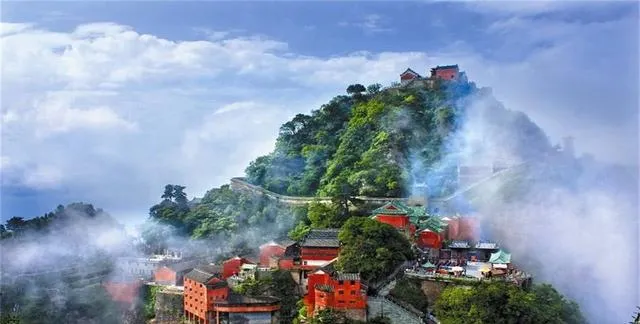
Two-Day Travel Guide to Mount Wudang
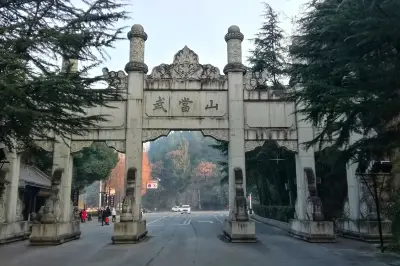
Mount Wudang is one of China's famous Taoist holy sites, renowned worldwide for its prominent status as the "Crown of the Five Sacred Mountains," described in the phrase "All four great mountains bow in homage; the five celestial peaks pay tribute together." It is a UNESCO World Cultural Heritage site. Most of the 36 palaces, temples, and nunneries in the mountain were built during the Ming Dynasty, forming the most complete, largest, and highest-grade ancient Taoist architectural complex in China, hailed as "a museum of ancient Chinese architectural achievements."
Mount Wudang is also known as Taihe Mountain, Xieluo Mountain, Shenshang Mountain, and Xianshi Mountain, and historically was called "Taiyue," "Xuanyue," and "Dayue." From the late Han Dynasty through the Wei, Jin, Sui, and Tang periods, it was a retreat for those seeking immortality and studying Taoism. In the Song Dynasty, Taoist scriptures began to associate the mythical god Zhenwu with Mount Wudang, claiming it as Zhenwu's birthplace and place of ascension. Consequently, Mount Wudang is also the birthplace of Wudang martial arts, known as "an unparalleled sacred site through the ages, the foremost immortal mountain under heaven." In the late Yuan and early Ming dynasties, the Taoist priest Zhang Sanfeng synthesized its teachings and founded the Wudang school, which remains influential today. Mount Wudang is extremely rich in medicinal plants; among the over 1,800 kinds of Chinese herbs recorded in the "Compendium of Materia Medica," more than 400 are found on Mount Wudang, earning it the name "natural pharmacy."
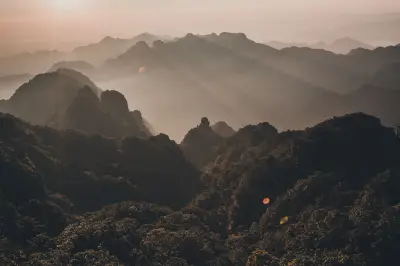
Mount Wudang is located in Danjiangkou, Shiyan City, Hubei Province, with an area of 312 square kilometers. It mainly consists of the Golden Summit Scenic Area, Zixiao Scenic Area, Wulong Scenic Area, Nanyan Scenic Area, Taizipo Scenic Area, and Laoying Scenic Area. Natural attractions include 72 peaks like a forest of arrows, 36 cliffs with precipitous drops, 24 rushing streams, 11 misty caves, and 10 strange rocks and 9 terraces. Cultural attractions include the grand Taoist architectural complex and numerous Taoist relics, earning it the reputation of "a treasure house of Taoist cultural relics."
Two-Day Tour Guide to Mount Wudang: Mount Wudang operates on a single-entry ticket system; a two-day trip requires staying overnight on the mountain.
Day 1: Enter through the main gate of Mount Wudang, take the eco-friendly bus to the Qiongtai Scenic Area to visit the Middle Temple, then take the cable car to the Golden Summit Scenic Area at the top of Tianzhu Peak, the essence of Mount Wudang. Visit the Golden Summit, Taihe Palace, and Golden Hall, spending about one hour. After lunch, take the eco-friendly bus to the most precipitous Nanyangong Scenic Area, visiting the Imperial Stele Pavilion, Dragon and Tiger Hall, Sweet Dew Well, Xuandi Hall, Dragon Head Incense, and Tianyi Zhenqing Palace Stone Hall, spending about one hour. Stay overnight at a guesthouse near Nanyan; bargaining is possible.
Day 2: After breakfast, take the bus to Zixiao Palace, the best-preserved and largest imperial Taoist temple on Mount Wudang, for a visit of about 45 minutes. Then take the bus to Taizipo Scenic Area (visit about 45 minutes). After lunch, you may choose to visit Yuxu Palace or Wulong Palace, then end the trip.
Food: Taoist vegetarian dishes unique to Mount Wudang can be tasted at Zixiao Palace and Taihe Palace. The snack street in the mountain is located in the "Yongle Flourishing Era" antique street near Yuxu Palace.
Accommodation: Lodging is available in the area of Crow's Ridge (Wuyaling), Yuxu Palace, and Nanyangong; some nunneries in the mountain also offer overnight stays.
Central Route: Laoying Scenic Area (Yuxu Palace) → Mozhenjing → Taizipo → Jianhe Bridge → Xiaoyao Valley → Zixiao Palace → Wuyaling → Langmei Temple → Qixingshu → Huanglong Cave → Chaotian Palace → First, Second, Third Heavenly Gates → Chaosheng Gate → Golden Summit Scenic Area (Taihe Palace, Golden Hall).
Eastern Route: Laoying Scenic Area (Yuxu Palace) → Mozhenjing → Baxian Temple → Qiongtai → Golden Summit Scenic Area.
Western Route: Laoying Scenic Area (Yuxu Palace) → Renwei Temple → Yinxianyan → Wulong Palace → Wulongding.