A Journey to the Golden Summit of Wudang Mountain in Hubei
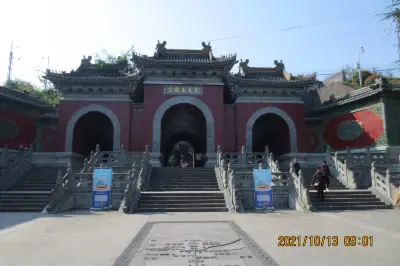
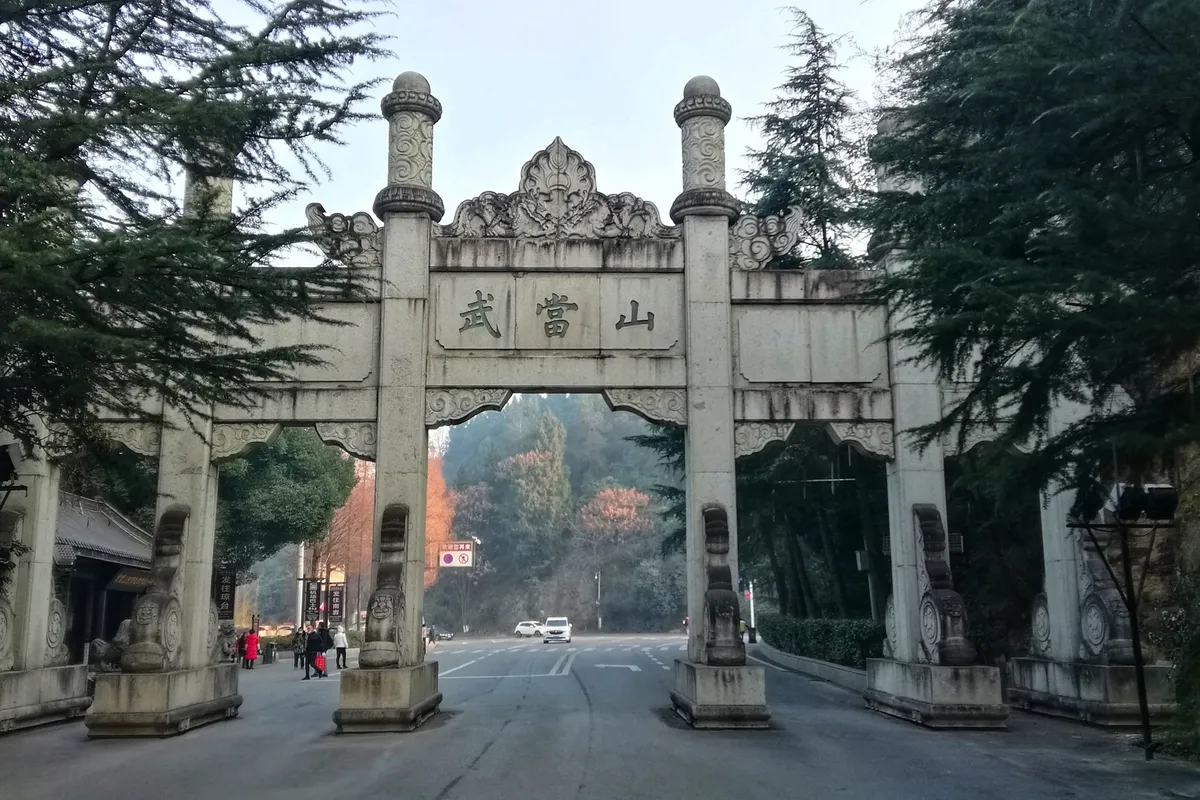
On December 20, 2020, the weather was cold. After breakfast at the Wudang Mountain Impression Hotel, my wife and I rested briefly, then set out. We took a bus to the first mountain gate of Wudang Mountain. People often speak of the Five Great Mountains, but Wudang Mountain surpasses them all. As the saying goes, 'If you haven't been to the Golden Summit, you haven't truly visited Wudang Mountain,' making the Golden Summit the symbol of Wudang.
Starting from the mountain gate, we walked through Wudang Golden Street to the Visitor Center. Due to the pandemic, Wudang Mountain waived the entrance fee. We bought tickets for the internal shuttle bus and headed to the Qiongtai Cable Car Station.
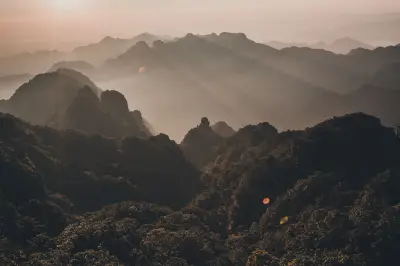
The shuttle bus wound along the treacherous, winding mountain road toward the towering, misty main peak of Wudang. Because the road was slippery in winter, the bus moved slowly, taking nearly 50 minutes to reach the Qiongtai Parking Lot.
From the parking lot, we walked to the Qiongtai Cable Car Station, passing by the Qiongtai Middle Temple. We stopped to visit and took photos as souvenirs. The Qiongtai Temple, called Qiongtai Palace in the Yuan Dynasty, was renamed a temple in the Ming Dynasty. It is divided into Upper Temple, Middle Temple, and Lower Temple. Each of the three Qiongtai Temples has a beautiful name: the Upper Temple is called 'White Jade Turtle Terrace,' the Middle Temple 'Purple Mountain Qiongtai,' and the Lower Temple 'Jade Music Cloud Terrace.' According to historical records, 24 Daoist courtyards with hundreds of rooms were built among the three temples, connected by pavilions and bridges. It was said that moving among the three temples 'you never see the sky when leaving a building, nor wet your shoes in the rain,' showing how grand and ingenious the Qiongtai Temple complex was—one of the largest Daoist temples among the 36 on Wudang Mountain.
After visiting the Qiongtai Middle Temple, we walked to the cable car station, bought round-trip tickets, and boarded the cable car to ascend the mountain.
At the Qiongtai Cable Car Station, we could see the huge red characters 'First Mountain' on the opposite cliff, calligraphy by the famous Song Dynasty calligrapher Mi Fu.
We boarded the cable car to the Golden Summit, the highest peak of Wudang, and drifted slowly upward into the sea of clouds. Looking up at the towering cliffs above and down at the misty abyss below, we felt like a leaf suspended in mid-air, enjoying the scenery along the way.
When the cable car reached the top, we found there was still a lot of snow because of recent snowfall and consistently low temperatures.
The cable car station was only halfway up the mountain. The Golden Summit was still several hundred meters of steep mountain path away, normally a 30-minute climb. It took us a full 90 minutes to arduously reach the Golden Summit, arriving at the 'Pillar Supporting the Sky' and taking photos. The Taihe Palace, also known as 'Grand Mountain Taihe Palace,' is built on the very top of Tianzhu Peak, the highest peak of Wudang, surrounded by other peaks and piercing the clouds. It is praised as 'One Pillar Supporting the Sky,' the ultimate scenic spot on Wudang. Whether pilgrims or tourists, only by reaching the summit and entering Taihe Palace can one truly say they have been to Wudang Mountain.
Opposite the main hall of Taihe Palace, on the small Lotus Peak, stands a small bronze hall. Inside are statues of the True Warrior (Xuanwu), Golden Boy, and Jade Maiden. This bronze hall was cast in the 11th year of the Tianli reign of the Yuan Dynasty (1308) with funds raised by believers from Hubei and Henan. Nearly 700 years old, it is modeled after wooden structures and is a precious artifact for studying Yuan Dynasty bronze casting, as well as the earliest surviving bronze hall in China. Originally placed on top of Tianzhu Peak, it was later replaced by the Golden Hall due to its small size. In the 14th year of the Yongle reign of the Ming Dynasty (1416), when Taihe Palace was built, it was moved here. Because it was moved down from the peak, it is also called the 'Fortune-Turning Hall,' meaning turning luck around. It is said that walking counterclockwise around the bronze hall can dispel misfortune and bring good luck. Thus, for centuries, visitors to the Golden Summit have made it a point to circle the hall. We joined the crowd and walked around inside. Inside, the space was extremely narrow—only a few dozen centimeters wide—and pitch black. We had to use our phones as flashlights to navigate through, hoping to bring good luck to ourselves and our families.
Taihe Palace, formally named 'Grand Mountain Taihe Palace,' was granted by Emperor Yongle. It is located on the south side of Tianzhu Peak and was built in the 14th year of the Yongle reign (1416). It was expanded during the Jiajing reign of the Ming Dynasty. After that, with the Golden Summit wall as a boundary, the area outside was called 'Taihe Palace,' and the area inside was called 'Purple Forbidden City,' also known as 'Golden Hall.' Wudang Mountain is renowned as the 'Crown of the Five Great Mountains' with the saying 'All four famous mountains bow in homage, all five sacred peaks pay tribute,' and is honored as the number one Daoist mountain.
The Hall of Ten Thousand Saints was originally a kitchen, built in the 14th year of the Yongle reign (1416). Now it enshrines the True Warrior, the Holy Father, the Holy Mother, and many other deities, hence the name.
In front of Taihe Palace is the Hall of Worship, commissioned in the 10th year of the Yongle reign (1612? actually 1412). It bears a plaque reading 'Three Religions Founder.' On both sides of Taihe Palace are the Bell and Drum Towers, arranged similarly to those in Buddhist temples, reflecting the religious life of 'morning bells and evening drums.' The Bell Tower houses a giant bronze bell, 1.57 meters high and 1.43 meters in diameter, cast in the 13th year of the Yongle reign (1415). The bell can be dimly seen through the door.
The Grand Mountain Taihe Palace is built on the summit of Tianzhu Peak, the highest peak of Wudang, which is surrounded by other peaks and reaches into the clouds. Constructing such a grand Daoist palace at an altitude of 1,612 meters embodies an unprecedented ambition and a conqueror's triumph. The unique landform of Wudang, with peaks bowing from all directions, magically highlights the supreme authority of imperial power. Inside the Taihe Hall are statues of the True Warrior, the Four Marshals, the Water and Fire Generals, and the Golden Boy and Jade Maiden.
The Purple Forbidden City, also known as Imperial City or Red City, surrounds the top of Tianzhu Peak, named for the Golden Hall within. It was commissioned by Emperor Chengzu in the 17th year of the Yongle reign (1419), built as a wall encircling the peak's summit, enclosing the Golden Hall. This was Zhu Di's 'Purple Forbidden City' built for the True Warrior on earth, modeled after his own Forbidden City in Beijing. During the Jiajing reign, Taihe Palace was further expanded, with halls and rooms totaling 520. After this expansion, names changed: outside the Golden Summit wall was 'Taihe Palace,' inside was 'Purple Forbidden City.' 'In the north there is the Forbidden City, in the south there is the Purple Forbidden City'—showing that the status of Grand Mountain Taihe Palace was second only to the imperial palace in Beijing.
Walking up the stone steps, holding the stone railings, we reached the Lingguan Hall. This is the mountain gate hall of Daoist temples, housing the guardian deity. Lingguan is the most revered guardian spirit in Daoism, responsible for inspecting both heaven and earth, punishing those who break laws or are unfilial. A mural on the wall depicts Wang Lingguan holding an iron whip, guarding the law.
Finally, we exited the long corridor of Lingguan Hall, which was chilling and gloomy. Before ascending to the Golden Hall, one must pass through Lingguan Hall, which carries a clear and significant meaning. The path to the Golden Hall is very steep, but the scenery along the way is breathtaking—the entire 800-li beautiful landscape of Wudang unfolds before your eyes. The overall architectural layout of Grand Mountain Taihe Palace follows the natural terrain, taking advantage of the steepness to enhance its solemnity, achieving an artistic effect of grandeur and majesty, with stability in suspension and awe-inspiring dignity.
The Golden Hall was built in the 14th year of the Yongle reign (1416). It is a Ming Dynasty bronze cast imitation wood-structure palace, located at the center of a stone platform on the top of Tianzhu Peak. The hall is 5.5 meters high, 5.8 meters wide, and 4.2 meters deep, covering an area of about 160 square meters. It was made with 200,000 jin of copper and 2,000 jin of gold, making it the largest gilded bronze hall in China. All components were cast in bronze, transported to the summit after casting at the foot of the mountain, and then assembled with mortise and tenon joints, seamlessly connected without any trace of casting or chiseling. Despite over 500 years of wind, frost, rain, snow, and lightning, it remains resplendent and bright as ever—a masterpiece of ancient Chinese architecture and casting craftsmanship. The beams and coffered ceiling inside are adorned with exquisite patterns. A gilded pearl hangs from the ceiling, known as the 'Wind-Averting Immortal Pearl.' Legend says it can suppress mountain winds so they cannot blow into the hall, keeping the divine lamps burning forever. Actually, the wind cannot enter because the wall and door components are extremely tight and precise. Inside the Golden Hall is a bronze statue of the True Warrior, weighing 10 tons. Outside is a white marble balustrade, below which is the Purple Forbidden City, about 1,500 meters long. Since it was Sunday and during the free admission period, there were many visitors, surrounding the Golden Hall in layers. I barely managed to take a photo of the Golden Hall.
Behind the Golden Hall is the Parents' Hall, built in the 42nd year of the Kangxi reign. It enshrines the parents of the True Warrior—King Mingzhen of the Jingle Kingdom and Queen Shansheng. The essence of Wudang Daoism lies in morality and filial piety.
After great effort, we finally reached the Golden Summit and naturally took commemorative photos.
The Imperial Scripture Hall of Taihe Palace is where Daoists chant scriptures every morning and evening, and it is an important sacrificial site of Wudang Daoism. At the times of morning bells and evening drums, Daoists gather here for morning and evening prayers, a practice uninterrupted daily. This hall dates from the Ming Dynasty and was repaired multiple times in the Qing Dynasty, preserving many architectural techniques from both periods, with historical and research value. Inside are enshrined Daoist deities such as the Three Pure Ones, Jade Emperor, True Warrior, Patriarch Lü, and Lingguan, with a dazzling array of ritual vessels and法器 (ritual implements), all fine examples of casting and carving art. A large plaque hanging in the center reads 'Sheng Tian Li Di' (Creating Heaven and Standing on Earth), inscribed by Emperor Daoguang of the Qing Dynasty. Outside the hall is a horizontal board inscribed with 'Bai Yu Jing Zhong' (In the White Jade Capital). Wind chimes hang from each eave. The hall's horizontal boards and partitions are carved with many Daoist immortal stories, exquisitely crafted and lifelike. Nearby originally stood buildings such as Tianyun Tower, Tianchi Tower, Tianyi Tower, Taihe Tower, and Dragon Temple.
In the 14th year of the Yongle reign (1416), Taihe Palace was built on Tianzhu Peak. At that time, there was no surrounding wall around the summit. In the 17th year of the Yongle reign (1419), Emperor Chengzu ordered the Marquis Longping Zhang Xin and the Commandant Deputy Mu Xin to build the Purple Forbidden City on Tianzhu Peak. The emperor decreed: 'When building the surrounding wall on the Golden Summit, do not alter the mountain itself. The wall must follow the terrain, and must be sturdy and solid.' The project took five years to complete. The wall, built with giant stone slabs, has a perimeter of 344 meters, perched on the precipice yet sturdy and stable, like a halo surrounding the Golden Summit, a marvel to behold. Four Heavenly Gates were built on the wall in the four directions, symbolizing the celestial gateways. These gates stand high above the clouds, emphasizing the majesty of the heavenly realm.
Grand Mountain Taihe Palace was praised by ancients as 'a thousand layered pavilions rising in the air, ten thousand layered clouds surrounding the feet,' and was said to 'complete the legacy of Qin Shi Huang and Han Wu Di, rarely seen in history.' All World Heritage experts, space scientists, and architectural specialists who have visited Wudang Mountain marvel at the architectural ideas reflected in Taihe Palace and the perfect harmony between human landscape and natural scenery, praising it as 'an unparalleled masterpiece, unprecedented and unrivaled.'
Walking from the Golden Summit back to the cable car station was just as strenuous as the ascent for us. We took the cable car down to Qiongtai, then quickly crossed the Wudang Folk Culture Sightseeing Corridor, which was actually a row of stalls selling local souvenirs and specialties. We hurried to the parking lot and took the scenic shuttle bus to other attractions.
In the 10th year of the Yongle reign (1412), Emperor Chengzu ordered the construction of Taihe Palace. After completion, he exalted Wudang Mountain as 'Grand Mountain Taihe Mountain' and the palace on the summit as 'Grand Mountain Taihe Palace.' This imperial honor elevated Wudang's status to the foremost among the Five Great Mountains. Located at the highest point of the main peak Tianzhu Peak, at 1,612 meters, Grand Mountain Taihe Palace embodies an unprecedented ambition and a conqueror's triumph. The unique landform of Wudang, with peaks bowing from all directions, magically highlights the supremacy of imperial power. Grand Mountain Taihe Palace is the ultimate scenic spot on Wudang. Whether Daoists, pilgrims, or tourists, only by reaching the summit and entering Taihe Palace can one truly say they have been to Wudang Mountain. The Golden Summit on top of Tianzhu Peak has now become the essence and symbol of Wudang.