Cultivating at Mount Wudang
To behold the scenic wonders of a famous mountain and ancient sites, to savor the charm of a martial arts holy land, to seek tranquility away from the hustle and bustle, and to grasp the mystery of Taoist culture. In November 2014, the year of Jiawu, late autumn and early winter, the season when forests were painted in layers of color, my wife and I took advantage of the APEC meeting holiday and traveled from Beijing via Wuhan to Mount Wudang. We roamed Taihe, inquired about the Way at Wudang, and a poem was made:
To seek scenic wonders, Wudang we roam,
Each rugged step, our joy finds home.
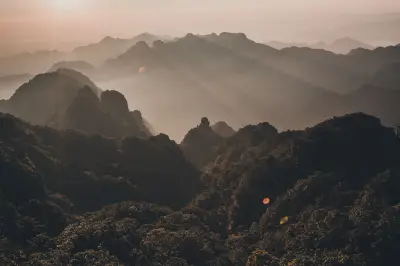
Misty peaks on all sides unfold,
Sparse trees and autumn leaves, a story told.
Mount Wudang, also known as Taihe Mountain, was anciently called "Taiyue" or "Dayue". It is a sacred site of Taoism in China, located in Danjiangkou City, Shiyan City, northwestern Hubei Province, belonging to the eastern section of the Daba Mountains. Mount Wudang faces the Danjiangkou Reservoir to the front and backs onto the Shennongjia Forest Area, stretching over 400 kilometers.
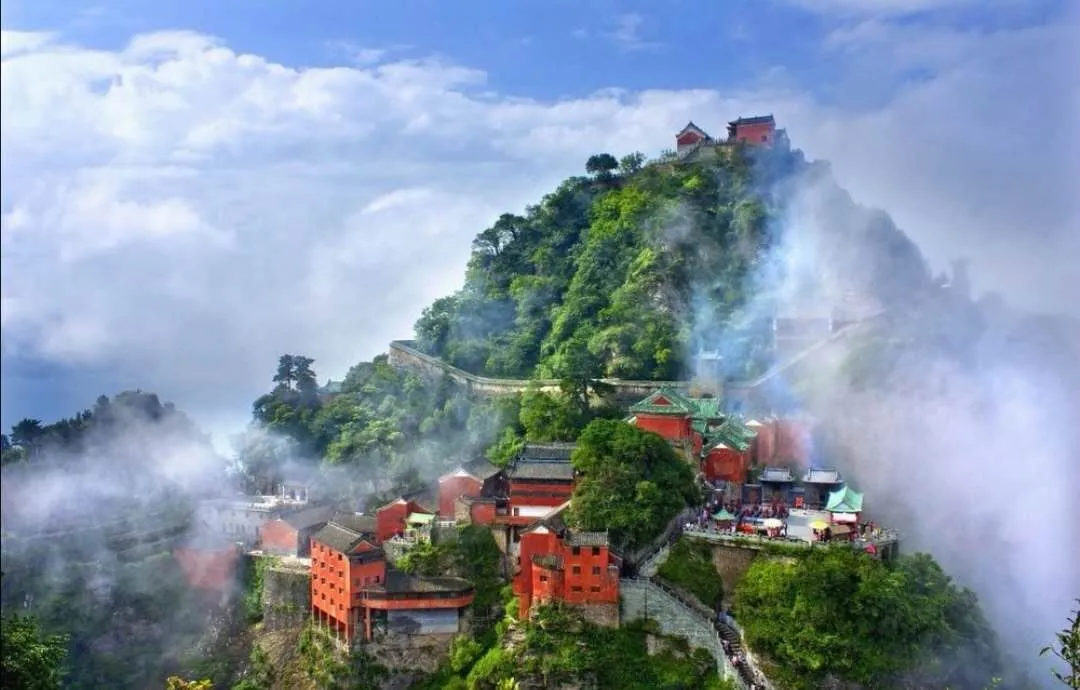
Mount Wudang is magnificent in momentum, with numerous scenic spots, including seventy-two peaks, thirty-six cliffs, twenty-four streams, eleven caves, three pools, nine springs, ten ponds, nine wells, ten rocks, and nine terraces. It is a scenic area that perfectly combines natural landscapes and cultural heritage, famous worldwide for its long-standing Taoist culture, grand ancient architectural complexes, the renowned Wudang martial arts, and the splendid natural scenery.
We spent two days touring Wudang. Below, I will first introduce key travel tips in as much detail as possible; the later travelogue will mainly describe scenery, allusions, and impressions.
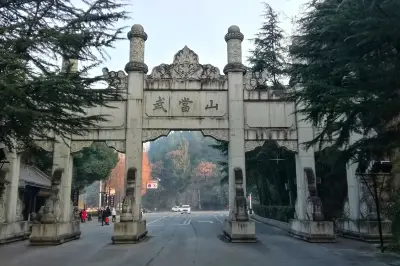
Not far from the entrance is Wudang Gold Street, a commercial street built in an antique style, mainly dealing in Wudang swords, medicinal herbs, candies, handicrafts, and various tourist souvenirs.
November is already the off-season for tourism, so Wudang Gold Street was sparsely populated and business was sluggish.
This antique street would be perfect for a Gu Long movie: a windy autumn night, on a deserted street, only a few dim candlelit lanterns swaying in the wind. In the distance, the sound of the third watch's clapper, a black-clad assassin stands in the dim darkness and says, 'End of the world, one who returns at night, at the third watch one's soul should break, even at the end of the world one's soul is broken.' Isn't that atmospheric?
Alright, enough showing off. Following Wudang Gold Street, we reached the ticket office: 246 yuan per person, including tickets, mountain bus fare, map, and insurance. After getting the tickets, we followed the signs out to board the tourist bus heading directly to Prince Slope. From the entrance, there are only buses to Prince Slope; to go to Nanyan and Qiongtai, you need to transfer at Prince Slope.
Arriving at Prince Slope station, since we still had to climb, carrying luggage and backpacks and a camera was inconvenient. There is a luggage storage shop next to the station, 5 yuan per item, and you just need to pick it up before 5 PM. This way we could carry only the camera and proceed lightly.
To ascend Prince Slope, you first cross Fuzhen Bridge. Fuzhen Bridge is a stone bridge built in the Ming Dynasty, paved with square stones, with stone railings and pillars on both sides, appearing like a rainbow from afar. Although it was already early winter, the vegetation by the bridge remained verdant and full of life.
After crossing Fuzhen Bridge, there is a bright stone holy path leading directly to the gate of Prince Slope, symbolizing that as long as you practice sincerely, your light is right before your eyes.
In the distance, we saw an elderly Taoist priest, holding a sword, standing firmly with his right leg raised upward on the steps. Many tourists were taking photos with him—truly admirable!
Could he be the Wudang sect leader who annihilated the seventy-two stockades of Taihu Lake overnight: Chongxu Daoren? Alright, I admit I've read too many wuxia novels.
Climbing the ancient stone steps, we saw the red walls and green tiles of Prince Slope, which stood out vividly against the green trees. On the arched red lintel, three characters in regular script "太子坡" (Prince Slope) were prominently carved, written by Mu Xin, the husband of Emperor Yongle's daughter.
Wudang Mountain's Taoism worships "Xuantian Zhenwu Emperor". It is said that the name "Wudang" means "Only Zhenwu is worthy to be its counterpart."
Dear readers, starting from Prince Slope, I will tell you the legend of [Zhenwu's Cultivation to Immortality].
It is said that on the shore of the Western Sea, there was a beautiful country called Pure Joy. The king was a clean-handed ruler, and the queen, Kind and Sagely, had a kind heart. They had a son, Prince Zhenwu.
When Prince Zhenwu grew up, he refused to inherit the throne but instead traveled everywhere seeking teachers to learn the Way, wanting to become an immortal and ascend to heaven. One day, a Taoist in purple robes came and said to the prince: 'To attain the Way and become immortal, you must leave the mortal world, cross the sea to the east, and there is Mount Wudang, a good place for your cultivation.' This Taoist was the incarnation of Yuqing Shengzu [Purple Qi Primordial Lord].
At the age of fifteen, the prince resolutely left his parents and royal life, alone took a boat across the sea, and arrived at Mount Wudang. The Kind and Sagely Queen could not bear her son's departure and chased after him to the slope of Mount Wudang; this place is now called "Prince Slope". A poem says:
Before entering the true immortal realm,
One first ascends Prince Slope.
White clouds envelop the halls,
Clear chime sounds emerge from misty vines.
The ancient architectural complex of Prince Slope is named [Fuzhen Temple], basically designed meticulously according to the story of Zhenwu's cultivation. It is said that Prince Zhenwu, after cultivating here for a period, could not endure the hardship and intended to descend the mountain to return to secular life. When he reached the Needle-Grinding Well, the old woman incarnated by [Purple Qi Primordial Lord] enlightened him by grinding an iron rod into a needle, so he returned here and cultivated resolutely. Hence the name "Fuzhen Temple" (Return to Truth Temple), a place for seeking blessings in learning since ancient times.
In the 12th year of Ming Yongle (1414 AD), this temple was built according to this legend to commemorate Prince Zhenwu of Pure Joy's return to truth. It was renovated three times in the 1st, 23rd, and 29th years of Qing Kangxi (1662, 1684, 1690). After the founding of the nation, it underwent comprehensive restoration, returning to its historical appearance.
The ancient architectural masters skillfully utilized the steep slope topography of Lion Peak at 60 degrees to create not only a 16,000-square-meter area but also over 200 halls, forming famous sights such as "Four Gates in One Li", "Nine-Turn Yellow River Wall", "One Pillar Twelve Beams", and "Ten-Mile Osmanthus Fragrance".
Entering the mountain gate, we saw the red enclosing walls built along the mountain slope on the ancient path. This is the Nine-Turn Yellow River Wall. The design, layout, and intention of the Nine-Turn Yellow River Wall are all very ingenious. The smooth arched walls, like undulating waves, are exceptionally majestic. They are rounded and smooth, with pleasing flowing curves, topped with green glazed tiles, resembling two dragons spiraling and soaring. No matter the viewing angle, they give a sense of beauty, reflecting the grandeur and luxury of imperial architecture.
Regarding the origin of the name "Nine-Turn Yellow River Wall", Taoist thought holds that those who donate Taoist robes, scriptures, statues, buildings, ritual implements, lamps and candles, bells and chimes, vegetarian food, and incense to a temple can receive divine protection, known as "Nine Kinds of Merit." It can be said that the Nine-Turn Yellow River Wall is also an architectural embodiment of Taoist thought.
The overall layout of Prince Slope is irregular left and right, high and low, harmonious and perfect, ingenious and full of mystery. Standing at the highest point of Prince Slope, you can look down into the deep valleys, see the twisting streams flowing blue, and gaze upon the myriad peaks competing in beauty.