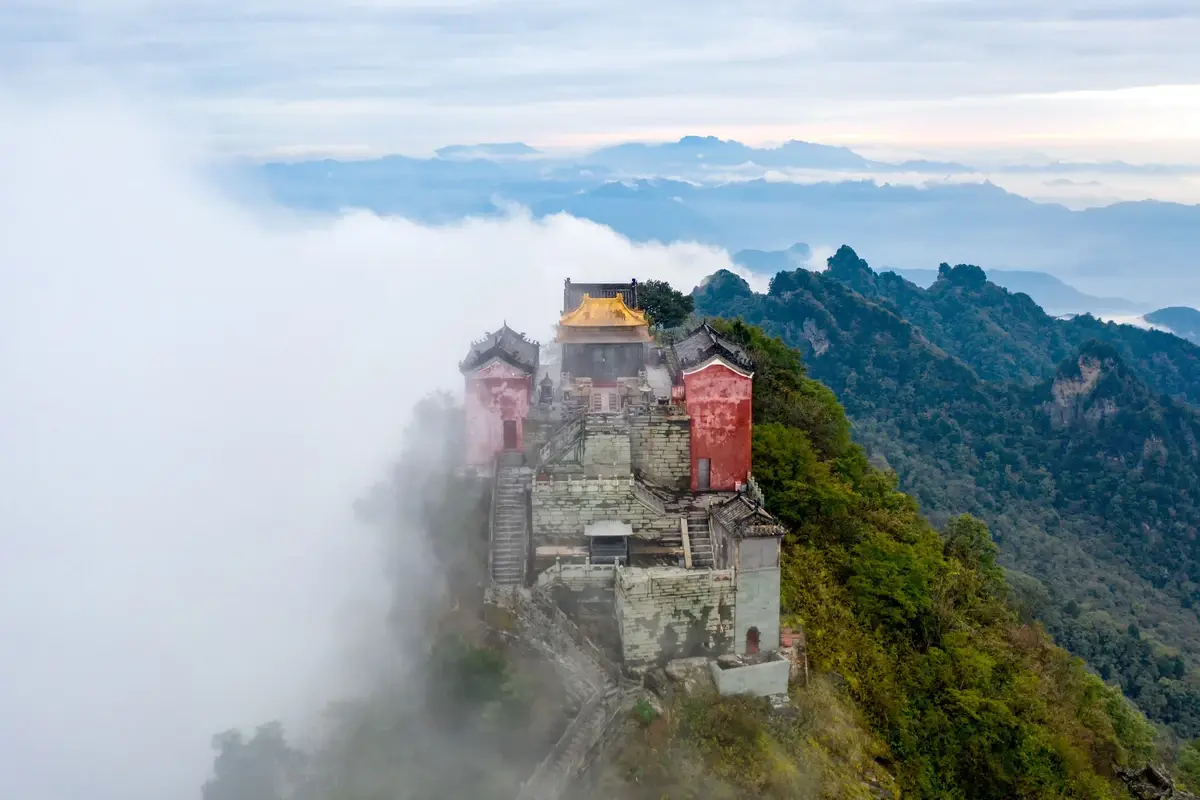
China's Largest Taoist Temple in Hubei, Surpassing Mount Tai in Status, with a 'Forbidden City' on the Peak, Free Admission
As a fan of Mr. Jin Yong's books, although I had memorized the names of the Seven Heroes of Wudang from 'The Heaven Sword and Dragon Sabre' since childhood, and was obsessed with Song Yuanqiao and Yu Lianzhou's True Martial Seven-Section Formation as well as Zhang Sanfeng's natural Taoist Tai Chi, it was only two years ago that I actually visited Mount Wudang myself.
In Hou Hsiao-hsien's film 'The Assassin', the Taoist nunnery where the Taoist nun resides harmonizes perfectly with the ethereal green mountains. The Tianyi Zhenqing Palace stone hall clings to the sheer cliff, its long corridor embedded directly into the rock, blurring the line between the mortal world and a fairyland. This filming location is the famous South Cliff of Mount Wudang, which rekindled my interest and prompted me to go.
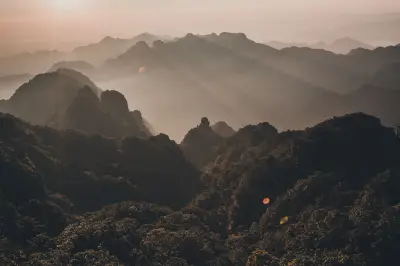
Mount Wudang is located in Danjiangkou City, in the northwest of Hubei Province. It is a 5A scenic area, spanning eight hundred li in circumference. Its history can be traced back to the Han Dynasty, but the Mount Wudang we see today was mostly built during the Yongle reign of the Ming Dynasty, about 600 years ago. Since its construction, it has earned many nationwide reputations, such as 'Unrivaled Scenic Wonder, the Number One Immortal Mountain Under Heaven', 'Grotto of the Immortals', and 'Imperial Family Temple'. It was even given the titles 'Taiyue' and 'Dayue', surpassing the Five Sacred Mountains in status.
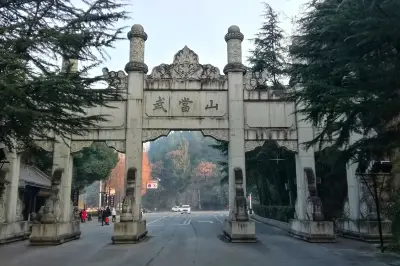
Historically, Mount Wudang had another title, though rarely mentioned in modern times: 'Taoist Kingdom and Immortal Capital'. Although there are also Jiangxi's Longhu Mountain, Sichuan's Qingcheng Mountain, and Anhui's Qiyun Mountain, collectively known as the 'Four Great Taoist Mountains', only Mount Wudang can bear the grand name of 'Kingdom'. This designation has a long history. Legend has it that the main deity of Mount Wudang, Emperor Xuanwu, was once the prince of the Jingguo Kingdom who attained Taoism through cultivation. In 1552, Emperor Jiajing built the 'Governing the World's Mysterious Mountain' archway at the foot of Mount Wudang.
This meant using Wudang Taoism and the worshipped Emperor Xuanwu to govern the realm, demonstrating the emperor's faith in Xuanwu and his vision of building a 'Taoist kingdom'. Today, this archway is a landmark on the ancient sacred path of Mount Wudang. As the largest Taoist temple in the country, Mount Wudang, within its eight-hundred-li radius, is indeed dotted with Taoist temples and filled with Taoist priests, truly appearing as a Taoist heaven and a city of immortals.
The typical route for visiting Mount Wudang is to enter the gate, take a sightseeing bus to the Taizipo transfer station, and then split into eastern and western routes to Qiongtai or Wuyaling. At the eastern terminal, Qiongtai, there is a cable car that goes straight to the Golden Summit. The western route passes through Xiaoyao Valley and Zixiao Palace, finally reaching Wuyaling.
What is now referred to as climbing Mount Wudang actually starts from Mount Wudang itself, passing through Langmei Temple, Huanglong Cave, Chaotian Palace, First Heavenly Gate, Second Heavenly Gate, and Third Heavenly Gate, finally reaching the Golden Summit. This is the most traditional climbing route since ancient times, known as the 'Ming Dynasty Sacred Path'.
Mount Wudang has many palaces and temples. The highest level is 'gong' (palace), followed by 'guan' (temple), then 'miao' (shrine) and 'an' (nunnery). The most notable one is the highest-altitude palace on Mount Wudang: the Dayue Taihe Palace, commonly called the Golden Summit, situated atop the soaring Heavenly Pillar Peak. There are several interesting wonders and legends about the Golden Summit worth pondering.
First, legend has it that when Ming Emperor Zhu Yuanzhang was conquering the realm, he was besieged by Yuan dynasty troops on Mount Wudang and forced to retreat to the mountaintop. He accidentally discovered a small stone shrine there, which housed the statue of the True Martial Patriarch. He kowtowed and prayed for assistance. After his wish came true, Zhu Yuanzhang's son, Zhu Di, lavishly built this magnificent complex on the steep and perilous peak, enshrining Emperor Xuanwu.
Second, this Golden Summit built by Zhu Di was not an ordinary temple but a Wudang 'Forbidden City' that echoed the Forbidden City in Beijing, meticulously crafted as an imperial Taoist temple. For easy management, during the Ming Dynasty, Mount Wudang was directly under the jurisdiction of the imperial family rather than local authorities, reaching an unprecedented scale and fame.
Later, several Ming emperors expanded and renovated it multiple times, and its name changed accordingly. With the Golden Summit's city wall as the boundary, the area outside the wall was called 'Taihe Palace', and the area inside was called 'Zijin City' (Purple Forbidden City), also known as the 'Golden Hall'. In fact, they were originally a single entity.
Third, geographically, Mount Wudang lies south of the Qinling Mountains, so it is considered part of the south. Setting aside the legends, why did Zhu Yuanzhang designate it as the temple for the Northern Deity? This has long been a mystery in history.
Later, a photographer at Mount Wudang, while taking aerial shots, accidentally discovered that the shape of Heavenly Pillar Peak resembles a giant tortoise's back, and the surrounding 'Forbidden City' looks like the snake on Xuanwu's back—exactly the image of the 'Tortoise and Snake Generals', the divine beasts under Emperor Xuanwu. This revelation made people suddenly understand: Heavenly Pillar Peak itself is a giant Xuanwu. One cannot help but admire the wisdom of the ancients.
Additionally, the wonders of the Golden Hall—'Patriarch Sweating', 'Sea Horse Spitting Mist', and 'Lightning Purifying the Hall'—have been passed down for a long time and are widely praised. However, these phenomena can only be seen under specific conditions, and I did not witness them myself. If you want to see them, be sure to do your homework in advance.
Standing on the Golden Summit and looking down the mountain, I was greeted by lush greenery and a cool breeze. Compared to the scenery, I was more attracted by the historical depth and rare tranquility of Mount Wudang. True mystery can only be revealed after the accumulation of time.
Another famous attraction on Mount Wudang is of course the South Cliff. This south-facing precipice is the most beautiful rock face on Mount Wudang. The South Cliff Palace is built here, appearing from afar like a pavilion in the sky. While trying to take a photo without tourists, I waited a long time. Occasionally, visitors passed by, and from their conversations, I learned they too had come because of 'The Assassin'.
From the same spot, looking towards the Liangyi Hall, one can see the famous Dragon Head Incense. Carved from bluestone, it juts out horizontally over a deep abyss, with the dragon's head facing the Golden Summit. A small incense burner sits on the dragon's head. In the past, to show their devotion, believers would risk falling off the cliff, crawling on the dragon's back to pray and offer incense. Countless people fell to the bottom. Finally, the Governor of Huguang issued an order banning the practice of burning incense on the dragon's head.
I only stayed at Mount Wudang for two days, and I had roughly visited all the places I wanted to see. My only regret was not being able to go to the Golden Summit in the early morning to see the sea of clouds, to experience that ethereal feeling of 'not knowing what year it is in the heavenly palace'. But even a brief glimpse was enough to leave a lasting impression. Mount Wudang is like a hidden pearl in western Hubei, well worth exploring and savoring.
It is worth mentioning that from August to the end of 2020, Hubei Province offers free admission to all A-level scenic spots, including the 5A-rated Mount Wudang. You can start planning your trip now.
Some pictures are sourced from the internet.