Gazing Far into the Vast Chu Sky (Part 3)
--- Continued from the previous post.
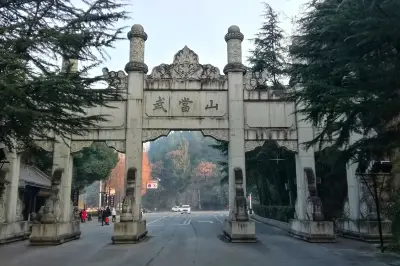
Wudang Mountain, a sacred site of Chinese Taoism, is also known as Taihe Mountain, Xieluo Mountain, Canshang Mountain, and Xianshi Mountain. In ancient times, it was called 'Taiyue', 'Xuanyue', and 'Dayue'. During the Ming Dynasty, Wudang Mountain was granted the titles 'Dayue' and 'Zhishi Xuanyue' by the emperor, and was revered as the 'Imperial Family Temple'. Wudang Mountain is renowned as the 'Crown of the Five Sacred Mountains', with the saying 'The Four Great Mountains all pay homage; the Five Immortal Peaks all come to court.' It is a famous Taoist mountain and the birthplace of Wudang martial arts, known as the 'Unmatched Holy Land Through the Ages, the Most Immortal Mountain Under Heaven.' Wudang martial arts is a major school of Chinese martial arts. At the end of the Yuan Dynasty and the beginning of the Ming Dynasty, the Taoist Zhang Sanfeng synthesized its essence and founded the Wudang Sect. As of 2013, Wudang Mountain had 53 ancient buildings with a total floor area of 27,000 square meters, 9 building ruins covering over 200,000 square meters, and 5,035 cultural relics preserved throughout the mountain.
Taking the cable car, we went straight to Qiongtai.
I don't know who Long Rui is, but on a distant mountain, the stone inscription 'First Mountain' can be seen.
The highest point is the Golden Summit.
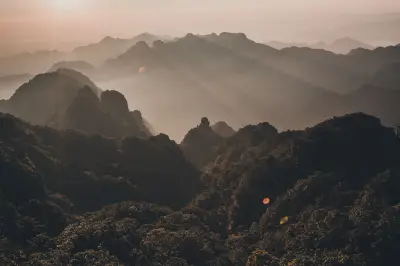
Gazing into the distance, the vast mountain ranges stretch endlessly, with a sea of clouds surging.
The Four Great Mountains all pay homage.
The Five Immortal Peaks all come to court.
Purple qi reflects auspiciousness in the Hall of Immortals.
Auspicious light envelops the Taihe Palace.
The Golden Hall of Wudang Mountain is located at the top of Tianzhu Peak in Hubei Province, at an altitude of 1,612 meters, covering an area of about 160 square meters. It was built in the 14th year of the Yongle reign of the Ming Dynasty (1416) and is the largest and highest-grade gilded bronze hall in China. The Golden Hall faces west, with a width of three bays (5.8 meters), a depth of three bays (4.2 meters), and a height of 5.54 meters. It is a glided bronze hall imitating wooden structure with a double-eave hip roof. The hall body is made of bronze partitions, on which large and small architraves are cast. The upper eaves feature double bracket sets with nine tiers supporting the eaves rafters. The lower eaves have single bracket sets with seven tiers of gilded brackets. At the eaves hangs a vertical gilded bronze plaque inscribed with the characters 'Jin Dian' (Golden Hall). All components of the Golden Hall were cast separately, assembled using mortise and tenon joints, and then fully gilded. The structure is precise and tightly connected, with no traces of casting or chiseling. Inside the hall stands the statue of Zhenwu (Perfected Warrior), with a golden boy holding a book on the left and a jade maiden holding a seal on the right, and the Water and Fire Generals holding flags and drawing swords. On the rear wall hangs a gilded plaque with the words 'Golden Light and Marvelous Appearance' in the regular script of Emperor Kangxi of the Qing Dynasty. The beams and coffered ceilings inside the hall are decorated with intricate patterns. A gilded pearl hangs from the caisson, known as the 'Wind-Avoiding Immortal Pearl'. Legend says this pearl can suppress the mountain wind, preventing it from blowing into the hall, thus ensuring the sacred lamps inside burn forever without extinguishing. In reality, the wind cannot enter because the hall's walls and doors are cast with great precision and tightness. Inside the Golden Hall is a bronze statue of Zhenwu, weighing 10 tons.
The Golden Hall, located on Tianzhu Peak, the main peak of Wudang Mountain, is the largest gilded bronze hall in China, built in the 14th year of the Yongle reign (1416). The hall is 5.5 meters high, 5.8 meters wide, and 4.2 meters deep. Outside the hall is a white marble balustrade terrace, beneath which lies the Forbidden City, about 1,500 meters long. The city wall is built with huge rectangular stone blocks stacked along the mountain terrain. This Golden Hall stands on the most majestic and perilous Tianzhu Peak among the peaks of Wudang Mountain, creating an effect of a 'Heavenly Jade Terrace and Golden Palace'. The Purple Cloud Palace, built in the 11th year of the Yongle reign (1413), is the main palace of Wudang Mountain and one of the best-preserved buildings. It comprises 860 halls, pavilions, and corridors, grand in scale and imposing in style.
The winding Forbidden City wall along the mountain.
After descending from the Golden Summit, I looked back.
Wild orchids by the roadside, of an unknown variety.
Heading toward the Chaotian Palace.
The Chaotian Palace, first built in the Yuan Dynasty, was repeatedly destroyed and rebuilt. According to legend, it was considered the boundary between heaven and the mortal world.
Heavenly Palace Holy Water, said to have been used by the True Warrior Emperor to cure Lü Dongbin's abdominal pain.
I really like this kind of mountain gate, which seems like a boundary, with a sense of vicissitude, more common in the north.
Going up from here, you can see the Yellow Dragon Cave.
Viewing the Nanyan Palace from a distance.
I took a detour, going down the mountain and then up again.
One of the nine sons of the dragon, Bixi, bearing a heavy load.
The palace is ancient, solemn, and majestic.
The famous Dragon Head Incense, for which many people fell to their deaths while offering incense, until it was banned during the Kangxi reign.
Looking at the location of the Dragon Head Incense in person.
Below is the path I had just taken up.
Nanyan Palace (also known as Zixiao Yan or Duyang Yan, called Nanyan because it faces south) is revered by Taoism as the sacred place where the True Warrior ascended to immortality. To the south lie the peaks of Tianzhu, to the north overlooks Wulong Peak, to the east is Zhanqi Peak, and to the west is Feisheng Terrace. With its steep peaks, lush forests, touching the blue sky above and overlooking deep ravines below, it is a scenic spot described as 'Qi swallows Taihua and the Milky Way is near; Shi overwhelms Min'e and Yulei stands tall.' It is the most beautiful of the 'Thirty-Six Cliffs' of Wudang Mountain.
The Purple Cloud Palace, also known as 'Taiyuan Zixiao Palace', is a Ming Dynasty Taoist temple located in Wudang Mountain within the city of Danjiangkou, Shiyan, Hubei Province. It sits at the foot of Zhanqi Peak, northeast of Tianzhu Peak, the main peak of Wudang Mountain, covering an area of approximately 274,000 square meters. Facing Zhaobi, Santai, Wulao, Lazhu, Luomao, and Xianglu peaks, with Leishen Cave on the right and Yuji Pond and Baozhu Peak on the left, the surrounding mountains naturally form a treasure chair with two dragons playing with a pearl, which Emperor Yongle of the Ming Dynasty named 'Zixiao Blessed Land'. The Purple Cloud Palace is a well-preserved imperial temple complex on Wudang Mountain and an important part of the relatively intact building groups there. It is one of the historical Taoist temples on Wudang Mountain and a nationally key open Taoist temple. In 1932, during the Second Revolutionary War, it served as the headquarters of the Third Red Army, where Marshal He Long once resided.
In May 1931, He Long led the Third Red Army to Wudang Mountain, establishing the Northwest Hubei base area, and used the Purple Cloud Palace as the rear hospital and headquarters. When departing, He Long presented a couplet to the Taoist leader Xu Benshan: 'The great man comes from the east, all purple qi; the woodcutter's song goes west, clouds soar over the sky.'
On this day, I walked 35,000 steps, setting a personal record for walking.
After the visit, I drove to Xiangyang City.
After checking in, we strolled through the ancient city of Xiangyang. Xiangyang has long been a famous historical and cultural city in China and a strategic location contested by military forces throughout history.
Xiangyang City stands majestically in the middle reaches of the Han River. It has a history of over 2,800 years, dating back to the Northern Ferry Crossing of Chu. The city wall was first built in the Han Dynasty. Xiangyang City has six gates: the Large and Small North Gates, Long Gate, East Gate, West Gate, and South Gate.
We specially drove to the Han River Bridge, where the most famous beef tallow noodles are sold.
Especially at Chen's Noodle House, where a long line had already formed in front of the shop.
Xiangyang's beef tallow noodles are more chewy than the southern Yi noodles, rounder than the northwestern hand-pulled noodles, and share the same origin as Wuhan's alkaline noodles. Soaked in red, sizzling beef tallow, they give people a glowing complexion. The beef is extremely generous, made from high-quality beef, cut into large thin slices, braised to a rich aroma, and very soft and glutinous, easy on the teeth.
The first stop was Mi Gong Ancestral Hall.
Mi Gong Ancestral Hall, located by the Han River in the historical and cultural city of Xiangyang, was originally called Mi Jia An. It was first built in the Yuan Dynasty, expanded in the Ming Dynasty, and later renamed Mi Gong Ancestral Hall. It commemorates Mi Fu, a calligrapher and painter of the Northern Song Dynasty in ancient China. It is one of the landmark attractions in Xiangyang. 'Mi Gong Ancestral Hall and Its Stone Inscriptions' was listed as a Hubei Provincial Key Cultural Relic Protection Unit in 1956. On May 25, 2006, Mi Gong Ancestral Hall, as a Ming and Qing Dynasty ancient building, was approved by the State Council to be included in the sixth batch of National Key Cultural Relic Protection Units.
A circular poem by Su Dongpo.
Leaving Mi Gong Ancestral Hall, I went to the Han River again.
By the Han River, on the city wall, the flowing river surges onward, vast and mighty. How many heroes have turned into past events! Gazing at this city with a long history, I am filled with emotions. The Xiangyang in history books is a Xiangyang of impending storms and emerging heroes. Climbing the city wall, looking out over the water, the sagas of various heroes vying for supremacy in the land unfold in my mind. How can one not feel a surge of excitement and a flight of thoughts?