Among the Verdant Mountains and Waters ~ Tracing the Path of Shennong, the Long Ascent ~ Seeking the Dao of Wudang
Where does this journey lead?
We traversed high mountain wetlands.
We admired the shimmering waters.
We paid homage to temples and halls.
And we walked, through tens of thousands of steps...
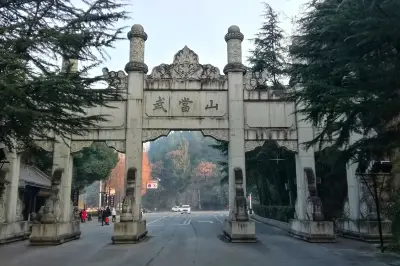
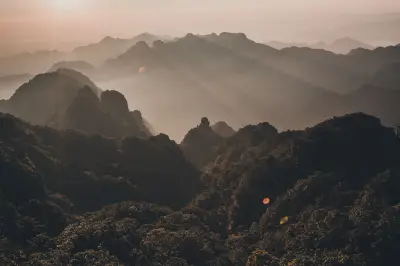
This is Hubei~~ the primitive and mysterious Shennongjia and the Wudang Mountains, which surpass the Five Great Peaks.
Dragon Head Incense, suspended from the sheer cliffs of Wudang Mountains. Years ago, I caught a fleeting glimpse of it in a documentary, and it has never left my memory.
Since childhood, the famous Wudang master Zhang Sanfeng, seemingly omnipotent, has been a household name. I longed to visit the sacred realm of Wudang, where in novels and TV shows, the True Man soared freely.
Naturally, the "World Heritage" site of Wudang Mountains was added to my long list of dream destinations.
In Shanghai, the summer of the pandemic year, the rainy season was exceptionally long.
Bored at home, we only managed occasional short trips to Jiangsu and Zhejiang.
Teacher Wang invited me to Wudang, and we agreed instantly, finally able to break out of the "free shipping zone."
Just a few days later, Hubei Province launched the "Enjoy Hubei" campaign, offering free admission to all A-level scenic spots nationwide. It felt like divine help.
How could a travel enthusiast pass up this chance to venture far? Another "World Heritage" site, Shennongjia, about 200 kilometers from Wudang Mountains, was also added to our itinerary.
From Shanghai to Wudang Mountains, we took a Spring Airlines flight to Hubei's Shiyan Wudangshan Airport.
This is the only direct flight from Shanghai to Wudang Mountains.
Outbound: 9C8723 14:05-16:30
Return: 9C8724 20:40-22:55
However, flight times change with the seasons, typically at the end of March and the end of October.
When I first planned the trip in midsummer, the spring-summer schedule had the outbound flight at around 8:00 AM and the return at around 7:00 PM.
This combination pleased me greatly, as it allowed us to fully utilize the first and last days.
Later, the return time changed to around 12:00 PM, leaving us with nothing to do but fly.
In the end, the autumn-winter schedule adjusted to an outbound flight around 5:00 PM and a return flight around 8:00 PM.
Our outbound day happened to fall between the two schedules; that week, the outbound flight was at 2:00 PM.
Not having to catch an early flight was a blessing.
The tickets were not expensive. On non-holiday Spring Airlines official website: about 450 RMB (including 50 RMB airport construction fee);
The ticket only includes 7 kg of carry-on luggage.
Purchasing checked baggage online in advance is cheaper than at the airport, starting at 50 RMB for 5 kg, with an additional 50 RMB for every 5 kg.
That is 100 RMB for 10 kg, 150 RMB for 15 kg, 200 RMB for 20 kg, and so on.
Generally, no more than 30 kg, and multiple people can combine their allowances.
For two people traveling together, the one-way total with 20 kg of checked baggage is usually around 1100 RMB.
It will be more expensive on holidays, but since this is not a hugely popular tourist area, there won't be a doubling.
If you need checked baggage, it's more economical to buy a ticket that includes it.
If there are flash sales or promotions, it can be even cheaper; I caught one.
In the end, the total for two outbound tickets (including 20 kg baggage allowance) was around 600 RMB, and the return was around 800 RMB.
Wudang Mountains Scenic Area is 25 km from Wudangshan Airport, about a 30-minute drive.
From Wudang Mountains Scenic Area to the northernmost Bataoyuan Scenic Area in Shennongjia Forest Region is 150 km, about a 2.5-hour drive.
Our return flight was around 8:00 PM, so we decided to visit Shennongjia first, then climb Wudang Mountains.
On the last day, we descended from Wudang Mountains, had a quick meal, and headed straight to the airport, wasting no time.
The primitive and mysterious Shennongjia Forest Region has high mountains, deep valleys, and dense forests.
Its unique natural environment and historical culture have created extremely rich and precious natural and cultural landscapes.
The forest region is vast with scattered attractions, generally divided into the following major areas:
A: Bataoyuan Scenic Area
This is the north gate of Shennongjia Forest Region and a tourism node connecting Shennongjia and Wudang Mountains. It features natural landscapes such as virgin forests and alpine lakes, as well as leisure facilities like forest cabins, RV camping bases, and a water park.
B: Tianyan Scenic Area
This area is dominated by virgin forests and is home to many nationally protected plants and animals.
C: Hongping Scenic Area
Also known as Hongping Gallery Valley, this canyon has towering peaks on both sides and rare medicinal herbs scattered throughout. Legend says Shennong built wooden ladders here to collect herbs, and ancient Shennong ladders are still preserved.
D: Xiangxiyuan Scenic Area, Tiansheng Bridge, Shennong Altar, Guanmen Mountain. These belong to Muyu Town, the tourism hub of the forest region, which has the best tourist facilities in the area and is the south gate of Shennongjia. The four small scenic spots are relatively close, with the farthest being about ten kilometers and the nearest four to five kilometers.
Xiangxiyuan Scenic Area: The source of the Xiangxi River. Legend says that Wang Zhaojun, before her marriage to a Xiongnu chieftain, returned to her hometown and washed her face in the stream, dropping pearls into it. Since then, the water has been fragrant, hence the name Xiangxi (Fragrant Stream).
Tiansheng Bridge: Features a natural cave, waterfall, stone bridge, and cliffside plank road.
Shennong Altar: A natural and cultural scenic area themed around Shennong culture and spirit, showcasing the great achievements of the ancestor Shennong.
Guanmen Mountain: A large eco-science scenic area with more plant and animal displays.
E: Shennong Peak Scenic Area
This is the most primitive wilderness in Shennongjia, preserving the best-preserved virgin forest ecosystem in the mid-latitudes of the Earth. The highest peak, Shennong Peak, is 3106.2 meters above sea level, known as the "Roof of Central China."
F: Dajiuhu Scenic Area
Dajiuhu, also called Jiuhu Ping, is an alpine plain, a cloud-interwoven wetland, and the westernmost part of Shennongjia Forest Region.
PS: The "Enjoy Hubei" free admission campaign lasts until December 31 this year. During the campaign, all A-level scenic spots in Hubei offer free entry.
Only the entrance fee is waived! Eco-friendly shuttles and cable cars within scenic areas are not free!
All Shennongjia scenic areas except Dajiuhu can be visited by self-driving. Dajiuhu requires taking the scenic area's eco-friendly shuttle, which costs 60 RMB per person.
After the "Enjoy Hubei" campaign ends, Shennongjia tickets should revert to the original policy. Each small scenic spot can be ticketed separately, and there are also combo tickets.
The combo ticket costs 269 RMB, valid for five days, covering six scenic areas: Tianyan, Tiansheng Bridge, Shennong Altar, Guanmen Mountain, Shennong Peak, and Dajiuhu.
Bataoyuan, Hongping Gallery Valley, and Xiangxiyuan are not included in the combo ticket and require separate admission.
The transportation route of the entire Shennongjia Scenic Area resembles an inverted capital letter Y.
Entering Shennongjia from Bataoyuan, passing through Tianyan and Hongping Gallery Valley, it forks at Yazi Kou.
Southeast leads to Muyu Town's Tiansheng Bridge, Shennong Altar, Guanmen Mountain, and Xiangxiyuan.
Southwest leads to Shennong Peak Scenic Area, then all the way west to Dajiuhu Scenic Area.
Following our relatively relaxed style, a four-day itinerary for Shennongjia~~
D1: Tianyan, Hongping Gallery Valley (did not enter Bataoyuan), stayed in Muyu Town;
Accommodations near Tianyan and Hongping Gallery are poor, so we drove to Muyu Town, an hour away, for the night, since the next day we would also be visiting the Muyu area.
D2: Xiangxiyuan, Tiansheng Bridge, Shennong Altar (did not enter Guanmen Mountain), stayed in Muyu Town;
This was the easiest day of the entire Shennongjia trip.
Short travel times, all attractions close together, the farthest no more than 10 km.
D3: Shennong Peak Scenic Area, stayed in Pingqian Ancient Town, Dajiuhu;
This day was more tiring, with many activities and longer drives.
Starting from Muyu Town, the Shennong Peak Scenic Area route was nearly 60 km.
Then we headed to Dajiuhu for lodging to facilitate the next day's visit.
D4: Dajiuhu Scenic Area, returned in the evening, stayed in Fang County.
After playing at Dajiuhu during the day, if we had rushed to Wudang Mountains that night, time would have been tight and the drive long.
So, we compromised and chose Fang County, an hour's drive from Wudang Mountains, as a rest stop.
This decision proved wise; we arrived at the hotel in Fang County at 8 PM, just in time for dinner. If we had driven another hour to Wudang, we might have gone to bed hungry.
PS: The entire Shennongjia forest region is vast. Without a car, it would be extremely inconvenient. Public transportation within the forest region only operates paid tourist buses in Shennong Peak Scenic Area.
Therefore, self-driving or hiring a car is the best way to visit.
However, for novice drivers or those lacking confidence in their driving skills, hiring a car is recommended, as these long mountain roads can be challenging. We drove ourselves; friends from Shiyan led the way in the first car, and Panpan followed closely.
Wudang Mountains Scenic Area is relatively simpler and can be done as a day trip if tight on time. Naturally, we didn't rush and arranged two days.
Key points within Wudang Mountains Scenic Area: Prince Slope, Xiaoyao Valley, Purple Cloud Palace, South Cliff Palace, Qiongtai Central Temple, Taihe Palace, Golden Summit, and Yuxu Palace at the foot of the mountain in Wudangshan city.
If time allows, visit them all.
If time is limited, it is recommended to visit Prince Slope, South Cliff Palace, and take the cable car to Golden Summit.
Tickets for Golden Summit and Purple Cloud Palace are not included in the scenic area ticket and are not part of the "Enjoy Hubei" free campaign; they cost 27 RMB for Golden Summit and 15 RMB for Purple Cloud Palace.
Regarding scenic area transportation:
★ Eco-friendly shuttles run within the scenic area; private cars are not allowed.
Vehicles can be parked at the parking lot at the main entrance. We parked from 9:30 AM to 4:10 PM the next day, costing 46 RMB, which was acceptable.
★ The eco-friendly shuttle costs 105 RMB, including 5 RMB insurance.
★ The shuttle routes form a capital Y shape, departing from the visitor center with three lines:
A. Visitor center - Prince Slope. Prince Slope is a major transfer hub, like the intersection of the Y.
B. Visitor center - South Cliff (Crow Ridge). After Prince Slope, Xiaoyao Valley, Purple Cloud Palace, and South Cliff Palace are along this line.
C. Visitor center - Qiongtai (Qiongtai Central Temple). After Prince Slope, Eight Immortals Temple and Qiongtai Central Temple are along this line. Qiongtai is also the cable car station to Golden Summit.
★ Cable car: 90 RMB up, 80 RMB down. Round-trip tickets have no discount.
To reach the Golden Summit, there are the following options:
Spend money to save effort: Take the cable car round trip from Qiongtai, about 5 minutes one way, costing 170 RMB.
Save money but exert effort: There are walking paths from Qiongtai and South Cliff. The time varies, generally 2.5-3.5 hours.
Most of the better guesthouses and hotels are concentrated around Purple Cloud Palace and South Cliff (Crow Ridge). If you want to go to Golden Summit from South Cliff, you can only walk.
If staying at South Cliff but wanting to take the cable car up, you must first take the shuttle to Prince Slope, then transfer to the Qiongtai-bound shuttle.
Two-day itinerary for Wudang Mountains~~
D1: Prince Slope, Purple Cloud Palace, South Cliff Palace, stayed at South Cliff; Xiaoyao Valley is currently closed.
D2: Walk up to Golden Summit, starting from South Cliff, passing Langmei Temple, Yellow Dragon Cave, Chaotian Palace, First Heaven Gate, Meeting Immortals Bridge, Second Heaven Gate, Third Heaven Gate, Holy Pilgrimage Gate, arriving at Taihe Palace, and finally reaching Golden Summit. Descend via cable car to Qiongtai Central Temple, then take the eco-friendly shuttle out of the scenic area.
Shennongjia Forest Region is deep in the mountains, so accommodation conditions are generally average; similarly for Wudang Mountains. Over eight days and seven nights, we stayed at six hotels/guesthouses.
D1: Stayed in Shiyan city;
D2/3: Stayed in Muyu Town, Shennongjia;
D4: Stayed in Pingqian Ancient Town, Dajiuhu, Shennongjia;
D5: Stayed in Fang County;
D6: Stayed in Wudang Mountains city (at the foot of the mountain);
D7: Stayed within Wudang Mountains Scenic Area (on the mountain).
Except for the first night, which was booked by friends in Shiyan, among the other five, I recommend three; the other two were average, so I won't recommend them.
D2/3: Kangdi Junlan Hotel (Muyu Town, Shennongjia)
Muyu Town is the distribution center for Shennongjia tourism and has the best accommodation in the forest region, with many hotels, guesthouses, and restaurants.
Kangdi Junlan is the best and tallest hotel in Muyu Town, not a guesthouse.
The rooms are 60 square meters, very spacious, with a balcony.
A superior room with double breakfast costs over 700 RMB; a deluxe room with double breakfast costs over 800 RMB.
The room type and facilities are the same, only the floor differs. Deluxe rooms are on the top two floors (8 and 9).
I grabbed a Ctrip BOSS live broadcast deal, so I got a deluxe room at a price lower than a superior room.
D5: Ji Hotel (Fang County)
I stayed at a Ji Hotel in Zhangjiajie in September and had a good impression.
So when I saw there was a Ji Hotel in Fang County, I booked without hesitation.
Chain business hotels have consistent standards, so rooms in different cities are nearly identical.
The rooms are simple and stylish, spacious, with separate wet and dry areas, and good water pressure in the shower.
The usual price is around 200 RMB per night.
D7: Dayue Yuan Hostel (within Wudang Mountains Scenic Area)
Dayue Yuan Hostel is located at South Cliff in Wudang Mountains Scenic Area, right next to the South Cliff eco-friendly shuttle terminal.
I really liked their duplex rooms, especially for tea lovers like us, as they have a dedicated tea area.
The host even prepares purified water, tea, melon seeds, and snacks—very thoughtful.
The lobby also has a public tea area.
The room rate is over 1,500 RMB per night including four breakfasts, roughly 800 RMB per room.
Non-duplex rooms in the guesthouse range from 500 to 800 RMB.
First-floor: king bed rooms.
Second-floor: twin bed rooms.
~~~~~~~~~~~~~~~~~~~~~~~~~~~~~~~~~~Shennongjia~~~~~~~~~~~~~~~~~~~~~~~~~~~~~~~~~~~
I once visited Wuhan in 2009.
Traveling to Hubei in 2020 felt particularly meaningful.
Breakfast should have local flavor; this bowl of hot dry noodles, eaten again after eleven years, was precious.
Before departure, our friends from Shiyan performed their traditional paper-burning ceremony, hoping the Earth God would bless our journey with safety.
We fully embraced the local customs.
[Today's Itinerary]
Tianyan Scenic Area ~ Hongping Gallery Valley
When mentioning Shennongjia, the first thing that pops into our minds is "wild man." Although no one has ever seen a wild man, and it may just be a legend, the idea is deeply ingrained in us.
Sure enough, the closer we got to Shennongjia Forest Region, the more wild man elements there were: Wild Man Cave, Wild Man Lake, Wild Man Valley, one after another.
After Wild Man Valley, there is a famous winding road called "Ten Turns Back."
Ten sharp turns in a row—imagine that.
Self-driving friends, please drive carefully and stay safe.
Endless beautiful scenery along the way; even before entering Shennongjia, we had already pressed the shutter many times with our cameras and phones.
Eyes full of colors, autumn at its peak.
Autumn is truly my favorite season.
Compared to the monotonous green of summer and the monotonous white of winter, autumn's ripe yellow, red, and deep green each show their charm while complementing each other.
Thousands of trees and flowers, the deeper autumn gets, the more vivid they become.
We stopped briefly at the entrance of Bataoyuan Scenic Area; the men got off for a five-minute "mind adjustment."
The G209 National Road leading to Tianyan Scenic Area changed its beauty again.
This area is mostly covered with fir trees, with long leaves in green and gold, giving a unique flavor.
★ Tianyan Scenic Area
Tianyan Scenic Area is divided into two parts: Tianmen Ya and Yanzi Ya.
Ya usually refers to a narrow place between two mountains, so in high mountain areas, there are many passes.
When we reached Tianmen Ya, it started to drizzle, and the temperature dropped sharply. We quickly put on down jackets in the white fog.
Look, the surroundings were like this. I couldn't help but shudder, remembering our trip to Zhangjiajie in September. Oh my, it rained every day, and we couldn't see anything in the clouds and fog, just imagining the scenery in our minds.
But being in Shennongjia, imagining the wild man legend, the scene became mysterious.
It is said that on cloudy days at Tianmen Ya, clouds and fog often linger, making one feel as if ascending to heaven, hence the name "Tianmen Ya" (Heaven's Gate Pass).
So I can't blame it; even on cloudy days, the fog doesn't dissipate, let alone when it rains.
Tianmen Ya has a Chinese Humanoid Animal Scientific Research Exhibition Hall.
Most of Tianyan Scenic Area's attractions are in Yanzi Ya.
Climbing the stone steps to a flat area, we found the wooden circular walkway of Yanzi Ya.
The figure-8 walkway is built along the mountain, with cliffs on the outside. To the left, it leads to Yanzi Cave.
Yanzi Ya is named after "Yanzi Cave" (Swallow Cave).
The cave is home to many swallows, with nests densely covering the cave roof and cliffs.
A section of two to three hundred meters of walkway is open for visitors. The notice at the entrance says not to use the flashlight on your phone, so we had to grope our way in the dark. Inside, it was pitch black, we couldn't see anything, and there was no sign of swallows.
The cave was very damp, with water dripping in many places; we walked slowly.
After exiting the cave, we walked back along the plank road.
At that time, there were no other tourists except our group.
We only heard the gurgling of mountain streams, the creaking of our footsteps on the wooden planks, and the drip of rain on leaves.
The negative oxygen ions in the mountain were off the charts; walking through the forest, the air was slightly sweet, and we kept taking deep breaths.
We savored the lush greenery all around.
In the tiny crevices of the rocks, some strange pines and cypresses grew.
Sometimes they were only a few meters away from the cliff but could bend upward and grow into towering trees.
In nature, everyone has their way of living; as long as you survive, you are the king.
"Splitting the mountain and building a bridge, Yan Tian Fei Du" refers to the Rainbow Bridge spanning the gap of Yanzi Ya, also called Feiyun Du.
This all-steel high-altitude bridge, with a high suspension and large span, is the highest scenic bridge in Asia.
The cliff below the Rainbow Bridge was created by manual blasting during the construction of the G209 National Road.
I gently bounced on the bridge and felt it slightly spring up and down.
Having a fear of heights, I decided not to be playful.
But the Rainbow Bridge seemed very elastic. Other suspension bridges sway left and right, but this one goes up and down.
When we came down from the Rainbow Bridge, the rain stopped. From the viewing platform, we had a panoramic view of Yanzi Ya. The two sides of the cliff were like the wings of a flying swallow.
In golden October, the mountains were covered in red, stretching for thousands of miles, the forests dyed in layers.
First impression of Shennongjia: truly picturesque.
★ Hongping Gallery Valley
Hongping Gallery Valley is about ten kilometers from Tianyan Scenic Area, a canyon within the virgin forest.
The stream in the canyon is clear, with lush vegetation, another natural oxygen bar.
In the 1970s, famous painter Zhang Bu sketched here; in the 1980s, famous painter Luo Guoshi created a 150-meter-long large group painting, "Shennongjia Wonders." The works of both painters were exhibited in many countries and caused a strong sensation.
Thus, Hongping Gallery Valley got its name and became world-famous.
Here, the peaks stretch continuously, the vegetation is moist, and as you walk, you often hear the tinkling sound of streams.
Spring and autumn are the best times to visit the gallery valley.
In spring, the canyon is filled with blooming mountain flowers, exuding vitality. In autumn, it becomes an ocean of colors.
Personally, I find autumn even better, with colorful mountains and fields everywhere.
A natural gallery, truly worthy of its name.
Legend says that Shennong built wooden ladders here to collect herbs and later ascended to immortality. The ancient Shennong ladders are still preserved today.
Between the two cliffs is a narrow stone passage with 499 stone steps. The width is at most two meters, and at its narrowest, only half a meter, allowing only one person to pass.
Walking through, looking up at the sky, only a sliver of blue remains. A narrow strip of sky, living up to its name.
There are many small waterfalls in the scenic area. The waterfalls here are delicate and exquisite, small and lovely.
Walking in the valley, the scenery unfolds on both sides.
Clear streams beat against the rocks.
For city people used to noise and chaos, this rare tranquility is a blessing.
Accommodation around Hongping Gallery Valley is relatively average, so we drove 45 kilometers away, about an hour, to Muyu Town for lodging.
We arrived in Muyu Town in the evening and checked into Kangdi Junlan Hotel. Standing on the top floor, we looked out at the ancient mountain town surrounded by mountains, with the Xiangxi River flowing through it.
The sky seemed to clear. I calculated that tomorrow would be a good day.
Just as I thought last night. Today, the sky fulfilled my wish: clear and cloudless.
After breakfast at the hotel, we set off for Shennong Altar.
[Today's Itinerary]
Shennong Altar ~ Tiansheng Bridge ~ Xiangxiyuan Scenic Area
Yan Emperor Shennong, the ancestor of us all, the Chinese people.
Legend has it that Shennong traveled across mountains and rivers to collect herbs. To get healing herbs on the towering peaks, he had people build wooden ladders to reach the top. He tasted all the divine grasses on the mountain, made hundreds of herbs, and wanted to descend, but the ladders had disappeared. Fortunately, a flock of white cranes flew in and took him to heaven. Later, the wood from the ladders took root, sprouted under the rain, and grew into a vast forest.
To commemorate Shennong's merits in tasting herbs and curing diseases for the people, later generations named this forest "Shennongjia."
Shennong Altar is surrounded by green mountains and ancient trees, grand and spectacular.
The statue of Shennong inside the altar has a human body and a bull's head, solemn and dignified, with eyes slightly closed, as if silently observing all things.
Here, people do not worship Buddha or Dao; they regard Shennong as the most sacred and supreme faith.
Although it is a cultural attraction, it is still worth coming to pay respects.
From afar, we saw a guide leading a group of tourists, and we couldn't help but quicken our pace to join them.
On the ground of the sacrificial area, there are circular and square patterns representing "heaven" and "earth." The five-colored stones on the "earth" represent the Five Elements: metal, wood, water, fire, and earth.
We overheard some stories about Shennong and marveled at the great kindness, love, and perseverance of the ancients.
After buying incense at the incense counter, the staff gave us a yellow blessing ribbon and said to go to the small building across, where they would tell us where to tie it and how.
Naively, we didn't feel tricked...
When the staff across finished speaking, they also read our fortunes.
Then they took out a phone QR code... I understood...
After making a donation, they told us we could first ring the bell on the left, then beat the drum on the right, and tie the ribbons on both sides.
With a clear conscience, we struck the bell three times and beat the drum nine times, praying for a safe life.
Shennong Altar has a thousand-year-old fir tree, thick and towering, so huge that six people can barely encircle it.
There is an old anecdote that ancient people, seeking blessings and avoiding disasters, carved a temple at its base and placed a statue of Shennong to worship. Over the years, the tree grew thicker and eventually engulfed the statue.
This "Shennong Old Tree," the king of firs, still stands majestically.
Tiansheng Bridge Scenic Area is famous for strange caves, strange bridges, strange waterfalls, and strange pools.
The area preserves traces of the ancient Ba people, no wonder the entrance pillars are carved with Ba script.
Since the scenic area is named "Bridge," water is naturally abundant.
And what about "Tiansheng" (Heaven-Born)?
It turns out that Tiansheng Bridge lies at the foot of Laojun Mountain.
The Huangyan River, originating from Laojun Mountain, flows through here. Over millions of years, surface and groundwater dissolved and eroded, creating a natural stone cave.
The river rushes through the cave, like a dragon.
From a distance, it looks like a natural stone bridge spanning east and west, hence the name. Truly a "heaven-born bridge" of nature.
Following the sound, a waterfall hangs from the cliff.
Silver splashes, then plunges down the mountain, winding away.
It was already deep autumn, but the sound of water was still thunderous. In summer, after the rainy season, you'd need an umbrella or raincoat to pass through.
We strolled leisurely along the plank road built around several pools, indulging in the oxygen.
Compared to majestic waterfalls and surging rivers, I prefer these gentle, winding streams.
I feel this pool has a spiritual quality.
The water is like a bronze mirror, crystal clear, you can see the colorful pebbles at the bottom.
Walking beside it, I felt relaxed and happy, leaving all my worries behind.
Tiansheng Bridge Scenic Area ends at the Cast Sword Pavilion; attractions are concentrated in the first half, and the second half is mostly shopping points. So, if you're not interested in shopping, you can return after reaching the pavilion. Since we had to go back anyway, we continued forward.
It was harvest season, so we checked out some local specialties.
★ Xiangxiyuan Scenic Area
Xiangxiyuan originates from the 2,800-meter-high Fengjing Ya (Scenic Pass). Beautiful places always have beautiful legends.
Legend says that Wang Zhaojun was born in a village at the source of Xiangxi. Before her marriage, she returned home and accidentally dropped her pearl necklace into the stream.
Since then, the stream has been crystal clear and fragrant all year round, hence the name Xiangxi (Fragrant Stream).
Xiangxiyuan is known as the Fourteenth Spring under Heaven. The ranking criteria are unknown, but a stele proves it.
Legend also says it was Shennong's herb-washing pool when he collected herbs.
The scattered rocks meet the clear water, with moss-covered rocks accompanying the stream.
Enjoying this scene in the quiet, I felt very comfortable.
I felt a sense of déjà vu, but couldn't remember where I had seen it.
This calm, emerald pool perfectly embodies the "transparency" and "greenness" of Xiangxiyuan.
The moss-covered stones in the water glow like emeralds.
The water droplets splashing against the rocks are truly pearls.
The water here is so clear; I hope such high-quality water sources can be protected from pollution.
I really like the following set of photos; Panpan named them: "Deep Valley Clear Stream, Thin Water Winding Around Rocks."
Xiangxiyuan Scenic Area is similar to the scenery after the stone cave at Tiansheng Bridge. Since it's currently free, we visited both.
After the free policy ends, Xiangxiyuan is not included in the Shennongjia combo ticket and requires a separate ticket. If you have enough time, it's worth a visit.
★ Shennong Peak Scenic Area
Shennong Peak Scenic Area is the main scenic area of Shennongjia, stretching from Dalongtan to Dajieling, with a tour route of 40 km.
Attractions are distributed along both sides of the mountain road, from north to south, east to west, mainly including: Xiaolongtan, Golden Monkey Ridge, Shennong Source, Shennong Camp, Shennong Peak, Shennong Valley (Fengjing Ya), Big Footprint Secret Valley, Observation Tower, Tianji Ridge (Liangfeng Ya), Meiren Chang, Banbi Rock, Prince Ya, Prince Deng, Dajieling.
Dalongtan, as a research and protection base for golden monkeys, is no longer open to tourists.
In a broad sense, Shennong Peak refers to this vast scenic area.
In a narrower sense, it refers to the highest point of the entire Shennongjia Forest Region—the 3,106.2-meter "Roof of Central China" Shennong Peak.
If you ask where is the most beautiful place in Shennongjia, I would say that every step is beautiful, every spot is essence.
But only Shennong Peak gave me the desire to explore and challenge myself.
[Today's Itinerary]
Golden Monkey Ridge ~ Shenxiu Terrace ~ Shennong Valley
Another sunny day, we set off from Muyu Town to Shennong Peak Scenic Area.
Along the road, there were several dazzling golden ginkgo trees. The older female tourists danced with their signature red scarves, while I sprained my ankle here.
I was a bit worried about the rest of the trip.
Golden Monkey Ridge is a typical representative of Shennongjia's hundreds of thousands of acres of virgin forest and a protected area for rare animals like golden monkeys and white bears.
It is similar to Tiansheng Bridge and Xiangxiyuan, mainly featuring forests, waterfalls, and streams.
But it is more primitive, and the higher you go, the worse the road.
Golden Monkey Ridge is one of the best-preserved virgin forests in Shennongjia. It was one of the few places we faced the wilderness directly.
Quiet forest, velvet-like moss, gentle streams. It felt like the most likely place for wild men to appear, and maybe even golden monkeys...
It is said that in the early days of the scenic area, golden monkeys were often seen, but as tourists increased, the monkeys moved deep into the forest. Now, seeing a golden monkey depends on whether the monkey likes you. But if a monkey appeared before me, I would definitely run faster than anyone else.
Because of fear, we didn't complete the full route... haha, just kidding, it was due to time.
Golden Monkey Ridge has two entrances. We entered from the upper entrance, walked a short section of the virgin forest, and then returned the same way.
If you have plenty of time, you can circle the virgin forest and then go down along the Golden Monkey Stream to the lower exit.
But if you're self-driving, different entrances and exits can be a hassle for retrieving the car.
A viewing platform by the roadside.
The complex geography and climate of Shennongjia nurture diverse vegetation types.
Looking down from a height, the mountains are steep and the valleys numerous.
From here, we could see Shennong Camp in the distance, named because Shennong set up camp here while collecting herbs.
Shennong Camp is the entrance to Qingyun Ladder, leading to Shennong Peak, the roof of central China. When I first planned the trip, climbing the 2,999-step Qingyun Ladder above 3,000 meters was one of my Shennongjia obsessions. However, upon detailed research, I found that the Qingyun Ladder had been closed since 2018...
Alas, whether for ecological protection or scientific research, I can no longer reach the true roof of central China. Perhaps stepping on the Qingyun Ladder to ascend Shennong Peak will remain a legend.
My path of "exploration" in Shennongjia: going up was out of the question.
Once again, it proves that you should do things early!
Shennong Valley is at an altitude of 2,820 meters. To allow visitors to enjoy the scenery up close, the forest region specially built a 4,398-meter U-shaped wooden plank road. The plank road has two entrances: Shennong Valley and Big Footprint Secret Valley. The drop from the viewing platform to the bottom of the plank road is 258 meters, with about 4,000 steps up and down each, totaling about 8,000 steps for the entire route, taking 2.5-4 hours.
The misty Shennong Valley is like a fairyland on earth; its former name was Fengjing Ya (Scenic Pass).
If there's no scenery here, where is it?
Fengjing Ya is not called that for nothing. I found photos online.
Unfortunately, we arrived at noon on a sunny day, and the clouds had already cleared. Beautiful scenery is a matter of luck.
Of course, if it had been shrouded in clouds and fog and we couldn't see anything, I would rather have the current view.
This reminds me of Zhangjiajie again.
Shennong Valley, located on the north-south airflow passage of Shennongjia, has rapidly changing weather. Below the valley mouth is a deep gorge with clustered stone forests like pillars and shoots.
Most tourists take a look from the viewing platform, take a photo, and leave, since walking the full route takes time and physical effort. Because of my "exploration," we had to explore the 8,000-step Shennong Valley.
Looking out, the long wooden plank road seemed embedded in the mountain. Let's go!
For me, the 4,000-meter plank road hike felt okay, thanks to my regular walking and running.
The wooden plank road was springy and comfortable underfoot, unlike stone. The friends encouraged each other, joking, "Wait, the steps we go down now, we'll have to come back up later."
When passing a gentle section of the plank road, I suddenly thought it would look beautiful under the lens, so I turned back.
Indeed, I never found another spot with such a feel throughout the entire route.
Don't think the people climbing on all fours are exhausted.
That kind of movement is not sustainable for the untrained. They are athletes, quickly dashing up with ease. Someone nearby tried to follow but was out of breath after a few steps.
Remember, this is an altitude of nearly 3,000 meters. Normal walking is fine, but if you exercise, you might experience altitude sickness.
We occasionally met hikers coming up; they were near victory, while we were just starting.
We encouraged each other; there is never a lack of brave souls on this path.
After walking and resting, we finally reached the bottom of the plank road, quite tired and a bit hungry. There were few toilets along the way, so we didn't dare drink too much water.
Our friend from Shiyan was experienced and thoughtful, knowing that the Shennong Valley leg would take time and we would miss lunch. So he prepared food and carried it all the way to enjoy a big meal at the bottom.
Although it was the bottom of Shennong Valley, the altitude was still high.
After eating the instant food and cleaning up, we continued.
The next part was truly challenging.
We usually say going up a mountain is easier than going down, but at nearly 3,000 meters, going up is definitely harder than going down.
Crossing Shennong Valley is not just among strange peaks and rocks; there is plenty of vegetation accompanying us.
The world of mountains, rocks, trees, and grass was silent. Breathe deeply.
If you don't explore Shennong Valley, you haven't truly been to Shennongjia.
Three-quarters of the way through, victory beckoned.
Despite spraining my ankle in the morning, after walking so far, it didn't hurt. Shennong blessed me. Maybe he respects me as a "tough guy."
Looking back from the plank road at the top of the valley, thinking about the beautiful scenery we had traversed, I felt happy and proud.
Don't be deterred by the seemingly bottomless valley. The fairyland of Shennong Valley is worth exploring.
However, the last long stone road down to the highway was quite exhausting.
The feeling underfoot was not as comfortable as the wooden plank road inside Shennong Valley.
The observation tower on the opposite mountain is the highest point ordinary tourists can reach in Shennongjia Forest Region.
Feeling that it was getting dark, we quickly withdrew and headed to Pingqian Ancient Town in the Dajiuhu area for the night.
From Shennong Valley to Pingqian Ancient Town is only about 30 km, but the mountain roads are winding, and the drive takes an hour.
It gets dark quickly in the mountains. Self-driving tourists unfamiliar with mountain roads should leave before 5 PM, and even earlier in winter.
Passing Prince Ya Scenic Area, we could see the Three Provinces Terrace, overlooking Sichuan, Shaanxi, and Hubei—a view of three provinces, and a moment for self-reflection, hehe.
★ Dajiuhu Scenic Area
[Today's Itinerary]
Dajiuhu ~ Banbi Rock ~ Observation Tower
Dajiuhu is located at the junction of Hubei and Chongqing, surrounded by Shennongjia mountains, forming a unique alpine basin. It is also a wetland and marsh. It has many nicknames: "Hubei Hulunbuir," "Jiangnan of Shennong."
Dajiuhu is mainly characterized by wetland and landscape views, with two best viewing times: early morning and sunset. Especially in the early morning, with mist swirling, water and mist blend.
I have indeed seen those dreamy, ethereal photos.
But to see the morning mist, you have to enter the scenic area at 5 AM to catch the first shuttle. I can't get up; what can I do? Waking up early kills me, and the whole day is ruined. And whether you can see it or not, as always, it's a matter of fate! I'll just enjoy other people's photos.
A few years ago, in response to the government's call for ecological protection, all residents in the original Dajiuhu Scenic Area were relocated. At the same time, all accommodation, dining, and other business activities were stopped, and tourists were prohibited from staying overnight in the scenic area.
Pingqian Ancient Town was built as a new town closest to the scenic area for these residents, and tourists also stay there.
Private cars are no longer allowed; tourists must take eco-friendly shuttles from the visitor center, then transfer to a small train at Sizi Hao to enter the main scenic area. From the visitor center to the actual lakeside of Dajiuhu, it takes nearly 40 minutes by car.
This was my first visit to Dajiuhu. Seeing the still unremoved houses, guesthouses, and restaurants along the roadside made me feel inexplicably sad.
Dajiuhu Scenic Area naturally has nine lakes. We took the small train directly to the deepest interconnected lakes 7, 8, and 9.
Dajiuhu might be better in summer; lakes are about water.
In autumn, Dajiuhu lost some of its water, giving a slightly decadent feel.
In fact, I never figured out which lakes were 7, 8, and 9.
Maybe it was the dry season in late autumn; I could only imagine the beautiful scene of "trees growing in water, people walking on the shore" along the plank road.
Dajiuhu is surrounded by mountains over 2,000 meters high, with abundant rainfall all year round.
The wetland has no external rivers to replenish it, nor any rivers flowing out. Every drop of water in Dajiuhu comes from the clouds above.
Here, there are 47 magical sinkholes. All surface water flows through these sinkholes into underground rivers, eventually reaching Zhushan County and emptying into the Du River. Water comes from the sky and goes underground.
Without these sinkholes, Dajiuhu would be a vast ocean.
The scenery at Lake 5 looked good. A casual photo could be a painting.
Perhaps only by being here can one understand the poetic and distant意境.
Lake 6 across from Lake 5.
Scenery is a matter of personal taste. If it pleases your eyes, it is beautiful.
Unfortunately, Dajiuhu was not my cup of tea.
After visiting Lakes 5 and 6, it was almost 1:30 PM, and we had to leave the scenic area and return.
While waiting for the small train, I happened to look up and saw "Monkey King Asking Heaven," which was quite lifelike.
★ Shennong Peak Scenic Area
Coming out of Dajiuhu, we had to pass through Shennong Peak Scenic Area again.
At the junction of the two scenic areas, Dajieling, there is a large sculpture of the character "Shen" (神). It looks like a man and woman dancing, but actually symbolizes the mystery of reproduction in this vast primitive land.
Banbi Rock, known as the "Stone Forest" of Shennongjia and "Wild Man Haunt."
It is said that wild men often appear in this area, and suspected wild man hair, feces, footprints, and bamboo nests have been found.
Having seen many stone forest landscapes, we only took a few distant photos and left.
As for what it looks like, it's all up to imagination.