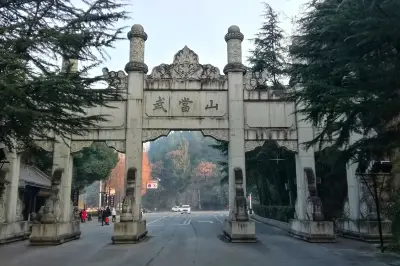
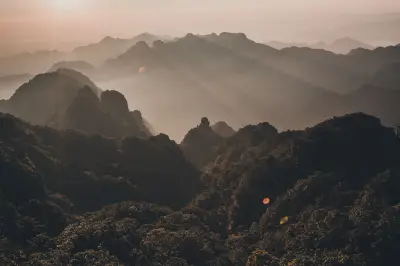
Come to Wudang Mountain to See the Ethereal Snow Scenery and Savor the Atmosphere of a Martial Arts World
There are now bullet trains from Wuhan to Wudang Mountain. A one-way drive takes about 4.5 hours. A two-day trip gives ample time, making it a great weekend getaway. Now with heavy snowfall, it’s even imbued with the ethereal atmosphere of Jin Yong’s martial arts world.
[Route Recommendations]:
1. One-day tour of Wudang Mountain
2. Two-day tour of Wudang Mountain and Tai Lake (Tai Chi Lake)
3. Two to three-day tour of Wudang Mountain and Danjiangkou
The Grand Taihe Palace is built on the summit of Tianzhu Peak, the highest peak of Wudang, surrounded by numerous peaks and reaching into the clouds. Constructing such a large-scale Taoist palace on the 1,612-meter peak top showcases an unprecedented boldness and a victor’s proclamation. The unique terrain of Wudang Mountain, with peaks bowing to it as if paying tribute, miraculously accentuates the supreme authority of imperial power.
The Grand Taihe Palace is the highest sacred site on Wudang Mountain. Whether Taoist priests, devotees, or tourists, it is only by climbing to the summit and entering Taihe Palace that one truly arrives at Wudang Mountain.
The Forbidden City (Purple Forbidden City) was built in the 17th year of the Yongle reign (1419) of the Ming Dynasty. It encircles Tianzhu Peak, with a perimeter of 345 meters, foundation thickness of 2.4 meters, wall thickness of 1.8 meters, and a highest point of 10 meters. The walls are built with stone blocks weighing over 500 kilograms each, laid on the rock cliffs.
Following the model of Chinese heaven, four stone-carved imitation wooden gate towers representing the east, south, west, and north gates were built, symbolizing the Heavenly Gates. These stone carvings are perched on sheer cliffs, ingeniously designed and challenging to construct, representing a combination of Ming Dynasty science and art.
Jingle Palace ranks first among the eight palaces of Wudang Mountain. Built in the 11th year of the Yongle reign of the Ming Dynasty, it was submerged under the Danjiangkou Reservoir when the dam was constructed in 1958. Some relics, including the archway and tortoise-stelae, were relocated to Danjiangkou.
In 2002, the city of Danjiangkou invested 70 million yuan to fully restore Jingle Palace. After more than two years of construction, the first phase—including the square, mountain gate, stele pavilions, three main halls, and side halls—has taken shape, recreating the grandeur of the original Jingle Palace. It serves as an exemplary case of relocating and restoring above-ground cultural relics for the South-to-North Water Diversion Project.
Yuxu Palace, fully named 'Xuantian Yuxu Palace,' was built in the 11th year of the Yongle reign (1413) of the Ming Dynasty, with 2,200 halls and temples. It was renovated in the 31st year of the Jiajing reign. It was the largest unit among the ancient building complex of Wudang Mountain. Most of it was destroyed in the 10th year of the Qianlong reign (1745) of the Qing Dynasty. Some buildings and ruins remain, along with four 'tortoise-stelae' pavilions each weighing 100 tons.
Qiongtai Observatory is located about 10 kilometers southeast of Tianzhu Peak, at a vertical distance of 1,350 meters. It is divided into Upper, Middle, and Lower observatories. In the Yuan Dynasty, it was called 'Qiongtai Palace.' During the Ming and Qing dynasties, it was renovated and expanded to include 24 Taoist courtyards and hundreds of rooms. It was destroyed by war in the 6th year of the Xianfeng reign (1856) of the Qing Dynasty. Some rooms have been restored. This is the starting point of the Wudang Mountain cable car and has become an important tourist hub.
Additionally, Danjiangkou City has several national AAA-level tourist attractions, including Jinchan Gorge, Danjiangkou Dam, Songtao Villa, and Wuzhu Peak Scenic Area.
Has this beautiful snow scenery not moved you yet? If you are inspired, take action now!