Seeking the Dao at Wudang
Seeking the Dao at Wudang - A Travelogue of Mount Wudang
In the last few days of 2020, I embarked on a journey to seek the Dao at Mount Wudang together with several colleagues from the mall. We arrived at the small town at the foot of Mount Wudang on the afternoon of December 28th. That evening, we enjoyed some local specialties, and with high spirits, we drank a bit more wine than usual, then slept soundly through the night.
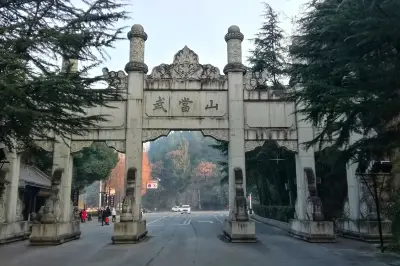
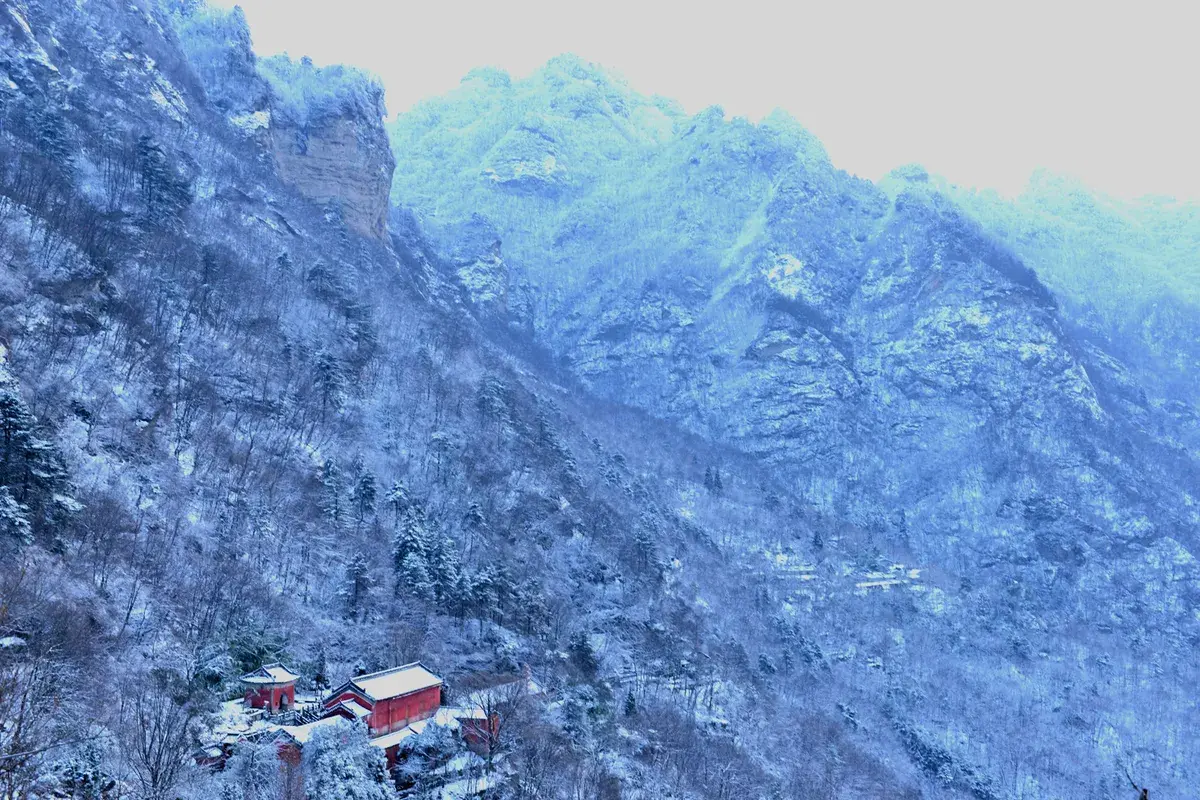
Due to the pandemic this year, all 5A scenic spots in Hubei Province waived entry tickets. Early the next morning, we bought scenic area bus tickets at the visitor center for 105 yuan per person and boarded the bus with other tourists. Snowflakes were already falling in the mountains, and snow had accumulated on the treetops, turning the forest into a white expanse. The bus wound its way up the mountain, and soon we arrived at Prince Slope (Taizipo). After climbing nearly a hundred steps, we saw a solemn and elegant gate with red walls and green tiles, inscribed with the words: "Prince Slope." Past this gate, we entered a winding corridor built by ancient architectural masters along the mountain’s contours, known as the Nine-Bend Yellow River Wall. Amid the heavy snowfall, walking through this corridor felt like a dream of twists and turns that suddenly opened up. Quietly, we arrived at the serene and elegant Fuzhen Temple (Fuzhen Guan). By then, the snow was falling even harder, like popcorn, drifting past the plaque above the main hall that read: "Yun Yan Chu Bu" (First Steps into the Mist). The bold and vigorous Yan-style calligraphy created an illusion of time and space shifting, as if time had stopped. At the time, we couldn't figure out the meaning of "Yun Yan Chu Bu," but after returning, we consulted Baidu and learned that it refers to the prince of the Supreme Emperor (Xuan Di) who first entered Mount Wudang to practice cultivation here, stepping into a realm beyond the clouds.
The next scenic spot was the Purple Cloud Palace (Zixiao Gong), a Taoist monastery where practitioners cultivate. By then, the mountains, forests, bridges, and pillars were covered in thick snow, turning the entire world white. The red-walled palace was set against the white snow, and a Taoist nun's light footsteps in the snow, accompanied by swirling snowflakes, gave a sense of traveling back to ancient times. I believe everyone at that moment forgot worldly worries and the cold of their bodies, feeling inner peace and unity with nature.
Our time at Purple Cloud Palace was short but precious. We are merely mortals, and it wouldn't be proper to disturb the Taoists' daily life for too long. The tour bus took us to the next stop: South Cliff (Nanyan). South Cliff is an important transfer point within Mount Wudang, with inns, hotels, and restaurants. We successfully booked a room and then found a restaurant for lunch. The warmth and kindness of the locals added a touch of human connection to our journey.
During the Yongle period of the Ming Dynasty, Emperor Zhu Di, who had just seized power, ordered the construction of a palace on an extremely steep cliff facing south, hence the name South Cliff Palace (Nanyan Gong). At this altitude, the snow had frozen, making the paths slippery. Under the guidance of a warm-hearted local woman, we slowly made our way along the stone steps. After the heavy snow, the peaks across from us looked like they were wearing white cloaks, facing the Golden Summit (Jinding) like guarding soldiers, majestic and grand—a breathtaking celestial scene. Everyone's spirits rose. The trees were dressed in white cotton coats, and we walked through them carefully, afraid to touch the snow on the branches and ruin the beautiful scenery.
Climbing up to the Southern Heavenly Gate (Nantian Men) and descending a few minutes later, we arrived at South Cliff Palace. From here, looking out at the highest peak of Mount Wudang, the Golden Summit at 1,613 meters above sea level, one could only marvel at the smallness of humans yet admire the bravery of the ancients who built palaces on these hundred-meter-high cliffs. What drove them? Was it the irresistible power of imperial authority or profound reverence for the divine?
The most wondrous part of South Cliff Palace is the Dragon Head Incense. The ancients built a dragon-head stone extending three meters out from the cliff, with an incense burner on top. It is said that the two dragons carved on this stone were the mounts of the Supreme Emperor. Because of this, many devout pilgrims risked crawling along the narrow dragon body to light incense at the dragon's head, then knelt and backed away. A single misstep would send them falling to their deaths. It is said that since the Ming Dynasty, countless pilgrims became fallers. By the Kangxi period of the Qing Dynasty, the government had to erect a stele warning against burning incense on the dragon head. The gods are merciful; sincerity is what matters!
On the cliff wall of South Cliff, we saw the four characters "Shou Fu Kang Ning" (Longevity, Fortune, Health, Peace) written by the famous Ming Dynasty scholar Xia Yan in the Jiajing period. The character "Shou" represented Xia Yan's loyal wish of longevity for Emperor Jiajing, while the last three characters expressed his own weariness with court political struggles, conveying that health and peace were true blessings. Today, people come to South Cliff to worship the Golden Summit, also seeking "Shou Fu Kang Ning."
At South Cliff Palace, we encountered two cats. One was completely white with odd-colored eyes, but unfortunately missing a front leg. It hobbled in the snow; if it hadn't been lying in the snow meowing hoarsely, no one would have noticed it. The other was a tabby cat, imposing and agile, often jumping onto the stone railing by the high cliff and gazing into the distance, drawing exclamations from everyone. I wonder if their ancestors have always lived here, and whether we outsiders have disturbed their cultivation and tranquility.
That evening, we ate local wild vegetables and cured meat from Wudang, and drank some yellow wine given by the restaurant owner to warm ourselves. We sighed in admiration at the snowy scenery of Wudang and felt reluctant to return.
At 5:50 the next morning, I got up alone, put on my camera and snow spikes, and stepped into the snowy night of Mount Wudang. At South Cliff, it happened to be the 16th day of the lunar month, with a full moon hanging over the Golden Summit to the west. Moonlight spilled over the forest, reflecting off the snowflakes and shimmering. The silent valley echoed occasionally with the caws of crows. Although crows are considered auspicious birds on Mount Wudang, their cries sounded mournful to me at that moment, adding to my fear. My mind struggled several times, wanting to turn back, but my feet kept moving forward quickly. Watching the sunrise from the mountain had been a long-held wish of mine.
In the mountain at dawn, it was minus 5 degrees Celsius. The bottled water in my backpack had frozen into slush. I walked alone, never stopping, not allowing myself to rest. After much effort, I found the sunrise viewing platform that the innkeeper had told me about. I endured until 7 a.m. in the snow. The sky was beginning to lighten, and red light appeared over the peaks ahead. I grew a little excited, casting aside fear and cold. Lights in the houses below flickered on, and smoke rose from chimneys. Around 7:20, the sky turned deep blue, and a line of red emerged from the mountain peaks, growing brighter, casting faint clouds in the sky. Around 7:30, the sun, like an impatient child, was eager to jump out. The magnificent scene was perfectly described by the phrase "bursting forth." Soon, the sun rushed over the mountain peak and bestowed upon me its first rays of light. My cheeks felt warm and red, but the minus 5 degrees Celsius still caused my phone battery to die. Fortunately, my DSLR was quite reliable. I pressed the shutter again and again, capturing this scene full of light and hope. My heart raced and warmed with the sun. The snow on the treetops sparkled in the light. Finally, the sun fully emerged into this temporarily cold world, emitting dazzling radiance.
On the way back, I passed the Southern Heavenly Gate. Sunlight streamed through the ancient, quiet gate. I leaned against the stone railing, basking in the sunlight, quietly feeling time pause before me. The Southern Heavenly Gate, like an old man, silently watched as six hundred years of history cycled before its eyes.
Back at the inn, my companions were worried about me because their phones couldn't get through. I happily shared the morning scenery with them, but they, having slept in, couldn't fully appreciate my feelings.
After breakfast, at 9 a.m., we set off for the Golden Summit on time. The local woman who had guided us and taken group photos yesterday was already waiting for us, leading us to her home to buy incense. Business is tough these days, and since we didn't stay at her inn, we felt we should at least do some business with her as a gesture of gratitude, reciprocity, and cultivation. Mountain people are always simple and kind. The woman walked with us for over ten minutes through the mountain, constantly reminding us to watch our steps and be careful of the slippery snow. Her inn was located under the Seven Star Tree, quiet and elegant—a wonderful spot. After buying incense, my companions continued onward. We occasionally encountered elderly porters carrying loads uphill. When we asked how much they earned per load, one elderly man missing his left arm, resting, calmly replied: "50 yuan." We were somewhat shocked, lamenting the cheapness and helplessness of human labor.
The path to the Golden Summit is called the Spirit Path (Shendao), paved by the Ming court with great effort. As we walked, we were not as cautious or reverent as the ancients; we felt more relaxed, though perhaps with less respect. While admiring the snowy mountain scenery, we eagerly anticipated reaching the Golden Summit. Passing by Langmei Temple, Yellow Dragon Cave, and Chaotian Palace, we were already drenched in sweat and our legs were heavy. We kept encouraging each other. After about three hours, we finally reached the Taihe Palace (Taihe Gong) at the foot of the Golden Summit. By then, Taihe Palace was bustling with noise: devout believers, lovers, families with children, and groups of friends all climbing the stone steps toward the Golden Summit with determination.
Six hundred years ago, Emperor Chengzu of the Ming Dynasty, Zhu Di, designated Mount Wudang as "Dayue Taihe Mountain," elevating its status above the Five Great Mountains, making it truly the number one mountain under heaven. Taihe Palace was also named "Dayue Taihe Palace," with a layout identical to the Forbidden City in Beijing, highlighting its high status. We could see that the overall architectural layout of Taihe Palace was built along the natural terrain, taking advantage of the steep mountain cliffs to achieve a solemn and majestic visual effect, making pilgrims feel the awe-inspiring dignity of the gods. The tall and magnificent palace walls encircled the summit, with three gates in the middle. The central gate was the Spirit Gate, permanently closed and accessible only to emperors; one side was the Ghost Gate, which was formless and intangible; the other side was the Human Gate, through which we entered. As we neared the Golden Summit, we grew more excited, forgetting our fatigue, and climbing the steep and narrow stone stairs felt easy.
In just over ten minutes, we reached the Golden Summit. A bronze and gold-plated palace stood before us. The summit was not large, nor was the Golden Hall (Jin Dian). Worshippers crowded shoulder to shoulder. After devoutly kneeling, we walked around the hall, touching the railings, which is said to bring health and longevity. We found the golden brick located in the southwest corner, still shining. Why this golden brick was placed here remains a mystery. The bronze statue of Zhenwu (Supreme Emperor) inside the Golden Hall has been seated for six hundred years, witnessing all the vicissitudes of the world. The incense before it never burns out, according to legend, because there is a Wind-Avoiding Immortal Pearl on the roof of the hall that can suppress the mountain wind. But this explanation seems unscientific, haha!
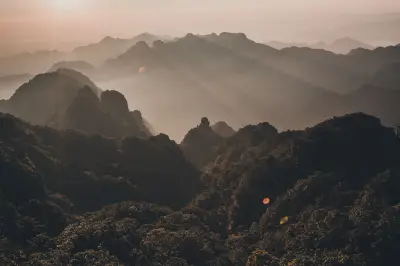
If at Prince Slope, Purple Cloud Palace, and South Cliff Palace we only felt the unity of man and nature and the Taoist principle of following the natural way, then climbing the Golden Summit was absolutely a deep veneration for Wudang and a worship and plea to the spirit of Zhenwu. Standing on the Golden Summit and looking around, we saw the surrounding mountains rushing toward the summit, forming the miraculous scene of seventy-two peaks paying homage to the great summit. We marveled at the uncanny work of nature and even more at the ingenuity and hardship of the ancients. Although the wind was biting, our hearts were burning with passion.
Standing on the top of the Golden Summit, our travelogue is almost at its end. The title is "Seeking the Dao at Wudang," but in reality, we haven't delved too deeply into the relationship between Wudang and the Dao. Wudang is a mountain with beautiful scenery and profound Taoist culture. So, what is the Dao? "The Dao begets one, one begets two, two begets three, three begets all things"? Only through our future lives can we explore and perceive this.