Traveling Hubei by High-Speed Rail, from Wuhan to Wudang (Stop 7: Wudang Mountain)
All photos in this article were taken by the author of "Black and White Touch". All rights reserved. Unauthorized use is strictly prohibited.
Traveling Hubei by High-Speed Rail, from Wuhan to Wudang (Part 1: Wuhan, Jingzhou)
Traveling Hubei by High-Speed Rail, from Wuhan to Wudang (Stop 3: Yichang)
Traveling Hubei by High-Speed Rail, from Wuhan to Wudang (Stop 4: Enshi)
Traveling Hubei by High-Speed Rail, from Wuhan to Wudang (Stop 5: Shennongjia)
Traveling Hubei by High-Speed Rail, from Wuhan to Wudang (Stop 6: Xiangyang)
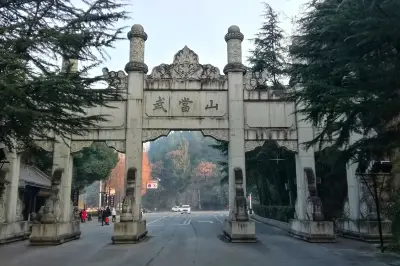
Taking a high-speed train from Xiangyang northwestward, in less than an hour I arrived at Shiyan, where the renowned Wudang Mountain is located.
There is also a Wudang Mountain in the small county town of my hometown, and there should be many Wudang Mountains across the country. Any mountain bearing the name "Wudang" is sure to be a Taoist sacred site, probably because the Taoist Zhang Sanfeng, active during the late Yuan and early Ming dynasties, founded the Wudang school of Taoism. This school, besides cultivating the mind and nature, also emphasizes qigong and martial arts. Zhang Sanfeng was proficient in both literary and martial arts; as a youth he passed the imperial military examination, then resigned from office to live in seclusion, dedicating himself to martial arts and Taoist cultivation. He integrated Wudang martial arts and promoted Taijiquan, eventually becoming a grandmaster. The Wudang school rose to fame, standing alongside Shaolin, Emei, and other martial arts schools as a sacred destination for martial arts practitioners and a major force in the world of wuxia novels.
The place where Zhang Sanfeng founded the Wudang school is precisely the Wudang Mountain in Shiyan, the most famous among all the Wudang Mountains. This mountain is the Taoist site of the True Martial Emperor (Zhenwu Dadi). With its exceptional scenery and flourishing Taoist tradition, it has been favored by imperial courts since ancient times, honored as the "Imperial Family Temple" and revered as "all four great mountains bow in homage, all five sacred peaks pay tribute" and "the unparalleled wonderland on earth, the foremost immortal mountain under heaven."
For the final stop of my Hubei trip, let us experience Taoist culture on the "foremost immortal mountain" and enjoy the unparalleled scenery in the "unparalleled wonderland."
A trip to Wudang Mountain can be done in one day. As shown in the map below, there are fewer than ten major scenic spots. Starting in the morning and taking the scenic bus uphill, with a compact itinerary, you can tour them all in a day. However, I recommend arranging two days, because the night sky over Wudang and the sunrise at Golden Summit are worth staying overnight on the mountain.
I arrived at the foot of the mountain at noon. In the afternoon, I visited Mozhenjing (Needle-Honing Well), Xiaoyao Valley (Carefree Valley), and Zixiao Palace (Purple Cloud Palace), staying overnight at Nanyan (South Cliff). Before dawn the next day, I climbed to Golden Summit to watch the sunrise, then returned to Nanyan to visit Nanyan Palace, took a bus to Taizi Slope, and finally toured Yuxu Palace at the foot of the mountain. The following text will present the main attractions of Wudang Mountain in this order.
Mozhenjing is the first stop on Wudang.
During the pandemic period, there were few tourists. Only I got off the bus at Mozhenjing among the handful of passengers, which made me wonder if this spot was not worth visiting...
After visiting, I felt sorry for those who sped away: Mozhenjing is not a well but a Taoist temple, small in size, yet it is an important exhibition site of Wudang Taoist culture. Here you can learn the legend of how the Wudang main deity, the True Martial Emperor, cultivated Taoism and became immortal. If you skip the murals and texts here, you might not recognize the main deity in the hall on Golden Summit, which would be a pity.
Mozhenjing is also called the "Temple of Taoist Integrity," originally built during the Kangxi reign of the Qing dynasty. The temple's architecture is compact and delicate, while outside the temple, peaks embrace the view, surrounded by verdant forests, bamboo offering cool shade, and plum blossoms sending subtle fragrance—a scenic wonder where "bamboo and moon, plum and wind beautifully complement each other."
The name "Mozhenjing" comes from the legend of "grinding an iron rod into a needle."
Most people know the "grinding an iron rod into a needle" story associated with Li Bai, but there is another version of this tale, whose protagonist is the True Martial Emperor.
According to legend, the True Martial Emperor was originally the prince of the Pure Land Kingdom in the celestial realm. As a child, he studied Taoism on Wudang Mountain, but his will wavered and he wanted to leave the mountain and return to secular life. His master, the Primordial Lord of Purple Energy, transformed into an old woman (Laomu) and enlightened him by grinding an iron rod into a needle at this spot. The True Emperor was moved, repented, and returned to the mountain to practice diligently, eventually becoming a deity capable of vanquishing demons and commanding mountains and waters.
Inside the Taoist Integrity Temple, there is a Laomu Pavilion, and in the pavilion there is a well; the well water is called "Laomu Holy Water." Laomu Pavilion not only commemorates the "grinding an iron rod into a needle," but the well water also has a deeper meaning: the "well" implies order and rules. Well water may not be full, but it can be drawn daily without exhaustion; if full, it overflows, like those who greedily hoard wealth will eventually lose the right to draw from the well.
The temple also features the Patriarch Hall, Qingyuan Hall, and a Taoist Integrity Culture Corridor. Qingyuan Hall is the main exhibition hall of Taoist integrity culture, displaying over a hundred Taoist precepts objects, murals, steles, and statues. Among them, ancient murals—Resisting Temptation of Beauty, Liu Hai Playing with the Toad, Abandoning Wealth and Honor, Grinding an Iron Rod into a Needle—depict the entire process of the True Martial Emperor's cultivation and ascension.
Mural of Liu Hai Playing with the Toad: Liu Hai was one of the Five Northern Patriarchs of Taoism. At the beginning of his cultivation, his master was extremely greedy, and due to his avarice, he was framed and fell into an ancient well. Liu Hai tried various ways to rescue him but failed. Then he tempted his master with a string of coins. The master, tempted by the sight of money, tightly grasped the string and was pulled out of the well, transforming into a three-legged toad. (There are multiple versions of Liu Hai Playing with the Toad.)
The cultural corridor outside the temple is built along the mountain slope, connecting Fangyou Pavilion, Sifan Pavilion, Dianhua Pavilion, and Chengdao Pavilion into a corridor. Along the corridor are hand-painted illustrations of the Hundred Filial Piety, with bright colors and vivid forms, allowing visitors to reflect on life and cultivate their character during the tour.
Taking the bus further south uphill from Mozhenjing, I arrived at Xiaoyao Valley.
Xiaoyao Valley is a fascinating natural scenic spot on the mountainside of Wudang. Here, ancient trees reach the sky, dense shade blocks the sun, streams murmur, and flowers and fruits are everywhere. If time permits, you can hike all the way from here to Qiongtai, a distance of about 9 kilometers, and then take the cable car to Golden Summit. Unfortunately, on the day I went, the latter section was closed, but even just in Longquan Lake, Dujuan Creek, and Macaque Valley, I was able to experience the carefree essence of Xiaoyao Valley.
Here, the streams and lakes complement Taoist temples, strange rocks and macaques fill the valley, blending pristine natural beauty with cultural elegance, spectacular landscapes with the wonder of martial arts—it is truly an ideal realm in wuxia novels. Therefore, it serves as one of the filming locations for Wudang Mountain movies and TV dramas; many famous works have been shot here, such as "The Karate Kid," "The White Haired Witch," "The Assassin"...
The scenic area features a statue of Zhang Sanfeng performing Taiji. I visited in autumn, and fallen leaves were scattered at Zhang Sanfeng's feet, reminding me of the movie "Tai Chi Master" starring Jet Li. In the film, Junbao (Zhang Sanfeng's original name) after enlightenment practices Taiji in the forest; his fist wind swirls, leaves fly, "The ultimate and non-ultimate become Taiji, a wisp of true qi hides in the chest"—ethereal, elegant, transcendent. Looking at the statue, though aged with long beard, its free and easy spirit still inspires admiration.
Taoism advocates "non-action," "naturalness," and "non-contention," as the song "Follow Fate" from "Tai Chi Master" sings: "Push with both hands, neither black nor white, the sky and sea vastness hold my style... Without victory, how can there be defeat? Without going, how can there be coming? No sword in hand, no dust in heart, follow fate with the wind, only then is my bosom..."
The following scenery embodies this unrestrained and transcendent realm:
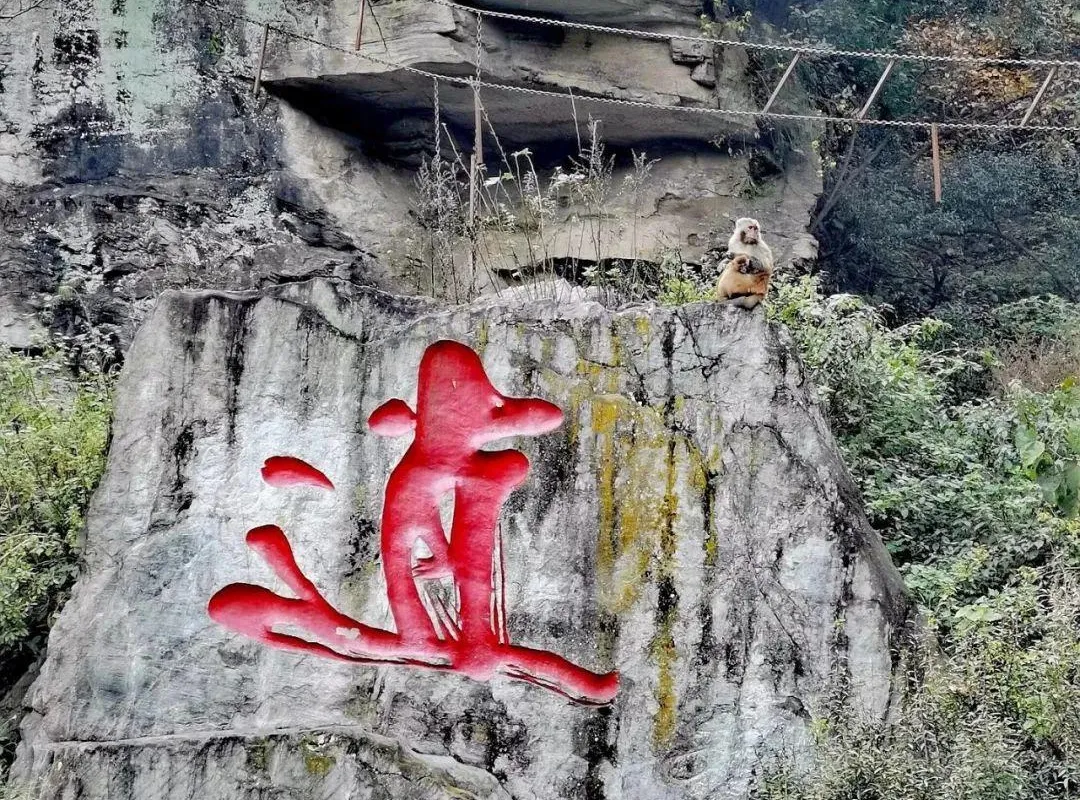
The photo above was taken in Macaque Valley, where a large group of macaques lives. As soon as tourists arrive, they come down the mountain to beg for food. One macaque, however, sat obediently on a Taoist rock, seemingly listening to Zhang Sanfeng's discourse, but its restless nature soon made it look around, eager to find some excitement.
In such a green wilderness wonderland, even worldly people can temporarily let go of mundane troubles and experience a moment of peace and tranquility.
From Macaque Valley, following Dujuan Creek downstream leads to Longquan Lake, where the water is extremely clear, and the colors of autumn are fully reflected in the lake.
The lake features wooden walkways and stone bridges. The stone bridges separate lake surfaces at different levels, while the wooden walkways lead to thatched cottages deep in the forest. The lakeshore is surrounded by dense autumn hues, and the lake center is crystal clear. Walking through such beautiful scenery, one's mood becomes carefree and joyful.
Elegant swans glide on the lake, unhurried, mirroring the mood of visitors.
Under the bushes and on the rocks by the lake, there are many Wudang martial arts sculptures, depicting flying over eaves and walking on walls, stirring sand and stones, creating a mysterious and chivalrous atmosphere.
A woman in white practiced Taiji on the plank road, each move graceful and spirited, yin and yang in harmony.
On the way back to the bus stop, I saw this little monkey, out of place with the scene, tied alone to a chain, looking pitifully at visitors. Had it angered its trainer or bullied a tourist, imprisoned here as punishment?
Zixiao Palace is located at the foot of Zhanqi Peak between Xiaoyao Valley and Nanyan. It is the center of Taoist activities on Wudang Mountain, historically an imperial temple.
Zixiao Palace was first built during the Xuanhe era of the Northern Song dynasty (1119-1125). It was rebuilt in the Yuan dynasty, named "Zixiao Yuansheng Palace." In the tenth year of Yongle (1412) of the Ming dynasty, it was expanded and granted the name "Taixuan Zixiao Palace." Built along the mountain, the palace has a layout that is sparse in front and dense in the rear, with layered terraces presenting a solemn atmosphere, rows of halls and towers, red walls and green tiles—grand and majestic, exuding the aura of an imperial Taoist site.
Outside Zixiao Palace, there is a winding stream and a stone bridge. Crossing the bridge, one enters the East Heavenly Gate, where one can see the Dragon Tiger Hall, Imperial Stele Pavilions, Shifang Hall, Zixiao Hall, and Fumu Hall (Parents' Hall). The most striking is Zixiao Hall with double eaves and nine ridges, built on multiple terraces, enshrining the True Martial Patriarch.
The famous Wudang Quan and Wudang Sword both originated at Zixiao Palace. Today, the Taoist priests here still teach boxing and practice martial arts. With luck, you might see young Taoists performing Wudang Quan on the square, their figures agile, steps varied, earning applause.
Behind Zixiao Hall is Sanqing Pavilion, below which is Fumu Hall, built in the Yuan dynasty, enshrining the Holy Father and Holy Mother. The tenet of Wudang Taoism is loyalty to the country and filial piety to parents, so every Taoist temple has a Parents' Hall.
On one side of Fumu Hall is the former site of the Red Third Army Headquarters. In May 1931, He Long led the Red Third Army to Wudang Mountain, establishing the northwestern Hubei base area, using Zixiao Palace as a rear hospital and headquarters.
After touring Zixiao Palace, it was evening. I took the bus to Nanyan to stay overnight, preparing to get up early the next morning to climb Golden Summit for sunrise.
[Sunrise at Golden Summit]
In November, sunrise on Wudang Mountain occurs around 7 a.m. It takes about two hours to climb from Nanyan to Golden Summit, so I set off at 4 a.m.
There were no lights outside, but fortunately, there were a few companions, all using their phones for illumination, so I didn't feel lonely. The road was pitch black, while the stars shone brightly in the sky. In the city's night sky, stars are rarely seen, but on Wudang, they were dense. The starlight was not bright, which made the moon look huge and luminous. As I climbed, I hummed, "Stars light the lamp, illuminating my future..."
In the dark night, the Big Dipper was easy to identify: Tianshu, Tianxuan, Tianji, Tianquan, Yuheng, Kaiyang, Yaoguang formed a giant ladle hanging upside down in the silent world, silently guiding the direction.
Modern people don't need the Big Dipper for direction; using phone navigation, I easily reached Golden Summit.
Although the distance was nearly five kilometers, and the climb was not exactly easy, for some reason, the whole journey felt effortless. Perhaps the novelty of night climbing, or the fact that not seeing the road reduced mental fatigue—at any rate, I reached Golden Summit faster than I expected.
At that time, the moon was still high in the sky, while the sun's light was already invading the night. The cold tones gradually receded, warm tones rose, and the stage of heaven and earth was about to be renewed.
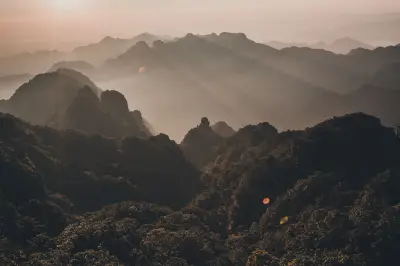
Close to 7 a.m., at the distant edge of the mountains, at the boundary between mist and clarity, a red sun slowly emerged. It wasn't exactly "slowly," because if you looked away and then back at the sun after a moment, you would see the entire sun already in plain sight. Only by staring fixedly at the rising sun would you not miss the whole process from "just revealing a tip" to its full appearance. Although I had watched sunrises several times before, I still felt a surge of excitement each time, witnessing a new beginning.
During the sunrise, the crescent moon was still hanging there. Thus, the sun and the moon met at this moment. Standing at that distance, the moon and the sun appeared almost the same size—could this be counted as "sun and moon shining together"?
As the sun rose higher, on the opposite peak, I suddenly saw a man standing with a zither on his back, playing in the sunrise on the mountaintop. That person had artistic flair indeed.
The kitten under the temple eaves, however, was not so lively, squinting as if still dreaming.
After a while longer, the lingering mist of the night was swept away, the crisp freshness of morning arrived, and the palaces and peaks on Tianzhu Peak revealed their shapes.
Golden Summit consists of structures such as Zhuanyun Hall, Taihe Hall, Huangjing Hall, and Zijingcheng (Purple Forbidden City). It is the place with the densest and most magnificent temples on Wudang Mountain. From the sunrise viewing platform to Zijingcheng, one needs to climb a staircase.
Zijingcheng is located at the highest point of Tianzhu Peak. It was built by imperial order in the 17th year of Yongle of the Ming dynasty (1419). It winds around Tianzhu Peak and has four heavenly gates—east, south, west, north—and is known as the "Heavenly Palace above the Clouds, Pure Capital beyond the Skies."
Ascending from the South Heavenly Gate, one passes Lingguan Hall, which enshrines a statue of Lingguan with three eyes, capable of discerning human good and evil, specifically in charge of inspecting the heavens and the mortal world.
Behind Lingguan Hall, climbing the Nine-Petal Steps, one arrives at the Golden Hall.
The Golden Hall was built by imperial order in the 14th year of Yongle (1416), located at the summit of Tianzhu Peak at an altitude of 1612 meters. Inside, a gilded bronze statue of the True Martial Emperor is enshrined, with golden lads and jade maidens holding books and treasures standing on either side, water and fire generals holding flags and swords guarding the flanks. Below the altar are the tortoise and serpent generals. Above hangs a golden plaque with the imperial inscription "Golden Light and Marvelous Form" by Emperor Kangxi.
Many people gathered around the side of the Golden Hall out of curiosity. They were looking at this gold brick on the outer wall:
Behind the Golden Hall is Fumu Hall, built in the 42nd year of Kangxi (1703), enshrining the parents of the True Martial Emperor—King Mingzhen of the Pure Land Kingdom and Queen Qiongzhen, reflecting the importance Wudang Taoism places on filial piety.
Looking down from Golden Summit, the temple complex is built along the mountain, ingeniously arranged, complementing the surrounding peaks. "Heavenly created Xuanwu" is breathtaking.
Descending from Golden Summit, passing through the three Heavenly Gates, I arrived at Chaotian Palace.
Chaotian Palace was first built in the Yuan dynasty, repeatedly destroyed and rebuilt. In the 10th year of Yongle (1413), 17 halls including the Xuan Emperor Hall and side halls were built by imperial order. Upon completion, it was granted the name "Chaotian Palace." According to legend, Chaotian Palace is regarded as the celestial realm, the boundary between heaven and the mortal world.
Further down from Chaotian Palace, I reached Huanglong Cave. There is a natural rock shelter, and under it a divine spring. The cave enshrines Huanglong, Lingguan, and the Medicine King deities. The path leads to seclusion, mysterious and wonderful.
Continuing downward, I arrived at Langmei Immortal Shrine.
Langmei Immortal Shrine was also built in the Yuan dynasty, later destroyed by war, then rebuilt by imperial order in the 10th year of Yongle and restored in the Jiaqing era of the Qing dynasty. It gets its name from a legend: When the True Martial Emperor was cultivating on Wudang, his will faltered and he went down the mountain midway. After being enlightened by the Primordial Lord of Purple Energy, he returned to continue cultivation. On the way, he broke a plum branch and inserted it into a lang tree (a type of oak), vowing that if he achieved enlightenment, it would bloom and bear fruit. Later, he succeeded in cultivation, and the branch indeed blossomed and bore fruit.
The shrine enshrines the True Martial Emperor and Golden Lads and Jade Maidens.
After Langmei Immortal Shrine, I returned to Nanyan, the starting point of my early morning climb. Next, I went to visit Nanyan Palace.
On the way to Nanyan Palace, I encountered a quiet dog basking in the sun, looking adorably dazed:
On Wudang Mountain, I met many small animals: the Taoist-listening macaque, elegant swans, sleepy kitten, silly dog... At Tianyi Lake not far from Nanyan Palace, I learned a wonderful legend about crows: Crows, often seen as omens of bad luck, are considered sacred birds on Wudang. Hearing a crow's caw or seeing one fly is believed to bring good luck. This is because, according to legend, when the True Martial Emperor was cultivating on Wudang, he often got lost in the dense forest, and crows would guide him from the air. After the True Emperor attained Tao and ascended, he appointed crows as deities. During the Yongle era of the Ming dynasty, when the imperial court extensively renovated Wudang, a Crow Temple was built by imperial order, enshrining crows as honored deities. Hence, crows are known as the "sacred birds of Wudang." There is also a spectacle called "Crows Receiving Food"—tourists toss corn or other food into the air and shout "Crows, receive food!" and flocks of crows will circle and come. This is one of Wudang's famous eight dynamic scenery.
From here, through the dense forest, one can already see Nanyan Palace clinging to the mountainside.
As early as the Tang and Song dynasties, Taoist priests practiced here on the cliffs. The scale was expanded in the Yuan dynasty, and in the 10th year of Yongle of the Ming dynasty, palaces were built by imperial order, granted the name "Dasheng Nanyan Palace." Because of the pleasant scenery and extraordinary peaks, it is known as the "Palace Hanging on Silk Walls."
The main hall of Nanyan Palace is Xuan Emperor Hall, built on three layers of high stone platforms. Inside, seated and standing deities are placed on Sumeru thrones, majestic and spectacular.
Behind Xuan Emperor Hall, on a cliffside corridor, there is a unique sight—the Dragon Head Incense Burner. It projects directly over the precipice, facing Golden Summit, as if in worship. It is one of Wudang's famous dangerous attractions, known as the "Number One Incense Burner under Heaven."
According to legend, ancient Taoist believers, to express their piety to the gods, risked climbing onto the dragon's back to pray and burn incense. Countless people fell to their deaths. In the 12th year of Kangxi of the Qing dynasty (1673), Cai Yurong, Governor of Huguang, ordered a ban on burning incense at the Dragon Head and erected a stele to warn against it, putting an end to the practice.
A walkway on one side of the Dragon Head Incense Burner leads to natural wonders like the Dressing Table and the Ascension Cliff, which are not only delightful scenic spots themselves but also provide platforms for viewing the beautiful landscape of Wudang Mountain.
Ascension Cliff is named after the place where the True Martial Patriarch ascended to immortality. This peak is also called the "Natural True Martial Dressing Image." According to legend, the True Martial Emperor lived in seclusion on Wudang Mountain for 42 years. On the morning of September 9th (lunar), he suddenly encountered an immortal who transformed into a beautiful young woman, combed his hair, enlightened him, and then he ascended to the celestial realm, achieving success and fulfillment. This place symbolizes rapid advancement and promotion step by step.
Taizi Slope is a popular scenic spot on Wudang, because the Nine-Bend Yellow River Wall here has bright colors, providing a beautiful photo backdrop for many ladies.
Taizi Slope, also called "Fuzhen Temple" (Temple of Returning to Truth), leans against Lion Mountain and faces a thousand-zhang deep ravine. It has a peaceful environment, beautiful scenery, and well-arranged buildings, making it a must-see for photography enthusiasts.
Taizi Slope was built by imperial order in the 10th year of Yongle and was renovated three times during the Qing dynasty. It is one of the larger Taoist temples in the Wudang complex, gathering four distinctive features: the Nine-Bend Yellow River Wall, One Pillar with Twelve Beams, One Li with Four Gates, and the Fragrance of Cassia for Ten Li.
Upon entering Taizi Slope scenic area, the first thing to see is the Nine-Bend Yellow River Wall—a red winding wall stretching 71 meters along the mountain. The smooth, curved wall undulates like waves, like a dragon coiling, with graceful arcs that are both pleasing and imposing.
At the end of the Nine-Bend Yellow River Wall is a spacious courtyard enclosed by three main halls. Currently, it hosts calligraphy and painting exhibitions and Wudang Mountain photography works.
On the left side of the main courtyard lies a serene, elegant compound of overlapping courtyards. First one sees Wuyun Tower and opposite, the Scripture Library building, with red walls and green tiles, both ancient and vibrant.
Wuyun Tower is the tallest wooden structure among Wudang's ancient buildings. Its design is ingenious, using 12 cross-stacked beams to scientifically distribute loads, achieving harmony between construction technique and functional use, saving materials while increasing space. It is called "One Pillar with Twelve Beams."
On one side of Wuyun Tower is the Prince's Study Hall. According to legend, this was where the prince of the Pure Land Kingdom (the True Martial Emperor) studied and sought Taoism when young. This is also the origin of the name "Taizi Slope" (Crown Prince Slope). Scholars of successive dynasties came here to seek teachers, such as Zhang Shixun of the Song dynasty, who studied at Taizi Slope as a child. The Taoist priest enlightened him with Taoist teachings; Zhang studied diligently and later became Chief Minister, achieving great fame.
The hall enshrines a statue of the prince. Many parents bring their school-age children to worship here, hoping for academic success.
Yuxu Palace is located at the foot of Wudang Mountain, about 2 kilometers from the mountain gate. On my way to the bus station after descending the mountain, I passed by and took a look.
Yuxu Palace, fully named "Xuantian Yuxu Palace," was built in the 11th year of Yongle of the Ming dynasty (1413), originally having 2,200 halls and temples. It was the largest unit among the ancient building complex of Wudang Mountain, with strict rules and numerous courtyards.
However, most of these grand buildings were destroyed during the Qing dynasty. The remaining structures mainly consist of two palace walls totaling 1,036 meters in length, two stele pavilions, and the Parents' Hall and Yuntang rebuilt in the Qing dynasty. The ruins today are still very impressive and worth seeing.
The end of my Wudang Mountain journey also marked the end of my entire Hubei trip. The spring cherry blossoms in Wuhan are captivating, but the land of Jingchu has even more lingering beauties—the landscapes of the Three Gorges, tales of the Three Kingdoms, songs and dances of the Tujia people, legends of Shennong, the wondrous karst caves and canyons, the morning mist of the Nine Lakes, the sunrise at Wudang...
Writing this article, several months have passed since my Hubei trip, but some beautiful moments remain vivid in my mind: the charming golden monkeys, the sensitive and gentle sika deer, the ethereal morning fog and joyful swans at Dajiuhu Lake, the stars lighting up the night on Wudang, and the macaque listening to Taoism...
Inevitably, there were discomforts and fatigue on the road, but what makes it worthwhile is that somewhere, the beauty of the world has forever stayed in my heart. It can serve as material for future boasting, and more precious, as bricks and tiles for the spiritual world, allowing us, amidst mundane daily routines and moments of cynicism and pessimism, to hold on to a belief that life is worth living."