A 9-Day Trip to Wuhan, Xiangyang, Wudang Mountains in Hubei and Yueyang in Hunan for Family Visits and Historical Exploration
Trip Overview: On November 7, 2020, we left Shenyang for Wuhan at 8:40 am. After lunch at the Garden Expo (lotus root soup, choy sum, chicken, freshly cooked Wuchang rice), we toured the Garden Expo. Then we went to the Wuhan Riverbank to see the reeds and the chrysanthemum exhibition. After dinner (Tan Duck Blood Hotpot), we stayed at my cousin's home.
On November 8, 2020, after breakfast (sweet tofu pudding, doupi, pan-fried buns, etc.), we visited the Yellow Crane Tower, then crossed the Wuhan Yangtze River Bridge to Guiyuan Temple. For lunch we ate street snacks at Hubu Alley, then visited the Hubei Military Government (known locally as the 'Red Building'), East Lake Pear Garden, the Greenway, Moshan Chutian Pavilion, Zhurong Star Observation, and Zhu Bei Pavilion. After dinner we stayed at my cousin's home.
On November 9, 2020, Wuchang–Yueyang. Bus 22 to Yueyang Tower scenic area, Baling Square, then bus 55 to Yueyang East Station–Wuhan Station. We checked into the Wuhan High-Speed Rail Hanting Hotel Apartment and had dinner nearby.
On November 10, 2020, after breakfast we took a taxi to the Hubei Provincial Museum, then a taxi to Gudu Temple. After a vegetarian lunch, we toured Gudu Temple, then took a taxi to Hankou Station–Xiangyang East. Bus K12 to Xiangyang Station, checked into Home Inn Xiangyang Station. After dinner at Happiness Road beef noodles, we took Bus 1 to Tangcheng for a night tour.
On November 11, 2020, after breakfast at Home Inn, we took Bus 512 to Gulongzhong. Lunch at Zhuge Restaurant. We then took the scenic shuttle to Guangde Temple, then took Bus 512 to Shizi Street stop, visited the Xiangyang Museum to see the bronze horse, Xiangyang Ancient City, and Furen City. We took a taxi to Migong Temple, then Bus 14 back to Xiangyang Station. Dinner at a Hunan restaurant, stayed at Home Inn.
On November 12, 2020, after breakfast at Home Inn, we took the train from Xiangyang Station to Wudangshan Station, then Bus 203 to Huoshen Temple stop, checked into Wudang Shuidu Hotel. After lunch, we visited Yuxu Palace (closed for renovation), then walked along the pedestrian street to Wudang Museum, then took Bus 206 to Yuzhen Palace (closed for renovation), Xuan Yue Gate, and Xiangfu Nunnery (under construction). Bus 206 back to Huoshen Temple stop, rested a bit, then dinner on the pedestrian street, bought bread and fruit, and returned to the hotel.
On November 13, 2020, after breakfast we left some luggage at the hotel, took Bus 203 one stop to Wudang Mountain. At the visitor center we bought scenic shuttle tickets, then took the shuttle to Taizipo, then to Xiaoyao Valley, then to Zixiao Palace. We walked around; the prices for water and lunch nearby were not expensive, truly the cheapest among all famous scenic spots as netizens said. We had brought bread and fruit and didn't want to carry them, so we ate some for lunch. Actually we could have had lunch at the farmhouse below Zixiao Palace, the price was no higher than in Wudangshan Town. Took the shuttle to Nanyan, toured Nanyan scenic area, picked up our bags, rested at Langmei Shrine, then hiked uphill via the ancient Qing Dynasty sacred path to Fenjining, passing through Xiao Wudang, Huanglong Cave, and Chaotian Palace. My wife rested while I climbed to Golden Summit Diaozhongtai to watch the sunset. Returned to Fenjining for dinner (shredded bamboo shoots with pork, egg noodles, rice).
On November 14, 2020, I got up early to watch the sunrise and sea of clouds at Fenjining. After breakfast finishing the remaining bread and fruit, we said goodbye to the host and climbed to Golden Summit. At the summit we enjoyed the sea of clouds, watched Taoist masters practicing swordplay on the peak, and toured Taihe Palace. We took the cable car down to Qiongtai Zhongguan, visited Qiongtai Zhongguan, then took the scenic shuttle back to the visitor center. After booking the 3:30 pm airport bus, we had beef noodles for lunch. Then we returned to Shuidu Hotel, dropped off luggage, and took Bus 206 to Tai Chi Lake (Jinhua Lake, part of Danjiangkou Reservoir). Time was limited; after enjoying the lake, we took Bus 206 back to Huoshen Temple stop. We visited two turquoise shops and bought one raw stone while learning about turquoise quality. From Huoshen Temple stop we took the airport bus to Shiyan Wudangshan Airport, flew from Wudangshan to Dalian at 6:00 pm, arriving more than 20 minutes early again. We walked out of the airport and checked into Home Inn Dalian Airport. This was our first time in Dalian since my daughter graduated; the last time was during the May Day holiday in 2019 when we stayed at Dongbei University of Finance and Economics (DUFE) and accompanied her to see cherry blossoms. Note: Those with average physical fitness can reverse the above itinerary (mostly downhill), but the way we did it gives a sense of landscapes becoming more beautiful and spectacular.
On November 15, 2020, after breakfast at Home Inn, we took Bus 710 to Dalian New Mart, dropped luggage at the train station, then took Bus 23 to Xinghai Bathing Beach. We toured Xinghai Park, strolled by the sea—Xinghai was still the same, the waves sounded the same—but our daughter is now studying at Xiamen University and is no longer by our side here. Then we went to her undergraduate alma mater, Dongbei University of Finance and Economics. We had planned to enjoy autumn colors on campus and then have lunch at Bashu Renjia, but the school was still not open to the public, so we had to go around and take a taxi via the student apartments to Bashu Renjia. After lunch, we took Bus 23 from Zhishuyuan Student Apartment stop back to Youhao Square, then strolled to the train station. On the platform, I took out my phone to snap a picture of the high-rise buildings across from the station. Although the Dalian in my mind is still as beautiful as ever—the autumn river, golden ginkgo, full autumn atmosphere, clean streets—our daughter no longer lives in this city, and we may not visit often anymore. Nevertheless, this was the city where she worked hard for four years and where we visited most often. Bless Dalian, goodbye Dalian!
I had long planned to visit my uncle in Wuhan, but the distance and many affairs at home and work delayed me. In summer 2018, my daughter was accepted for a graduate push interview at Zhongnan University of Economics and Law in Wuhan, and we had already bought plane tickets. My cousin (uncle's daughter) was ready to pick us up, but later, because of a conflict with the push interview at Southwestern University of Finance and Economics, we canceled the trip. That disappointed my uncle's family a lot. Since the end of last year, the COVID-19 pandemic starting in Wuhan worried us, but luckily my uncle's family and relatives were safe. At the end of January this year, my younger uncle (father's younger brother), who had always been healthy, passed away from illness. Now among my father's four siblings, only my uncle (the eldest) survives. He is 83 years old and not as healthy as before, so I wanted to visit him as soon as possible.
Because my wife had a 24-hour caregiver for her mother since October and we both had unused annual leave, we booked the November 7 flight from Shenyang to Wuhan. Early in the morning at 5:30, we took the first airport bus from Anshan to Shenyang Taoxian Airport and flew directly to Wuhan. The flight scheduled to arrive at 12:10 actually arrived more than 40 minutes early—the first time I experienced an early arrival. Surprisingly, the return flight from Wudangshan to Dalian was the second early arrival, but that's later. Luckily, my cousin and her husband were waiting at the airport. It was emotional to see them. They cared about us all the way, and my cousin's husband introduced landmarks and scenery along the way. The temperature in Wuhan was over 20°C, no cold at all, many flowers still blooming, and trees green. To make our first visit to Wuhan enjoyable, my cousin put a lot of thought into it, calling and messaging us repeatedly to ask what we wanted to eat and see, and sent us a full schedule of planned attractions.
After picking us up at Tianhe Airport, they drove directly to Wuhan Garden Expo. After a carefully arranged lunch in the restaurant inside the Expo parking lot, we entered the park. The Garden Expo is huge, so we took the electric sightseeing car for a quick overview, saving time for the 31,000-square-meter Yangtze River Civilization Museum, one of the most distinctive pavilions of the Expo. The museum has multiple halls including the Preface Hall, Into the Yangtze River Hall, Perceiving Civilization Hall, and Dreamlike Yangtze River Hall, featuring a large collection of objects, specimens, pictures, and cultural relics. According to information, it is the first museum to display the natural ecology and human civilization of the Yangtze River basin. The giant silicified wood and dinosaur fossils in the Natural Museum were also stunning and left a deep impression. Reflecting on the vicissitudes of the world, I couldn't help feeling the smallness of ourselves and the swift passage of time.
After the tour, we went directly to Hankou Riverbank, where a chrysanthemum exhibition was being held. The chrysanthemums were varied and colorful. Chrysanthemums blooming in autumn have long been praised by ancient and modern literati, especially Tao Yuanming's verse: 'Plucking chrysanthemums under the eastern fence, leisurely seeing the southern mountains.' Many people yearn for such a life. Now, standing on the vast riverbank facing the mighty Yangtze, with tall reeds on the bank and chrysanthemums vying for beauty, I thought that just this morning we were in Liaoning, nearly 2000 kilometers away, but now in the evening we were on the Yangtze shore in Wuhan. Modern technology truly brings great convenience to life.
( Hankou Riverbank )
At dinner, we finally met my uncle and my male cousin. I hadn't seen my uncle for over ten years; he had aged significantly. We had so much to talk about—too much to write here. The dinner was at Tan Duck Blood Hotpot, for which my cousin's child had queued early. Even after queuing, we waited outside for a while, during which the restaurant arranged a face-changing performance to ease the waiting guests' impatience. It was refreshing.
On the morning of the 8th, my cousin and her husband took us out for 'guozao' (breakfast). In Wuhan, few people cook breakfast at home, which is very different from Liaoning. Here at home, we usually eat at the work cafeteria or at home, and there aren't as many breakfast shops on the street as in Wuhan. They arranged doupi, sweet tofu pudding, pan-fried buns, and other breakfast items not common in our area. While tasting the different flavors, we also experienced different habits and folk customs. During breakfast, I thought about how desolate this lively, prosperous city must have been during the lockdown. Fortunately, everything is over now, and Wuhan has regained its vitality.
When we arrived at Yellow Crane Tower, there were still many empty parking spaces. The scenic area and its surroundings are well-planned, with excellent management and reasonable tour routes. Ascending and descending the tower in order, we looked far into the distance from the top. Naturally, Cui Hao's poem 'The sage on yellow crane was gone amid clouds white. To what avail is Yellow Crane Tower left here?' came to mind. We saw the leisurely river, the long bridge spanning it, the confluence of the Han River, and the three towns of Wuhan. Especially when I saw Sa Ying'a's couplet: 'One tower gathers the spirit of the three Chu regions, clouds and cranes both gone, a horizontal flute remains; two rivers merge with hundreds of streams, past and present endless, the great river flows,' I deeply understood the author's vision and talent. When we descended, there were already many visitors lining up, but due to the well-planned route, there was no congestion or chaos. Just after descending, we caught a live dance performance in front of the tower—very beautiful—which brought our visit to Yellow Crane Tower to a climax.
Because of traffic restrictions, we took a taxi from Yellow Crane Tower via the Yangtze River Bridge to Guiyuan Temple. The taxi driver, hearing we were from Liaoning, immediately said: 'You must visit the Hubei Provincial Museum in Wuhan; it's really worth seeing.' This was the first time I had taken a taxi and the driver's first recommendation was a museum—I was quite surprised. Guiyuan Temple was not as grand as I imagined, though its grounds are large. The famous Arhat Hall was under renovation and closed. After the tour, we took a taxi to Hubu Alley. To our surprise, the driver, upon hearing we were from out of town, also said we should go to the Provincial Museum. That astonished us! When taxi drivers in a city recommend a museum, it shows that Jingchu culture has deeply permeated everyone. My cousin's husband also said we should really go, but we had too little time. I quickly replied: 'It's okay; keeping some regrets will make us want to come again.'
Hubu Alley snack street is not long, but it has many kinds of snacks. One that left a deep impression was lotus root starch—with peanuts, sesame, nuts, etc.—sweet but not greasy, crystal clear, worth trying. After a round, we were full and got a taste of the local culture. We originally planned to take a taxi back to the Yellow Crane Tower parking lot, but the taxi driver stopped at a square and told us to walk through—he probably didn't want to detour. After getting off, we walked a short distance and saw a red building—it turned out to be the 'Hubei Military Government.' So we entered and visited this unplanned attraction, learning about another piece of history.
From the Yellow Crane Tower parking lot, we drove directly to East Lake. We parked at Pear Garden, then took an electric car along the Greenway to Moshan. East Lake is truly beautiful and vast—far beyond my imagination. There were many tourists. Since the electric cars run until 4:30 pm, my cousin was worried we might not get a ride back after climbing Moshan, and there might be no shared bikes. But her husband said: 'If you come to East Lake and don't climb Moshan, it's a wasted trip!' So we went straight up to Chutian Pavilion and climbed to the top in about ten minutes. My cousin's husband was surprised we climbed so quickly—he exercises regularly, and our stamina was pretty good. Passing Chutian Pavilion, we stopped briefly at Zhurong Star Observation, then walked to Zhu Bei Pavilion, climbed up and looked into the distance. My cousin's husband pointed out the plum garden, cherry blossom garden, etc. Against the setting sun, the vast East Lake glittered—the scenery was breathtaking.
( Sunset at Moshan, East Lake )
At dinner, we were with my uncle's whole family—three generations together, full of joy and laughter, chatting about family. In his later years, my uncle has children and grandchildren, a harmonious family—he should be very happy. After dinner, we strolled along the Wuchang riverbank at night, feeling the river breeze. It was rare to have such leisure. Over the past two days, my uncle's family, especially my cousin and her husband, took great care of us—driving us around, accompanying us on climbs, and constantly introducing things. They worked very hard.
On the morning of the 9th, my male cousin went out early to buy the breakfast my cousin had specially ordered: hot dry noodles, sweet soy milk, steamed buns, etc. After breakfast, we rested a bit, then my uncle and cousin drove us to Wuchang Station. Parting was hard; this trip was rushed. In name, we came to see my uncle in Wuhan, but we only spent time together during dinner on the 7th and from yesterday's dinner to this morning. Still, I was glad to see that my uncle was doing okay. The Z137 from Wuchang to Yueyang was unexpectedly delayed by nearly 30 minutes. We took Bus 22 from Yueyang Railway Station to Yueyang Tower scenic area. After buying tickets, we entered and toured slowly. On the left was the vast Dongting Lake. I had memorized 'Yueyang Tower' in middle school, but only now at 51 did I visit. Although I was familiar with Yueyang Tower from various sources, being there was deeply moving. Inside are the authentic and fake carved screens of 'Yueyang Tower' by Zhang Zhao, and the couplet by He Shaoji of the Qing dynasty—all rare treasures. In scale, Yueyang Tower is not as large as Yellow Crane Tower or Tengwang Pavilion, but its unique helmet-shaped roof is very distinctive. From the top, overlooking Dongting Lake, Fan Zhongyan's words 'Worry before the world's worries, rejoice after the world's joys' seemed to echo in my ears. Leaving the scenic area, we walked a short distance to Baling Square, took a quick look, took a photo, then took Bus 55 directly to Yueyang East Station and took G1032 back to Wuhan. We checked in near Wuhan Station, had dinner, and reserved tickets for the next day (Monday, the 9th, the museum is closed; we used this day for Yueyang) for the Hubei Provincial Museum. A peaceful night.
On the 10th, after breakfast, we packed up and took a taxi to the Hubei Provincial Museum. The driver said the museum is a must-see, especially the Sword of Goujian, King of Yue, and the Zenghouyi Bells. I've taken taxis in many cities across the country, but nowhere have so many drivers recommended a free museum like in Wuhan. Big applause for Hubei and Wuhan! The museum opens at 9:00 am. When my wife and I arrived, there was only one other visitor—a female nurse from Anhui who was traveling in Hubei. She was probably a bit older than me because she said her child was already working in Singapore and she had a few years until retirement. Talking about the pandemic, everyone sighed. Luckily, the outbreak is now under control, allowing us to travel. Once inside, our first stop was the Sword of Goujian. I remembered first seeing the real sword in August 2014 at the National Museum in Beijing; now seeing it again, it still shines! In the Zenghouyi Bells exhibition area, just after entering, a volunteer gave a talk. I learned a lot. The volunteer said his background was mechanical engineering—it was admirable how rich his knowledge of cultural artifacts was.
( Sword of Goujian, King of Yue )
We left the museum at noon and, to save time, took a taxi to Gudu Temple, recommended by my colleague. At the entrance, we noticed a vegetarian restaurant on the second floor. We asked if they served visitors. It was already 12:00, so we decided to have lunch there before touring the temple. Gudu Temple is not large, but its unique architectural style mixing European and Asian religious features is refreshing. The temple incorporates Mahayana, Hinayana, and Tibetan Buddhism—rare for an inland Buddhist temple. After wandering for over an hour, we took a taxi to Hankou Station. The driver, hearing we were going to Xiangyang, told us to be sure to eat local beef noodles and rice wine. Thanking him, we took G6827 from Hankou to Xiangyang East, arriving on time at 15:12. From Xiangyang East we took Bus K12 directly to Xiangyang Station, walked a few steps to the Home Inn, checked in, rested a bit, then left the hotel for the Happiness Road beef noodles recommended by the front desk. We each had a bowl of beef noodles and a bowl of egg rice wine. The beef noodles tasted good, but as a Liaoning native, I found them a bit spicy; luckily the sweet egg rice wine helped—a perfect match.
After dinner, we took Bus 1 from Xiangyang Station to Tangcheng scenic area, which we had booked on Huihui Hubei earlier. As a film and television base, the Tang-dynasty-style buildings are magnificent, and under the colorful lights, they looked even more splendid. There were many tourists; timed performances in different areas drew large crowds. The scenic area has city walls, gates, towers, pavilions, pagodas, bridges, hills, water, flowers, grass, and trees—all well-managed. A night tour has a unique charm.
( Xiangyang Tangcheng )
On the 11th, after breakfast at Home Inn, we took Bus 512 from Xiangyang Station directly to Gulongzhong scenic area. I should mention that the Home Inn Xiangyang Station offers convenient bus access to various attractions; the window faces the station exit, and surprisingly, we heard no train noise at night—it was very quiet. At the Gulongzhong visitor center, we showed our reservation code and entered. We planned to buy the 20 yuan scenic shuttle ticket, but a sign read: 'Visitors from Ningxia, Liaoning, and Fujian need not buy tickets; please proceed directly to board.' At the ticket check, we showed our ID, and the staff immediately opened the side door for us. Thinking it might be because Liaoning had aided Xiangyang during the pandemic, I asked: 'Excuse me, why don't visitors from these three provinces need to buy shuttle tickets?' The staff said: 'Because you helped Xiangyang during the pandemic, we exempt you—it's our way of thanking you!' Even though I had guessed as much, I was deeply moved. It was the medical workers who risked their lives on the front lines of the invisible war, bringing us peace. My respects to them! When I thanked the staff, she said: 'No need to thank us; we should thank you!' Riding the shuttle, I gradually calmed down—our peaceful, happy life is indeed sustained by countless silent heroes bearing heavy burdens.
( Gulongzhong Stone Archway )
A short walk from the shuttle stop, we saw the Gulongzhong Stone Archway. Tourists were taking photos one by one. The four-pillar, three-door stone archway is not very tall but has a solemn, ancient air that inspires reverence. Following the scenic route, we visited Longzhong Academy, Marquis Wu Shrine, Three Visits Hall, Thatched Cottage Pavilion, and other spots. We climbed to Tenglong Pavilion and looked around from the top—the mountains are majestic and covered with greenery. Descending by another path, we came to the Three Kingdoms Culture Village. Further down, at Zhuge Restaurant, we had a set meal of one meat dish, one vegetable dish, one soup, and rice—only 20 yuan per person, very filling. Such a price is very cheap within a scenic area. After lunch, we strolled along the path to Laolongdong scenic area, where bamboo groves were lush and vibrant. The peony garden and cherry blossom garden were not in bloom in early winter (though it was warm), but the chirping of unknown birds added a different charm. After visiting Gengtian Field, Qin Terrace, and Lotus Pond, we arrived again at the Gulongzhong Stone Archway, knowing the tour was nearing its end. At the shuttle stop, we asked staff if there was anything else to see. They told us the Thatched Cottage Theater was under construction, and Yueying Flower Valley had no flowers in this season, so nothing worth seeing. They suggested taking the shuttle to Guangde Temple for a visit, then directly catching Bus 512 back to Xiangyang city. We thanked them and followed their advice. Noteworthy: in the lotus pond at Longzhong scenic area and near Guangde Temple, we saw many wild ducks, indicating good ecology. But I unkindly wondered if wild duck tastes delicious.
Following the Bus 512 driver's advice, we got off at Shizi Street, walked a short distance to the intersection, turned left, crossed the road, and headed to Xiangyang Ancient City. Passing the Xiangyang Museum, we saw it was still early, so we went in. On the first floor, the exhibition hall displayed the 'First Bronze Horse of China'—said to be the only authentic three-dimensional bronze horse from the Three Kingdoms period, a rare national treasure. There were few visitors, but a young male volunteer was earnestly explaining to everyone—admirable. Thank you. After touring, we walked to Xiangyang Ancient City, famous for Jin Yong's 'Condor Trilogy.' After showing our reservation code, we ascended the city wall. Below, the moat sparkled; in peacetime, there were no smoke signals of war—in the tranquility, it slowly tells 2,800 years of history. This is an ancient city with a heavy history, producing many famous figures. Migong Temple, dedicated to Mi Fu, one of the Four Great Calligraphers of the Song Dynasty, sits on the banks of the Han River. The temple has many stone inscriptions and pavilions. At first, there were few visitors, allowing us to tour slowly. Calligraphy requires a calm mind to appreciate—unfortunately, fewer people nowadays have the patience to learn calligraphy.
( Xiangyang Migong Temple )
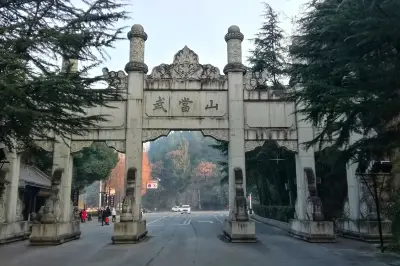
On the 12th, after breakfast, we took a train from Xiangyang Station to Wudang Mountain. Upon arrival, we took Bus 203 to the foot of Wudang Mountain and checked into our pre-booked hotel. After lunch, we explored Wudangshan Town. Unfortunately, Yuxu Palace, Yuzhen Palace, and Xiangfu Nunnery were all under renovation and closed. We only visited Wudang Museum and Xuan Yue Gate.
On the 13th, we left some luggage early, had breakfast, and headed straight to the Wudang Mountain Visitor Center. The scenic area is very well-managed with clear routes. The shuttle took us to the first stop, Taizipo. We got off and walked a short distance to the entrance. Taizipo features four main sights: the Nine-Bend Yellow Wall (Jiuqu Huanghe Qiang), One Pillar Twelve Beams (Yi Zhu Shi Er Liang), Four Gates in One Li (Yi Li Si Dao Men), and Ten Li of Osmanthus Fragrance. In late autumn, we couldn't smell osmanthus, but the other three sights were enchanting. As a World Cultural Heritage site, it is well-preserved, simple and natural.
( Wudang Mountain Taizipo: One Pillar Twelve Beams )
( Wudang Mountain scenic shuttle route map, very clear and useful )
The second stop was Xiaoyao Valley. Mountains and waters complement each other, natural scenery is excellent. Monkeys play in the mountains, and the stream water is clear—very refreshing. We saw many azaleas along the road; if we came in spring with all flowers blooming, it would be even more beautiful. From Xiaoyao Valley, we took the shuttle to the third stop: Zixiao Palace. The main hall is magnificent and large. Many tourists were there; several Taoist priests were practicing swordplay on the square, with fluid movements like immortals. The square outside Zixiao Palace is large, and shuttle transfers are convenient. There are many places to eat nearby. As netizens said, dining and drinks inside the scenic area are not much more expensive than outside. We could safely have lunch here without worrying about high prices. Since we had brought bread, fruit, and yogurt and didn't want to carry them, my wife and I ate some for lunch.
( Zixiao Palace, Zixiao Hall )
The fourth stop was Nanyan (also called Crow Ridge), the most time-consuming scenic area and the last before the summit. Here, accommodation and dining options are plentiful due to the large area, and prices are reasonable. If you have time to stay several days on Wudang Mountain or want a slow tour due to average stamina, this is the best place for food and lodging. Nanyan is said to be the most beautiful of the 36 crags of Wudang Mountain, and the Dragon Head Incense (Longtou Xiang) is long famous. After a circular tour, we rested near Langmei Shrine. Seeing we still had time and energy, we decided to proceed to Fenjining for overnight accommodation and get up early to watch the sunrise and sea of clouds. The path was all uphill, and since we had already expended much energy, the latter half was quite strenuous. Upon arriving at Fenjining lodging, my wife started showing signs of hypothermia—she had sweated a lot, the mountain temperature was low, and she felt very cold. The host made the bed and turned on the electric blanket, and she lay down to rest. I rested a bit, then took a small backpack and climbed to Golden Summit Diaozhongtai to watch the sunset. It was late, so there were few tourists. Later, a person staying at Golden Summit also came to watch the sunset, and we took photos for each other. Golden Summit accommodation is much better than Fenjining and very convenient for early sunrise viewing, but the price is much higher. After descending to Fenjining, I asked the host to make some hot food and noodle soup. After washing up, we went to sleep. The mountain wind blew; the thick quilt plus electric blanket kept us warm against the cold. At this altitude, except for pine trees, everything was withered and yellow, leaves gone, unlike the green below. Due to the rapid altitude increase, the low pressure caused the cap on my large moisturizer bottle to pop open, spilling some of the cream.
( Nanyan Dragon Head Incense )
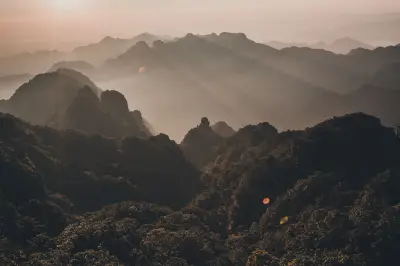
On the 14th, my wife didn't want to see the sunrise, so I went to a high spot near Fenjining and watched the sunrise and sea of clouds—quite magnificent. Many people from Nanyan and here had already started climbing to Golden Summit for the sunrise. I admired those who started from Nanyan early! After my wife got up, we ate the remaining food and fruit, drank some hot water, and the host refilled our thermos bottles. Then we said goodbye and headed for Golden Summit. At the top, there were many people. The sea of clouds was spectacular; the rising sun made Golden Summit look like a fairyland. On the opposite peak, three Taoist masters were practicing swordplay, as if flying in the clouds. Watching from afar, the phrase 'hermit master' immediately came to mind. The Golden Hall is made of bronze and gilded, housing the statue of Emperor Zhenwu. Visitors streamed in to worship.
( Sea of Clouds at Wudang Golden Summit )
Taking the cable car down to Qiongtai Zhongguan, we visited it, then took the scenic shuttle downhill. Here it was green again. Wudang Mountain, as a World Cultural Heritage site from Zhu Di's 'Build the Forbidden City in the north, build Wudang in the south,' has extremely exquisite and magnificent architecture, beautiful natural scenery, complete management, and good facilities. It is very worth visiting.
After descending and having lunch, we booked the airport bus. Seeing we had some time, my wife and I took the bus to Tai Chi Lake to enjoy the water. Tai Chi Lake (Jinhua Lake), part of the Danjiangkou Reservoir, has vast, clear waters. Many tour buses brought visitors to take boat rides; the landscape was pleasant.
At 6:00 pm, we flew from Wudangshan to Dalian, arriving more than 20 minutes early again. We walked out of Zhoushuizi Airport to the pre-booked Home Inn Dalian Airport—quiet and comfortable, a peaceful night.
On the 15th, after checking out, we took Bus 710 to Dalian New Mart, dropped luggage at the station, then took Bus 23 to Xinghai Bathing Beach. We toured Xinghai Park, strolled by the sea—Xinghai was still the same, the waves sounded the same—but our daughter is now studying at Xiamen University and no longer by our side here. Then we went to her undergraduate alma mater, Dongbei University of Finance and Economics. We had planned to enjoy autumn colors on campus and then have lunch at Bashu Renjia, but the school was still not open to the public, so we had to go around and take a taxi via the student apartments to Bashu Renjia. After lunch, we took Bus 23 from Zhishuyuan Student Apartment stop back to Youhao Square, then strolled to the train station. On the platform, I took out my phone to snap a picture of the high-rise buildings across from the station. Although the Dalian in my mind is still as beautiful as ever—the autumn river, golden ginkgo, full autumn atmosphere, clean streets—our daughter no longer lives in this city, and we may not visit often anymore. Nevertheless, this was the city where she worked hard for four years and where we visited most often. Bless Dalian, goodbye Dalian!
( Outside Dalian Station )
After returning to Anshan, I organized the pictures and text of this trip. Entering December, I was busy with miscellaneous affairs and stopped writing. Until this weekend, returning from Shenyang, I sat quietly in front of the computer today and finally completed the record of this trip. Many thanks to netizen Saga for answering 'Footprints on the Stone of Three Lives' question 'How many days to spend on Wudang Mountain' and netizen's Wudang Mountain tour and hiking guide [Guide to the Four Famous Taoist Mountains] and other articles. The content is detailed and clear. Especially after the tour, I found these articles extremely helpful. Thank you very much! I also hope my article can provide some help and tips for netizens planning to visit Hubei.
First drafted in November 2020, finalized on March 21, 2021