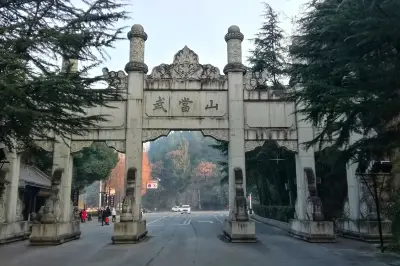
Travelogue of Nanyan Palace, Wudang Mountains, Hubei
On December 20, 2020, I took the cable car from Golden Summit to Qiongtai in the afternoon, then transferred to a scenic area bus to Taizipo Transfer Station, and continued by bus to the Crow Ridge Parking Lot. From there, I began walking to Nanyan Palace. Since I had expended too much energy in the morning and the mountain path to Nanyan Palace was extremely difficult, my wife suggested resting by the roadside, so I headed alone to Nanyan Palace.
From the Crow Ridge Parking Lot, there are two ancient sacred paths: the one descending to the left leads to Golden Summit, while the one ascending to the right leads to Nanyan, Taichang Temple, and Thunder God Cave.
It is widely believed that Nanyan Palace is the most beautiful and unique temple among the Wudang Mountains' Taoist temples. Tired from walking, I stood by the roadside and gazed at Nanyan Palace in the distance. On the sheer cliffs opposite, the main structure of Nanyan Palace, the "Taiyi Zhenqing Palace," is entirely made of stone and embedded in the precipice. From afar, it blends seamlessly with the rock face, as if carved and chiseled out, standing majestically over the abyss. Known as the "Palace Suspended on the Precipice," it is a masterpiece of Chinese architecture. One cannot help but admire the incredible craftsmanship of the ancients. The overall layout of Nanyan Palace is a brilliant fusion of human design and nature. The artistic conceptions depicted by ancient painters, such as "Fairy Mountains and Jade Pavilions" or "Dawn Clearing on the Red Terrace," are vividly realized here at Nanyan.
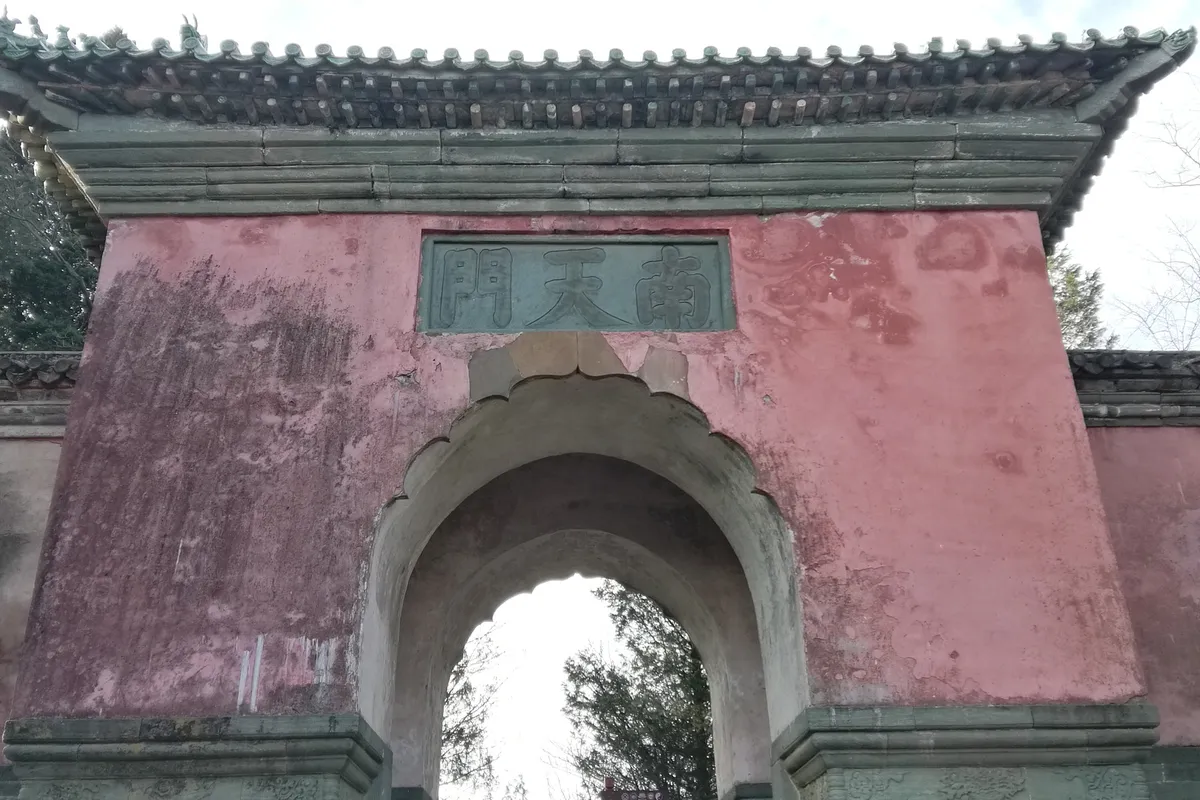
I trudged along the shaded sacred path, passing steep and winding ancient roads, until I reached the Southern Heavenly Gate. Nanyan Palace has two heavenly gates: the Southern Heavenly Gate and the Northern Heavenly Gate, both built in the tenth year of the Yongle reign (1412), with a design identical to the Second Heavenly Gate at Tianzhu Peak.
The overall layout of Nanyan Palace is the most flexible among the nine palaces, being both rigorous and full of variation. With an illusion of "seeing the heavenly gate only in the azure sky," visitors ascend the Southern Heavenly Gate. After entering the Southern Heavenly Gate, the path suddenly twists and descends steeply to the Small Heavenly Gate. Two large stele pavilions appear before the eyes, yet they completely break the symmetry. After turning through Chongfu Rock, one arrives at the palace gate—in front of the Dragon Tiger Hall. Entering the gate, the view opens up slightly, with decorated balustrades and layered terraces. Ascending the terraces and passing through the ruins of the main hall, one finally sees the Nanyan Stone Hall and its associated buildings.
Nanyan Palace, full name "Great Saint Nanyan Palace," is located on the southern cliff of Wudang Mountains. To the south lie the peaks of Tianzhu, to the north overlooks Wulong Peak, to the east faces the Banner Peak, and to the west is the Flying Ascension Terrace. It connects to the azure sky above and overlooks a deep stream below. Construction began in the 22nd year of the Zhiyuan reign of the Yuan Dynasty (1285) and underwent several renovations. The existing main buildings are remnants of reconstructions from the Ming and Qing dynasties. The current buildings and ruins cover an area of 61,187 square meters, with 83 temple rooms and a total floor area of 3,539 square meters. The complex mainly consists of the Nanyan Stone Hall, Southern Heavenly Gate, stele pavilions, Liangyi Hall, Imperial Scripture Hall, Eight Trigrams Pavilion, Dragon Tiger Hall, as well as ruins such as the Yuanjun Hall, Nanxun Hall, and Yuanguang Hall.
On the peaks south of the cliff are historical sites like the Dressing Table and the Flying Ascension Terrace. Inside the main gate of Nanyan Palace are the Small Heavenly Gate, ruins of Taishang Temple, Five Masters Hall, Abbot's Room, and Refectorium. In the courtyard of Dragon Tiger Hall is the Sweet Dew Spring, surrounded by sites such as Dripping Water Cliff, Immortal Companions Cliff, Black Tiger Cliff, Thunder God Cave, and Dragon Pool. Nanyan Palace is a representative Taoist architectural complex and a center for Taoist culture among the nine officially built palaces of Wudang Mountains. In December 1996, Nanyan Palace was listed as the fourth batch of key national cultural heritage sites by the State Council.
Ascending nine stone steps, we arrived at the Dragon Tiger Hall. Entering it, the two tall, thick wooden doors opened and closed with a melodious sound, like the calls of golden pheasants and phoenixes. Legend has it that when Zhenwu was cultivating here, golden pheasants and phoenixes crowed to wake him, giving rise to the saying "rise at cockcrow and practice the sword." Elderly people say that pilgrims who hear the sound of the golden pheasant and phoenix doors (the "gospel sound") will receive blessings upon returning home.
Passing through Dragon Tiger Hall, we entered a stone-paved courtyard. In the courtyard is a hexagonal ornamented well, named "Sweet Dew Well." It is unfathomably deep, and its water is cool and sweet. It is said that from ancient times to the present, whether crowded with people or suffering severe drought, it has never dried up. Taoists regard it as "golden liquid and jade dew," a "holy water." Legend holds that drinking it can cure diseases. "Sweet dew"—sweet means pleasant, and "dew" is water from heaven. According to the "Classic of Mountains and Seas," those who attain the Way drink sweet dew, believed to be a gift from heaven that absorbs the essence of heaven and earth and the vitality of the sun and moon. Drinking it can lead to immortality. It is said that when Zhenwu practiced asceticism facing the cliff, he drank this water while abstaining from grains. Later, Taoism absorbed this idea, considering it a shortcut to achieving immortality through cultivation. The water is clear, of excellent quality, and sweet. Used for brewing tea, it is pleasant and refreshing. Pilgrims often take a bottle or pot home for their families to treat illnesses; regular consumption is believed to strengthen the body.
The Xuandi Hall, also known as Yuanjun Hall (or Great Saint Nanyan Palace), is the main hall of Nanyan Palace. It faces south and sits on three tall stone platforms, placing the building at the highest point. The hall has a rectangular plan, with each platform 0.95 meters high, total length 29.85 meters, and total width 22.05 meters. In front of the hall is a terrace, supported by a high stone base surrounded by ornate railings, making it grand and spectacular. The hall is five bays wide and five bays deep; the platform, stone base, and railings are well preserved. Inside the hall are pedestals for seated and standing deities. I slowly ascended the layered red steps with ornate railings from the courtyard to the ruins of Yuanjun Hall. There, 36 finely carved stone column bases and stone pedestals survived, along with a set of clay-gilded statues of deities, with the statue of Xuandi in the center, flanked by Golden Boy and Jade Girl. Although they have endured disasters, weathering, and the passage of time, with broken walls and steles still visible, the grandeur of the former scale is evident. It still preserves the artistic wisdom of ancient laborers.
Stepping out of the gate of Xuandi Hall, one is greeted by vast open sky, with the unfathomably deep Black Tiger Ravine below. Looking ahead, the main peak of Wudang, Tianzhu Peak, is surrounded by numerous green mountains shrouded in mist and clouds, evoking a feeling of floating like an immortal. Fragrant breezes ripple over thousands of green waves, colorful clouds wrap around ten-thousand-foot perilous cliffs, pines hanging from the cliffs sway like green clouds, and below the cliffs, dangerous and deep, emerald waves roll. Leaning on the railing and looking down is breathtaking. On this perilous cliff, a row of halls, pavilions, and kiosks are embedded, giving an impression of "hanging pavilions in the air." This is the Nanyan Stone Hall, a unique wonder in Chinese architecture. Strolling here, one truly feels "as if shaking one's clothes while walking beside the Big Dipper."
Along the sacred path behind the main hall, about 50 meters to the left is a small mountain gate. On the cliff inside the gate are carved four large characters: "Longevity," "Blessing," "Health," and "Peace." Each character is 1.5 meters high and 1 meter wide, with bold and vigorous strokes, embodying the style of Yan Zhenqing and Liu Gongquan. This is the famous "Fushou Kangning" cliff inscription at Nanyan Palace. Due to weathering of the cliff, these four characters have long been mistakenly attributed to Wang Yong. However, careful examination reveals differences in calligraphy. According to expert research, the character "Longevity" was written by the Confucian scholar Wang Yong of the Ministry of Rites in the 16th year of the Jiajing reign (1537); the three characters "Blessing, Health, Peace" were written by Xia Yan, Minister of Rites and Grand Secretary of the Wuying Hall, in the 20th year of Jiajing (1541). Although written by two different people, it is difficult to distinguish them from the style. These four simple characters express all the good wishes of the human world. The true essence of Taoism lies not only in self-cultivation but also in saving all living beings, educating people, and offering good wishes to the world. Today, the "Fushou Kangning" cliff inscription is an ideal spot for tourists to take photos.
Liangyi Hall is located to the right of Nanyan Stone Hall, facing south and overlooking a great valley. It is a brick-and-wood structure with a gable-and-hip roof covered with glazed tiles. Behind the hall, a shrine is built against the rock. The front features lattice doors set on the front golden columns, forming an inner corridor with the eaves columns that leads directly to the Stone Hall. It is three bays wide, 10.03 meters, 3.9 meters deep, and 7.29 meters high. The western subsidiary bay is the Goddess Hall, dedicated to the three goddesses Yunxiao, Qiongxiao, and Bixiao. Liangyi Hall is also known as the Parents' Hall. "Liangyi" refers to heaven and earth, or yin and yang, derived from Taiji (the Great Ultimate). The "Book of Changes" uses the numerology of Wuji giving rise to Taiji, Taiji giving rise to Liangyi, Liangyi giving rise to Four Symbols, and Four Symbols giving rise to Eight Trigrams to infer changes in natural phenomena. In the hexagram statements of the "Book of Changes," yang is heaven, qian, father; yin is earth, kun, mother. Because the hall enshrines Zhenwu's parents, it is called Liangyi Hall.
Passing through Liangyi Hall, one can see the famous Dragon Head Incense Burner. Also known as Dragon Head Stone, it is carved from bluestone, 2.9 meters long and 0.3 meters wide, projecting horizontally over the sheer cliff, soaring into the clouds. The dragon's head faces Golden Summit, as if in worship. A small incense burner is placed on the dragon's head; looking down from it makes one's hair stand on end. The dragon's body is carved using techniques such as openwork carving, relief, and round carving into two divine dragons and auspicious clouds. Beautiful in shape and smooth in lines, it is an extremely precious masterpiece of ancient stone carving art. In ancient times, Taoist believers, to show their piety to the gods, risked stepping onto the dragon's back to pray and offer incense, resulting in countless deaths from falling off the cliff. In the 12th year of the Kangxi reign (1673), Governor Cai Yurong issued an order and erected a stele titled "Ban on Burning Incense at the Dragon Head," as a warning. The stele inscription reads: "Below Nanyan, a hall is built against the cliff to worship the spirits. At some unknown time, stone was carved into a dragon's head with an incense burner placed in front, overlooking a deep abyss. Looking down from a height, one trembles with fear; if a worshiper loses their footing, they will fall to their death. This is done by vulgar and reckless people, not the intention of the Supreme God who loves all living beings. Now, the burner has been moved inside the hall for the convenience of worshipers, so that filial sons do not climb heights or approach deep places. A stone is erected in front of the eaves to permanently block the path of petty people taking risks for luck. The abbot and all Taoists are to constantly admonish and not follow the old ways. This must be followed without negligence. Governor of Sichuan, first day of the sixth month, eleventh year of Kangxi."
The Nanyan Stone Hall, with the plaque "Taiyi Zhenqing Palace," was built in the 27th year of the Zhiyuan reign of the Yuan Dynasty (1290). It faces south and is built on the cliff. It is a stone carving imitation of a timber structure, with beams, columns, eaves, rafters, brackets, doors, windows, roof tiles, plaques, etc., all carved from bluestone and assembled with mortise and tenon joints. It is three bays wide (11 meters), three bays deep (6.6 meters), and 6.8 meters high, with a floor area of 74 square meters. The roof is covered with stone slabs, a single-eave gable-and-hip roof, making it the largest existing stone hall in Wudang Mountains. The hall is solid and robust, with large brackets and finely carved door and window patterns, demonstrating superb skill. Because the stone components are quite heavy and construction was carried out on a sheer cliff, the difficulty was immense. Therefore, the construction of Nanyan Stone Hall fully reflects the intelligence and superb craftsmanship of ancient Chinese artisans, truly a rare treasure of stone carving art.
On the main ridge beam are incised characters in regular script: "May the country be peaceful and the people safe" and "May the winds and rains be timely." Inside stand four round stone columns, with a shrine built against the rock. The hall enshrines a statue of Emperor Zhenwu. In front of the shrine are four honored deities, known in Taoism as the Four Imperial Sovereigns. "Imperial" is a respectful title for emperors, and the Four Imperial Sovereigns are four heavenly emperors. Taoism holds that the Four Imperial Sovereigns assist the Three Pure Ones. They are: the Jade Emperor of the Golden Palace of the Azure Heaven, the Great Emperor of the Central Ultimate Purple Subtlety of the North Star, the Great Emperor of Gouchen Upper Palace of the Southern Pole, and the Imperial Earth of the Houtu, who inherits heaven's way. On the beams and surrounding walls are arranged 500 cast-iron gold-plated statues of the Patrolling Inspectors, each about a foot high, with varied expressions.
In a finely carved wooden shrine beside the hall coils a golden dragon over ten feet long, with fierce claws and teeth. Attached to it lies a young man with a pink face, starry eyes, round cheeks, and red lips, sleeping fully clothed, with his head pillowed on the golden dragon, looking composed and carefree. This is the famous "Prince Sleeping on the Dragon Bed." The Prince Sleeping on the Dragon Bed, also called "The Hall of Eternal Youth for the Gentleman," is a finely carved wooden sculpture, an artistic masterpiece. The sleeping posture of the prince is one of the three health-preserving sleeping positions in Taoist cultivation. Legend has it that when the prince entered Wudang Mountains for cultivation, he could not forget worldly affairs at night. His master, Master Ziyuan, gave him a dragon-headed walking stick and told him to place it by his side while sleeping to calm his mind and rest. Later, when the prince attained enlightenment and became an immortal, the stick turned into the dragon bed. Thus, the dragon-headed walking stick of Wudang Mountains became a sacred token for Taoist believers.
In terms of technique, the ancient architecture of Nanyan breaks away from traditional completely symmetrical layouts and patterns, achieving a high degree of harmony and unity with the natural environment. The craftsmen skillfully adapted to the terrain, building against the mountain and cliff, creating a group of small, exquisite individual buildings that form a dramatic, staggered, and imposing complex.
Nanyan Palace is the most representative of the nine palaces of Wudang Mountains. Not only does it feature diverse architectural types and high construction standards, but it is also the most concentrated reflection of architecture and scenery, Taoism and mythology. The layout takes advantage of the mountain's varying heights, using concealment and exposure, winding and turning, in overall planning. Although man-made, it appears as natural as heaven; it is both simple and beautiful, yet rich in variation. In terms of overall architectural conception, design, and layout, it creates a majestic, steep, deep, and winding endless artistic conception. As the ancients praised: "Returning, one asks where the path came from; deep in the cave mouth, it is already unknown."