Travel Notes on Prince Slope at Mount Wudang, Hubei
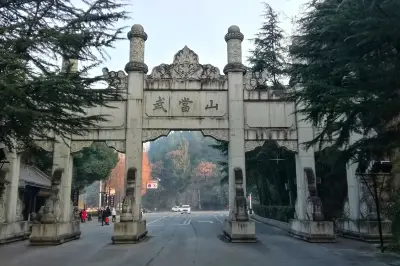
On December 21, 2020, at the Mount Wudang Scenic Area, I left the Purple Heaven Palace and took the internal scenic bus to the Prince Slope parking lot, then walked into the Prince Slope scenic area. First, I passed the必经之路 (only way) leading to Prince Slope, crossing the ancient Fuzhen Bridge that has weathered many vicissitudes.
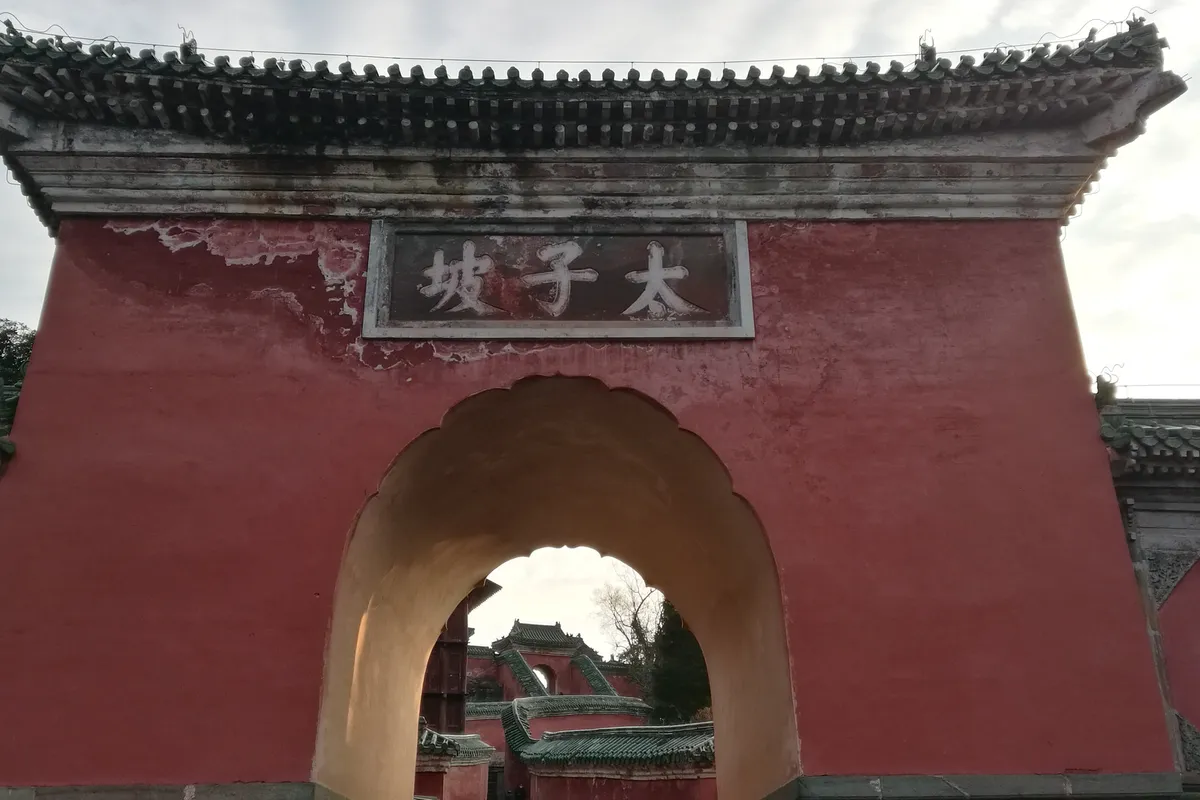
Ascending the steps from Fuzhen Bridge and walking along the ancient divine path, the stone steps of Prince Slope are ingeniously designed, rising along the mountain slope with each step, hiding the platform from view, symbolizing steady advancement. Soon, amidst the sea of clouds and green shade, a row of palace walls supported a arched red door lintel, a mountain gate towering above the clouds. The gate is of brick and stone structure with a歇山顶 (hip-and-gable roof), below which is a stone-carved琼花须弥座 (Qionghua sumeru base), with red walls and green tiles, and a brick-carved plaque on the lintel bearing the three regular script characters "太子坡" (Prince Slope). This was inscribed by the驸马都尉 (commandant-escort) of Emperor Yongle of the Ming dynasty. It is also the first of the four gates within one li.
In front of the gate is a stone-paved platform surrounded by stone railings.
Mount Wudang's Fuzhen Temple, also known as Prince Slope, is recorded as follows: In the tenth year of Yongle in the Ming dynasty, Emperor Zhu Di ordered the construction of 29 rooms, including the Xuandi Hall, mountain gate, and corridors. In the thirty-second year of Jiajing in the Ming dynasty, the hall was expanded to over 200 rooms. During the Kangxi period of the Qing dynasty, it was repaired three times. From the twentieth to the twenty-sixth year of Qianlong in the Qing dynasty, the main hall and mountain gate were rebuilt. Later, due to years of neglect, it was severely damaged. In 1982, with national investment, Fuzhen Temple underwent comprehensive restoration, now having 105 temple rooms covering an area of 1,600 square meters. It restored its historical appearance and was listed as a provincial and national key cultural relic protection unit.
Entering the mountain gate of Fuzhen Temple, the eye is met with this夹墙复道 (double-walled corridor) built along the winding and undulating mountain terrain—the Nine-Bend Yellow River Wall. The design and layout of the Nine-Bend Yellow River Wall are ingenious, with red walls and green tiles enclosing winding stone steps. The smooth, curving wall resembles rolling waves, majestic in appearance. The wall is 71 meters long, 1.5 meters thick, and 2.5 meters high, rounded and smooth, with pleasingly fluid curves. Topped with green glazed tiles, it looks like two giant dragons spiraling and soaring. From any angle, it is aesthetically pleasing, reflecting the grandeur and luxury of imperial architecture. At the same time, the tall, winding red wall gives visitors a sense of remoteness and depth. Walking along this double-walled corridor, one cannot help but associate life with this winding path—no one can have a smooth journey; as long as one keeps climbing uphill, perseveres, and holds firm to their faith, they can reach the summit.
Regarding the origin of the name "Nine-Bend Yellow River Wall," opinions vary. Wudang Taoist thought holds that those who donate Daoist robes, scriptures, statues, buildings, ritual implements, lamps, bells, vegetarian meals, or incense to Taoist temples can receive divine protection, known as the "Nine Merits." The Nine-Bend Yellow River Wall can be seen as an architectural embodiment of Taoist thought. Walking along the winding wall is like walking along the dikes of the winding Yellow River; the tall walls resemble those of the Forbidden City in Beijing. Walking beneath them, one always feels small, highlighting the temple's majesty and height, evoking a sense of mystery, depth, and穿越 (time travel). The design of the Nine-Bend Yellow River Wall epitomizes the Taoist philosophy of顺应自然 (following nature), returning to simplicity, and the unity of heaven and man.
Passing through the second gate, one sees the Dragon Tiger Hall, with its door lintel carved with dragons and crocodiles supporting it. Standing in front of the Dragon Tiger Hall and looking up, one can see three plaques: the first says "复真观" (Fuzhen Temple), the second "灵光普照" (Numinous Light Illuminating Everywhere), and the third "初步云崖" (First Step on Cloudy Cliff)—a creation of the building artisans. Prince Slope is both Fuzhen Temple. Inside the hall are statues of the Azure Dragon and White Tiger. On the left is the Azure Dragon statue, fierce in appearance, belonging to yang. On the right is the White Tiger statue, serene in appearance, belonging to yin. Placing Azure Dragon and White Tiger in one hall, according to Taoist theory, achieves the effect of yin and yang complementing each other. The two deities guard here day and night.
Passing through Dragon Tiger Hall is the main hall of Fuzhen Temple, also known as Patriarch Hall or Xuandi Hall, with a plaque reading "云岩初步" (First Step on Cloudy Rock). It is a brick-wood structure with a single-eave硬山顶 (flush gable roof), green glazed tile roof, and a抬梁式 (post-and-lintel) wooden frame. It is the main building of the divine area of Fuzhen Temple and the climax of the entire complex. It has a front and back corridor and a fully open lattice door on the front. All columns, beams, brackets, doors, and windows are painted with colorful decorations, carved beams and painted rafters, adorned with gold, extremely magnificent. Through the铺垫渲染 (foreshadowing and embellishment) of the Nine-Bend Yellow River Wall, the照壁 (spirit screen), and the Dragon Tiger Hall, a high platform rises in the second courtyard. On this platform stands the main hall of Fuzhen Temple. The splendid hall inspires awe, solemnity, and reverence, instantly arousing piety. The courtyard is adorned with railings and lofty terraces supporting the main hall, with green tiles and red walls, painted and gilded. Inside, statues of Zhenwu and the Three Pure Ones are enshrined, with incense smoke curling.
The main hall of Fuzhen Temple was ordered to be built in the tenth year of Yongle of the Ming dynasty, expanded during the Jiajing period, severely damaged at the end of the Ming, and rebuilt in the twenty-fifth year of Kangxi of the Qing. Because Qing repairs were funded by local officials and lay believers, while they could hardly maintain the imperial grade of the original building, they added many folk building techniques. Therefore, through the main hall, one can see the architectural techniques and artistic remains of both Ming and Qing dynasties. Inside the hall, statues of Zhenwu and his attendants, the Golden Boy and Jade Girl, are enshrined. What is even more noteworthy is that this group of huge statues is the largest painted woodcarving on the whole Mount Wudang. After 600 years, it remains brilliant and new.
The Five Cloud Tower of Fuzhen Temple, also called the Five-Story Tower, is 15.8 meters high and is the tallest wooden structure on Mount Wudang today. Without excavating the mountain body, the ancient laborers built entirely according to the changes in the mountain terrain, achieving the best effect in both overall layout and practicality. The Five Cloud Tower adopts traditional ethnic construction techniques: walls, partitions, doors, and windows are all wooden. The halls and rooms on each floor are adapted to local conditions, each with its own variation.
Descending the small path in front of the Sutra Library, one reaches another courtyard, which is the third gate. In the courtyard, built against the rock, is the Five Cloud Tower, commonly called "Five-Story Tower." The most famous feature of the Five Cloud Tower is its top floor's "One Pillar with Twelve Beams." That is, on one main pillar, twelve beams are inserted and stacked, crisscrossed and layered on a single support. The structure is unique, the calculations precise, the craftsmanship exquisite, and it is a marvel of skill. This purely architectural framework is a masterpiece of ancient wooden architecture and a unique wonder in China's ancient buildings. No similar structure has been found nationwide, and it has always been highly praised. "One Pillar with Twelve Beams" is a mystery of ancient Chinese architecture. Having survived for several hundred years, it remains intact and solid, becoming a great creation in the history of Chinese ancient architecture in mechanics. It has become a major cultural landscape in Fuzhen Temple. Faced with such a bold and wise work of the ancients, people have forgotten the original name of the Five Cloud Tower and call the entire building "One Pillar with Twelve Beams." This is also one of the famous sights of Prince Slope.
Climbing dozens of stone steps along the double-walled corridor behind the main hall, at the highest point of the Fuzhen Temple complex stands the Prince Hall built in the Ming dynasty. It is small and exquisite yet retains the grandeur of imperial architecture. The Prince Study Hall is uniquely arranged. The murals of the young Zhenwu studying, the stone desk, brushes, ink, and ancient books create an atmosphere of hard study, reminding one of the hardships, faith, and perseverance of the young prince's life and study. Inside the hall, a bronze statue of the young prince studying is enshrined, the only place on Mount Wudang for praying for academic success. Visitors who observe the expression of the prince statue carefully and comprehend the prince's concentration in studying may gain new inspiration and understanding of learning. The Prince Study Hall was built to highlight the young Zhenwu's diligent study of scriptures. It is said that students who come to pay homage here can achieve academic success. Throughout history, countless young students have come to visit to build perseverance and confidence in their studies. Many parents who hope their children will succeed often come here to pray for their wishes and their children's success.
Inside the Prince Hall is a statue of the prince in childhood, the place where the Pure-Land Prince began reading and cultivating. Leaning on the railing in front of the Prince Hall and looking down at the ravine, one sees winding streams flowing green; looking out over the mountains, thousands of peaks vie in beauty; looking into the distance at the Golden Summit, misty clouds make a hazy scene, creating the wonderful courtyard scene of "birds flying toward the sun, people returning from the sky." According to legend, at the age of 15, the Pure-Land Prince was enlightened by his teacher, the Purple Mist Primordial Lord, and came to Mount Wudang to cultivate, initially living on this slope, hence the name "Prince Slope." After cultivating here for some time, he once became disheartened and intended to descend the mountain to return to secular life. When he reached the Millstone Needle Well, the Purple Mist Primordial Lord transformed into an old woman and used the iron pestle grinding into a needle to enlighten him. He then returned to the mountains to practice with a calm mind. Therefore, Prince Slope is also called "Fuzhen Temple" (Return to Truth Temple).
Entering the second gate, on the left is a delicate altar, now housing a large bronze bell, and on the right is a delicate green glazed brick incense burner, the best-preserved stone incense burner on Mount Wudang. In the middle is a tall spirit screen, inlaid with the three large characters "福" (Blessing), "寿" (Longevity), and "禄" (Fortune). Here, after burning incense, pilgrims close their eyes and touch any of the three characters on the screen. Touching "福" foretells blessings as vast as the sea; touching "寿" foretells health and long life; touching "禄" foretells stability and solidity. Then they go to the prayer altar to strike the auspicious golden bell. According to the number of characters touched, striking three times for each character will fulfill their wishes. On the platform, a stone turtle (赑屃) carrying a stele is from the Qing dynasty. Two 5-meter-high turtle-borne stelae are the record stele and merit stele from the 29th year of Kangxi in the Qing dynasty.
Prince Slope on Mount Wudang, also called Fuzhen Temple, is an ancient building on a 60-degree slope of Mount Wudang's Lion Peak. Facing a thousand-zhang deep ravine, adjacent on the right to the Heavenly Pool, during rain it has a thousand-zhang waterfall, and in clear weather it is lush and green. On the left is the Lower Eighteen Bends, with the "divine path" flowing like a ribbon. Viewed from afar, it resembles a lotus floating on green waves; up close, red walls look like moon balconies surrounding a fairy palace. The environment is quiet and the scenery beautiful. The ancient architects skillfully used the mountain terrain, integrated layout, fully utilized a narrow slope under steep and dangerous rocks, arranged in longitudinal and horizontal sequences, surrounded by red walls, with winding corridors, tightly combining architecture with environment, fully displaying imperial style. They constructed famous sights such as "Four Gates within One Li," "Nine-Bend Yellow River Wall," "One Pillar with Twelve Beams," and "Osmanthus Fragrance for Ten Li."
Ancient architectural masters skillfully used the mountain terrain to build a double-walled corridor like rolling waves, called the Nine-Bend Yellow River Wall. Entering the second mountain gate, a spacious courtyard suddenly appears. Strolling in, one sees overlapping small courtyards, quiet and elegant. In front is the rock-built "Five Cloud Tower," in the middle are "Imperial Scripture Hall" and "Sutra Library," and behind on a high platform is "Prince Hall." The overall layout of Prince Slope is asymmetrical left and right, high and low scattered, coordinated and perfect, ingenious and mysterious. It fully embodies the Taoist connotation of tranquility and inaction. Standing at the highest point of Fuzhen Temple, looking down into the deep ravine with winding streams flowing green; looking out over the mountains, thousands of peaks vie in beauty; every sunset, one can also see the wonder of Wudang "Taihe Silhouette." For hundreds of years, the human landscape of Fuzhen Temple has been widely praised.
The ancient building complex of Prince Slope is basically carefully designed according to the story of Zhenwu's cultivation. Legend has it that at the age of 15, the prince of the Pure-Land Kingdom entered Mount Wudang to cultivate and once lived on this slope, hence the name "Prince Slope." After cultivating here for some time, unable to endure hardship, he intended to descend the mountain and return to secular life. When he reached the Millstone Needle Well, he was enlightened by the Purple Mist Primordial Lord, who transformed into an old woman using the iron pestle grinding into a needle. He then returned here to practice with a strong will, hence the name "Fuzhen Temple" (Return to Truth Temple). Many buildings in China face east, but Prince Slope faces west, which is relatively rare.
Passing through the hall is the Imperial Scripture Hall and Sutra Library. In front of the Imperial Scripture Hall is an osmanthus tree about 5 meters high with a chest diameter of 0.5 meters, over 300 years old. Every mid-autumn, the osmanthus blooms, the fragrance is overwhelming, known as "Osmanthus Fragrance for Ten Li," a major scenic spot of Prince Slope. In the central courtyard is a stone-railed pool called "Tears Pool." The Sutra Library stores Taoist scriptures on the upper floor. To the south is the altar. To the north is the incense burner. Opposite is a spirit screen carved with the characters "福禄寿" (Blessing, Fortune, Longevity).
The Prince Slope scenic area includes Hui Long Temple, the exquisitely carved Millstone Needle Well pavilion, the Heavenly Pool waterfall that plunges a hundred zhang, Laojun Hall, the Eight Immortals Temple, the winding Upper and Lower Eighteen Bends ancient path, the grotesque rocks in the Nine Ford Stream, the steep and perilous Jade Void Cliff, and other attractions. The Prince Slope building complex skillfully uses the terrain, with an overall layout of scattered highs and lows, harmonious and perfect, giving a quiet feeling, embodying the Taoist connotation of "tranquility and inaction." After visiting, I have gained further understanding and knowledge of Prince Slope. Prince Slope was the original name; Fuzhen Temple is the real name. Here, "复" (return) in Fuzhen Temple means restoration, "真" (truth) means reality, and "观" (temple) means worldview. Its meaning is that people's understanding of the world deviates from the universe and life, becoming a life of trouble and suffering. Therefore, it is necessary to restore the grasp of the universe and life, turning a troubled and painful life into a wise and happy one. The ancients were so thoughtful—I wonder if people today can understand it.