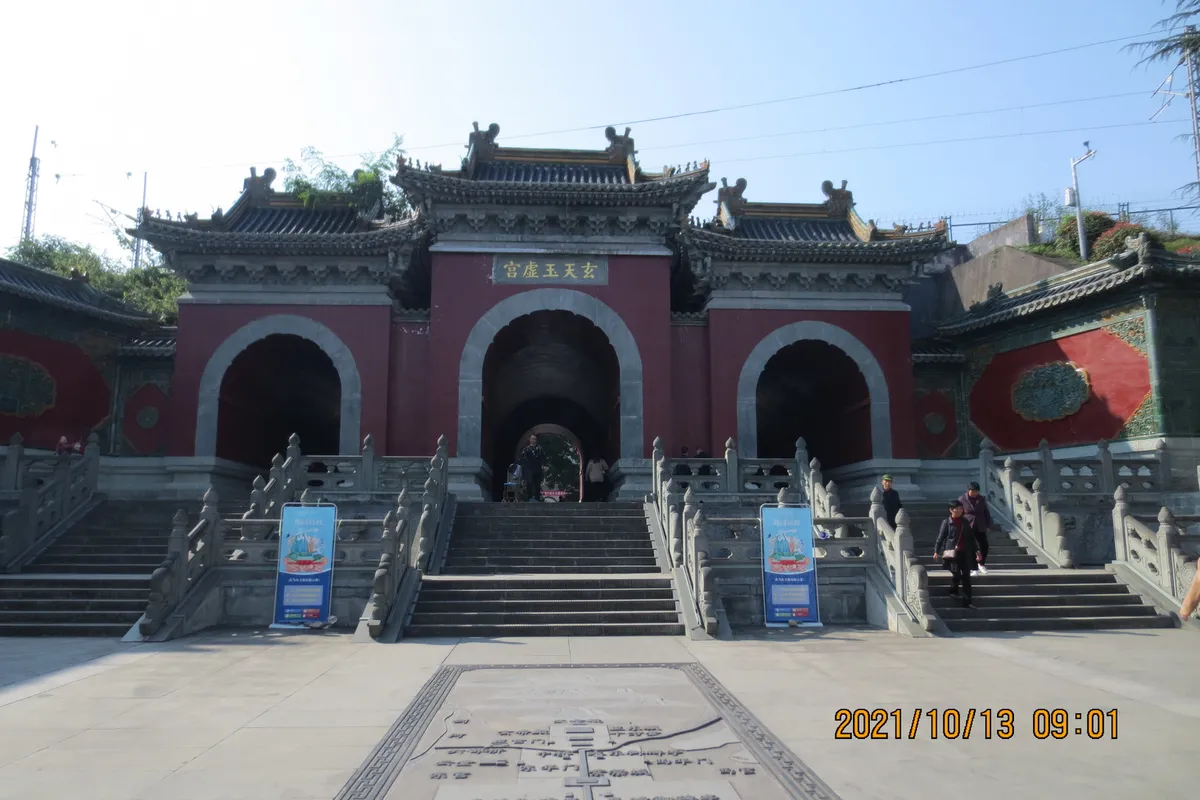
Taoist Sacred Site—Wudang Mountains Part 2: Yuxu Palace and Yuzhen Palace
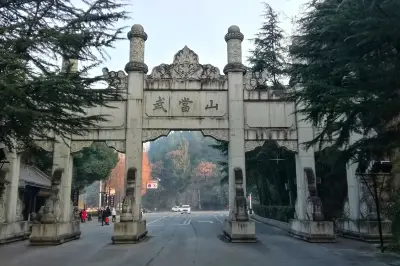
During the stay in Wudang Mountains, I also visited Yuxu Palace and Yuzhen Palace in the town, both not far from the hotel. Yuxu Palace is only 500-600 meters away, while Yuzhen Palace is a 14 yuan taxi ride or 2 yuan by bus 206. They are now free attractions.
Yuxu Palace, full name 'Xuantian Yuxu Palace', commonly known as 'Laoying Palace'. Legend has it that after the True Martial God attained enlightenment and ascended to heaven, the Jade Emperor appointed him as 'Yuxu Xiangshi', so after Yuxu Palace was built, Emperor Yongle designated it as 'Xuantian Yunti Palace'. It was first built during the Yongle reign of the Ming dynasty, with strict regulations and multiple courtyards. The existing buildings and ruins mainly include a 1036-meter long palace wall, two stele pavilions, five hall foundations in the inner music city, and the Fumu Hall and Yuntang rebuilt in the Qing dynasty, as well as the ruins of the East, West, and North Heavenly Gates. These remaining ruins still have a strong appeal today and are well worth visiting. Yuxu Palace was once the cultivation site of Zhang Sanfeng. Zhang Sanfeng once predicted that 'Wudang will surely flourish in the future.' Indeed, in the eleventh year of Yongle (1413), Emperor Yongle ordered the construction of Yuxu Palace, which was rebuilt in the thirty-first year of Jiajing (1552). The famous Ming dynasty writer Wang Shizhen described it as 'Taihe's highest peak resembles a transformed city, Yuxu is like the Qin Epang Palace,' showing its grand scale at the time.
In the seventh year of Tianqi (1627), a devastating fire broke out in Yuxu Palace, destroying most of its axis buildings. A hundred years later, in the tenth year of Qianlong (1745), Yuxu Palace was struck by another fire, reducing its auxiliary buildings to ashes. In the summer of 1935, a flash flood occurred, washing hundreds of thousands of cubic meters of sand and mud into Yuxu Palace, engulfing large areas of buildings. Since then, Yuxu Palace, once called the 'Forbidden City of the South,' became a ruin of broken walls... The main hall restoration project started in May 2007, and the main hall was restored by the end of September 2012. After another year of repairs, it was opened to the public this National Day. Some buildings have been restored, and the Fumu Hall and others are still under restoration.
Inside and outside the palace, there are four stele pavilions standing opposite each other, built in the eleventh year of Yongle and the thirty-first year of Jiajing. Inside the pavilions are stone Bixi (turtle-like mythical creatures) carrying imperial steles of varying sizes. The largest Bixi is 6.06 meters long, 2.85 meters high, and 2.35 meters wide; the imperial stele is 6 meters high, 2.35 meters wide, with a total height of 9.03 meters, weighing over a hundred tons. The four Bixi-carried imperial steles are inscribed respectively with Emperor Chengzu's 'Edict to the Taoist Priests of the Great Taihe Mountains' and 'Imperial Record of the Taoist Palace of the Great Taihe Mountains', and Emperor Shizong's 'Imperial Record of the Restoration of the Xuan Hall of the Great Taihe Mountains' and 'Record of the Restoration of Palaces and Temples'.
Yuxu Palace Dragon Tiger Hall
Yuxu Palace Ming Dynasty Incense Burner
Yuxu Palace Ming Dynasty Incense Burner
Yuxu Palace Xuan Emperor Hall
Yuxu Palace Xuan Emperor Hall
Yuxu Palace Xuan Emperor Hall: In the forty-second year of Kangxi, Emperor Kangxi personally wrote five plaques and sent them to Wudang Mountains. Among them, the plaque 'Qingxu Zhide' was hung in Yuxu Palace, and the ones hanging on the left and right now are... The plaque 'Mozan Huangyou' is hung in Wudang Mountains' Jingle Palace, and the plaque 'Xianlu Chongxu' is hung inside Wuzhen Temple.
Yuxu Palace Xuan Emperor Hall plaque 'Mozan Huangyou'
Yuxu Palace Xuan Emperor Hall plaque 'Xianlu Chongxu'
Yuxu Palace Xuan Emperor Hall
Zhenwu Emperor, also known as Xuantian Supreme Emperor, Emperor Xuanwu, Supreme Emperor of the Northern Pole Xuantian, You Sheng True Lord Xuantian Supreme Emperor, Demon-Subduing Heavenly Lord, Yuxu Xiangshi, Nine-Day Demon-Subduing Patriarch, Boundless Patriarch, with the full title 'Supreme Emperor of the Northern Pole, True Martial Xuantian Supreme Emperor' is the northern deity in Chinese mythology, a prestigious deity among Taoist immortals. Zhenwu Emperor was originally the assistant deity Xuanwu of Emperor Zhuanxu. Later, Zhenwu Emperor succeeded Emperor Zhuanxu as the northern heavenly emperor, while Zhuanxu became the Emperor of Fengdu ruling the underworld. Now, the main deity enshrined in Wudang Mountains, Hubei, is Zhenwu Emperor, called in Taoist scriptures 'Zhenwu Lingying Yousheng Dijun', abbreviated as 'Zhenwu Dijun'. He is respectfully called Xuantian Supreme Emperor, Northern Emperor, Xuan Di Gong, Requiting Gratitude Patriarch, etc. in Chinese folk religion.
Yuzhen Palace in Wudang Mountains, because of its reputation, I wanted to visit. After asking the hotel front desk lady, I took a taxi. But even the hotel staff didn't know that Yuzhen Palace has never been open. We only saw the mountain gate.
Yuzhen Palace is located 4 kilometers east of Wudangshan Town, one of the nine palaces of Wudang Mountains. It backs against Phoenix Mountain, faces Nine Dragons Mountain, with Wangxian Terrace on the left and Black Tiger Cave on the right. Surrounded by mountains and streams like a city, it was formerly called Huangtu City. This palace is surrounded by high mountains, murmuring streams, and towering trees. In the early Ming dynasty, Zhang Sanfeng cultivated here. During the Yongle reign, the emperor ordered the construction of Yuzhen Palace, completed in the fifteenth year of Yongle, with 97 halls, rooms, etc. By the Jiajing period, Yuzhen Palace had expanded to 396 rooms, with spacious courtyards and a quiet and serene environment. At that time, there were 296 large and small buildings including halls, dining halls, corridors, mountain gates, and pavilions. On January 19, 2003, a sudden fire broke out in the main hall of Yuzhen Palace, reducing the most valuable main hall to ashes. Later, because Yuzhen Palace is located on the edge of the Danjiangkou Reservoir, the implementation of the South-to-North Water Diversion Middle Route Project will raise the normal water level of the Danjiangkou Reservoir from 157 meters to 170 meters. Yuzhen Palace lies below the 170-meter waterline, facing the risk of being submerged. Finally, a protection plan of 'in-situ elevation' was chosen. The entire protection project, including reconstruction, is expected to cost over 200 million yuan. Yuzhen Palace was 'lifted' 15 meters on site. In fact, this costly 'lifting project' only targeted the mountain gate and the east and west palace gates, as the other buildings had either long ceased to exist or were dismantled and rebuilt elsewhere.
Wudang Mountains Yuzhen Palace
Wudang Mountains Yuzhen Palace Mountain Gate
Wudang Mountains Yuzhen Palace, with Cultural Revolution slogans still on it.
Wudang Mountains Yuzhen Palace, Cultural Revolution slogans still on it.
Wudang Mountains Yuzhen Palace, Cultural Revolution slogans still on it.
Wudang Mountains Yuzhen Palace
Wudang Mountains Yuzhen Palace
Wudang Mountains Yuzhen Palace
Wudang Mountains Yuzhen Palace
Danjiangkou Reservoir in front of Wudang Mountains Yuzhen Palace