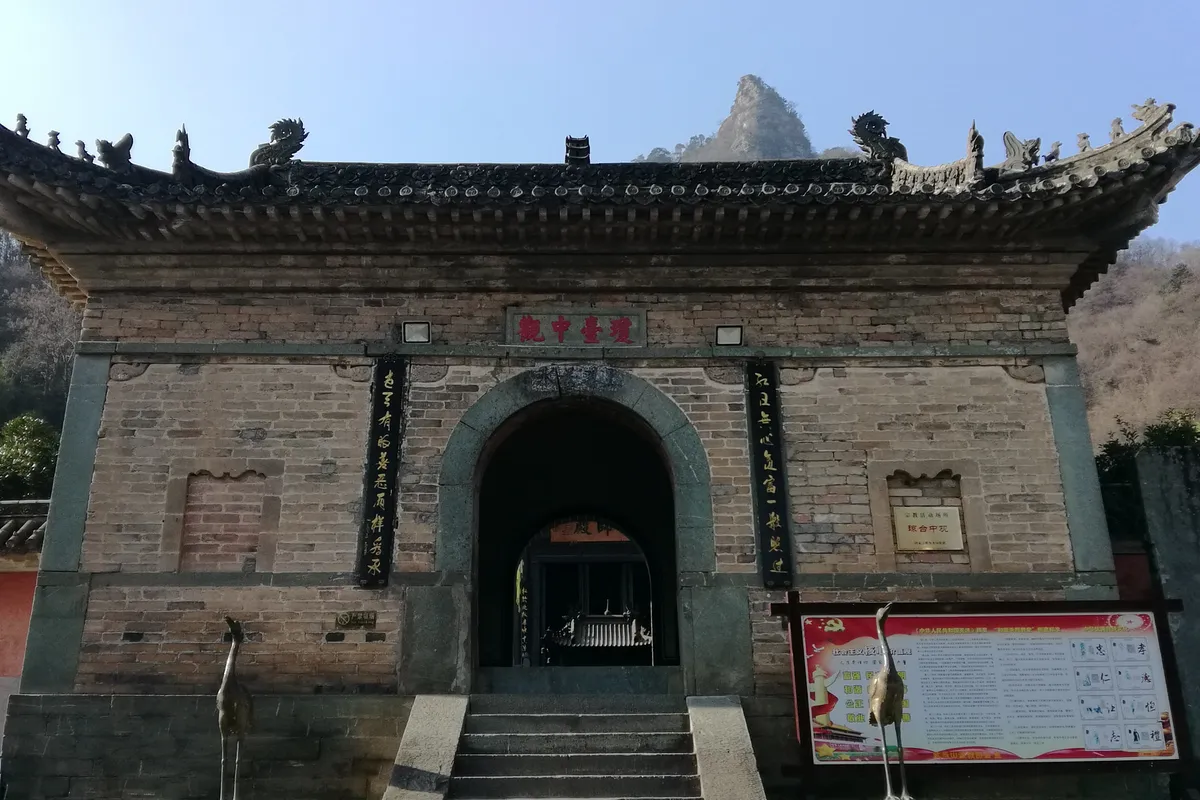
A Visit to the Qiongtai Middle Temple at Wudang Mountain, Hubei
The Qiongtai Middle Temple of Wudang Mountain, situated at the foot of Tianzhu Peak, the highest peak of Wudang Mountain, is a necessary stop for those taking the cable car to the Golden Summit. On the morning of December 20, 2020, my wife and I took a scenic bus from the Wudang Mountain Visitor Center to the Qiongtai parking lot. Since the Qiongtai Middle Temple lies between the parking lot and the cable car departure point, we took the opportunity to visit this historically rich temple.
The Qiongtai Temple, called Qiongtai Palace during the Yuan Dynasty, was renamed a temple in the Ming Dynasty and was divided into an Upper Temple, Middle Temple, and Lower Temple. Each of the three Qiongtai temples has a very pleasant name: the Upper Temple is called "White Jade Turtle Terrace," the Middle Temple is called "Purple Peak Qiongtai," and the Lower Temple is called "Jade Music Xiao Terrace." According to historical records, between the three Qiongtai temples, 24 auxiliary monasteries were built along the mountain's contours, with hundreds of rooms, connected by pavilions and bridges. Thus, it was said that when moving between the three temples, "one does not see the sky when going out, and one's shoes do not get wet in the rain," indicating the grand and ingenious architecture of Qiongtai Temple at that time. It was one of the largest temples among the 36 temples of Wudang Mountain. We climbed the stone steps, and from a distance we saw a plaque hanging above the ancient yellow mountain gate, inscribed with the four characters "Qiong Tai Zhong Guan" (Qiongtai Middle Temple).
After centuries of vicissitudes and war, the Qiongtai Temple's buildings have been severely damaged. Today, the Upper Temple only retains its ruins and a stone Xuanwu statue, which is also the largest stone Xuanwu statue found on Wudang Mountain. The Lower Temple only has a dilapidated main hall and a few temple rooms. As it stands now, the best-preserved part of the entire Qiongtai Temple is the Middle Temple. The Middle Temple still houses a Yuan Dynasty stone hall entirely made of bluestone, enshrining a Xuanwu Saint statue also carved from bluestone. This stone hall, covering only 18 square meters, is of great value for studying the history of Taoism on Wudang Mountain during the Yuan Dynasty. Legend has it that after the True Martial Emperor attained the Great Way, the Five Dragons escorted him to the Heavenly Palace, and the Jade Emperor conferred upon him the title of Supreme Mysterious Heavenly God of the North at Qiongtai. Therefore, people believe that Qiongtai on Wudang Mountain was the place where the True Martial Emperor received his title, and it is revered even more.
Entering the mountain gate hall of Qiongtai Middle Temple, there are two statues: on the left is the Azure Dragon, on the right is the White Tiger. Their role at the temple gate is to suppress earthly qi. Passing through the corridor, we were immediately delighted, entering a courtyard. The small courtyard was very quiet and leisurely. The main hall in the center is the Patriarch Hall.
On both sides of the courtyard, the eastern and western side halls are both Cihang Halls.
Of course, there is also a Hall of Wealth.
We continued up the steps and entered a larger space. The architectural design had three tiers of steps; we stood on the first tier. On the left and right of the second tier stood two exquisite corner towers, namely the Bell Tower and the Drum Tower. On the third tier stood the Sanqing Hall. A plaque hung above the main hall, reading "Sanqing Hall." Guarded by the towering peaks, it appeared very solemn and dignified. Looking up from below, we could see the main building of Qiongtai Middle Temple, the Sanqing Hall, which towered high above the steps, giving a feeling of supremacy.
With the piety of a pilgrim, we slowly climbed up to the third tier, where we could clearly see the plaque of "Sanqing Hall." Under the eaves, three plaques were hung: the central one read "All Dharmas Return to the One," the left one read "Purple Qi Comes from the East," and the right one read "The Right Path is Bright." Inside the Sanqing Hall are enshrined the highest deities of Taoism: the Three Pure Ones—Jade Pure, Upper Pure, and Great Pure. This arrangement is rare on Wudang Mountain, as most temples enshrine the True Martial Emperor. Additionally, the main hall contains a wealth of precious artifacts, including a Ming Dynasty copper-cast, gold-gilt statue of the True Martial God, tall and solemn, very precious, as well as the largest stone statue of the True Martial found on Wudang Mountain, and fragments of Yuan Dynasty steles, which are important historical materials for studying Wudang Mountain.
Qiongtai Middle Temple is located about 10 kilometers southeast of Tianzhu Peak on Wudang Mountain, at a vertical distance of 1,350 meters, covering an area of 3,600 square meters with a building area of 479 square meters. The architecture of Qiongtai Middle Temple fully utilizes the terrain, built along the mountain, typical of Taoist architectural style. It is arranged symmetrically along a central axis, reasonable and rigorous. Although not large in scale, its red walls, green tiles, lush trees, and fragrant flowers create a unique scenery. Truly, "Red walls and green tiles lock in elegance, with osmanthus fragrance drifting in a painted scene." No wonder the ancients praised it, saying: "Qiongtai has many secluded delights, the mountain is as tranquil as ancient times." This praise is by no means exaggerated; it is entirely deserved. Qiongtai Middle Temple was also the pharmaceutical factory of the Ming Dynasty Taoists for making "Eight Treasures Purple Gold Pills."
The Qiongtai Temple was first built in the Yuan Dynasty, renovated and expanded during the Ming and Qing Dynasties, with hundreds of temple rooms. In the sixth year of the Xianfeng reign of the Qing Dynasty, it was destroyed by war, and part of the temple rooms were rebuilt during the Guangxu reign. The current Qiongtai Middle Temple still preserves the Yuan Dynasty stone hall and the main hall and 14 side rooms rebuilt in the Qing Dynasty. The buildings and ruins cover an area of 15,000 square meters. The Yuan Dynasty stone hall is located to the right of the main hall, facing east from west, with a stone structure, a nine-ridge, hipped-gable roof, and a stone-carved sumeru base. The wall thickness is 0.94 meters, with a single bay in width and depth, covering an area of 18 square meters. The main hall faces northeast from southwest, brick-and-wood structure, with a flush gable roof, Qing-style roof truss, a front porch, and rear sealed eaves. It has 3 bays, 13.13 meters wide, a depth of 9.85 meters, and a total height of 11.03 meters. The Qiongtai Lower Temple now has 13 rooms including the main hall and side rooms, with a building area of 571 square meters. The main hall is a Qing-style brick-and-wood structure with a flush gable roof, lifted-beam wood frame, and a roof of dry yin-yang pan tiles. It has a front porch and rear sealed eaves. The front eaves are decorated with 11 sets of five-color double-ang Qing-style brackets, and the front side is made of lattice doors. It has 3 bays, 13.65 meters wide, a depth of 10.80 meters, and a total height of 9.80 meters. The northern side room in front of the hall collapsed under heavy snow in the winter of 1987, leaving only ruins; the existing southern side room has 5 bays and two floors, brick-and-wood structure, flush gable roof, small green tiles, column-and-tie wood frame, and the front side is entirely wood-finished.
I recall that when people talk about the Upper, Middle, and Lower Qiongtai temples, they are actually referring to three outlooks on life. Qiongtai Upper Temple: All good and bad are nourishment; all people and events contribute to oneself; be grateful. It says that people are content because of gratitude, and the world is beautiful because of gratitude. Qiongtai Middle Temple: No birth, no death; no permanence, no impermanence; no coming, no going; no difference, no sameness. It says that without growth there is no decay, what is old must die; wildfire cannot burn it all out, the spring wind makes it grow again. Qiongtai Lower Temple: There is good and evil; good is rewarded with good, evil with evil. It says that good and evil have their retribution; the way of heaven revolves; the net of heaven is vast and wide, and nothing escapes it.