Travelogue of the Zixiao Palace at Wudang Mountain, Hubei
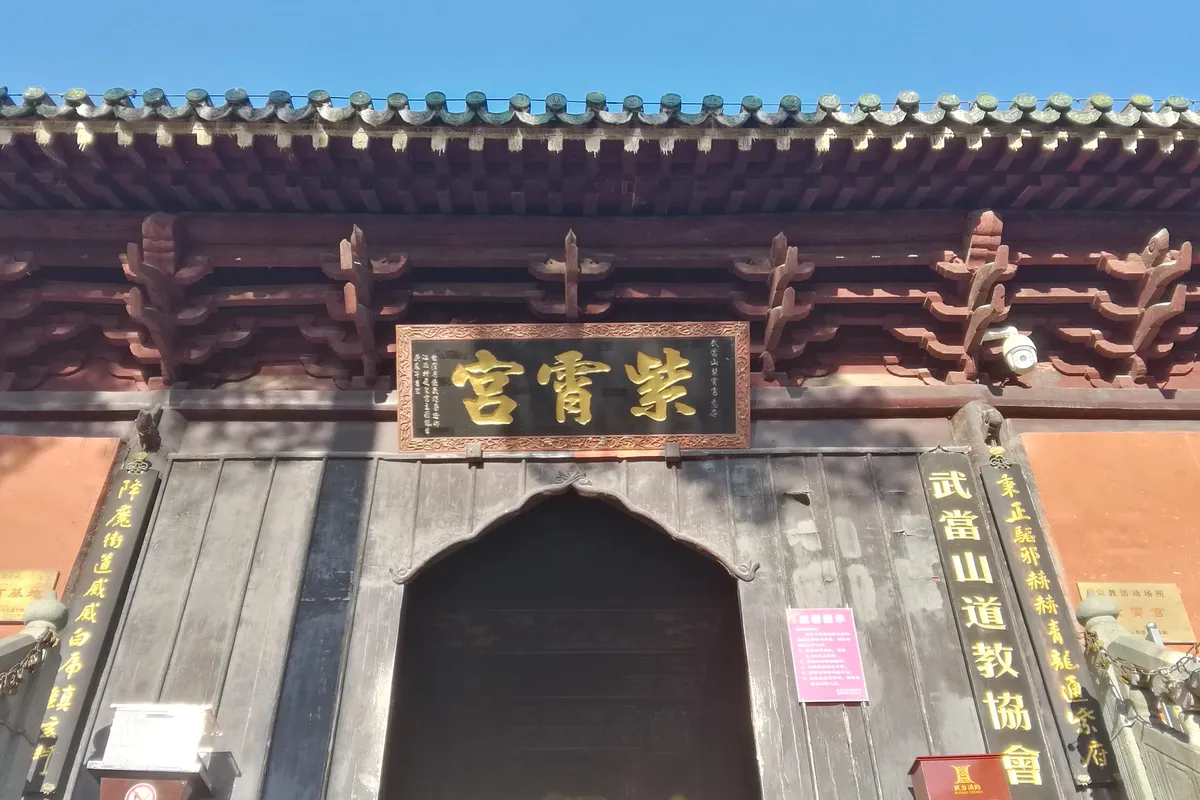
On December 21, 2020, the weather was cold. Because I was too tired from yesterday and in a hurry, I continued to explore the Wudang Mountain scenic area today. With the bus ticket from yesterday, I only needed to spend 20 yuan today. After boarding the scenic area bus, about half an hour later, I arrived at the gate of Zixiao Palace. I spent 15 yuan on an admission ticket and began my formal visit to Zixiao Palace.
Zixiao Palace is one of the famous Taoist temples in Wudang Mountain's history, with nearly a thousand years of history. Its architectural concept of conforming to nature fully reflects the essence of Taoist culture. It preserves rich and vivid ancient cultural content and is an important part of the relatively well-preserved Wudang architectural complex. In 1982, Zixiao Palace, as an imperial temple complex, was listed by the State Council as one of the second batch of national key cultural relics protection units. In 1984, Zixiao Palace was opened as a national key religious activity site. In December 1994, it was inscribed on the UNESCO World Heritage List as part of the ancient building complex of Wudang Mountain. Zixiao Palace is also the current seat of the Hubei Wudang Mountain Taoist Association.
Why is it called "Zixiao Palace"? Actually, "Zixiao" symbolizes the Ziwei constellation in the sky, which resides in the center as the Celestial Emperor; "Zixiao Palace" means the purple altar at the center of heaven and earth. Zixiao Palace was first built during the Xuanhe period of the Song Dynasty. According to historical records, Emperor Huizong of Song believed in Taoism and called himself the Taoist Lord Emperor. One night, Emperor Huizong dreamed of the "Fire God," and a Fangshi (alchemist) interpreted his dream, saying that only by sending the Water God to the south to suppress it could he be free from worry. So a Taoist temple was built here and given the name "Zixiao Yuansheng Palace." At the end of the Song Dynasty, when the Jin army marched south, Zixiao Yuansheng Palace was ravaged. In the early Yuan Dynasty, Emperor Shizu Kublai Khan used religion to stabilize the people's hearts, sent officials to grant seals, restored Taoism, and again undertook large-scale construction to rebuild Zixiao Palace. In the tenth year of Yongle in the Ming Dynasty (1412), it was renovated and inscribed with the name "Taixuan Zixiao Palace." In the eleventh year of Yongle (1413), the left imperial stele pavilion was engraved with the imperial decree, the heading reading "Imperial Edict," the content being a legal notice forbidding outsiders from disturbing the Taoist site. In the same year, Emperor Chengzu Zhu Di rebuilt Wudang Mountain, and Zixiao Palace was one of the key palaces reconstructed. The main building, Zixiao Grand Hall, was rebuilt and became the imperial family temple of the Ming Dynasty, a "national prayer site." In the sixteenth year of Yongle (1418), the right imperial stele pavilion was engraved with an imperial stele, the heading in seal script reading "Imperial Stele of the Great Taihe Mountain Taoist Palace," recording the imperial construction of Wudang Mountain. In the thirty-first year of Jiajing (1552), it was expanded to 806 rooms. From the eighth to the twenty-fifth year of Jiaqing in the Qing Dynasty (1803–1820), a major restoration was carried out, followed by more than ten minor repairs through subsequent dynasties.
Zixiao Hall is located at the foot of Zhanqi Peak in southeastern Wudang Mountain, standing against the mountain with majestic momentum. It is one of the eight major palaces and temples of Wudang Mountain, a large-scale and well-preserved Taoist architecture. It comprises 29 buildings with a construction area of 6,854 square meters, covering an area of approximately 274,000 square meters. The buildings are symmetrically arranged, with five terraces on the central axis. From top to bottom are built the Dragon Tiger Hall, Stele Pavilions, Shifang Hall, Zixiao Grand Hall, and Fumu Hall. Layers of halls are stacked against the mountain, ingeniously laid out in a staggered pattern. Red walls and green tiles make it magnificent. Hundreds of wide stone steps are built against the mountain, layered terraces solemn and imposing, halls and pavilions in close order, red walls and green tiles grand and spectacular. Seen from afar, it is majestic and solemn, exuding the grandeur of an imperial Taoist site. The remaining halls and pavilions are arranged in close order, with the East Palace and West Palace on both sides forming independent courtyards, quiet and elegant. Surrounded by lush pines, dense bamboo forests, rare flowers and herbs, they complement each other. On both sides, auxiliary rooms and other buildings divide the area into three courtyards, forming a complex of halls and buildings in close order with clear primary and secondary distinctions. In the middle wings of the palace are courtyard-style residences for Taoists.
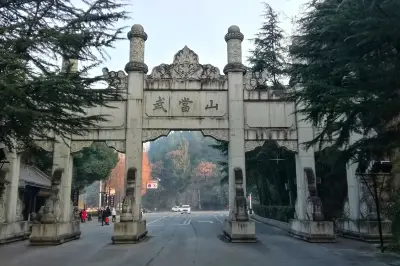
I walked up along the central axis of the Jinshui Bridge. In the moat, there is a sculpture of a turtle and snake conjoined, which matches the Golden Summit. At the mountain gate, I saw a young Taoist priest intently reciting the "Tao Te Ching." It seemed he had recently left worldly life, seen through the mundane world, and begun a new life.
Crossing the Jinshui Bridge and climbing the stone steps, I arrived at the first mountain gate of Zixiao Palace, the Dragon Tiger Hall. As the name suggests, it enshrines the gods Qinglong (Azure Dragon) and Baihu (White Tiger). Outside the hall there is a splayed wall decorated with patterns of colored glass flowers and peacocks. The interior of the hall is gloomy and terrifying. In the central shrine is enshrined Wang Lingguan, armed with armor and a whip, with a stern countenance. He is the protector deity in Taoism. Wang Lingguan's original name is Wang Shan. Legend has it that he has three eyes, able to distinguish good from evil, punishing evil and promoting good. He is upright, fair, and impartial. On both sides are enshrined clay statues of Qinglong and Baihu, each over ten feet tall, with wide glaring eyes, bared teeth, wearing armor, holding halberds, tall and mighty, vividly lifelike, inspiring awe. The statues of Qinglong and Baihu are guardian deities of Taoism and also the gatekeepers of Wudang Mountain temples. According to research, these two statues are surviving works of the famous Yuan Dynasty sculptor Liu Yuan's school, and are treasures of Wudang Mountain's clay sculpture art.
Exiting the back door of the Dragon Tiger Hall, I saw two Bixi-bearing imperial stele pavilions symmetrically standing on both sides of the stone balustrade path. The Bixi-bearing imperial stele pavilions are situated on high stone platforms. Inside the pavilions, the Bixi-turtle-bearing imperial steles are each carved from a single piece of bluestone, 8 meters high, 4 meters long, 2.5 meters wide, weighing 98 tons. The Bixi-turtle-bearing imperial stele is complete in form, finely carved. Bixi carrying an imperial stele is commonly called "turtle carrying a stele." Bixi is not a turtle; it is the eighth son of the dragon, good at bearing heavy loads, and the emperor had it carry imperial edicts, symbolizing the stability of the realm. It was built by imperial order during the Yongle period of the Ming Dynasty and restored to its original state in October 1988. The pavilion has a double-eave gable-and-hip roof, red walls and green tiles, with an arched opening on each of the four sides. Inside the pavilion are Bixi carrying imperial steles. The inscriptions are respectively Emperor Chengzu's "To the Taoists of the Great Taihe Mountain" and "Imperial Stele of the Great Taihe Mountain Taoist Palace."
Dragging my sore legs, I arduously climbed 96 steps, looked up, and arrived at the second hall, "Chaobai Hall" (Worship Hall). Legend has it that during the Ming Dynasty, only the emperor's ministers sent to Wudang Mountain for sacrifices could enter Zixiao Grand Hall, while ordinary pilgrims and believers could only worship Zhenwu here. Inside the hall, the central shrine enshrines a Yuan Dynasty copper-cast gold-gilded statue of Zhenwu, with statues of Lü Dongbin and Zhang Sanfeng on both sides. Hence it was called Chaobai Hall. In the late Qing Dynasty, its name was changed to Shifang Hall, meaning a gathering place for Taoists from all directions, where itinerant Taoists could stay.
Passing through Chaobai Hall, my view suddenly opened up. A quiet and elegant courtyard paved with bluestone bricks appeared before me. In the square, a group of young Taoists in white clothes were practicing martial arts. On the three-tiered balustraded terrace stood the main building of the palace, Zixiao Hall, which is also the most representative wooden structure on Wudang Mountain. In front of the foundation platform, there are steps leading up to the terrace of the hall in the center and on both sides. The main hall has five bays in width and five bays in depth, 18.3 meters high, 29.9 meters wide, and 12 meters deep, covering an area of 358.8 square meters. There are 36 eaves columns and inner columns arranged in order. The hall is a large wooden structure with a double-eave gable-and-hip roof, set off by three layers of terraces, with moderate proportions and harmonious appearance. The upper and lower eaves retain the construction style before the early Ming Dynasty. The column heads and bracket sets show the characteristics of Ming Dynasty dougong. The beam frame structure uses nine purlins, with a height-to-width ratio of 5:2.5, maintaining the material proportions since the Song and Liao dynasties. Inside the hall, the inner columns and bracket sets have a caisson ceiling, and the central bay's inner trough has an octagonal caisson.
Zixiao Grand Hall of Wudang Mountain is the main hall of Zixiao Palace and the only remaining double-eave gable-and-hip roof wooden structure hall on Wudang Mountain. This Taoist building, a rare example of post-and-beam large wooden structure in Chinese ancient architecture, has a scientifically reasonable structure and layout, a unified artistic style, and integrates harmoniously with the natural environment, possessing a unique style within the Wudang Mountain ancient building complex. At the same time, over the long historical process, it has accumulated the skills and wisdom of craftsmen from various dynasties, embodying the brilliant achievements of Ming and Qing Chinese architecture, with high ornamental and scientific value. On the stone carved Sumeru throne inside the hall, there is a partial shrine decorated with four golden dragons and two golden phoenixes, dragons soaring and phoenixes dancing, vivid in posture. The shrine enshrines imperial copper-cast gilded statues from the Ming Dynasty. On the altar are arranged imperial incense burners, candle stands, vases, and other ritual vessels, all copper-cast and gold-gilded, seamlessly integrated and shining brightly.
Zhenwu Emperor is one of the deities worshipped in Taoism, also known as Yousheng Zhenwu Lingying Zhenjun, Yisheng Baode Zhenjun, Yousheng Zhenjun Xuantian Shangdi, Dangmo Tianzun, the supreme deity in charge of the northern heavens. In ancient Chinese legend, Qinglong, Baihu, Zhuque, and Xuanwu are the great gods in charge of the four directions. "Zhenwu" is "Xuanwu." Taoist worship of Zhenwu Emperor flourished during the Song and Ming dynasties and continues to this day. Taoism also regards Zhenwu as the "Ancestor of the Thunder Department," the god in charge of wind, thunder, and lightning, and also as the "Wuqu" (Martial) great god. Wudang Mountain is revered as the holy land of Zhenwu Emperor, so statues of Zhenwu are commonly worshipped. In the center of the hall is enshrined a Ming Dynasty colored clay statue with gold leaf, 4.8 meters tall, wearing a crown with tassels, dressed in imperial robes, holding a scepter, seated on a throne. It is the largest surviving clay statue on Wudang Mountain.
The roof of Zixiao Hall is entirely covered with peacock blue glazed tiles. The main ridge, vertical ridges, and diagonal ridges are decorated with openwork carvings mainly in yellow and green, with rich and splendid decorations rarely seen in other religious buildings. The double-eaved vertical ridges of Zixiao Hall are lined with dragons, phoenixes, lions, qilins, etc., in varied and wonderful poses. The bracket sets on the upper and lower eaves and the caisson ceiling in the inner trough are entirely decorated with colored paintings of various flowers, birds, and figure stories. Architectural features: Zixiao Hall is five bays wide, with double eaves and nine ridges, green tiles and red walls, dazzling. Its architraves, bracket sets, and ceilings are covered with colored paintings, and the caisson ceiling has a two-dragon playing with a pearl relief, vividly alive as if real. Due to the colored paintings, the entire hall appears dazzling and magnificent. The platform in front of the hall is very spacious, with carved balustrades winding around, majestic and splendid. Inside the hall are worshipped statues of the Jade Emperor, Zhenwu, and Lingguan, vivid and lifelike, with delicate and realistic carving techniques.
In front of Zixiao Hall, there is an iron incense burner about 2 meters high. The burner body was cast in the fourteenth year of Yongle in the Ming Dynasty (1416), and the burner top was cast in the tenth year of Zhengde (1515). On the burner are engraved three "卍" characters. This character is pronounced "wan," meaning "auspicious cloud sea." It is also occasionally used in Buddhist iconography.
Zixiao Palace houses many precious cultural relics. For example, around Zixiao Grand Hall are displayed hundreds of statues and ritual vessels cast during the Yuan, Ming, and Qing dynasties, most of them copper-cast and gold-gilded, a dazzling array. These relics were moved here when other Wudang Mountain temples collapsed in the early Republic of China. Zixiao Palace also treasures a copy of "The Supreme Jade Emperor's Scripture of the Original Acts," in three volumes, handwritten in gold on indigo paper by the Hanlin Academy in the fifth year of Zhengtong in the Ming Dynasty (1440). After more than 500 years, it still looks new and shines with golden light. In 1982, a gold dragon unearthed on Wudang Mountain, made by Prince Zhu Bo of Xiang in the first year of Jianwen in the Ming Dynasty (1399), measuring 11.5 cm long and 5.2 cm high, with exquisite craftsmanship, lifelike. The temples along the way on Wudang Mountain are all treasure houses of cultural relics. The numerous statues, ritual implements, tables, offerings, scriptures, and stelae all have precious artistic and historical value, providing rare first-hand materials for studying Chinese Taoist history.
Passing Zixiao Hall to the right, there are many stone steles on a flight of steps. Some steles are ancient, and the characters are difficult to recognize. Going up to Fumu Hall (Parents Hall), this hall has five bays, rebuilt during the Guangxu period of the Qing Dynasty. It is a high building, elegant and beautiful, complementing Zixiao Hall. The central shrine in the hall enshrines the parents of the Zhenwu God, namely the Pure Joy King Mingzhen Emperor and the Good Victory Queen Qiongzhen Supreme Immortal. The left and right shrines enshrine statues of Guanyin, the Three Xiao Ladies, and the Child-Giving Lady, etc. In the past, childless male and female believers often came here to pray for children. It is said to be very efficacious. Fumu Hall is also the last hall on the central axis.
In front of Zixiao Grand Hall are the Fushou Hall (Blessings and Longevity Hall) and the Sixty Yuanchen Hall (Sixty Cyclical Deities Hall). In Fushou Hall, the shrine enshrines the God of Wealth, the God of Longevity, and the Medicine King Sun Simiao. On both sides of the shrine are two Ming Dynasty iron candlesticks, commonly known as "iron tree blooming lanterns," with exquisite craftsmanship, identified as the earliest forged iron art treasures discovered in China, listed as national first-class cultural relics. The candlesticks are 2.65 meters high, with a maximum diameter of 0.95 meters. Forged iron parts are welded into the shape of an iron tree in bloom, decorated with heavy colors. The base is a tripod of three dragon feet, the upper part is a multi-edged floral cluster, and in the middle, an iron rod supports two spherical floral clusters on top, exquisitely made, symbolizing jade branches, emerald leaves, and jade flowers, lush and perfect. Several peacocks frolic among them, and a dragon swims through the flowers, symbolizing good luck and happiness. The hall also displays many precious cultural relics such as statues, ritual vessels, implements, Taoist robes, and Taoist scriptures. In the Sixty Yuanchen Hall, a statue of Doumu Yuanjun with three eyes, four heads, and eight arms is enshrined, surrounded by sixty star deity portraits hanging on the walls.
Unexpectedly, Zixiao Palace also has important revolutionary historical sites. In May 1931, after He Long led the Third Red Army to capture Junzhou, they were stationed on Wudang Mountain. The headquarters of the Third Red Army was set up in Zixiao Palace. Fumu Hall was once He Long's bedroom and office, and his desk, chair, and bed are still preserved there, simple and plain. The west side room of the hall still hangs a small plaque reading "Headquarters of the Third Red Army." Inside, a couplet written by He Long and presented to Xu Bengshan (also known as Xu Weiqiao), the chief Taoist of Wudang Mountain, is preserved: "The great man comes from the east, all in purple air; the woodcutter's song goes west, clouds soar to the sky."
On the side wall of Zixiao Palace, I also saw slogans written during the Cultural Revolution. Times have changed, and it is hard not to feel a myriad of emotions.
Behind Zixiao Palace is the Purple Bamboo Forest. Following the stone steps upward, one can reach the Prince's Rock. Legend has it that this is where the prince cultivated immortality. The cave is about 10 meters high, 15 meters wide, and 12 meters deep. Inside the cave is a small stone hall built in the early Yuan Dynasty, housing a childhood statue of the prince. On the side of the hall is a stone plaque inscribed with "Prince's Rock," carved in the twenty-seventh year of Zhiyuan in the Yuan Dynasty (1290). Nearby are scenic spots such as Yuqing Rock, Taiqing Rock, Water Curtain Cave, Old Dragon Cave, and the Tomb of the Golden Finger King, quiet and serene, with charming scenery. Zixiao Palace also has many wonderful sights, such as "Turtle Neck Spouting Water," "Gold and Silver Sand Pits," "Fish Watching in the Sun Pool," "Golden Frog Calling the Morning," "Double Waterfalls Hanging in the Air," "Silver Thread Piercing Pearls," "Shuttle Dream Hiding the Moon," "Magpies Welcoming Guests," "Zixiao Clearing Snow," and other landscapes. "Turtle Neck Spouting Water" refers to a spring behind Zixiao Hall called "Tianyi Zhenqing Spring," which gushes sweet water all year round without drying up. Beside the spring is placed a stone severed-head turtle-snake. Beside the turtle's head, whenever there is thunder and rain, the turtle's neck spouts a stream of clear water, considered a wonder. It is understood that the reason for the turtle neck spouting water is that a hidden water channel is chiseled under the turtle's belly. This spring water is sweet and refreshing, called by Taoists the "holy water that transforms the body." "Fish Watching in the Sun Pool" refers to a pool in front of Zixiao Hall, about six or seven meters in diameter. The fish in the pool are colorful, changing from black to blue, from blue to red, from red to multicolored, from multicolored to white, named five-colored fish, very beautiful. "Golden Frog Calling the Morning" — when you stamp your foot on the central axis stone slab of Zixiao Grand Courtyard, it emits a frog-like croak, very peculiar. These sights are a great feast for the eyes and refreshing to the mind.
Zixiao Palace is located at the foot of Zhanqi Peak, with excellent feng shui, a great convergence of feng shui. Directly in front is a small hill, and on the left and right are two small hills like the armrests of a chair. The terrain resembles a large armchair, with Zixiao Palace in the middle. Facing Zhaobi, Sanguan, Wulao, Lazhu, Luomao, Xianglu peaks, it looks like jade shoots standing upright, trailing purple and blue. On the right is Leishen Cave, on the left is Penglai First Peak, with floating clouds and mist. Nearby are Yuji Pond, Baozhu Peak, etc. The surrounding mountains naturally form a two-dragon-playing-with-a-pearl treasure chair, with peaks clustered around, emerald forests encircling, in an elegant environment with pleasant climate. The Yongle Emperor of Ming named it "Zixiao Blessed Land." The entire architecture of Zixiao Palace is magnificent and imposing. In later dynasties, emperors often issued edicts to set up altars and hold Taoist ceremonies here, praying for the blessings and virtues of their ancestors in heaven, and also seeking divine help for national peace, favorable weather, abundant harvests, and the consolidation of the imperial throne.
Taoism advocates harmony between humans and nature, harmony among humans, governing by non-action, being content with one's lot, transcending the mundane, living in seclusion, and hiding one's name in the mountains. It demands very little in material terms, mainly pursuing spiritual attainment. Zixiao Palace is relatively special, being a place of cultivation mainly for women. Male Taoists are called "Qiandao" (heavenly way), and female Taoists are called "Kundao" (earthly way), derived from the "I Ching" concept of Qian representing yang and Kun representing yin.
Zixiao Palace is one of the national key open Taoist temples. Those who become Taoists must strictly abide by Taoist teachings and precepts, and be proficient in the five arts of Taoism. The five arts of Taoism are "Mountain, Medicine, Fate, Physiognomy, Divination." "Mountain" refers to cultivating a perfect personality through meditation, practice, martial arts, diet therapy, etc. "Medicine" refers to using prescriptions, acupuncture, scripture chanting, spiritual treatment, etc., to achieve health preservation and treat diseases. "Fate" is the study of predicting a person's destiny through Taoist techniques, thereby improving human development. "Physiognomy" is a method of observing objects with the eyes to seek good fortune and avoid misfortune. "Divination" refers to methods such as casting lots, selecting auspicious dates, and trigram divination to predict and handle affairs.