Hainan Self-Driving Return Trip Journal Part 4: Danjiangkou and Shiyan
Hainan Self-Driving Return Trip Journal 4 (Danjiangkou, Shiyan)
Last late autumn, I went to Hainan and stayed for about half a year. As the weather in Hainan gradually warmed up, and with the Qingming Festival offering three free days on the expressway, I decided to return home, traveling and sightseeing along the way. The itinerary was planned but subject to change based on actual conditions. Due to length, the journal is published in four parts.
Trip Summary: Total distance 2540 km, expressway toll 501 yuan (three days free during Qingming)
3.31: Haihua Island – Leizhou, total distance 219 km, toll 31 yuan. Stayed in Leizhou.
4.1: Sightseeing in Leizhou, total distance 10 km. Visited West Lake, Tianning Temple, Leizhou Museum, Sanyuan Pagoda, and Leizu Temple. Stayed in Leizhou.
4.2: Leizhou – Wuzhou, total distance 383 km, toll 158 yuan. Visited Longmu Temple. Stayed in Wuzhou.
4.3: Wuzhou – Chenzhou, total distance 413 km, toll free. Visited Chenzhou Beihu Park. Stayed in Chenzhou.
4.4: Chenzhou – Yiyang, total distance 396 km, toll free. Visited Chenzhou Yidi Mausoleum and Yiyang Museum. Stayed in Yiyang.
4.5: Yiyang – Zhongxiang, total distance 359 km, toll free. Visited White Deer Temple, Yiyang Ancient City, Zhou Libo's Former Residence, and the First Village of Great Rural Transformation. Stayed in Zhongxiang.
4.6: Zhongxiang, total distance 45.7 km, parking fee 13 yuan. Visited Mochou Lake, Mochou Village, and Ming Xianling Mausoleum. Stayed in Zhongxiang.
4.7: Zhongxiang – Jingmen – Danjiangkou, total distance 304 km, toll 100 yuan. Visited Zhongxiang Museum and Jingmen Museum. Stayed in Danjiangkou.
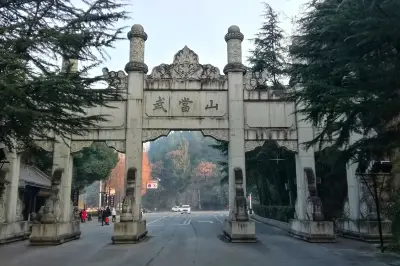
4.8: Danjiangkou – Shiyan, total distance 125.5 km, toll 11 yuan. Visited Danjiangkou Museum, Jingle Palace, Danjiangkou Dam, the reservoir sightseeing road, Tai Chi Lake, and the "Governing the World, Black Tortoise" archway of Wudang Mountain. Stayed in Shiyan.
4.9: Shiyan – Xi'an, total distance 285 km, toll 201 yuan. Visited Shiyan Museum, then returned home.
4.8: Danjiangkou – Shiyan, total distance 125.5 km, toll 11 yuan.
Danjiangkou City is located at the border of Hubei and Henan. Its predecessor was Junzhou. The construction of the Danjiangkou Reservoir submerged Junzhou, leading to the creation of Danjiangkou City. Therefore, the Danjiangkou Museum is also called the Junzhou Museum. Danjiangkou is a county-level city directly under the Hubei Provincial Government, administered by Shiyan.
The Danjiangkou Museum exhibits two main themes: unearthed artifacts and the construction of the Danjiangkou Reservoir. Among the exhibits are several exquisite bronze pieces from the Chu State. It is a pity that none of the exhibits have labels, probably because the museum is newly built and the staff is few; the labels are reportedly being prepared.
From the museum, I went to Jingle Palace. Jingle Palace charges an admission of 20 yuan, free for those 65 and older.
Jingle Palace was built by imperial order in the 11th year of the Yongle reign of the Ming Dynasty, and was considered the foremost of the nine palaces of Wudang Mountain. In 1958, due to the construction of the Danjiangkou Water Control Project, Jingle Palace and the ancient city of Junzhou were submerged under the waters of the Danjiangkou Reservoir. The current Jingle Palace was rebuilt after 2003, chosen for its similar topography to the original site in Junzhou: backed by mountains and facing water. The reservoir in front, formerly Jingang Reservoir, was renamed Jingle Lake. This terrain matches the ancient feng shui principle of "left green dragon, right white tiger, south vermilion bird, north black tortoise."
All the buildings in Jingle Palace today are new, but some cultural relics were moved from the original palace. Two steles carried by stone tortoises (bixi) and the stone archway in front are original. These two steles and the archway are also the largest of their kind on Wudang Mountain. The steles are 9.52 meters high and weigh 102 tons. Moving such heavy objects was no small feat; photos of the relocation can be seen at the Shiyan Museum. Jingle Palace should also build an exhibition hall to present this history.
The stone archway at the entrance of Jingle Palace bears the plaque "Tianyuan Jingle Palace," an imperial gift from Emperor Yongle (Zhu Di).
The 102-ton stele carried by a stone bixi, relocated from the original site. As the saying goes: "Touch the bixi's head, never worry; touch the bixi's back, never be tired; touch the bixi's butt, never fall ill."
The main hall of Jingle Palace, Xuandi Hall, closely resembles the main hall of Zixiao Palace on Wudang Mountain.
The image below shows the Hall of Holy Parents, which enshrines the parents of Xuanwu the Great. Behind the hall are reliefs of the Classic of Filial Piety and the Twenty-Four Filial Exemplars. Just as Confucian temples share a similar architectural layout, Taoist temple layouts are also largely similar, with the hall of holy parents at the rear.
Inside Xuandi Hall, a Taoist monk played a flute, the melody melodious, evoking a sense of Taoist tranquility.
Beside the Hall of Holy Parents is a pond. A turtle was sunbathing on a floating wooden board, while another turtle struggled hard to climb onto the board to join its companion. After many failed attempts, it persisted with great determination, looking very strenuous. If even animals are so persistent, how much more so should humans be!
From Jingle Palace, I went to the Danjiangkou Dam scenic area. Admission to the dam scenic area is 65 yuan (including 15 yuan for the sightseeing bus), and 40 yuan for those 60 and above (including 15 yuan for the bus). Those 70 and above and military personnel are free but must purchase a sightseeing bus ticket for 15 yuan. Self-driving visitors can drive into the inner parking lot and then take the sightseeing bus to the top of the dam to view the upstream and downstream scenery and listen to the guide's explanations about the dam's history and stories. According to the guide, the Danjiangkou Reservoir is over 100 meters higher in elevation than Beijing. Thanks to this elevation difference, water flows to Beijing entirely by gravity, significantly reducing the cost of the South-to-North Water Transfer Project. The water quality of the Danjiangkou Reservoir is excellent and directly drinkable. A Nongfu Spring factory is built near the dam.
The highest water level of the Danjiangkou Reservoir is 175 meters; currently it is below 160 meters. During the flood season from September to October, the dam releases water, said to be spectacular.
Along the reservoir sightseeing road, I enjoyed the scenery of Danjiangkou Reservoir. There are many viewing platforms, the larger ones being Blue Water Connected to Sky and Thousand Island Gallery. Along the road are many resettlement villages of reservoir migrants, with well-planned houses.
The Blue Water Connected to Sky viewing platform.
The Thousand Island Gallery viewing platform requires driving up a very steep slope. From there, a path leads down to the water's edge. The reservoir water is very clear. I cupped some water from the Danjiangkou Reservoir and tasted it; it didn't taste sweet, but was very refreshing.
From Danjiangkou Reservoir, I went to Tai Chi Lake, a water recreation area within the Wudang Mountain scenic area. Then I went to the "Governing the World, Black Tortoise" archway.
The "Governing the World, Black Tortoise" archway, commonly called Xuanwu Gate, was the first sacred gate for pilgrims entering Wudang Mountain in ancient times.
Xuanwu Gate was built in the 31st year of the Jiajing reign of the Ming Dynasty (1552) by imperial order and with a plaque from Emperor Jiajing. It is located about 5 km east of the main gate of Wudang Mountain, on the north side of the road. There is no dedicated management or parking area; cars have to park by the roadside. Many large vehicles pass by, and some drivers are unkind, honking aggressively and deliberately cutting off others. Drivers should be very careful when parking and leaving.
From Wudang Mountain, I went to Shiyan.
4.9: Shiyan – Xi'an, total distance 285 km, toll 201 yuan.
Shiyan was established and flourished because of automobiles. In 1969, with the construction of the Second Automobile Works (SAW), Shiyan City was established under Yunyang Prefecture. In 1973, Shiyan was upgraded to a municipality directly under Hubei Province. Before 1982, Shiyan operated under a government-enterprise integration: Shiyan was SAW, and SAW was Shiyan; SAW ran both the enterprise and society. In 1982, the government and enterprise separated, and Shiyan City and SAW managed independently. In 1992, SAW was renamed Dongfeng Motor Corporation. "Shiyan" was originally a local place name related to an irrigation weir. According to historical maps, place names from "Yi Yan" (First Weir) to "Shi Yan" (Tenth Weir) existed locally. The choice of this site for SAW transformed Shiyan from a rural settlement into the current city.
The Shiyan Museum is combined with the Hubei South-to-North Water Transfer Museum. It has five permanent themed exhibitions: Into the Age of Dinosaurs, Ancient Human Homeland, Fairy Mountains and Jade Pavilions of Wudang, Water and Shiyan, and Automobiles and Shiyan, abbreviated as "Dinosaurs, Antiquity, Wudang, Water, Automobiles." In addition, the museum features an exhibition of artifacts unearthed from the Hubei reservoir area of the South-to-North Water Transfer Project. Shiyan is known nationwide for its Dongfeng trucks that travel across the country; Wudang Mountain attracts tourists from all over due to its celestial atmosphere; and the Danjiang water from the South-to-North Water Transfer benefits Beijing and Tianjin. The museum's exhibits are quite good, especially the Wudang Mountain exhibition, which is well worth seeing. Whether before or after visiting Wudang Mountain, it serves as an excellent preview, review, and summary. Perhaps such an exhibition should also be established on Wudang Mountain itself.
A model of the Golden Hall on Wudang Mountain.
The first Dongfeng automobile.
The South-to-North Water Transfer Project was first proposed by Chairman Mao when he inspected the Yellow River in 1952. Chairman Mao said, "The south has plenty of water, the north has little. If possible, borrowing some water would be fine."
The South-to-North Water Transfer gave rise to Danjiangkou City; Dongfeng Motor built Shiyan City.
The museum features an exhibition of artifacts unearthed from the Hubei reservoir area of the South-to-North Water Transfer.
Below is an image of an early, uniquely shaped pottery mandarin duck hotpot.
Leaving Shiyan, I drove back and arrived home at 5:00 PM. The journey ended, and I returned to my nest.
In retirement, one should not become idle. As long as health and finances permit, one should go out often, travel widely, admire the beautiful landscapes, and savor the flavors from all over.
Travel is an up-close appreciation of the magnificent rivers and mountains, a field study of historical figures and events, a personal experience of society and local customs, a taste of local specialties and cuisines, and an excellent opportunity for learning through practice and asking questions without shame.