Spiritual Hubei – Seeking Tao on Mount Wudang (Three-Day Essential Tour with Detailed Guide)
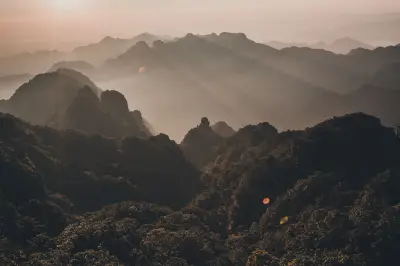
Hubei sits at the heart of China's map, with well-developed transportation. Precisely because it's so easy to reach, it often gets overlooked—Hubei ended up being the last province I visited in my domestic travels. When talking about major tourist provinces, Hubei rarely comes to mind first, but its tourism resources cannot be ignored. The ethereal Mount Wudang, with its Taoist charm, is a precious world heritage site.
What prompted this trip to Hubei was a group of hiking buddies. As a travel enthusiast, I naturally became the team leader for this journey.
There are not many direct flights from Xiamen to Shiyan, so just pick one with a suitable time. For the return trip, railway enthusiasts chose the high-speed train.
Transportation within the Mount Wudang Scenic Area: Nanyan, Qiongtai, and Taizipo are the three transfer hubs for scenic area shuttle buses. From these three hubs, you can reach any attraction within the scenic area.
The cable car within Mount Wudang costs 90 yuan for the ascent and 80 yuan for the descent, with no discount for a round-trip ticket.
The scenic area opens from 07:30 to 17:00. Please bring your valid ID card and a green "Health Code" to enter.
The Mount Wudang ticket is valid for three consecutive days. If you need to re-enter the scenic area on a second or third day, you must purchase a shuttle bus ticket for 20 yuan per person per entry.
The tickets for Golden Summit and Purple Cloud Palace are not included in the scenic area ticket. Golden Summit costs 27 yuan, and Purple Cloud Palace costs 15 yuan, and they need to be purchased separately.
If you book the ticket one day in advance online, it costs 230 yuan; buying on-site costs 235 yuan (including the main ticket, shuttle bus, and insurance).
Before the trip, I checked the accommodation situation on Mount Wudang. During the non-peak season, there is absolutely no need to book in advance. All accommodations are available for on-site viewing and check-in, and you can even negotiate the price.
Most of the well-conditioned guesthouses and hotels within the scenic area are concentrated near Purple Cloud Palace and Nanyan (Crow Ridge).
The accommodation conditions on the mountain within the scenic area are no worse than those in Wudang Town outside the scenic area, and the prices for food and accommodation are reasonable.
Day 1: Xiamen - Shiyan
Attractions visited: Yuxu Palace
Accommodation: Wudang Town
Day 2: Mount Wudang Scenic Area
Attractions visited: Langmei Immortal Shrine, Yellow Dragon Cave, Chaotian Palace, First Heavenly Gate, Meeting Immortals Bridge, Second Heavenly Gate, Third Heavenly Gate, Golden Summit, Qiongtai Middle Temple
Accommodation: Nanyan, Mount Wudang Scenic Area
Day 3: Mount Wudang Scenic Area - Wudang Town
Attractions visited: Nanyan, Nanyan Palace, Nanyan, Purple Cloud Palace, Xiaoyao Valley, Taizipo, Wudang Town
Accommodation: Wudang Town
There are two direct flights from Xiamen to Shiyan each day, one around noon and one in the evening, with similar ticket prices. I chose the noon flight to make use of the half day to visit the Mount Wudang Museum and Yuxu Palace.
After boarding smoothly, the plane was delayed due to air traffic control. For the afternoon plans of Mount Wudang Museum and Yuxu Palace, I had to choose only one of the two.
According to the guide, as long as there is a direct flight arriving at Shiyan Airport, there is an airport bus directly to Mount Wudang. However, this time, due to waiting for luggage and the crowd dragging on, we missed the bus. A taxi from Shiyan Wudangshan Airport to Yuxu Palace costs about 100 yuan.
Yuxu Palace is located in Wudang Town at the southern foot of Mount Wudang and is one of the largest palaces in the Mount Wudang architectural complex. Yuxu Palace was first built during the Yongle period of the Ming Dynasty. After its completion, Emperor Yongle designated it as "Xuántiān Yùxū Gōng". As the base camp for constructing the Taoist temple complex on Mount Wudang, it served as the headquarters for the "Three Dukes", and during the Ming and Qing dynasties, troops often camped there, hence it was commonly called "Old Camp Palace".
The main building faces southeast to northwest, with a symmetrical axis layout. Imitating the "Three Courts and Five Gates" system of the Forbidden City, the layout presents three routes and five entrances. Along the central axis are the Mountain Gate, Dragon and Tiger Hall, Worship Hall, Xuan Emperor Main Hall, and Parents Hall. Horizontally, it extends to include the East and West Imperial Stele Pavilions (four in total), East and West Incense Burning Furnaces, East and West Side Halls, Corridors, Star Observation Platform, Qisheng Hall, and Yuanjun Hall.
The palace gate is made of Qionghua Sumeru stone base with three arched openings. The two wings have eight-character walls inlaid with琉璃琼花 patterns. In front of the gate are ornamental steps, magnificent and splendid.
Entering the palace gate, there are two stele pavilions on the left and right. One bears the "Imperial Edict" inscribed by Emperor Shizong Zhu Houcong of the Ming Dynasty in the 32nd year of Jiajing (1553) for the reconstruction of the Wudang Taoist site, and the other is the "Stele of the Completion of the Reconstruction of the Great Grand Supreme Harmony Mountain Xuan Hall" from the 31st year of Jiajing (1552). The double stele heads are carved with coiled dragons, and the Bixi (turtle-like mythical creatures) are vividly lifelike. In the "Imperial Edict" inscription, he recounts the achievements of his ancestor, Emperor Yongle, in building Wudang Mountain, believing it was divine protection, and thus spared no expense, spending billions of wealth to rebuild Wudang.
Beneath the stele pavilions stretches a large courtyard covering over 40 mu, paved with green bricks, open and elegant. East of the palace wall is the East Palace, also known as East Daoist Courtyard, with ruins of brick chambers, bathing rooms, divine kitchens, dragon wells, etc. West of the palace wall is the West Palace, with ruins of the Immortal Viewing Platform, Water Curtain Cave, Imperial Garden, and Undefiled Hall.
Outside the second palace gate, there are two more stele pavilions with double-eaved hip-and-gable roofs. Inside each pavilion is a huge Bixi (legendary son of the Dragon King) carrying an imperial stele. The stone steles are 6 meters high, 2.35 meters wide, 0.76 meters thick, with a total height of 9.03 meters, each weighing over 100 tons. One stele bears an imperial edict from Emperor Chengzu Zhu Di in the 11th year of Yongle (1413) to protect the Taoist religion on Mount Wudang, and the other is the "Stele of the Great Grand Supreme Harmony Mountain and Taoist Temples" from the 16th year of Yongle (1418). In the inscription of the Yongle 16th year stele, Emperor Yongle quotes Taoist classics to describe the relationship between the "True Martial Emperor" and Mount Wudang, claiming that his father Zhu Yuanzhang and he himself received divine assistance from the True Martial God in gaining the realm, and therefore built temples on Mount Wudang to glorify divine merits and repay divine grace.
These two enormous Bixi-carrying steles are rare in China, much larger than the Bixi-carrying steles at the Dingling and Changling tombs of the Ming Tombs in Beijing.
The Yudai River passes through the city, and the Jinshui Bridge is built over it. This bridge, built in the Ming Dynasty, is made of square stone blocks, with lotus petal and pomegranate head railings on both sides, very exquisite.
Crossing the Yudai River leads to the second palace gate. The palace walls are thick and dignified, mottled and dilapidated, fully displaying the antiquity and decay of ancient architecture over centuries of historical vicissitudes.
Existing buildings and ruins mainly include two sections of palace walls totaling 1,036 meters, two stele pavilions, five hall foundations in the inner part, the Parents Hall rebuilt in the Qing Dynasty, the Cloud Hall, and the ruins of the East Heavenly Gate, West Heavenly Gate, and North Heavenly Gate.
The existing Yuxu Palace covers an area of about 100,000 square meters, larger than the Shenyang Imperial Palace or the Qufu Confucius Temple. Imagining back then, Yuxu Palace once covered over 5 million square meters, with architectural forms and scales comparable to the imperial Forbidden City.
In the 7th year of Tianqi of the Ming Dynasty (1627), a fire broke out in Yuxu Palace, destroying most of its main buildings. A hundred years later, in the 10th year of Qianlong of the Qing Dynasty, another great fire reduced the remaining附属 buildings to ashes. In the summer of 1935, a flash flood occurred, sending hundreds of thousands of cubic meters of mud and sand straight into Yuxu Palace, engulfing large areas of housing. Sadly, Yuxu Palace, once known as the "Forbidden City of the South," was left in ruins.
In June 2001, the Yuxu Palace site was listed as a National Key Cultural Relics Protection Unit. In recent years, the local government has adopted the method of restoring the old as it was, gradually repairing and rebuilding the Dragon and Tiger Hall, Yuxu Hall, Yudai River, and the stone pavement inside the palace. When we arrived, the most important Yuxu Hall and Parents Hall were still under renovation, and the second palace gate was tightly closed, allowing only a glimpse through a narrow crack. Originally, I thought the visit to Yuxu Palace would be tight on time, but unexpectedly, it became quite relaxed.
Attraction address: Wudang Town, Danjiangkou City, Shiyan City
Opening hours: All year round, 8:00-17:30
Ticket fee: Free
After leaving Yuxu Palace, we found a restaurant called "Shangshanfang" to rest and have our first meal at Mount Wudang. It was still early for dinner, and it was the off-season, so there were no other customers. The restaurant also provides accommodation.
Pan-fried big white fish was my favorite dish. Because of this pan-fried big white fish, I craved it every day during the subsequent days at Mount Wudang. You can see how delicious and popular it is, highly recommended.
It was most convenient to stay at a guesthouse near the scenic area entrance, so we were in no rush to book accommodation.
Sister Flower Express Hotel
Walking from Shangshanfang to the entrance of Mount Wudang Scenic Area is not too far. Along the way, there are many places to eat, most of which also provide accommodation. Moreover, prices for food and accommodation are cheaper than on Taihe Road, where Shangshanfang is located. So we booked accommodation for the night. The accommodation at "Sister Flower Express Hotel" was average, but the advantage was convenience for entering the mountain tomorrow and low cost. Seeing that accommodation was not tight at all, we decided not to book accommodation for the day after tomorrow in advance.
We booked tomorrow's Mount Wudang tickets on our phones. Booking online one day in advance not only saves time queuing at the scene but also saves a few yuan. The Mount Wudang official account and Ctrip offer a 230 yuan advance booking, while on-site purchase costs 235 yuan (including main ticket, shuttle bus, and insurance). The Mount Wudang ticket is valid for three consecutive days. If you need to re-enter the scenic area on a second or third day, you must purchase a shuttle bus ticket for 20 yuan per person per entry. We planned to stay inside the scenic area tomorrow to avoid unnecessary back-and-forth.
To enter the scenic area as early as possible, we got up early and went downstairs for breakfast. After breakfast, we stored our luggage and headed to the scenic area. There were already many people on the way heading into the mountain.
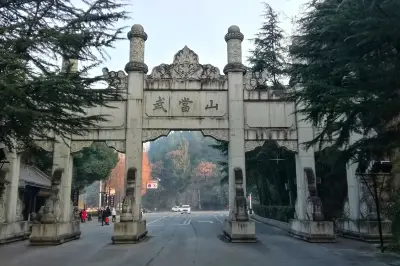
In less than 5 minutes, we arrived at the mountain gate. The Mount Wudang Gate is an imposing archaistic building serving as the passage into the Mount Wudang Scenic Area. The gate is a six-pillar, five-arch archaistic stele archway, with the three characters "武当山" (Mount Wudang) inscribed on the lintel.
After entering the mountain gate, we saw the tall archway of Wudang Gold Street. Wudang Gold Street is an archaistic commercial street, mainly selling Wudang swords, medicinal herbs, candies, crafts, and various tourist souvenirs. Passing through the long archaistic Gold Street, at the end is the "Mount Wudang Tourist Distribution Center," which has a Taoist temple architectural style. It was still early, so the distribution center hadn't opened yet, and the scenic area shuttle buses hadn't started operating. However, there were already many people waiting in line for the buses.
Most of the guesthouses and hotels on Mount Wudang are concentrated near Purple Cloud Palace and Nanyan (Crow Ridge). We decided to take the scenic area shuttle bus to Nanyan first to arrange tonight's accommodation, then start today's sightseeing.
"Mount Wudang Hotel" was undergoing exterior renovation, but the rooms looked very clean, with a standard double room costing 100 per night. I originally thought accommodation inside the scenic area would be poor or expensive, but it turned out not to be the case. Probably due to the off-season with fewer tourists and business competition, accommodation here seemed even cheaper than in Wudang Town at the foot of the mountain.
According to Mount Wudang records, "Only on clear days can you see it." Climbing to the top of Tianzhu Peak requires choosing the right day. "If the holy will does not permit, forcing an ascent will result in fog and clouds obscuring the height," which is a divine sign that cannot be forced. The weather forecast predicted rain tomorrow, so the innkeeper suggested we go to the Golden Summit today. We took her advice and finalized today's itinerary on Mount Wudang: Starting from Nanyan – Langmei Shrine – Yellow Dragon Cave – Chaotian Palace – First Heavenly Gate – Meeting Immortals Bridge – Second Heavenly Gate – Third Heavenly Gate – Chaosheng Gate – Taihe Palace – Summit Golden Hall; descend by cable car to Qiongtai Middle Temple, then take the scenic area shuttle bus back to Nanyan for accommodation.
Staying at Nanyan and going up to the Golden Summit from Nanyan is only possible on foot. If you want to take the cable car up, you have to take a bus to Taizipo first, then transfer to a bus heading to Qiongtai, and then take the cable car. We didn't plan to take the cable car up; we considered it as a warm-up for the subsequent hike.
Leaving the accommodation, following the road signs, the left path goes down to the Golden Summit, and the right path goes up to Nanyan Palace. Along the way, there are viewing platforms at intervals. We found a hidden sign for Langmei Shrine and took an easy descending stone staircase to the mountain gate of Langmei Immortal Shrine.
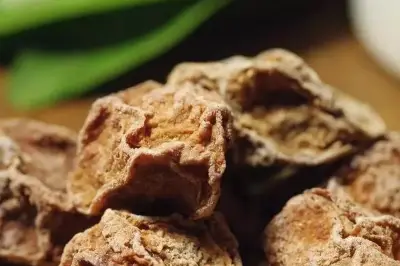
Langmei Shrine is located on the road from Crow Ridge to the Golden Summit. Legend has it that when the True Martial Emperor was young, he practiced Taoism on Mount Wudang but faltered and descended halfway. On the way, he met the Primordial Lord of Purple Mist, who transformed into an old woman to enlighten him. Enlightened, the True Martial returned to Mount Wudang. Along the way, he broke off a plum branch and inserted it into a lang tree (a type of oak), saying, "If I attain the Tao, it will bloom and bear fruit." Later, he indeed succeeded in his cultivation, and the plum branch inserted into the lang tree also survived, blossomed, and bore fruit. Because the lang tree bore plums, people called it the langmei tree, and its fruit the langmei fruit.
The emperor considered the fruiting of the langmei as an auspicious omen, a praise from the Xuanwu Emperor for his ascension to the throne. Zhu Di issued an imperial edict to protect the langmei tree, making its fruit a tribute and forbidden fruit, to be annually presented by the Wudang Taoist priests. The emperor often used langmei fruits to reward meritorious officials, and high-ranking ministers considered receiving a langmei fruit as a political honor and lifelong privilege. In the 10th year of Yongle of the Ming Dynasty, the Langmei Shrine was built by imperial order, fully named "Langmei Immortal Elder Shrine," which was the largest of the sixteen shrines on Mount Wudang at that time.
By the Qing Dynasty, the langmei trees on Mount Wudang had completely disappeared. People searched everywhere on Wudang for langmei but in vain, becoming an eternal mystery. Today, only the Langmei Shrine remains, with no langmei fruit to be seen.
The current Langmei Shrine is a small Taoist temple hidden deep in the mountains of Crow Ridge. Although small, it has a unique shape, with red walls and black tiles, creating a picturesque scene like a poem.
Past Langmei Shrine, there is a stone tablet inscribed with "Record of the Great Repair of the Ancient Sacred Path," documenting that the ancient sacred path from Crow Ridge to the Golden Summit was first built in the Ming and Qing dynasties and had suffered severe damage over centuries. Starting in 2003, a comprehensive repair was carried out.
Continuing upward on the sacred path, there is a wooden pavilion with a plaque reading "Yellow Dragon Cave." Most hikers heading up the mountain rest in this pavilion.
Further ahead is a small stone bridge. Crossing the bridge and turning left leads to a small path to Yellow Dragon Cave.
Yellow Dragon Cave is a natural rock shelter. According to records, before the Song Dynasty, Taoist priests and hermits practiced cultivation here, making it a place for generations of practitioners. Through successive constructions, buildings such as the Yellow Dragon Hall, True Martial Pavilion, Medicine King Hall, and Divine Spring Pavilion were added.
The most distinctive feature of Yellow Dragon Cave is that there is a cave within a cave. Legend says that a yellow dragon attained enlightenment here and ascended to heaven. To thank the place for nurturing him, the yellow dragon left an immortal pill. There is a pool of spring water in the cave, and the immortal pill made the water clear, sweet, and capable of curing all diseases. The Taoist priest suggested that if we had water bottles, we should fill them with the spring water to drink on the way.
After resting at Yellow Dragon Cave, we came out to face a towering cliff that seems to "stand ten thousand ren high." What followed was a long stone staircase, where every step seemed to elevate us higher. The sustained walking later became quite strenuous. Along the way, sedan chair carriers kept shouting for business, offering to carry us in a sedan chair. This kind of human-powered sedan chair sways mid-air; I dared not ride in it, and psychologically, I couldn't bear the feeling of oppressing the poor.
Chaotian Palace, built on the Wudang sacred path, arches up to Tianzhu Peak above and overlooks Nanyan Palace below. In front of Chaotian Palace, several stone tablets record the construction history over the dynasties.
Legend has it that Chaotian Palace is the boundary between the heavenly court and the mortal world. According to Wudang Taoism, it is the lowest boundary for immortals to roam and observe the human world, and the highest point mortals can reach. In ancient times, pilgrims coming to offer incense would consider themselves entering the celestial realm upon reaching this point, so they would first worship here before continuing to the Golden Summit.
The construction date of Chaotian Palace is unknown. It houses side halls (east and west) dedicated to other deities in the True Martial God system, as well as the main Taoist courtyard of Chaotian Palace.
Chaotian Palace is surrounded by mountains and lush vegetation, giving a strong sense of a Taoist paradise.
From Chaotian Palace, there is a fork in the road leading to the Golden Summit, divided into the Ming Dynasty ancient path and the Qing Dynasty ancient path. The Ming path has many steps and is difficult, but the important scenic spots—the Three Heavenly Gates, Meeting Immortals Bridge, and Chaosheng Gate—are all along this route. The Qing path is relatively flat but has few scenic spots. Naturally, we chose the more ancient Ming path to continue to the Golden Summit.
First Heavenly Gate, Second Heavenly Gate, Third Heavenly Gate
The stone staircase path became steeper and steeper. On the ancient sacred path to the Golden Summit on Mount Wudang, three heavenly gates are built, inscribed with First Heavenly Gate, Second Heavenly Gate, and Third Heavenly Gate. These three gates are magnificent, standing in sequence among thousands of ornate stone steps. The stone steps leading to the First Heavenly Gate are the longest and steepest, making it the most difficult. The section from the First to the Second Heavenly Gate is slightly less so, and the distance from the Second to the Third Heavenly Gate is the shortest, reachable within a few minutes, relatively easy.
Near the ruins of Wenchang Shrine below the First Heavenly Gate, there is a "Meeting Immortals Bridge" (Huixian Bridge). In ancient legends, to enter the immortal realm, one had to cross a bridge, so many places have such bridges. The bridge becomes a Taoist symbol connecting humans and gods, the mortal world and the immortal realm.
"Meeting Immortals Bridge" is also the terminal for sedan chairs. If you are riding a sedan chair, don't believe whatever the carriers say earlier, even if they claim they can carry you to the Golden Summit. Meeting Immortals Bridge is the final stop; there is no such service beyond this point.
After a arduous trek, we finally saw the Chaosheng Gate. As the name implies, Chaosheng Gate is the heavenly gate that pilgrims must pass through. It is the entrance gate to the Golden Summit of Mount Wudang. Passing through Chaosheng Gate, we entered the Golden Summit area, and the Golden Hall immediately came into view. The towering walls of the Purple Forbidden City on the Golden Summit stand beside us, with the majestic heavenly gate dominating the surrounding peaks.
Grand Supreme Harmony Palace (Taihe Palace) is a large architectural complex. The main hall is the Pilgrimage Hall (also called Taihe Hall), with a worship hall in front, bell and drum towers on the left and right. Below and to the right of the Pilgrimage Hall is the "Imperial Scriptures Hall," which has an opera stage, a divine kitchen, and the Three Officials Hall in front. These buildings are constructed relying on natural precipices, adapting to the mountain terrain, with exquisite structure and clever layout. Taking advantage of the soaring height of Tianzhu Peak, the sequence layout follows the imperial architectural regulations of the Ming Dynasty, emphasizing the supreme authority of divine power, achieving the artistic conception of "beautiful as a heavenly palace."
In the 15th year of Yongle (1417), Zhu Di issued an imperial edict: "Mount Wudang, anciently named Taihe Mountain, also called Dayue, is now named Dayue Taihe Mountain." This imperial bestowal elevated Mount Wudang's status to the top of China's Five Sacred Mountains.
Imperial Scriptures Hall (Scripture Chanting Hall)
The Imperial Scriptures Hall on the Golden Summit, also known as the Scripture Chanting Hall, is located on the lower right side of Taihe Palace and is the place for Taoist priests to chant scriptures and take lessons. The bluestone steps in front of the hall exude antiquity, and the marble slab in front of the hall is engraved with a double-crane cloud pattern. The lintel, corridor beams, and wooden partitions are all carved with many Taoist mythological stories. The images of rare birds and animals are lifelike, and the carvings are exquisite and superb, reflecting the social life, religious beliefs, and aesthetic tastes of the Qing Dynasty.
Fortune-Turning Hall (Yuan Dynasty Ancient Bronze Hall)
This hall is the earliest surviving bronze hall in China. The Fortune-Turning Hall enshrines the statue of the Xuantian Supreme Emperor, flanked by attendants holding flags and swords, and the four heavenly marshals Guan, Zhao, Ma, and Wen. Legend has it that walking around the ancient bronze hall once can turn one's fortune and bring blessings. People who come to worship at Taihe Palace on the Golden Summit usually walk through the narrow passage between the walls of this hall. It embodies people's wish to change their fate, turn fortune around, and rise step by step. Standing on the platform of the Fortune-Turning Hall, the red walls and green tiles in the mist appear ethereal, like Penglai fairyland.
Taihe Palace is the necessary passage to enter the Purple Forbidden City to reach the Golden Summit. The main hall of Taihe Palace is the Worship Hall, also called the Pilgrimage Worship Hall. Inside the hall is a bronze cast statue of the True Martial Emperor, flanked by the Four Great Marshals, Water and Fire Generals, Golden Boys and Jade Girls, and eight attendant deity statues, all lifelike.
Beneath the plaque inscribed with "Three Religions Patriarch" is the Golden Summit ticket office. The Mount Wudang ticket does not include the Golden Summit ticket; you need to buy a separate ticket here to go up to the Golden Summit.
Behind Taihe Palace is the Purple Forbidden City. Each of its four sides has an imitation wood stone heavenly gate, symbolizing heavenly portals. The east, north, and west sides of the Purple Forbidden City face sheer cliffs, with only the South Heavenly Gate accessible. At the northern end of Taihe Palace is the South Heavenly Gate of the Purple Forbidden City; passing through it leads into the Purple Forbidden City.
When the Golden Hall was first built, there were no surrounding walls. In the 17th year of Yongle (1419), Emperor Yongle issued an imperial edict for construction: "Now at the top of Dayue Taihe Mountain, build surrounding walls. Do not move the mountain itself at all. The walls must follow the mountain's terrain. Their height does not depend on measurement, but must be high enough that people cannot cross. They must be strong and solid, enduring for ten thousand years alongside heaven and earth. Thus decreed." The walls took five years to complete. From a distance, they look like a halo surrounding the Golden Hall, meandering and grand.
From then on, with the city wall as the boundary, the area outside was called "Taihe Palace," and the area inside was called "Purple Forbidden City." This was Ming Emperor Chengzu Zhu Di's "Jade Capital" built for the True Martial Emperor in the human world, modeled after his own "Purple Forbidden City" (Forbidden City in Beijing). During the Yongle period, entry into the Purple Forbidden City was very strict. At that time, there was a saying: "In the north, there is the Purple Forbidden City; in the south, there is the Purple Forbidden City," fully demonstrating the status of the Mount Wudang Purple Forbidden City at that time.
The Golden Hall of Mount Wudang was first built in the 14th year of Yongle of the Ming Dynasty (1416), adopting the highest specification of double-eaved hip roof. The Golden Hall is 5.54 meters high, 4.4 meters wide, and 3.15 meters deep. It is a bronze cast imitation wood structure, with double eaves, stacked ridges, and nine-step dougong brackets, which was the highest architectural standard that only emperors could use at that time.
From "Building the Forbidden City in the north, building Wudang in the south" to "In the north, there is the Purple Forbidden City; in the south, there is the Purple Forbidden City," a Golden Hall stands at the summit of Tianzhu Peak at an altitude of 1,612 meters. This is the symbol of Mount Wudang and the marker of the peak of Wudang Taoism under imperial support.
Descending from the west side of the Golden Hall is the Sacred Realm Platform. Looking far into the distance from here, the walls of the Purple Forbidden City meander up and down, the solemn Taihe Palace with its red walls and green tiles, together with the majestic and elegant Lion Peak, forms a breathtaking picture full of momentum and dynamic interaction.
Not far away is the Mount Wudang cable car that goes directly from the Golden Summit to Qiongtai. Going downhill, we don't retrace our steps. We wind all the way down to the cable car station and take the cable car down to Qiongtai. The Mount Wudang cable car costs 90 yuan for the ascent and 80 yuan for the descent, with no discount for a round-trip ticket.
It takes about ten minutes by cable car from the Golden Summit to Qiongtai. If you don't take the cable car, there is also a stone path between the Golden Summit and Qiongtai.
Qiongtai Temple is divided into Upper Temple, Middle Temple, and Lower Temple. Centuries of time and war have severely damaged the buildings of Qiongtai Temple. The Upper Temple only retains ruins and a stone carving of Xuanwu. The Lower Temple has only a dilapidated main hall and a few Taoist rooms. Only the Middle Temple still preserves a Yuan Dynasty stone hall completely built of bluestone and a main hall rebuilt in the Qing Dynasty, along with 14 side rooms, housing a bluestone carved statue of Xuanwu.
After finishing the tour of Qiongtai, today's itinerary came to an end.
There is no direct scenic area shuttle from Qiongtai to Nanyan, where we were staying. We needed to go from Qiongtai to the Tourist Service Center and transfer to a shuttle heading to Nanyan. Remember to pay attention to the operating hours of the scenic area shuttles and not miss the last bus.
By the time we returned to Nanyan, the sun had already set. After all, we were on the mountain, and the temperature dropped sharply after sunset. Restaurant prices were similar, so we chose one blindly for dinner. Still craving the delicious white fish from last night's dinner, we had to have fish. This time, we ordered fish head tofu soup, plus two local specialty dishes.
Today, we set off on the same road as yesterday. Yesterday, it was the path down to the Golden Summit; today, it was the path up to Nanyan Palace. Today's attractions are Nanyan Palace, Purple Cloud Palace, Xiaoyao Valley, and Taizipo. The sun had just risen. From the viewing platform, we saw the Langmei Shrine nestled among the mountains in the distance, with green trees and red walls, full of poetic charm. Walking on the mountain path, a gentle breeze brushed against us. The forecast rain didn't come; it seemed we were lucky.
Entering the Small Heavenly Gate, on the left is a slightly weathered imperial stele pavilion standing on a high platform. The pavilion has a double-eaved hip-and-gable roof with glazed tiles, the eaves stretch high, and it has four square sides each with an arched opening. The railings below are mottled with moss. Inside the pavilion is a Bixi-carrying stele from the Yongle period, inscribed with Emperor Yongle's edict.
Nanyan Palace is located under Duyang Cliff. Among the most spectacular and precipitous ancient architectural complexes on Mount Wudang, Nanyan Palace is the largest.
Nanyan Palace now only retains the stone hall built in the Yuan Dynasty, the South Heavenly Gate built in the Ming Dynasty, stele pavilions, Liangyi Hall, and ruins of Yuanjun Hall, Nanxun Hall, Yuanguang Hall, etc.
Xuan Emperor Hall is the main building of Nanyan Palace. Built by imperial order in the 10th year of Yongle (1412), it faces south and north, built on three high stone platforms. The front of Xuan Emperor Hall has five bays, with the three central bays larger and the two side bays smaller. Each of the three central bays has a horizontal plaque. The central plaque reads: "Qu Cheng Wan Wu" (Accomplishing All Things), the left plaque reads: "Dao Tong Tian Di" (Tao Connects Heaven and Earth), and the right plaque reads: "Bei Ji Shu Ting" (Arctic Pivot Court).
Passing through Xuan Emperor Hall and out the back door, the view suddenly opens up, and we finally arrived at the most thrilling place in Nanyan Palace. Thousands of mountains appear verdant. Leaning on the railing and looking down, the deep precipice below is unfathomable, with rolling green waves, stirring the heart.
From afar, we could see the most breathtaking Dragon Head Incense Burner outside Liangyi Hall.
Embedded on this precipitous rock face is a row of halls, pavilions, and kiosks, which is the Nanyan Stone Hall. On the cliff, there is an ancient plank road leading to Liangyi Hall, Tianyi Zhenqing Palace, and the Dragon Head Incense Burner.
Following the stone steps, we enter Liangyi Hall through the Liangyi Gate. Outside the narrow corridor in front of the hall is the famous Dragon Head Stone. The Dragon Head Stone is 3 meters long and only 30 centimeters wide, protruding horizontally into the air, proudly reaching into the void. The dragon's head faces the Golden Summit, and on it is placed a small incense burner, known as the "Number One Incense Burner Under Heaven – Dragon Head Incense." The Dragon Head Stone connects to the sheer cliff above, with a bottomless abyss below. The Dragon Head Stone is carved by ancient craftsmen using various techniques such as round carving, openwork carving, and shadow carving, merging two dragons into one shape. The two dragons look up as if swallowing a fireball, poised to fly, a breathtaking sight.
Continuing forward is the Nanyan Stone Hall, also known as Tianyi Zhenqing Palace, the largest existing stone hall on Mount Wudang. It is a human imagination of the celestial realm corresponding to the earthly scene, a heavenly palace built in the human world.
The overall layout of Nanyan Palace is the most flexible among the nine palaces on Mount Wudang, breaking the traditional symmetrical layout. It leans against the mountain and the rock, cleverly arranged like a mural hanging on the rock, worthy of being the best among the thirty-six cliffs.
Because the surrounding mountains of Purple Cloud Palace naturally form a shape of a precious chair where two dragons play with a pearl, it was once named by Ming Emperor Yongle as the "Purple Cloud Blessed Land." In front of the mountain gate of Purple Cloud Palace, the Jinshui Canal flows around. "Metal generates water, water flows long, water generates wood, wood grows evergreen," gathering qi and hiding wind, it is a naturally formed feng shui treasure land, implying that the incense of Purple Cloud Palace will be increasingly prosperous.
Here, you need to buy a ticket to enter Purple Cloud Palace, which costs 15 yuan.
From the East Heavenly Gate, enter the Dragon and Tiger Hall, follow the stele pavilions, Shifang Hall, Purple Cloud Hall, and Parents Hall, with layers of halls piled up along the mountain. The other halls and pavilions are arranged in close order. On both sides are the East Palace and West Palace, each forming their own courtyards, quiet and elegant. Surrounded by verdant pines and dense bamboos that intermingle, these ancient buildings appear even more noble and splendid.
Purple Cloud Hall stands majestically on three-tiered terraces, grand and towering. The platform in front of the hall is very spacious, with carved railings and grand appearance. It is a double-eaved hip-and-gable roof wood structure. Purple Cloud Hall has five bays, double eaves, and nine ridges. The roof is entirely covered with peacock blue glazed tiles. The main ridge and vertical ridges are mainly in yellow and green, with openwork carved decorations, rich and colorful. The ridge ornaments include 61 pieces of various small chiwen (mythical beasts) such as dragon and phoenix vases, immortals, heavenly horses, sea horses, lions, etc. Such architectural practice represented the highest level of imperial power in the Ming Dynasty.
Purple Cloud Palace is one of the core scenic spots on Mount Wudang, with magnificent architecture and imperial style. It has always been the center of religious activities on Mount Wudang and the most representative place of Chinese Taoism. In addition to experiencing the serene Taoist environment and admiring standard Taoist architecture, if you want to experience Taoism quickly and choose the most representative place, then Purple Cloud Palace on Mount Wudang is a good choice.
Xiaoyao Valley is 9 kilometers away from Purple Cloud Palace, about a 10-minute drive. There is no large parking lot here, and the scenic area shuttles are somewhat irregular. Some vehicles don't enter the parking lot but stop by the roadside to pick up and drop off passengers, causing us, who were waiting in the parking lot according to the signs, to miss several buses and waste time.
Xiaoyao Valley is the most naturally ecological of the main attractions on Mount Wudang, with a natural landscape belt stretching nine kilometers. After getting off the bus at Xiaoyao Valley, following the signs for a short distance, we reached the valley entrance. On both sides of the path, various sculptures of Taoist practitioners practicing martial arts stand in the woods, adding a touch of mystery to this martial arts sanctuary.
There is a scheduled martial arts performance at the martial arts performance ground every day, but we didn't see it when we arrived, and we didn't want to wait long. With few tourists, our companions went on stage to perform themselves.
Facing the martial arts performance ground is an ancient bridge spanning the Sword River, called "Sword River Bridge" or "Tianjin Bridge." Tianjin means the ferry to the celestial realm. The ideal of Taoist practitioners is to cross the troubled river of afflictions, attain longevity, and become immortals.
The other end of the ancient bridge leads to Longquan Temple, which is said to house many martial arts-practicing Taoist priests. When we arrived, the gate of Longquan Temple was tightly closed, and we didn't see any Taoist priests.
Xiaoyao Valley boasts beautiful natural scenery. The valley features clear, flowing water, bridges, streams, plank roads, and lush green mountains, exuding elegance and tranquility. Arriving here, one can feel the profound effect of purifying the mind and washing away worries. It is a rare place of peace. In the valley, fine trees and fragrant grass complement each other, giving a strong sense of a paradise away from the world.
If you want to see monkeys, after entering, cross the floating bridge, turn left, pass the small waterfall, and walk further ahead, you will gradually see macaques. Because we were short on time and worried about being attacked by monkeys with so few tourists, we walked only a short distance before turning back and returning to the bus stop.
After taking the scenic area shuttle to the Taizipo parking lot, we were greeted by a cute display stand. Turning a corner, we encountered layers of steps on an ancient path. This is a bright stone sacred path leading directly to Taizipo, symbolizing that as long as you practice sincerely, light is right before you.
Taizipo, also known as "Fuzhen Temple" (Returning to Truth Temple), is located on a 60-degree slope of Lion Peak on Mount Wudang. Legend has it that when the crown prince of the Pure Bliss Kingdom (the identity of the True Martial Emperor before becoming an immortal) first entered the mountain to practice Taoism at the age of 15, he lived on this slope. It was built by imperial order in the 10th year of Yongle of the Ming Dynasty (1412), expanded in the 32nd year of Jiajing (1552), destroyed and rebuilt three times in the early Qing Dynasty, and again expanded from the 20th to the 26th year of Qianlong (1755-1761). It now basically maintains the scale of that time. The Taizipo (Fuzhen Temple) architectural complex includes main buildings such as Fuzhen Bridge, Nine-Turn Yellow River Wall, Dragon and Tiger Hall, Ancestor Hall, Prince Hall, and Five-Cloud Tower. It is the largest and most complete Taoist temple among the Wudang architectural complexes.
Entering the mountain gate (North Heavenly Gate), the ancient path is a winding, undulating brick-walled double corridor built along the mountain, with green glazed tiles on the ridge, called "Nine-Turn Yellow River Wall." The "nine" in Nine-Turn Yellow River Wall is synonymous with the "pure yang number," belonging to the Qian yuan nine, reflecting Taoist thought. The tall, winding red walls create a feeling of remoteness and depth, as if passing through a time tunnel. This is also where tourists most like to take photos and linger.
Fuzhen Temple consists of three halls of different sizes as the main body of the building. The foremost is the Dragon and Tiger Hall. Standing on the steps of the Dragon and Tiger Hall, looking up, you can see three plaques stacked in sequence: the first reads "Fuzhen Temple" (Returning to Truth Temple), the second reads "Ti Hui Chang Chun" (Embodying Wisdom and Eternal Spring), and the third reads "Yun Yan Chu Bu" (First Step on Cloudy Rock).
If you are an ancient architecture enthusiast, you must not miss Five-Cloud Tower at Taizipo. The most remarkable feature of Five-Cloud Tower is a golden pillar starting from the second floor. This pillar, when reaching the fifth floor at the top, uses twelve beams and lintels that are pierced, crossed, and stacked to form a "one pillar with twelve beams." It has remained steady for centuries despite wind and rain.
At the highest point of the Fuzhen Temple architectural complex stands the Prince Hall, built in the Ming Dynasty. Prince Hall is where the prince studied, and inside it houses a bronze statue of the prince reading. It is the only place on Mount Wudang for praying for academic success.
After visiting Fuzhen Temple, we returned via the same path to the Taizipo parking lot and took a bus from Taizipo to the Tourist Center to descend the mountain.
Note: Taizipo is a transportation hub. There are three bus routes in the parking lot: to Nanyan, to Qiongtai, and to the Tourist Center. There is a sign on the front windshield; check before boarding.
Mount Wudang preserves many ancient Taoist buildings with long histories. Emperors of the Song Dynasty revered the True Martial God of Taoism, so Wudang Taoist priests actively built temples. The Ming Dynasty saw the peak of Wudang Taoism, with the construction of numerous temples, nunneries, and halls on Mount Wudang. "Building the Forbidden City in the north, building Wudang in the south" — to this day, these ancient buildings on Mount Wudang still exude a strong historical atmosphere.
Travelogue Table of Contents
1. Introduction
2. Transportation Guide
3. Ticket Information
4. Accommodation
5. Itinerary
6. Day 1: Xiamen - Shiyan (Yuxu Palace)
7. Day 2: Mount Wudang Scenic Area (Langmei Immortal Shrine, Yellow Dragon Cave, Chaotian Palace, First Heavenly Gate, Meeting Immortals Bridge, Second Heavenly Gate, Third Heavenly Gate, Golden Summit, Qiongtai Middle Temple)
8. Day 3: Mount Wudang Scenic Area (Nanyan Palace, Purple Cloud Palace, Xiaoyao Valley, Taizipo) - Wudang Town
Tourism Information
Hotel Index
Guide Index
Airfare Index
Website Navigation
Travel Index
Cruise Index
Corporate Travel Index
Franchise Cooperation
Distribution Alliance
Friendship Links
Corporate Gift Card Procurement
Insurance Agency
Agent Cooperation
Hotel Franchise
Destination and Scenic Spot Cooperation
More Cooperation
About Ctrip
About Ctrip
Ctrip Hot News
Contact Us
Careers
User Agreement
Privacy Policy
Business License
Security Center
Ctrip Content Center
Intellectual Property
Trip.com Group
Algorithm Disclosure