3-Day Tour of Wudang Mountain's Cultivation Caves and Temples
Wudang Mountain has been recorded with 36 Caves since ancient times, but in fact there are at least hundreds of caves with cultivation relics. This carefully selected 3-day itinerary can also be done as day hikes individually. The route starts from Jinding (Golden Summit) and ends at Wulong Gong (Five Dragon Palace), covering as many of the 36 Caves and other caves as possible, allowing one to experience the true cultivation culture of Wudang Mountain. Recommended group size: 3-10 people. Accommodation and meals along the way are only available at Nanyan, Zixiao Gong, and Wulong Gong, so you need to bring at least one day's food and water. Some caves require a guide familiar with the routes.
1. Bitian Cave (碧天洞): Contains a shrine inscribed with 'Clouds Surround the Blue Sky'.
Xiangu Rock (仙姑岩): A cultivation site of the Republican-era female Daoist Hu Hezhen, also known as Hu Shannyu (kind woman) and later called 'Hu Ziye' (Master Hu). She was from Laohekou, born into a wealthy family, studied scriptures, and donated to print the Taishang Ganying Pian and Xuantian Shangdi Bao'en Jing. She became a nun, lived in Xiangu Cave on Yunü Peak, later built Miaoxian Yuan. She was charitable, simple, and used herbs to heal people. In 1897, she saw Yuzhen Gong in ruins, used acupuncture and medicine to treat illnesses and advocated for its restoration, later becoming its abbot. In the early Republic, she also repaired Yuxu Gong. According to a stele erected in 1923 by local gentry: 'Grand Master Hu rebuilt over thirty rooms of the palace, established a school with over 80 students, and redeemed incense fields to support the abbot. Within a year, all neglected tasks were revived.'
2. Tianxian Rock (天仙岩) and Sangong Rock (三公岩). Located below Sangong Peak, east of Chaotian Gong. It is the upper rock. The path is perilous and difficult. Below there is another rock also named Sangong Rock, about 9 miles apart. The rock faces south, is dry and open, quiet and habitable. (From Wudang Blessed Land Anthology: The three peaks of Taishi, Taifu, and Taibao are east of the summit. Also called Sangong Mountain, in front of Zixiao Gong. Like jade sprouts dividing classes, even yellow cranes and monkeys cannot climb. The gorges of Wu and the top of Hua cannot compare; the most beautiful ruggedness in the world is unsurpassed. Below is a rock called Sangong Rock. The mountains are high and clouds deep, sunlight rarely lingers. Only those who abstain from grains can dwell here.)
About a few dozen meters above and to the right of Tianxian Rock, there is a mud wall and door. Rappelling down leads to the upper rock of Sangong Rock, which locals say has two layers with 14 Daoist rooms, all collapsed. On the cliff is red writing: 'As quiet as the moon, always without a speck of dust.' The cave is very large; it used to connect to Tianxian Rock, but the path is broken. In the cliff cave, a five-story building was built, with no ladder above and no road below. Historically, Yin Xi, Huang Daxian, Sun Simiao, Lü Dongbin, and Zhang Sanfeng all practiced here. To the left of Xianglu Peak, also called Baiyuan Cave. The peak stands tall, like ten thousand ren towering. In the early Republic, Daoist Zhou Qingkui built a four-story building here, five zhang high. Zhou Qingkui rebuilt nine stories against the mountain, with the top floor enshrining Zhenwu, celestial deities, and Lingguan.
3. Huanglong Cave (黄龙洞, speculated to be Empress Rock). From Wudang Blessed Land Anthology: Huangya Peak is north of the summit, corresponding to Tai'an Huangya Heaven. Golden walls block the sky, auspicious lights interweave, evening sunlight reflects, shining through the nine heavens. After rain, rainbows create colors, visible but unreachable. Below is a rock called Empress Rock. A sheer cliff hanging in the sky; only those with true body can rest here. In the past, Empress Shansheng, the holy mother, rested here while searching for the truth, hence the name. Empress Rock is below Huangya Peak, a steep cliff where birds and monkeys perch.
Ming Dynasty Wang Shizhen: Huangya Peak: Raindrops drizzly warm but not collected; Huangya wind rises suddenly autumn; floating clouds half-rolled beyond the blue sky; a line of Xiang River embracing the sun flows.
4. Qixing Branch Wudang (七星树小武当): 30 meters off the stone steps. Legend says this hillock is the tip of Wudang Mountain's Jinding that was sliced off by Zhenwu's sword and flew here.
Jinxian Cave (金仙洞): Legend says Li Shizhen collected herbs here. Below is an ancient path, hard to climb, just view from the road.
Jiaodeng Rock (脚蹬岩, also called Yunwu Rock): On the right of Nanyan Gong. Vaulted like a house. Looking up, giant footprints can be seen on the top rock.
Xie Tiandi Rock (谢天地岩): West of Nanyan, about a hundred steps up, a stone protrudes over a ten-thousand zhang chasm, called Trial Heart Rock. It terrifies everyone. Another ten steps is the rock where Xie Tiandi cultivated. In 1275, Daoist Lu Dayou, known for his Way, restored incense and offerings, equal to Wulong and Zixiao palaces. In the Tang dynasty, an unnamed Daoist practiced here; when asked, he only replied 'Thank Heaven and Earth,' hence the name.
6. Chongfu Rock (崇福岩): North of Nantianmen, once the Huangjing Hall of Nanyan Gong.
Leishen Cave (雷神洞): From Wudang Blessed Land Anthology: Chihuo Rock, also called Leidong, north of Zixiao Rock. The rock is like flames, trees like dragon claws. Inside is a Lingchi pool, water can cure diseases; prayers are answered. Whoever drinks the water secretly will be burned by divine fire, thunder and wind rise. Inside is the true form of Chihuo, which frightens viewers. The main Leidong is where Deng Tianjun practiced, at Diezi Peak, inaccessible.
Carved in the Yuan dynasty in 1333, it was the place where famous Wudang Daoist Zhang Shouqing practiced Qingwei Thunder Method and prayed for rain. On the right side of the road from Nanyan to Taichang Guan, inside is a Lingchi pool. There is a stone hall inside, enshrining Deng Tianjun's statue, with a human body, bird face, eagle beak, hawk eyes, holding thunder hammer and drill.
Crow Temple (乌鸦庙): Still existed in the 1960s, later destroyed.
Yuqing Rock (玉清岩), Taiqing Rock (太清岩), Taizi Rock (太子岩): Three rocks below Zhanqi Peak, also called Sanqing Rocks. All were places where the Dark Emperor traveled and rested. The stones show gold and silver colors. Yuqing and Taiqing Rocks were originally named Xiudao Rock, where Huang Taiqing attained the Way.
Baozhu Rock (宝珠岩): Taijiquan founder Zhang Sanfeng's chosen disciples on Wudang included Qiu Xuanqing, Lu Qiuyun, Zhou Zhengde, Yang Shancheng, Liu Guquan, and others. He ordered Qiu Xuanqing to live at Wulong, Lu Qiuyun at Nanyan, Liu Guquan and Yang Shancheng at Zixiao. Liu Guquan, from Henan, was said to have escaped the cage early, with aspirations to follow the shadow and void, perfected in the nine returns and seven reversals, never idle. When his spirit was complete and one with the Way, he entered Baozhu Rock and sat on a rush cushion, content with the spring breeze. One day he told fellow Daoist Yang, 'I am now ready to untie my belt.' After speaking, he departed. Yang Shancheng, from Taihang West Mountain, had a natural predestiny with the Way, quietly guarding the pearl's brilliance, deeply rooted, with aspirations on Taihe Zixiao. Later he achieved his wish. He made a winter pact with Liu Guquan, both entered Baozhu Rock. They talked about Taiji to the mystery of Wuji. With a nod, they each bid farewell. The next day, they passed away.
7. Cross the mountain to Buer Rock (不二岩, Yinxi Rock).
From Wudang Blessed Land Anthology: Also called Xian Rock. Zhanqi Peak is to the north, emerald ridges stand, jade streams tune a zither. In the past, Master Wen Shi (Yin Xi) lived here. Below is a stream called Niucao (Ox trough). The Supreme Venerable descended to visit Yin Xi, and the green ox lay here, hence the name.
Facing south, opposite Jinding, 6 zhang 2 chi wide, 2 zhang high, 2 zhang 8 chi deep. Inside are brick altars, clay painted statues, now lost, leaving only a square stone trough, round stone mill, broken steles, and a former grain storage. 30 meters below left is a relic of a Daoist dwelling. From afar, it looks like a tiger's ear. Because it is remote and tigers often roamed, locals call it 'Tiger Ear Rock'. During the Ming Wanli period, Monk Buer lived here, so it is also called 'Fozi Rock' or 'Buer Rock', also Hulu Rock. Legend says Yin Xi practiced here, and Laozi came to find him. The stream is where Laozi's green ox drank, named Niucao Stream. According to the Yudi Jisheng: 'The place where he lived is called Yinxi Rock; the stream is Niucao Stream and Qingyang Stream, all places where the Supreme Venerable incarnated to visit Yin Xi.' According to the Qing dynasty Taihe Mountain Annals: 'The tracks of virtuous scholars and officials arrived daily, imperial gifts and palace offerings arrived monthly, Tiger Ear Rock's fame spread everywhere.' This shows that during the Ming dynasty, due to Monk Buer's high reputation, all pilgrims, scholars, and literati visited him. During the Ming Zhengde period, Monk Buer traveled and performed charity; Emperor Wu heard his name and gave him a thousand-Buddha robe. Later, Monk Buer returned to the mountain and passed away at Tiger Ear Rock. Emperor Wuzong himself wrote his epitaph; he lived over 120 years. According to historical records, within a single month, tens of thousands came to visit Monk Buer, and his fame spread. Even the famous Ming writer Wang Shizhen (1526-1590) came to pay homage. In the second year of Wanli, the Vice Censor-in-Chief and Governor of Yunyang, in March of the following year, climbed Wudang and toured for four days. Among his writings, 'From Nanyan Seeking North Rock to Visit Monk Buer' includes:
'Descending and ascending though weary, my eyes delight and heart is pleased. With heart at ease body is calm, leaning on staff to explore the forest of the Way. At that time, it was late spring, distant green gathered into shade. A banner in the wind above the sky, double trees sprouting green. At first glance just a sheer cliff, slowly stepping I found the blue spirit. The hermit is detached, his gaze cannot be contained. He invited me to sit on a lotus, fed me with forest birds. Clear chants like flowing springs, vast like the sound of the ocean tide. Suddenly, the western peaks' scene, the round compass already half obscured. Returning, I am ashamed of birds and fish, self-content, forgetting the heights and depths.'
Follow the gully past the large cave, then cross the western opposite ridge.
8. Dishui Rock (滴水岩, Dripping Water Rock). From Wudang Blessed Land Anthology: South of Xianlü Rock, the rock is like a great mansion, water drips from cracked stone, hence the name. South of Xianlü Rock, below Nanyan Gong. The rock is open, the top is ochre like a lung cover, water drips like pearls. Below, a small stone pool holds water, never dry all year, clear and sweet. In the Yuan dynasty there was a shrine. In 1412, Ming Yongle ordered a hall built.
Wang Shizhen: Dishui Rock: One drop is a dew pearl, The sea of illness still regrets it's too little; If borrowing the rain-making gentleman, The front village would become vast waters.
Note: Dishui Rock is now called 'Shangyuan' or 'Shangyuan'.
Black Tiger Rock (黑虎岩): Has a stele preserved in Taichang Guan main hall.
Xianlü Rock (仙侣岩): From Wudang Blessed Land Anthology: North of the summit, facing Tianmen. The mountain is flat, a spring emerges from the rock, with a sound like striking gold and jade. Immortals often dwell here. Visitors feel no dust. The spring is called Baihua. Tao You'an attained the Way here.
Ren Ziyuan's 'Imperially Built Taihe Mountain Annals' (1431) records: 'Xianlü Rock is above Qingyang Stream, left of Baiyun Rock. The rock is bright and open. It is said: When the Dark Emperor attained the Way, immortals from Penglai came to congratulate, hence the name. There used to be statues, but incense and offerings have ceased. In 1412, a hall was built by imperial order to serve offerings, and a Daoist dwelling was built for cultivation.'
'Xianlü Rock is 6 li northwest of Nanyan Gong. When the Dark Emperor attained the Way, immortals from Penglai came to congratulate, hence the name.' 'Baihua Spring is at Xianlü Rock. The immortal Tao You'an attained the Way here.' Ming Jiajing 15th year (1536), Fang Sheng's 'Grand Mountain Overview'.
Note: Xianlü Rock is now called 'Xiayuan' or 'Xiayuan'.
9. Cave under Baiyun Bridge.
Baiyun Rock (白云岩): From Wudang Blessed Land Anthology: Baiyun Peak is west of the summit. Purple Canopy and Imperial Cliff flank east and west. Below is a rock called Baiyun, empty and spacious. Beside it, a stone cave like a star, named Star Window. Looking down on Wanhu Jian (Ten Thousand Tiger Gully), pine wind roars, ravine clouds fly. Only those united with the Way can dwell here. Chen Xiyi avoided fame, moved here three times, then later moved to Huashan from Wulong. Ren Zhiyuan's 'Imperially Built Taihe Mountain Annals': 'Xianlü Rock is above Qingyang Stream, left of Baiyun Rock.'
Early Northern Song Daoist Chen Tuan (Zhang Sanfeng's grandteacher) practiced fasting here three times.
Xiangui Rock (仙龟岩, Immortal Turtle Rock): From Wudang Blessed Land Anthology: Below Jinsuo Peak, the stone resembles a divine turtle, emitting mist. The rock is in the middle.
Ming writer Tan Yuanchun in 'You Xuanyue Ji': 'From Xiangui Rock pass Baihua Spring, east to Dishui Rock, observe the water dripping like a clepsydra.'
Xu Xuemo in 'You Taiyue Ji': After leaving Wulong Gong, he crossed Qingyang Stream, passed Xiangui Rock, Xianlü Rock, Dishui Rock... straight to Taihe Gong. Xu Xiake's Travels: 'Passed Baiyun, Xiangui, and other rocks, over 20 li, following steps straight down to the bottom of the ravine, then Qingyang Bridge.'
Now identified as the large rock on the left at the start of the ascent from Qingyang Bridge to Nanyan, shaped like a giant turtle, head facing upstream of Qingyang Stream.
10. Huayang Rock (华阳岩): From Wudang Blessed Land Anthology: Yunmu Rock, Yangxian Rock - two rocks 200 paces east of Wulong Gong. They face each other, peach blossoms line the path, cloud niches and moon mats face the peaks, pines and bamboos green in all seasons. In the past, the hermit Hua Yang (Hua Xiansheng) took medicines here, lived over a hundred years. When people visited, he would leap away. Asked why, he said: 'The smell of impurity touches my spirit, I cannot bear to sit.' Later he disappeared.
Ming Sun Ying'ao: Yunmu Rock: Sweeping peach blossom spring water, lush grass on solitary island; Mist breaks stone cliffs ready to crack, clouds fly over all trees floating.
Songjing Tai (诵经台, Sutra Chanting Terrace): Taoyuan Peak is north of Zigaifeng. The terrain is wide and far. To its west is Taoyuan Cave, the general burial ground for Daoists. There is an ancient precinct for yearly sacrifices. East is Songjing Tai, where Chen Xiyi moved and chanted the Yijing. The terrace remains.
Lingxu Rock (凌虚岩) and below it Shenxian Rock (沈仙岩): From Wudang Blessed Land Anthology: Shenxian Rock is west of Feisheng Tai, opposite Taoyuan Cave. The stone chamber is reclining, springs clear and quiet. In the past, Immortal Shen attained the Way here. Republican 'Further Revised Taihe Mountain Annals': 'Yang Xian, hailed as Huayang Xiansheng, also Shen Xian, also Tao You'an, all attained the Way on Wudang. One lived at Yangxian Rock, one at Shenxian Rock, one at Xianlü Rock Baihua Spring.'
Bailong Rock (白龙岩): From Wudang Blessed Land Anthology: Two Bailong Pools. One below Mozhen Jian, with a thousand-zhang waterfall, a temple inside the rock, prayers answered. One below Feisheng Tai, the pool is black and deep, clouds rise, rain falls immediately, rarely visited.
11. Changsheng Rock (长生岩, Longevity Rock): At the waist of Wulong Peak, facing a deep chasm. Eastern Han alchemist Yin Changsheng lived here, so in 1476 it was granted the name 'Changsheng Rock'. It is said to have been the grain storage of Wulong Gong. It is a natural grotto, flat arched roof, about 6 meters in length, width, and height. Facing east, three sides rock, one side facing cliff. On the cliff side, a wall was built of city bricks with a window. The back wall has a shrine carved in the rock; no statues remain. On the right side of the cliff, a pit is carved, 2.75m long, 1.45m wide, 1.15m deep.
Opposite Changsheng Rock to the right is the Menyue Nunnery (扪月庵) stele cave: Ming Jiajing era imperial censor Li Yuanyang inscribed a stele in the small cave opposite Changsheng Rock. 'Record of Menyue Nunnery': Menyue Nunnery is in front of Taizi Rock, behind Zixiao Gong, resided by Master Cao. Master, from Yangcheng, Shanxi. Initially left home, lived in Panshan of Yuyang, then Jingkou, Jinshan, moved to Jiaoshan, then Sanmao Mountain, all far from noise, staying longest at Maoshan. Late in life he entered Taihe Mountains, whose cliffs and valleys surpass the Five Sacred Mountains, and so he could not leave. A Daoist from the mountains, Tianmuzi, recognized him and asked for a record. Thus a nunnery was built named 'Menyue' (Touching the Moon). One gourd, one couch, reclining inside, a long whistle, mountains echo. Guests who knocked were not answered. He only sang: 'Inside the nunnery, what is there? A moon, walking by my side. Clouds come but do not fear cover; to take it, no need to cut. At leisure, I hold it out from the green peaks, while dragons at the bottom of the sea all face the Dipper.'
12. Lei Rock (雷岩) under Diezi Peak.
From Wudang Blessed Land Anthology: Lei Rock is where Deng Tianjun practiced. See Diezi Peak. Diezi Peak is south of Wulong Summit. Three mountains stacked like character '叠', looking up to the empty sky, stone steps climbing, pines and bamboos sparse. On its west cliff, there is a stone cave called Lei Rock. About 2 zhang deep, you go down by rope from above. The stones are like flames, with sitting marks and footprints. The divine wind is awe-inspiring. It is said to be where Marshal Lei (Chihuo Lüling Deng Tianjun) refined truth, where wind and thunder often rise.
Lei Cave (雷洞, legend says villagers could borrow tables, chairs, and utensils by burning incense here, but later stopped working when things were not returned).
From Wudang Blessed Land Anthology: Jinding Peak is west of Diezi Peak. The mountain is shaped like a tripod, often emitting clouds and mist. Below it is a rock called Cangyun. These are not ordinary dwelling places; near the dragon summit, the yin qi is chilling.
13. Wulong Rock (五龙岩), also called Lingying Rock. East of Wulong Peak, with rough stone paths and dense vegetation. Inside the rock is a spring. When there is drought, mountain people pray and get response. Below is a deep chasm, clouds and mist. Five peaks separate, with a Lingchi pool, never dry in drought. A stone temple named 'True Source Hall' is the dwelling of the Five Qi Dragon Lords. To the east is another rock, worshipping the Five Qi Dragon Lords. Throughout history, prayers were answered. Often halls were built but moved by wind and thunder. The stone path is rugged, extending upward, where white snakes and vipers mix with grass. In 1412, a hall was built by imperial order. A brick and stone temple remains.
Wenjia Cave (温家洞): Ancient virtuous person's cultivation place, like Water Curtain Cave.
14. Mozhen Bridge (磨针桥): Site of the legend of grinding an iron rod into a needle.
Mumu Temple (姥姆祠): At the head of Mozhen Bridge.
Heihu Rock (黑虎岩, Black Tiger Rock): From Wudang Blessed Land Anthology: On Heihu Jian (Black Tiger Stream), among large forests and huge rocks, where the black tiger dwells.
Heihu Rock is located 200 meters below the ancient bridge between two tunnels of Wulong Gong, 10 meters above Heihu Stream. Beside the stream is another cave; the large cave above is an ancient quarry. There are three caves total: one below by the river, one above large but not deep, and a rock formed by a giant boulder.
Yinxian Rock (隐仙岩, Hidden Immortal Rock): From Wudang Blessed Land Anthology: Yinxian Peak is north of Longding (Dragon Summit). Below is Yinxian Rock, front is Zhuguan, the second gate of the palace. Mountain God Hall is on the left. Yinxian Rock, also called Yinxian or Beiyan, above Zhuguan. High in clouds, overlooking Hanshui River, the stone like jade wall, displaying beauty. Ancient immortals Yin Xi and Yin Gui lived here; many past immortals refined great elixirs here; the furnace and stove remain. In recent times, Tian Suoyi (Straw Rain Cape) hid here and realized the Way. Under a big tree to the right of the rock, a stone chessboard is laid out, with stone seats left and right. It is said to be where Yin Gui played chess. At night in silence, often heard are steps in the void and jade chime sounds, frequent visions of immortals coming and going, with bears and tigers guarding. From Yudi Annals.
Yinxian Rock: Furnace and tripod wear down sun and moon, on the mountain a blue straw cape. White clouds do not know the immortal trace, now in which heaven jade clinks.
Jinhua Cave (金华洞): Between Renwei Guan and Yinxian Rock in Hudie Valley (Butterfly Valley). (Go up Jinhua Cave Gully, pass Zhaojiaya 500 meters to the right side gully, some mud walls and two headless statues remain, formerly a two-story building.)
Descend the mountain past Renwei Guan.
At the foot of the mountain at Haokou, the ruins of Wulong Xinggong (Five Dragon Palace Branch) are very large, a four-entry building that could feed over a thousand people at once, burned by Li Zicheng's army.
The above covers 22 of the 36 Caves of Wudang, plus 18 adjacent caves.
The remaining 36 Caves are scattered, and some are difficult to access, requiring dedicated time. Only photos are provided, not included in the above itinerary.
41. Taixuan Cave: Visible halfway on the cable car to the north side, 5 stories. Two Ming dynasty travelogues record the honeycomb-like Daoist rooms at Baiyu Rock and Taixuan Cave.
42. Baiyu Rock (白玉岩).
43. Yueya Cave (月牙洞, Crescent Moon Cave): At the entrance is a stele: 'Hear that the imperial-built Wudang Grand Mountain has 72 caves, auspicious signs... cultivate self, refine elixirs... crescent moon cave is surrounded by Chaoyang, Tianxian, Qizhen, Xingzhen, Xiaguang, Wolong, Huangting, Bixian, Guxian... Wudang holy land, many caves, crescent moon good for elixir, hundred years of cultivation complete, go to Penglai to meet old immortals.'
44. Zhujia Stockade under Tianxian Rock.
45-48. Daozhe Rock (道者岩, Qizhen Cave - Seven True Caves).
From Wudang Blessed Land Anthology: Jianren Peak is northeast of the summit, right of Sangong Mountain, soaring into the clouds, like a heavenly giant standing. Below is a rock called Daozhe Rock.
Taizi Po's 'Reconstruction of Fuzhen Guan and Stele of the Divine Path': 'Fuzhen Guan is one of the eight palaces and two observatories. It is located at Taizi Po, at the appropriate midpoint from Yuxu to Tianzhu. When the Emperor was a prince, he entered the mountain and began to cultivate here. After the late Ming disturbance, the observatory fell into ruin. In the first year of our emperor's reign, Governor Wang, on his pilgrimage, passed by and found the Quanzhen Daoist Bai Xuanfu hidden in Qizhen Cave, and invited him out.'
And surrounding cultivation rock temples (mostly retreat caves).
49-51. Shengzhen Rock (升真岩, Ascending to Truth Rock): From Wudang Blessed Land Anthology: Below Wulao Peak, rising into the sky, as if flying. Shilao, Zhenlao, Huanglao, Xuanlao, Yuanlao peaks. Five peaks southeast of the summit, also called Wulao Peak. The five peaks stand like a pen rest. In the past, when the Dark Emperor ascended, the Five Elders were commanded to open the way and stop their chariot here. Below is Shengzhen Rock and Baiyun Stream. The water encircles the cliff and falls rapidly, exiting through Jiudu Stream.
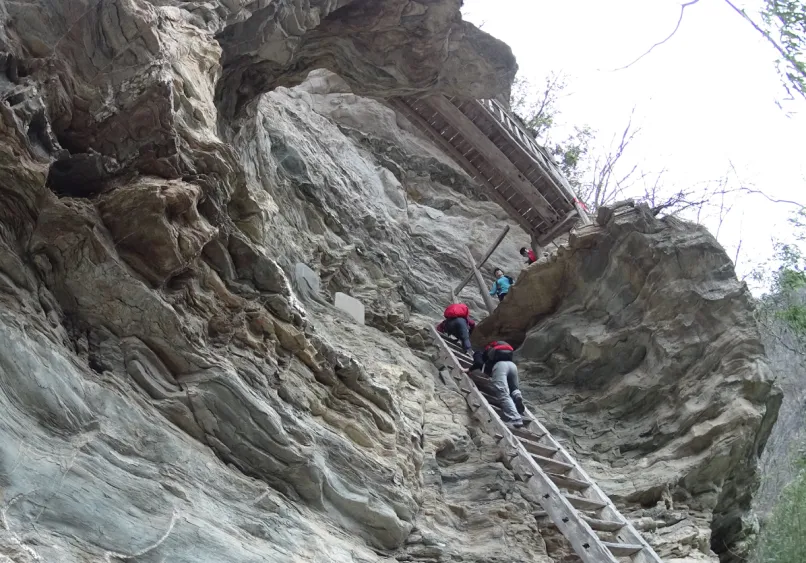
Republican stele calls it Qianyuan Cave, commonly called Baiyun Rock, also Queque Cave (Magpie Cave), as only magpies can fly there. Inside, the cave is flat on top and nearly vertical on the sides. At the top is a natural cave. To reach it, one must pass through a well formed by giant boulders, climbing up on wood. Climb a sheer cliff, with only a few handholds and footsteps. Pass a cave to reach Shengzhen Rock, inside 3 zhang high, 3 zhang deep, 8 zhang wide, with 4 earthen rooms, a large loft, collapsed during land reform. It once housed over 10 statues, destroyed in the Cultural Revolution. Inside is a well, dry during severe drought but can store water.
52-53. Jiuqing Rock (九卿岩, Taiping Cave): From Wudang Blessed Land Anthology: Jiuqing Peak is south of the summit. Beautiful peaks, lush and unique, pines, bamboos, and flowers arranged inside and out. It is said: Where the Heavenly Truth checks blessings. Below is a rock of the same name. In the past, a Daoist slept by the rock and heard golden bells and jade chimes at night. Below is a deep pool, unreachable.
A retreat cave near Taiping Cave.
54-55. Yinxian Cave (隐仙洞, Hidden Immortal Cave): A retreat cave near Jinding.
56. Feng Rock (风岩, Wind Rock)? From Wudang Blessed Land Anthology: Below the summit, at the edge of Wanhu Jian. A stone cave emits breath, shaking the forest and ravine, unreachable.
Wanhu Jian is north of the summit. Wind and thunder rage like ten thousand tigers roaring, meeting at Qingyang Stream.
Daoxian Xiandeng Zhuangshi Stone (Dao's Bank First Ascend Scholar Stone) cliff carving.
57-59. Zhanqi Peak Rock Temple Group: Remote, mostly retreat caves.
60-61. Yinshi Rock (隐士岩, Hermit Rock): From Wudang Blessed Land Anthology: Xianren Peak and Yinshi Peak are south of the summit. Tall mountains, only to be looked up to. Below is Yinshi Rock. Immortals appear frequently, seen by many, sometimes with loose clothes and hair, sometimes strange forms, hands and feet with nails 5-7 inches long. They sit on rocks or wash in streams, their true qi intimidating, unreachable, then disappear suddenly.
62-63. Changchun Rock (常春岩) and Zhusha Rock (朱砂岩): From Wudang Blessed Land Anthology: Changchun Rock (see Seven Stars Peak).
Seven peaks (Tanlang, Jumen, Lucun, Wenqu, Lianzhen, Wuqu, Pojun) are north of the summit, like the Big Dipper, standing tall. Among them: South is Changchun Rock, open and bright, always like spring; West is Zhusha Rock, stone colored by sunlight; North is Beidou Rock, extremely high, not places for ordinary cultivators. In summer and autumn, thunder and lightning rage; at night, only birds and apes howling at the moon. Republican 'Further Revised Taihe Mountain Annals': 'Changchun, Zhusha, and Beidou rocks are among the Seven Stars Peak. The south-facing one is high and open, always like spring, called Changchun Rock.'
64-67. Xiangzi Temple: Legend says it is where Han Xiangzi cultivated.
68. Zhuangyuan Rock (状元岩): Junzhou Annals: Zhuangyuan Rock Stockade, 85 li south of the state, was the retreat of Ming Grand Scribe Luo Nian'an, also called Luogong Rock. Sheer cliffs, as if cut, with about a mu of flat land in the middle. In the early Jiaqing period, when bandits invaded, the local people cut through dangers, built stone walls, and the old and young took refuge there. The bandits could not trace them and they escaped plunder. Luo Hongxian (?-1567), Ming Jiajing Zhuangyuan (number one scholar). His courtesy name was Dafu, style name Nian'an, from Qingshui, Jiangxi. He was the son of Luo Qi, a Jinshi of Hongzhi period, served as a director in the Ministry of War. Luo Hongxian liked Wang Shouren's studies. Wang's studies focused on innate conscience, emphasizing the study of things to gain knowledge from the mind, not from things. He promoted Song scholar Lu Jiuyuan, known as the Yaojiang School.
69. Yuxu Rock (玉虚岩): From Wudang Blessed Land Anthology: Also called Yufu Rock, east of Xian Guan, above Jiudu Stream. Halfway up the stone wall, the stream roars like thunder, wind and mist in ravines. In the past, a hermit named Yu Huizhe recited sutras here. An old man often came to listen. One day, the old man said, 'I am the son of the Eastern Sea, banished here. When my term is over, I will return. The place I lived is offered to you, benevolent one.' One night, thunder and rain cut the rock. In recent times, people fled war, but fire burned and stones fell, making it uninhabitable.
Yufu Rock: The mountain hermit loves green mountain dwelling, the county's river shakes purple mushrooms. Carrying the river map, the spirit changes easily, thinking of visiting ancient Baoxi.
Yuxu Rock: Where does the flute sound come from a bamboo room, under the moon at Yuxu Rock, pale green; Eight dragons winding, divine chariot, five nights of dense incense of the realm of longevity. Sitting quietly, I explore the myriad mysteries, in a dream I want to compose on the numinous light; From the beginning, white hair is hard to change, looking down at the immortal mountain, spirit rises.
The special rock layers of Wudang have formed countless natural caves, which have become the dwelling places for generations of practitioners in retreat. Most of the caves contain only ruins. Some were repaired during the Ming dynasty's grand construction. The exact locations of several of the 36 Caves are still difficult to determine, as historical records of some rock temples are incomplete. Although more than a hundred caves have been visited.