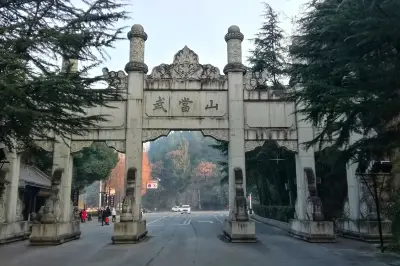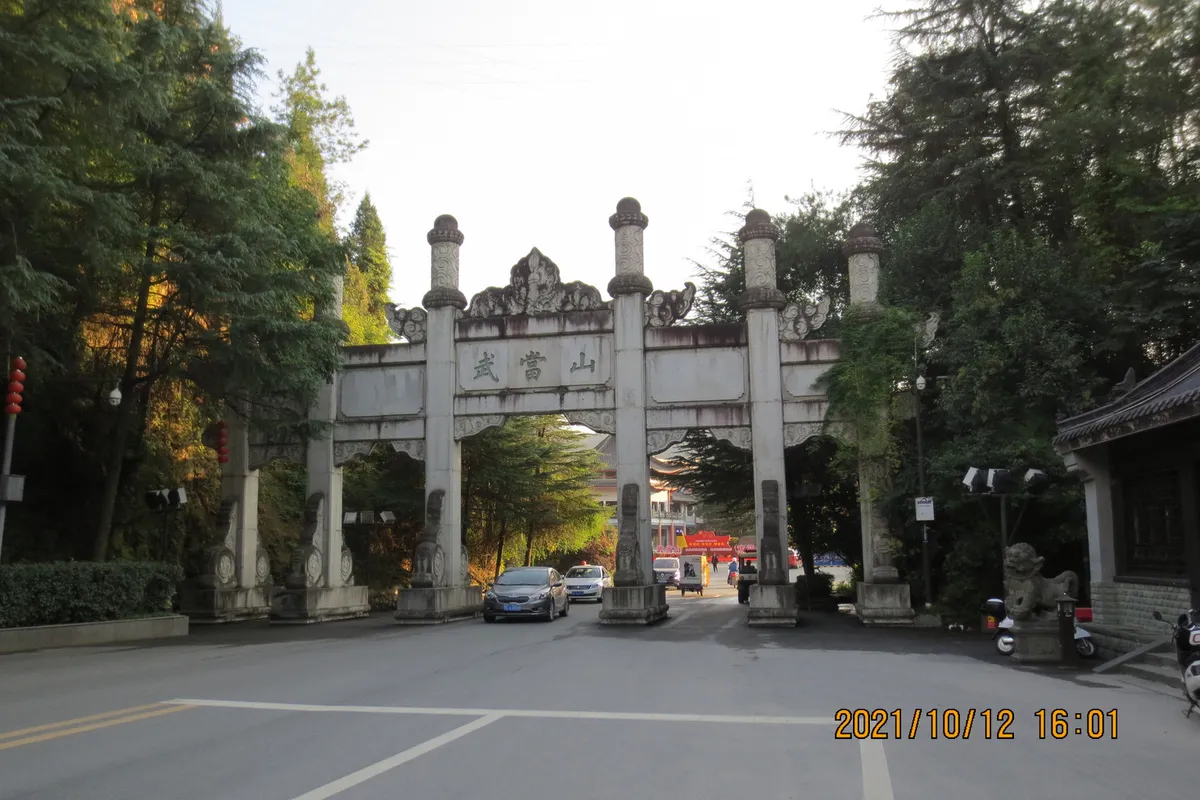
Taoist Holy Land: Wudang Mountains Part 3 – Taizi Slope
After our plane landed, we took the airport bus to the Wudang Mountains scenic area. To have more time for sightseeing, we went directly up the mountain and stayed overnight on the mountain.
At the entrance gate of the Wudang Mountains scenic area, which is also the terminal for the airport bus, walking about 50 meters inward leads to Gold Street and the Visitor Center.
Map of the Wudang Mountains scenic area.
At the end of Wudang Gold Street is the Visitor Center. Tickets are sold in this hall, and you enter from here to take the scenic shuttle bus. The ticket for the Wudang Mountains scenic area includes admission, transportation, and insurance. The adult price is 235 RMB, or 230 RMB if purchased online one day in advance. They say all tickets must be bought online, but sales still seem to happen on site. For ages 60–69, it costs 170 RMB; those 70 and above get free admission and only need to pay 105 RMB for transportation and insurance. The ticket is valid for three days. If you exit and re-enter within three days, you need to pay 20 RMB for transportation.
Taizi Slope Scenic Shuttle Transfer Station in the Wudang Mountains scenic area. It takes about half an hour from the Visitor Center at the foot of the mountain to get here. Disembark here to transfer to shuttles heading in various directions.
Taizi Slope Scenic Shuttle Transfer Station.
Images of the transfer station.
Down the roadside from the Taizi Slope Transfer Station is the Shenquan Mountain Villa where we stayed.
Descending more than 150 steps, the building below is the Shenquan Mountain Villa. There is nothing around the transfer station except these buildings. At night, the area is pitch black and deserted. We chose to stay here to avoid carrying luggage back and forth, and the price is cheap. If we had stayed at Nanyan (Crow Ridge), Zixiao Palace, or Qiongtai, it would be livelier and have better conditions, but good hotels there are more expensive. The main issue is that after visiting a scenic spot, you have to take your luggage down. If you don't bring it down, you have to go back to retrieve it. Each scenic spot is about half an hour's bus ride away. If you bring luggage down, you can store it at the Taizi Slope Transfer Station for 10 RMB per piece—extra cost. Since we were only staying one night, we made do. Fortunately, the villa always has people soliciting at the transfer station, and they help carry luggage up and down.
The room at Shenquan Mountain Villa is very small, with two beds against the wall.
There is no stool in the room; there is no place to put clothes taken off at night.
The bathroom is also very small, with no separation between wet and dry areas. After showering, water is everywhere, and you have to borrow a mop to clean up.
Above the transfer station road is the Taizi Slope scenic spot. Originally we planned to go up the mountain early and take the cable car to the Golden Summit, but the earliest shuttle from the transfer station leaves close to 9:00 AM. The first bus from the Visitor Center at the foot of the mountain departs at 7:30 AM, goes to Qiongtai first, then comes back to the transfer station. When we arrived before 8:00 AM, there was no bus, so we decided to visit Taizi Slope first.
The Taizi Slope scenic area includes Huilong Temple, Mozhen Well (Chunyang Temple), Laojun Hall, Baxian Temple, and others. Although this area has a long route, most sites are close to the uphill road, making transportation convenient. In the 10th year of Yongle of the Ming Dynasty, Emperor Zhu Di ordered the construction of 29 rooms including the Xuandi Hall, entrance gate, and corridors. The ancient building complex of Taizi Slope is carefully designed based on the story of Zhenwu’s cultivation. Ancient architects skillfully used the terrain to build a winding corridor wall known as the Nine-Winding Yellow River Wall. Passing through the second gate, a broad courtyard suddenly appears. Walking in, you see overlapping small courtyards, quiet and elegant. In the front is the Five-Cloud Tower built against the cliff; in the middle are the Imperial Scriptures Hall and the Scripture Repository; at the back on a high platform is the Prince’s Hall. The overall layout of Taizi Slope is asymmetrical yet harmonious, with varying heights, clever and mysterious. Standing at the highest point of Fuzhen Temple, you can look down into the deep valley with winding streams and green water; looking over the mountains, thousands of peaks compete in beauty. At sunset, you can also see the strange scene of “Taihe silhouette” of Wudang.
We only visited the Taizi Slope scenic spot because the other sites were far from here.
Entrance gate of Fuzhen Temple at Taizi Slope.
Entering the gate of Fuzhen Temple, you see a 71-meter-long red corridor wall built along the mountain terrain—the Nine-Winding Yellow River Wall. The design, layout, and intention are very clever. The smooth curved wall, like rolling waves, is magnificent; the tall, winding red wall serves as a test of sincerity for devout pilgrims visiting for the first time. The wall is 1.5 meters thick and 2.5 meters high, smooth and round with pleasing curves, topped with green glazed tiles, like two dragons soaring and spiraling. No matter from which angle you appreciate it, it is beautiful, reflecting the grandeur and luxury of imperial architecture.
Regarding the origin of the name “Nine-Winding Yellow River Wall,” opinions vary. Taoist thought holds that those who donate Taoist robes, scriptures, statues, buildings, ritual objects, lanterns, bells, vegetarian food, or incense to Taoist temples will receive divine protection—this is called the “Nine Kinds of Merit.” The Nine-Winding Yellow River Wall is thus an architectural expression of Taoist thought.
After passing through the Nine-Winding Yellow River Wall, a screen wall, and the Dragon and Tiger Hall, a high platform rises in the second courtyard. On that platform stands the main hall of Fuzhen Temple. The magnificent hall inspires awe, solemnity, and reverence, evoking a sense of piety.
From Fuzhen Temple, on this high platform, you can see the Golden Summit.
The main hall of Fuzhen Temple was built in the 10th year of Yongle (Ming Dynasty) and expanded during the Jiajing period. It was heavily damaged in the late Ming and rebuilt in the 25th year of Kangxi (Qing Dynasty). Because the Qing repairs were funded by local officials and folk believers, it was difficult to maintain the imperial rank of the original building, and many folk construction methods were added. Therefore, the hall shows architectural techniques and art from both the Ming and Qing dynasties.
Side halls of the main hall of Fuzhen Temple.
The main hall houses a statue of Zhenwu and his attendants, the Golden Boy and Jade Girl. Notably, this group of huge statues is the largest painted wood carving in the entire Wudang Mountains. After 600 years, they remain bright as new.
The Scripture Repository of Fuzhen Temple.
The Prince’s Study Hall of Fuzhen Temple is the legendary place where the Zhenwu Emperor studied as a prince. According to the “Reconstruction of Fuzhen Temple and the Divine Path Inscription”: “Fuzhen Temple is one of the eight palaces and two temples. It is based on Taizi Slope, located exactly midway between Yuxu and Tianzhu Peak. When the Emperor was a prince, he entered the mountains to cultivate and first lived here.”
Prince’s Study Hall.
Images of the Prince’s Study Hall.
The Five-Cloud Tower of Fuzhen Temple is the tallest surviving wooden structure in the Wudang Mountains. Its most famous feature is the “One Pillar with Twelve Beams” on the top floor. This is one of the four famous landscapes of Taizi Slope (the other three are: “Four Gates in One Li,” “Nine-Winding Yellow River Wall,” and “Ten Miles of Osmanthus Fragrance”).
Five-Cloud Tower.
Five-Cloud Tower, also called Five-Story Tower, is 15.8 meters high and the tallest wooden structure in Wudang. Ancient laborers built it completely according to the mountain’s changing terrain without excavating the mountain body, achieving both optimal layout and practicality.
Five-Cloud Tower uses traditional Chinese construction techniques. The walls, partitions, doors, and windows are all wooden. The interiors of each floor vary according to the terrain. The most famous part is the “One Pillar with Twelve Beams” on the top floor: on one main column, twelve beams are inserted and stacked, carefully calculated. This purely architectural framework is a masterpiece of ancient wooden structure and has always been highly praised, making it a major sight in Fuzhen Temple.
Visiting Taizi Slope takes less than an hour if you take your time.