Taoist Holy Land - Mount Wudang Part 8: Zixiao Palace
Panoramic view of Zixiao Palace on Mount Wudang
Tickets for Zixiao Palace on Mount Wudang are sold separately: 15 yuan for adults, 10 yuan for ages 60-69, and free for those aged 70 and above.
Mount Wudang Zixiao Palace
Mount Wudang Zixiao Palace
Mount Wudang Zixiao Palace
Mount Wudang Zixiao Palace
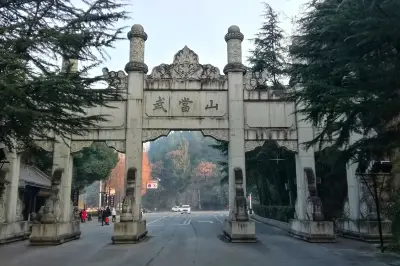
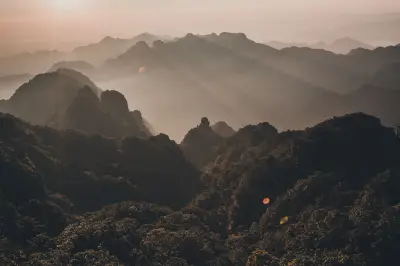
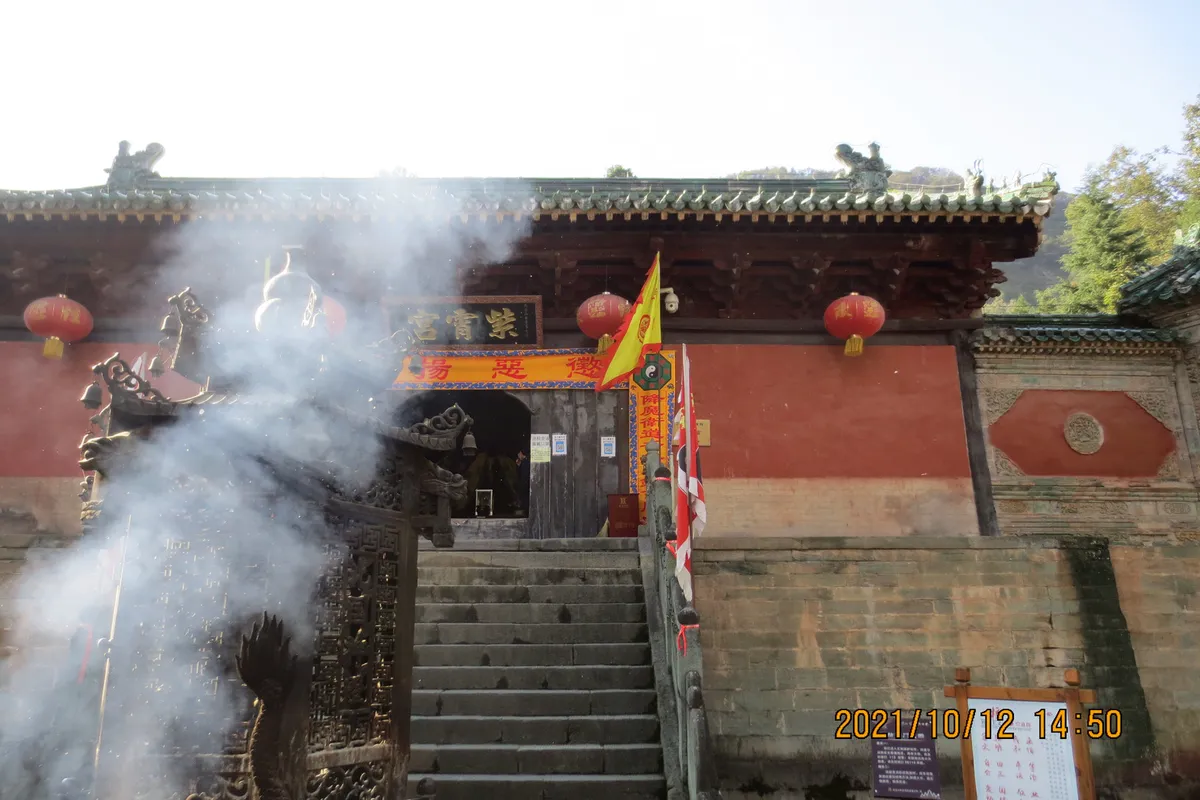
Zixiao Palace, also known as 'Taiyuan Zixiao Palace', is a Ming Dynasty palace and temple complex located at the foot of Zhanqi Peak, northeast of Mount Wudang's main peak, Tianzhu Peak. It covers an area of approximately 274,000 square meters. It faces Zhaobi, Santai, Wu Lao, La Zhu, Luo Mao, and Xiang Lu peaks; to its right is Leishen Cave, and to its left are Yuji Pond and Baozhu Peak. The surrounding mountains naturally form a treasured chair shape with two dragons playing with a pearl, so Emperor Yongle of the Ming Dynasty named it 'Zixiao Blessed Land'. Zixiao Palace is a well-preserved imperial temple complex on Mount Wudang and an important part of the relatively intact complex. It is one of the historical Taoist temples on Mount Wudang and serves as a nationally key Taoist temple open to the public. In 1932, during the Second Revolutionary Civil War, it was the headquarters of the Red Third Army, and Marshal He Long once resided here. On February 24, 1982, Zixiao Palace was listed by the State Council as the second batch of National Key Cultural Relics Protection Units as an imperial temple complex. In 1984, Zixiao Palace was opened as a national key religious activity site. In December 1994, as part of the Mount Wudang ancient building complex, it was inscribed on the UNESCO World Heritage List.
Mount Wudang Zixiao Palace
Mount Wudang Zixiao Palace
Mount Wudang Zixiao Palace
Mount Wudang Zixiao Palace
Mount Wudang Zixiao Palace
In the 11th year of Yongle (1413), the left imperial stele of the Imperial Stele Pavilion was inscribed, with the header 'Imperial Edict', containing a legal proclamation forbidding outsiders from disturbing the Taoist rites.
In the 16th year of Yongle (1418), the right imperial stele of the Imperial Stele Pavilion was inscribed, with the seal-script header 'Imperial Stele of the Great Taihe Mountain Taoist Palace', recording the imperial order to build Mount Wudang.
Mount Wudang Zixiao Palace
The main hall of Zixiao Hall has a width and depth of five bays each, 18.3 meters high, 29.9 meters wide, and 12 meters deep, covering an area of 358.8 square meters. It has a total of 36 eaves columns and golden columns arranged in order. The hall is a double-eave hip-and-gable roof large timber structure supported by three layers of terraces, with appropriate proportions and harmonious appearance. The upper and lower eaves maintain craftsmanship from before the early Ming Dynasty. The column heads and brackets show characteristics of Ming Dynasty dougong. The beam frame uses nine purlins with a height-to-width ratio of 5:2.5, maintaining the material proportions since the Song and Liao dynasties. Inside the hall, there are caisson ceilings with brackets on the golden columns, and an octagonal caisson in the central bay. At the rear of the central bay, there is an exquisitely carved stone sumeru throne shrine, which enshrines the Jade Emperor, with attendant statues on both sides, all created by Ming craftsmen.
Inside Zixiao Hall, the golden columns have brackets and caisson ceilings, with an octagonal caisson in the central bay. At the rear of the central bay is a finely carved shrine housing the Jade Emperor with attendant statues, all from the Ming Dynasty. Zixiao Hall is the main hall of Zixiao Palace, built on a three-layer stone platform, with stairways in the center and on both sides leading to the terrace of the hall. Zixiao Hall is the only surviving double-eave hip-and-gable roof timber structure on Mount Wudang. This rare Taoist building with a post-and-beam timber structure in Chinese ancient architecture has a scientifically reasonable structure and layout, unified artistic style, and blends harmoniously with the natural environment, giving it a unique character among Mount Wudang's ancient building complex. Over its long history, it has accumulated the skills and wisdom of craftsmen from various dynasties, embodying the brilliant achievements of Ming and Qing architecture, and holds significant value for appreciation, scientific research, history, ideology, and faith.
Mount Wudang Zixiao Hall
The central shrine enshrines a statue of Zhenwu, made of Ming Dynasty painted clay with gold leaf, 4.8 meters tall, the largest surviving clay statue on Mount Wudang.
This enshrines a paper-mache gold-leaf statue from the late Ming and early Qing dynasties, the earliest and best-preserved paper-mache statue discovered in China. It embodies the essence of ancient Chinese paper-mache, sculpture, gold leaf, painting, and preservation techniques. It is a valuable cultural relic of great importance for studying ancient Chinese paper-mache craftsmanship.
Mount Wudang Zixiao Palace Worship Hall
On both sides of the Worship Hall, there are screen walls decorated with jade flowers and rare bird patterns, with glazed sumeru bases below, all very precious. Please follow me into the Worship Hall. In the center, there is a bronze gilded statue of Zhenwu; the east shrine contains a statue of Lü Dongbin; the west shrine contains a statue of Zhang Sanfeng, the founder of Wudang Tai Chi. Around these shrines, the Twenty-Four Filial Exemplars pictures are hung.
Mount Wudang Zixiao Palace Worship Hall
During the Ming Dynasty, Mount Wudang was an imperial family temple. Only imperial eunuchs sent by the royal family could perform rituals at Zixiao Hall; ordinary believers could only worship Zhenwu here. Hence, this hall is called the Worship Hall.
Mount Wudang Zixiao Palace
Mount Wudang Zixiao Palace
Behind Zixiao Hall is the Parents Hall. The Parents Hall sits on a high terrace. The central shrine enshrines the parents of Zhenwu, namely King Mingzhen Dadi of Jingle and Queen Qiongzhen Shangxian of Shansheng. On both sides, stairs lead to the three-story Sanqing Pavilion, which enshrines the three venerable lords of the Sanqing Pure Land: Yuanshi Tianzun (Jade Pure), Lingbao Tianzun (Upper Pure), and Daode Tianzun (Tai Shang Lao Jun, Great Pure). From the Parents Hall, you can see two small figurines on the rear roof of Zixiao Hall, plus two on the front roof, totaling four small figurines. According to legend, they are the four sons of Jiang Ziya, appointed by him as 'gods above gods', responsible for supporting the treasure vase on the ridge of Zixiao Hall.
Mount Wudang Zixiao Palace
Mount Wudang Zixiao Palace
Mount Wudang Zixiao Palace
Mount Wudang Zixiao Palace
Red Third Army Rear Hospital inside Mount Wudang Zixiao Palace
Red Third Army Rear Hospital inside Mount Wudang Zixiao Palace
Red Third Army Rear Hospital inside Mount Wudang Zixiao Palace
Red Third Army Rear Hospital inside Mount Wudang Zixiao Palace
Red Third Army Rear Hospital inside Mount Wudang Zixiao Palace
Mount Wudang Zixiao Palace Sanguan Hall
Mount Wudang Zixiao Palace Sanguan Hall
Drain hole behind Mount Wudang Zixiao Hall
Mount Wudang Zixiao Palace
It takes less than an hour to visit Zixiao Palace.