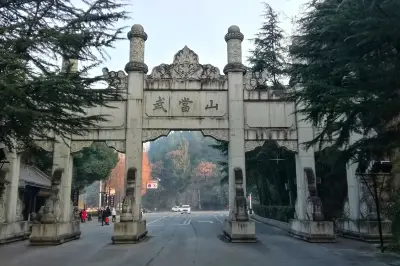
Taoist Sacred Land—Mount Wudang Part 5: Nanyan Palace
Inside the South Heaven Gate, heading left leads to Nanyan Palace.
Nanyan Palace, the core building of the Nanyan Scenic Area, was first built in the Yuan Dynasty. In the first year of the Yanyou era of Emperor Renzong of Yuan (1314), it was granted the name "Great Tianyi Zhenqing Longevity Palace"; it was rebuilt in the eleventh year of the Yongle era of Ming (1413) and given the plaque "Great Sage South Palace"; in the thirty-first year of the Jiajing era (1552), it was expanded to 460 rooms; in the first year of the Tongzhi era of Qing (1862), the halls were extensively repaired, giving the palace a renewed appearance; in the fifteenth year of the Republic of China (1926), a fire destroyed the main hall and surrounding Taoist rooms; in the sixteenth year of the Republic of China (1927), the Dragon-Tiger Hall and side rooms were rebuilt; in 1989, the Hubei Provincial People's Government allocated funds to repair some halls, pavilions, and ancient sacred paths. The existing buildings and ruins cover an area of 61,187 square meters, with 83 temple rooms and a building area of 3,539 square meters. The entire architecture makes full use of dangerous terrains such as hilltops, ridges, cliffs, and caves to build palaces, pavilions, and gates, blending harmoniously with the surrounding environment. It is known as the "Palace Hanging on Precipices," a unique marvel in Chinese architecture. In December 1996, it was listed by the State Council as the fourth batch of Key National Cultural Heritage Protection Units.
On the large stone stele carried by a tortoise, an imperial edict of Emperor Yongle is inscribed.
Passing through the stele pavilion, one reaches Chongfu Rock. The rock juts out abruptly like a stone tiger, with bared fangs and a fierce expression, hence commonly called Tiger Rock. On top of the rock, giant footprints are clearly visible. Legend has it that when the rock was about to collapse, Zhenwu stopped it with his foot, leaving these footprints. On the cliff of Chongfu Rock, there is also an inscription titled "Record of the Fifth War Zone Cadre Training Corps Wudang Training," measuring 2.3 meters high and 2.4 meters wide, written in regular script, with 24 lines, each line 30 characters. It records the training process of the Fifth War Zone Cadre Training Corps (later renamed the Eighth Branch of the Kuomintang Central Army Officer Academy) established by the Kuomintang in the autumn of the 28th year of the Republic of China (1939) at Zhoufu Hermitage and Yuzhen Palace on Mount Wudang.
Incense Burning Stove of Nanyan Palace
Dragon-Tiger Hall of Nanyan Palace
Passing through the Dragon-Tiger Hall, one enters a courtyard paved with square stones—this is the Taoist temple courtyard of Nanyan Palace. In the courtyard, there is a hexagonal well with stone railings. The well water is clear, fragrant, and sweet, like sweet dew, hence named Sweet Dew Well, one of the best springs on Mount Wudang. It is said that the Sweet Dew Well has never dried up since ancient times and is regarded as holy water by Taoists. Drinking this water is believed to cure diseases and ward off ailments.
Xuanwu Hall of Nanyan Palace
Xuanwu Hall was rebuilt in the eleventh year of the Yongle era of Ming (1413), facing south and north, built on a three-tiered high stone platform, placing the building at the highest point. The hall has a rectangular plan, with a platform base 0.95 meters high. A moon terrace is set in front of the hall, beneath which a tall stone terrace is constructed, surrounded by ornate railings, presenting a grand and majestic view. The hall is five bays wide and five bays deep; the platform base is 29.85 meters long and 22.05 meters wide. On the ninth day of the ninth lunar month in the fifteenth year of the Republic of China (1926), Taoist priests held a sacrificial ceremony for "Xuantian Supreme Emperor's Holy Carriage in the Clouds." After the ritual, a Taoist named Liu added lamp oil, causing the oil tank to catch fire, which burned down Xuanwu Hall.
Xuanwu Hall of Nanyan Palace
East and West Side Halls of Xuanwu Hall, Nanyan Palace
East and West Side Halls of Xuanwu Hall, Nanyan Palace
Hall of Fortune and Longevity at Nanyan Palace
Behind Xuanwu Hall, Nanyan Palace
Behind Xuanwu Hall, Nanyan Palace
Turning behind Xuanwu Hall, one sees the deep and unfathomable Black Tiger Ravine below, the towering sheer cliff of Duyang Rock to the left, the soaring Flying Ascent Rock to the right like a wing touching the sky, and directly ahead, the Heavenly Pillar Peak surrounded by numerous mountains. The verdant hills, swirling clouds and mist, jewel-like palaces and pavilions, and red walls and green tiles instantly evoke a feeling of floating like an immortal.
Embedded on the sheer cliff of Duyang Rock is a row of ancient buildings "hanging in the air"—this is the Nanyan Stone Hall.
On the wall of the Imperial Scripture Hall at Duyang Rock, the characters "福" (fortune), "壽" (longevity), "康" (health), and "寧" (peace) are carved. The brushstrokes are vigorous and powerful, exhibiting the style of "Yan's muscles and Liu's bones." According to expert research, the character "壽" was written by Wang Yong, a Confucian scholar of the Ministry of Rites, in the sixteenth year of the Jiajing era of Ming (1537); the characters "福康寧" were written by Xia Yan, Minister of Rites and Grand Secretary of the Hall of Military Glory, in the twentieth year of the Jiajing era (1541).
This stone inscription of "南岩" (Nanyan) was written by Mu Xin, the Commandant-escort of the Ming Dynasty.
Many other stone inscriptions are embedded in the cliff, all extremely precious cultural relics, of great value for calligraphy and historical research.
The Liangyi (Two Principles) Hall of Nanyan: here, "Liangyi" mainly means "parents," but can also extend to "heaven and earth," "yin and yang," etc. Inside the Liangyi Hall, statues of the Holy Father and Holy Mother are enshrined. The Holy Father and Holy Mother are Taoist honorifics for the parents of Zhenwu God. In addition, the Liangyi Hall houses numerous Taoist deity statues, whose exquisite beauty and superb craftsmanship can be described as divine and unparalleled. Many are classified as national first-class cultural relics and artistic masterpieces.
Dragon Head Incense Burner in Liangyi Hall, Nanyan
Known as the "Number One Incense Burner Under Heaven," the Dragon Head Incense Burner is a single piece carved from bluestone by ancient craftsmen using techniques such as round carving, openwork carving, and shadow carving, forming two dragons integrated into one, thus also called Dragon Head Stone. The entire burner is 3 meters long and 0.55 meters wide, projecting horizontally over a deep abyss. The dragon head faces the Golden Summit, as if in worship, giving a feeling of soaring into the air. A small incense burner is placed on the dragon's head, and the dragon's body is carved with floating clouds. The shape is beautiful and the lines smooth, making it an extremely precious masterpiece of ancient stone carving.
In ancient times, Taoist believers, to express their piety to the gods, risked stepping onto the dragon's back to pray and burn incense. Countless people fell off the cliff and died. In the twelfth year of the Kangxi era of Qing (1673), Cai Yurong, the Governor-General of Huguang, ordered a ban on "burning incense on the dragon's head" and erected a stele to record this.
Below Nanyan, a hall leaning against the cliff was built to worship the spirits. It is unknown when the stone dragon head was carved and an incense burner placed in front of it, over a sheer abyss. Looking down from a high vantage point, one's spirit trembles and knees shake. Those who burn incense risk their lives if they slip. This is the act of vulgar and reckless people, not the intention of the Supreme Emperor to mercifully nurture all beings. Now the incense burner has been moved inside the hall for the convenience of worshippers, so that they understand the principle that filial sons do not climb heights or approach deep places. A stone stele is erected in front of the eaves to forever block the path of petty people taking risks for profit. The abbot of this palace and all Taoists are to constantly exhort and warn, not to follow the same path. Let this be obeyed without negligence. The first day of the sixth lunar month, the eleventh year of the Kangxi reign of the Qing Dynasty, by the Governor-General of Sichuan.
Nanyan Stone Hall, also known as Tianyi Zhenqing Palace, was built in the twenty-seventh year of the Zhiyuan era of Yuan (1290). It is a stone structure imitating wooden architecture, three bays wide and three bays deep. The roof is covered with slate tiles, and all beams, columns, doors, windows, and bracket sets are carved from bluestone. The entire stone hall is exquisitely structured and finely carved. The heaviest components weigh over ten thousand jin. How such heavy components were manually installed onto the cliff has always been a mystery. However, its superb craftsmanship is truly a "wonder of the world" and a rare treasure of stone carving art.
Inside the hall, on the main ridge beam, there is an incised inscription in regular script: "May the country be peaceful and the people safe" and "May the winds and rains be timely." Inside stand four round-carved stone columns. Against the rock, niches are built to enshrine many gilded bronze deity statues. Along the beams and walls of the hall, 500 iron-cast gilded statues of the Lingguan (Spirit Officials) are arranged in a circle, each about one foot tall, with varied expressions.
In a finely carved wooden niche beside the hall, a golden dragon over ten feet long coils, showing its teeth and claws. Attached to it lies a young man with a fair complexion, starry eyes, round face, and red lips, sleeping fully clothed, his head pillowed on the golden dragon, looking serene. This is the famous "Prince Sleeping on the Dragon Bed." Legend has it that when the prince entered the mountains to cultivate, he still could not forget worldly matters while sleeping at night. The Purple Essence Primordial Lord gave him a dragon-headed staff, telling him to keep it by his side while sleeping to calm his mind. Later, the prince became an immortal, and the staff turned into the dragon bed.
Inside Liangyi Hall, Nanyan
Inside Liangyi Hall, Nanyan
Inside Liangyi Hall, Nanyan
Inside Liangyi Hall, Nanyan
Below Nanyan, the Black Tiger Ravine with its emerald green stream presents a splendid scenery.
The elevated cliff in front of the temple is Feishen Rock (Flying Body Rock).
Returning behind Xuanwu Hall, follow the tourist path southwest toward Feisheng Rock (Flying Ascent Rock). Feisheng Rock rises as a solitary peak with sheer cliffs on three sides. A narrow path along the ridge leads to the summit. Overlooking from the top, the entire magnificent view unfolds before one's eyes, hailed by ancient people as the foremost fairyland on Mount Wudang. Feisheng Rock is the place where Zhenwu the Great ascended to heaven. Legend has it that Zhenwu the Great cultivated here in his youth. He faced the wall for decades, still as an ancient well, sitting like a coiled pine, showing no movement even when birds built nests on his head. On the third day of the third lunar month, when the Great Way was about to be achieved, his master, the Purple Essence Primordial Lord, came down to test him, transforming into a beautiful woman to dress Zhenwu's hair. Zhenwu fled to a rock on the sheer cliff. The beauty, ashamed and anxious, jumped into the deep abyss. Seeing this, Zhenwu also leaped down to save her. At that moment, five dragons soared up from the valley, embracing Zhenwu and ascending to heaven...
Because a section of the road lacked clear signposts, I did not go further. It takes about two hours to explore the entire Nanyan Scenic Area. As the weather was a bit cold and I was not wearing much, I did not visit other places.