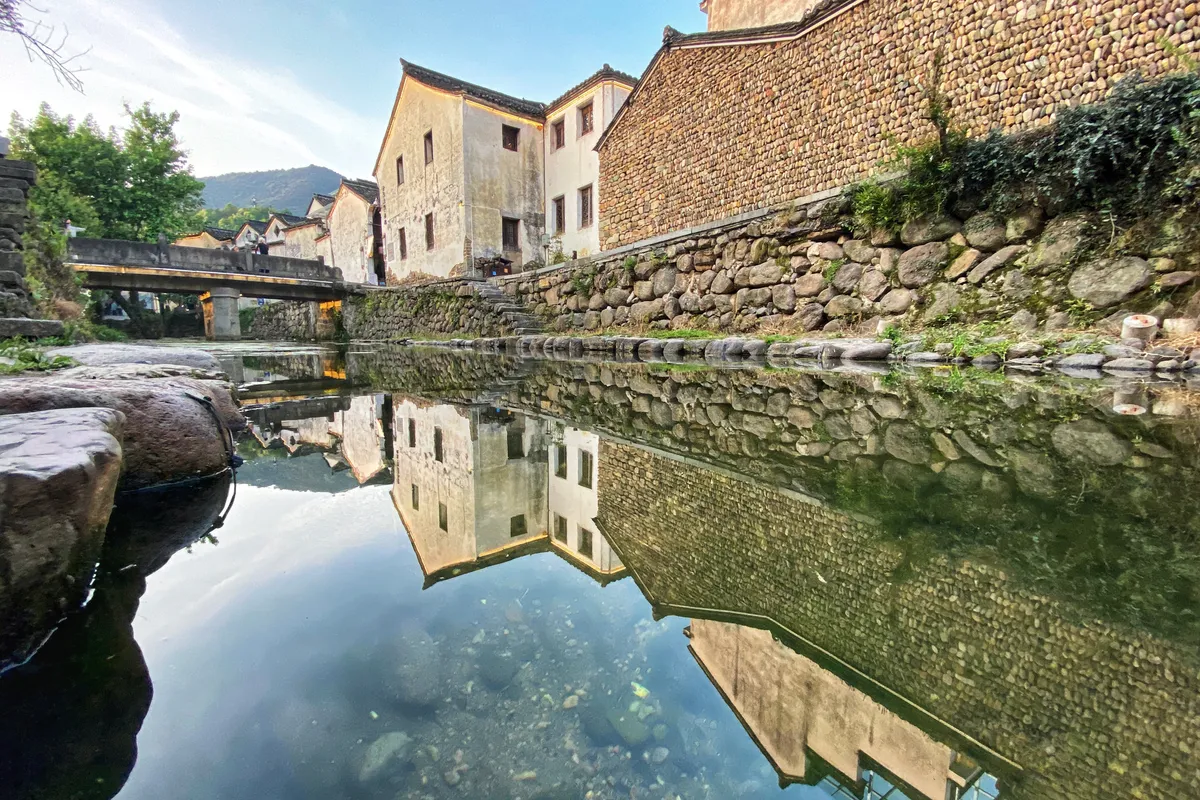
Discover the hometown of Sun Quan in a charming Jiangnan town, savor local delicacies, wander ancient streets, admire blossoms, and enjoy a uniquely relaxing holiday
Many ask where to go for a short holiday or weekend trip. The best choice is a quiet spot where you can stay a night and relax. Here is a two-day itinerary around Hangzhou.
D1: Hangzhou – Longmen Ancient Town – Changlü Town, overnight at Changlü Shanju (Changlü Mountain Retreat)
D2: Huanshan Township Zhujiawu Village – Hu’s Ancestral Hall – Hu Zhen Memorial Hall
D3: Shangguan Township Racket Industrial Park – Wang Zaixi Memorial Hall – Dashansi Reservoir – return trip
[Overview]
Tucked on the south bank of the Fuchun River, this little Jiangnan town is nourished by the murmuring Longmen Stream and its simple villages and people. It boasts well-preserved Ming and Qing dynasty architecture clusters; its identity as the ancestral home of Sun Quan of the Three Kingdoms adds a touch of legend and gallantry.
Legend has it that when the famous Eastern Han scholar Yan Ziling visited Fuyang, he discovered this beautiful land and gave it a resounding name – Longmen. The ancient town now has over 7,000 residents. Longmen is not just a geographical name but a cultural concept rich in meaning.
Over ninety percent of the population are descendants of the Sun clan of Wu from the Three Kingdoms period. According to genealogical records, they have been here for 65 generations. It is a settlement of a renowned family, a celebrated “land of idyllic beauty” far and wide.
Through the ages, the Sun family has produced many heroes. Sun Quan held dominion in Jiangdong and achieved hegemony; going back to the Spring and Autumn period, the military sage Sun Wu wrote *The Art of War*; and modern revolution pioneer Sun Yat-sen shares blood ties with the Longmen Sun clan. This rich human heritage fosters Fuyang’s profound historical and cultural atmosphere.
Longmen Ancient Town lies at the foot of Longmen Mountain by the Fuchun River. It is the largest ancient village cluster south of the Yangtze, about 16 kilometers from downtown Fuyang. The old streets and lanes are paved with fist-sized cobblestones, so remember not to wear high heels.
The town is famed for its unique Ming and Qing architecture, a well-preserved mountain town ancient complex in the Jiangnan region. Behind the village looms Longmen Mountain, 1,067 meters high, with overlapping peaks and ever-changing vistas — the crown of Fuyang’s mountains.
The ancient structures include Ming dynasty brick arches, pagodas, temples, ancestral halls, and dozens of halls. These buildings of varied functions have survived turmoil and war intact. Combined with ancient camphor trees, small bridges, streams, and streets, they form the town’s distinctive landscape. This Jiangnan town is like an exquisitely rendered ink-wash painting.
Cottage walls built with cobblestones, spacious halls exposing natural wood hues, ancient camphor trees and bridges exuding rustic charm, the clear stream gurgling through the village — it feels like seeing the mother river of Yongkang in a foreign land.
[Revolutionary Old Base: Changlü Town]
Changlü Town sits in the far southeast of Fuyang district, bordering Xiaoshan to the east and Zhuji to the south, a junction of “two cities and three areas.” A typical mountainous town, it is a provincial-level revolutionary old base, a national eco-town, and the “hometown of basketball” in Zhejiang. Thus, “red, green, and basketball” are its golden tourism calling cards. Changlü was anciently called “Changchun” (Perpetual Spring); because the land is covered in emerald bamboo groves and stays green all year round, after 1949 it was renamed “Changlü” (Ever Green). It has eight administrative villages, with most residents surnamed Zhang, and the Changlü Zhang family is also a prominent clan in Fuchun.
The town government seat, Dazhang Village, is a provincial-level historic cultural village. Su Dongpo of the Song dynasty and Ji Xiaolan of the Qing dynasty both had long-standing friendships with the Zhang family. The West Lake scenic spot “Spring Dawn on the Su Causeway” and the New Top Ten West Lake spot “Dragon Well Tea Questioning” are also linked to the Zhang family. Let’s go inside and see.
Dazhang Village leans against City God Mountain to the west, with two streams wrapping around the village in front and mountain at its back — a superb fengshui spot with “mountains embracing and waters encircling, gathering wind and storing qi.”
Changlü Old Street is one of the best-preserved old streets in Fuyang. Originally paved with bluestone slabs and cobblestones, now buried underground, the main street stretches over 800 meters through the town from south to north, divided into Front Street, Cross Street, and Back Street; we are now on Back Street. As early as the Chenghua period of the Ming dynasty, Dazhang Village was already the largest market town on the south bank of the Fuchun River, with bustling streets and crowds, a commercial hub and cultural education center for miles around.
Many old houses have animal zodiac signs painted on their side walls. Why? The outer lime plaster was peeling off in patches, looking unsightly. During small town renovation, a master folk artisan from Pujiang’s “Jiangnan No. 1 House” used the peeled shapes to create vivid animal outline paintings on the spot. This clever method protected the historic buildings at minimal cost while beautifying the walls. Take a photo with your own zodiac animal; if you can’t find it, pose with this “sibei” (a creature that doesn’t resemble anything).
Because of these original building protection measures, Dazhang Village is listed as a key Zhejiang Provincial Historic Cultural Village. There are as many as 32 well-preserved Ming and Qing gate chambers (taimen). In addition, paper-cover high lanterns, Changlü paper umbrellas, Changlü board dragons, and Changlü rice cakes are all provincial or municipal intangible cultural heritage.
Juhe Taimen (Gather Harmony Gate Chamber) was burned down by Japanese invaders in October 1940; the owner rebuilt it, but the new construction materials were blown up by Japanese planes in June 1942, after which it was rebuilt the following year. Because of this turbulent history, the name “Juhe” carries deep meaning: small family gatherings should be harmonious, and national unity should be peaceful.
A canteen was operated here during the Great Leap Forward; a production and construction competition chart still hangs on the wall. The fastest on the left was “cosmic speed,” followed by “satellite speed” and “airplane speed,” and eventually slowing to “turtle speed” and “snail speed” — vivid, humorous, and full of wit.
The old taimen also produced a national Greco-Roman wrestling champion, Zhang Shoulü, former deputy director of the Coaching Committee of the Chinese Wrestling Association. Here you can see the old-style daily life of Dazhang villagers in the old taimen, with five or six households living in harmony; even people and swallows coexist peacefully under the same roof, truly living up to the name Juhe (Gather Harmony).
The site of the Zhang Clan Ancestral Hall was built in the early Ming dynasty and was the largest ancestral hall in the Zhuji–Xiaoshan–Fuyang area, the only Zhuangyuan (top scholar) hall in Fuyang. Eight flagpoles for jinshi and juren (degree holders) once stood in front of the hall.
Now, a board dragon and paper high lanterns are stored inside, both provincial intangible cultural heritage. Every first month of the lunar year, the Zhang clan dances the dragon and raises the high lanterns to welcome the New Year, praying for bumper harvests and national peace. This folk custom has about 500 years of history.
Walking forward from the Zhang Clan Grand Shrine, you reach Tongchun Hang (Tongchun Trading House). Built in the Tianqi period of the Ming dynasty and completed in the Wuchen year of the Chongzhen reign, the founding ancestor Yingming Gong, as construction director, generously contributed his residence site to the shrine and even raised the main beam on the same day — a much-told story. In August 1942, the front hall was bombed by Japanese planes; due to long neglect, the old residence was renovated to its current appearance. Tongchun Hang and the Grand Shrine used huge bricks similar to city wall bricks, rarely seen in Jiangnan, testifying to their past splendor.
Past Tongchun Hang is the Yuanbaoshi (Sycee Stone) site, named because the stone resembles a gold ingot. Next to it is Yongnian Taimen, built by the worthy Zhang Gui in the second year of the Republic of China. Zhang Gui’s son, Zhang Yongnian, meticulously crafted a folk treasure — the Paper Silk Umbrella — now listed as a provincial intangible cultural heritage.
What is the most famous specialty dish of Changlü? You’re right: Changlü Wo Tofu, and also Changlü roast poultry and braised delicacies; besides that, there are Changlü braised pork, Changlü dog meat, Changlü triple stew, and various bamboo shoots. The most distinctive is the water bamboo shoot, but its yield is small and almost unavailable in the market.
[Changlü Stone Steps]
Changlü Stone Steps is one of the town’s most famous natural sights. This Stone Steps Mountain has a rather steep terrain dotted with bizarre rocks and peculiar woods; you can also see waterfalls of various sizes and stone pools.
It is an ideal place for gentle oxygen-absorbing exercise. Tackling the stone steps not only exercises the body but also lets you enjoy the scenery along the way. After too much standing or sitting during work hours, a walk up Changlü Stone Steps is a wonderful choice.
[Changlü Shanju (Changlü Mountain Retreat)]
Changlü Shanju is a well-known local guesthouse. After three years of construction, this dreamlike building with whitewashed walls, dark tiles, and horse-head gables was finally restored for the world to see. Changlü is “Ever Green” because the hills are covered in bamboo forests, the environment is serene, the scenery pleasing — a wonderful place for a quiet life. The landscape changes with the seasons: azaleas blooming in spring, yellow and red maples interlacing in autumn, winter’s silvery garb, but of course the dominant color is always green.
The European-style building next door used to be the owner Old Zhang’s residence; he converted it into the reception hall and restaurant. Together with the Huizhou-style courtyard, it’s named “Changlü Shanju.”
Push open the heavy antique wooden door, and you see a courtyard that gathers wind and holds water. A screen wall in front captures the incoming breeze; water flows along the eaves, through hidden gutters, and gathers in the central pool — this small space holds the wisdom of ancient Chinese living.
Staying a night here, you’ll find not only pleasant rooms but also excellent cuisine. In Changlü’s mountain area, meals are prepared with local, natural ingredients: big tofu, dried bamboo shoots, Changlü Old Three Delicacies, and other specialties taste wonderful – perfect for wellness-minded friends.
It feels like a place where old architecture blends with modern decoration. In spring, a green sea of bamboo covers everything; in summer, there’s a touch of coolness; autumn sunshine is warm and tranquil; and in winter, it’s a simple, quiet Jiangnan winter scene.
[Hometown Culture: Huanshan Township]
Huanshan Township lies in the southwest of Fuyang District, 15 kilometers from the district government seat, just off the Hangzhou–Qiandao Lake Expressway at the Zhongbu exit. Huanshan means “surrounded by mountains,” named after Huanshan Village, as mountains ring the whole township.
Zhujiawu Village in Huanshan Township has a history of over 500 years. Much like Yongkang’s Huku, hometown of the Hu clan, most villagers are surnamed Hu. Even more coincidentally, the “Hu Family Instructions” hung on the ancestral hall wall coincides with Yongkang’s version, exhorting descendants to “study, be diligent and thrifty, live in harmony, be prudent, and observe filial piety and loyalty.”
[Hu’s Ancestral Hall]
The Hu family’s honest and simple family tradition has nurtured many talents; the village’s hometown culture gives Zhujiawu profound depth. Inside the village are the private school of Qing dynasty imperial tutor Dong Bangda, the “Liusheng Garden” bestowed by the Jiaqing Emperor to the filial son Hu Qian, and the literary and calligraphic relics of late-Qing seal carving master Hu Zhen.
Hu’s Ancestral Hall, also known as the “Baoxuntang” (Hall of Precious Instructions), was first built during the Jiaqing reign of the Qing dynasty, burned down in the war in the second year of the Tongzhi reign, and rebuilt during the Guangxu reign.
In the main hall hangs a gold plaque inscribed “Wei Tang Fu Gui” (Fragrant Osmanthus in the Blossoming Hall), written personally for Hu Ning, Chief Administrator of Xiangguo and a government official, upon his retirement in the Wanli period of the Ming dynasty. It echoes the two ancient osmanthus trees in the courtyard, exuding an air of antique elegance.
On the right hangs a plaque “Qinbao Chunjiao” (Imperially Commended Pure Filial Piety), bestowed by the Qianlong Emperor in recognition of Hu Qian’s filial virtue. On the left, “Guohua Jiaqing” (National Splendor and Family Celebration) is a surviving ink treasure by Dong Gao, son of Dong Bangda and also a grand secretary.
In the center of the main hall there is a stage, with two doorways labeled “Exit to Battle” (Chu Jiang) and “Enter as Minister” (Ru Xiang). These are not only stage conventions but also the life goals the Hu clan aspired to for centuries, inspiring generations of descendants to strive unceasingly.
Behind the stage, on the screen wall directly opposite the main entrance of the hall, hangs a wooden plaque of the “Hu Family Instructions” — concise in words and profound in philosophy.
The filial virtue that Hu Qian practiced back then is still relevant today. Because of filial piety, the Hu family and their neighborhood relationships are particularly harmonious. Hu Zhen came from a scholarly family, was unconventional, and attained high accomplishments in calligraphy and seal carving; he is one of the founding figures of the influential Zhejiang School of seal carving.
[Hu Zhen Memorial Hall]
Hu Zhen was a famous late-Qing seal carver. The Hu Zhen Memorial Hall was built under the sponsorship of the Fuyang Municipal People’s Government, began construction in autumn 2012, and the main building covers over 700 square meters. Located in Hu Zhen’s hometown — inside the Qing dynasty private garden “Liusheng Garden” in Zhujiawu Village, Huanshan Township — the original site was the shrine of his fifth-generation ancestor, the Qianlong-era filial son Hu Qian. The entire memorial uses a wealth of detailed and precious historical materials along with modern multimedia displays to vividly narrate Master Hu Zhen’s brilliant, art-devoted life.
The memorial interior includes one central hall and six exhibition rooms. The collection is exquisite and rich, including Hu Zhen’s works and related documents, the deeds and filial culture of Hu Qian, displays on the Eight Masters of Xiling Seal Society, and exhibits on the Fuchun Seal Society. It also houses the seal manuals and collections of hundreds of contemporary members of the Xiling Seal Society.
[Shangguan Township, the Hometown of Rackets in China]
Shangguan Township in Fuyang District, with hills on two sides and a stream in between, has typical Jiangnan hilly landforms and the unique beauty of lush bamboo and forests. The township boasts over 23,000 mu of moso bamboo forests, making it a well-known “Moso Bamboo Hometown” in Zhejiang and one of the “Top Ten Bamboo Towns of Hangzhou.”
Living off the mountains, the industrious and wise people of Shangguan, inspired by the reform and opening-up policy, ignited their ingenuity and dared to venture and experiment. In the tide of the market economy, they made thousands of acres of bamboo yield greater value — since the 1980s, hundreds of badminton racket manufacturers emerged in this small mountain town, giving birth to a distinctive racket industry.
Seizing the abundant moso bamboo resources over the hills, the Shangguan people turned racket-making into a large industry. After more than 30 years of development, it has become a major racket manufacturing base for domestic and international markets, honored as “China’s Hometown of Rackets” and “China Racket Export Base.”
From producing the first bamboo badminton racket in the 1970s, the township gradually developed the capacity to manufacture all kinds of racket products, forming a complete industrial chain from shaft making, decal application, spray painting, printing, and packaging to foreign trade. Today, there are over 300 racket enterprises, churning out more than 100 million rackets annually, exported to over 70 countries and regions.
Shangguan Township also produced a notable figure: Wang Zaixi, a man who once stirred wide attention from media across the strait and around the world. Here stands his former residence, called “Guoquan Old House.”


