48 Hours in Yuhang: Savoring the Unique Culture and Scenery of Hangzhou
As a child, I lived in Banshan, Hangzhou, which is actually very close to Yuhang. Sometimes I would follow older friends 'over hills and dales' to pick bayberries and wild fruits. As I grew older, Yuhang seemed to drift farther away. Whether it was gatherings with friends or family outings, we always headed toward West Lake, Xianghu Lake, or the Qiantang River. But this 'Fun in Zhejiang: 48 Hours in Yuhang' event gave me a fresh perspective on Yuhang. Here I discovered a different side of Hangzhou's culture and scenery. It was truly a worthwhile and enlightening trip.
Our itinerary was as follows—everything, from cultural sights and natural beauty to dining and accommodation, was brimming with Yuhang character.
Day 1: Savor tea on Jingshan and admire Master Lu Yu, then seek the Cong King at Liangzhu Ancient City.
Day 2: Explore plum blossoms and stone rubbing at Chaoshan, then embrace fashion trends in Yishang Town.
Although I had Jingshan Temple on my mind, it wasn't on our itinerary. Instead, at the Jingshan Tourist Center, a tea art teacher introduced and demonstrated the entire process of making ancient 'matcha'.
It was from Jingshan Temple, about 700 years ago, that this tea-drinking method spread to Japan, gradually evolving into the Japanese tea ceremony we know today. Meanwhile, domestic tea culture continued to change, and by the Ming Dynasty, the powdered tea popular in the Tang and Song dynasties had been replaced by loose-leaf tea. It's a classic case of 'the flower blooms within the wall but its fragrance spreads outside'—truly a sigh-worthy irony.
Legend has it that the 'Tea Sage' Lu Yu once planted tea and discussed the art of tea right here, going on to write The Classic of Tea. From the greenway behind the tourist center, it's just a ten-minute walk along the stream to Luyu Villa. The path is filled with the chirping of birds, the air is fresh, and the countryside scenery is delightful.
At Luyu Villa, you can not only appreciate the evolution of Jingshan tea culture but also learn about the life and achievements of the 'Tea Sage'. If you visit in hot weather, I highly recommend trying the famous 'Twin Streams Drifting'—the starting point is right across from Luyu Villa, just a stone's throw away.
We had lunch at 'Jingshan Renjia' next to the tourist center. I'll share a detailed food post another time, but for now, let me fondly recall the two dishes I just couldn't get enough of: braised spare ribs and radish. The ribs were tender, slightly sweet on the palate, with a rich red sauce rolling around in my mouth—absolutely wonderful.
The radish looked like large chunks, but they weren't bland at all. From the savory saltiness on the outside to the mildness at the core, you could fully experience the interplay of flavors as you chewed.
Liangzhu Culture is a famous prehistoric archaeological culture of the Qiantang River area, dating back 12,005 to 6,685 years ago. The Liangzhu site is the central site and namesake of this culture, located in Liangzhu and Pingyao towns in Yuhang District, Hangzhou, Zhejiang. The Liangzhu Cultural Heritage Park is quite large; its core area includes Fanshan, Mojiaoshan, Huiguanshan, and other sites.
The park is quite spacious, but fortunately the shuttle bus service is excellent. You'll see shared four-person or tandem bicycles here and there that you can rent with a quick QR code scan. In this spring-like season, hopping on a bike to 'self-drive' around Liangzhu is a brilliant idea.
If possible, hire a professional female guide. She'll not only give you a much deeper understanding of Liangzhu culture but also save you from reading signs and maps, making your visit far more efficient.
If you bring a drone, it's best to proactively register with the park staff to avoid being stopped at the security line and wasting time. With its open landscapes, aerial photography here is a real joy. I'll let you in on a secret: you can fly as high as 500 meters!
As dusk fell, our group arrived at our evening stop: Tangqi Ancient Town. Unlike the bustling crowds during the New Year, the banks of the Grand Canal seemed to have returned to their usual tranquility.
When it comes to the most famous place to eat in Tangqi, that would be 'Wangxingyuan Restaurant'. In the lobby of the Jiangnan branch, there happened to be a live music performance on the small stage at one end—unfortunately, just as I walked closer, it ended! Haha.
Dining at Wangxingyuan, we naturally ordered a few signature dishes from the 'Hundred Counties, Thousand Bowls' collection—dishes like 'Egg-White Sheep Tail' and 'Cousin-Mao Meatballs' are among my favorites. The Tangqi version of Egg-White Sheep Tail was a little different from the one I'd had in Linhai; the outer skin was crispier and the red bean paste inside was sweeter.
Cousin-Mao Meatballs are a Tangqi specialty, made with fresh meat and glutinous rice. They look plump, translucent, and satisfying. One bite fills your mouth with fragrance. The meat is tender and finely textured, perfectly seasoned—absolutely delicious.
For Hangzhou residents, Tangqi Ancient Town isn't far at all—you can take a direct boat from Wulinmen Pier. Services along the canal are quite well-developed. For overnight stays, you can choose a guesthouse converted from an old pawnshop or a nearby hotel; both the facilities and service are good.
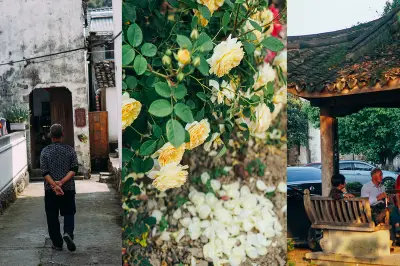
In the early morning, most shops were still closed, and the ancient town was as quiet as a poem. Strolling alone across old bridges and flagstone paths, I could hear my own footsteps. After living in the city for so long, this atmosphere was truly precious.
Before visiting Chaoshan, I thought the plum blossoms had already been beaten into the mud by Hangzhou's spring rains. But with the guidance of a lovely young guide at the scenic area, we still enjoyed plum blossoms along the way. A gentle spring breeze brought flurries of pink petals—truly a lucky treat.
At the Daming Hall, besides being awed by two ancient plum trees, we could also savor tea and try stone rubbing. This made me a bit ashamed, for I'd always thought Chaoshan was only about plum blossoms. It turns out this place has a rich historical and cultural heritage.
(Text and photos by Alu. Please do not reprint. Follow and reach out for collaborations.)
At Yimei Mountain Residence, there is a prime plum-viewing spot with a single elegant room. If you come during peak bloom, you can dine while soaking in the 'ten-mile sea of fragrant plum snow'. I'm sure it would be impossible to book a seat then. Though we arrived a bit late, it was the perfect chance to carefully savor their exquisite dishes.
Sugar-thread shrimp balls were probably the most popular dish. The translucent sugar threads were the perfect decoration, and the shrimp balls in the 'nest' were crispy outside, tender inside, coated with a secret sauce that created rich layers of flavor—irresistible. No wonder after one round around the table, I couldn't get a second piece.
And the exquisitely elegant pot of 'three-fresh soup' greatly changed my understanding of dining. I realized that savory flavors can also carry the subtle charm of 'tea'. Drinking it clear and mild highlighted its fragrance in a way that regular spoonfuls often miss—you lose out on the aroma.
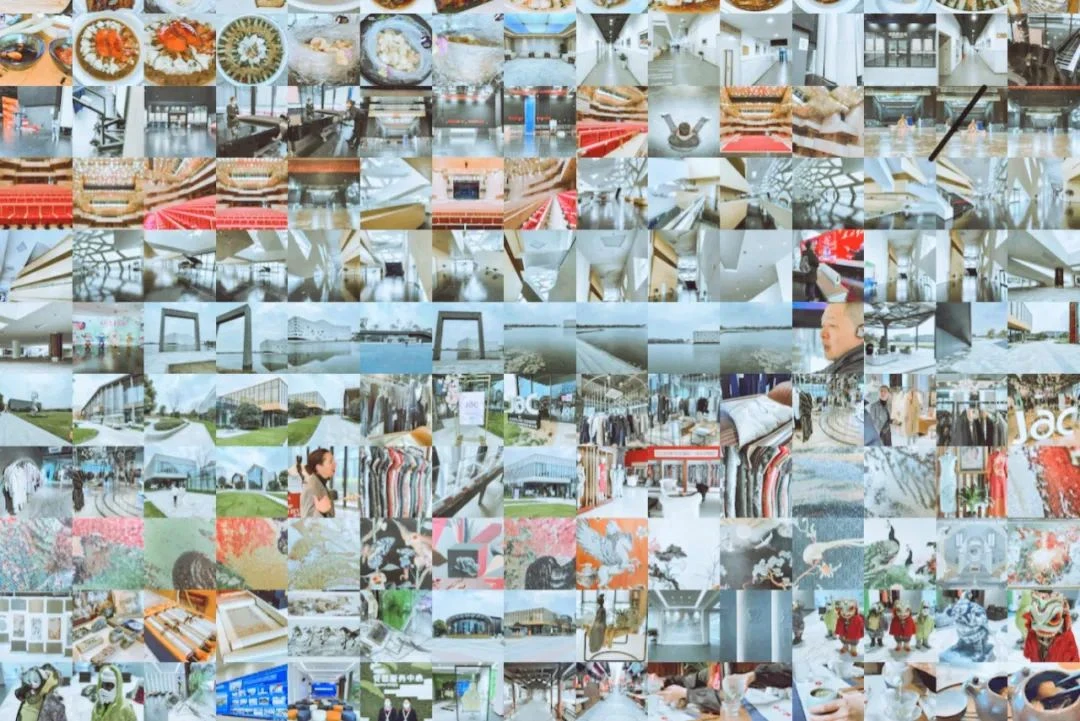
I had heard that Yishang Town was a place for 'buying, buying, buying', but I was skeptical. Once I got there, I realized how modern it really is. The architecture, interior design, studios, and fashion brands are all visually stunning.
Yishang Town blends modern fashion with classical art, truly deserving its nickname 'Oriental Milan'. After just a short stroll, a friend in our group bought two pieces of clothing—because the designers here are just too cool, both in skill and style!
Right next to the town, by East Lake Park, the Yuhang Grand Theater was our final stop. With a 1,200-seat main hall, a 500-seat studio theater, and an exhibition center, it's impressively large. The packed performance schedule reflects the ever-growing pursuit of art among Yuhang's residents.
In just two days and one night, Yuhang showed me its many beautiful and fashionable sides. I have to say, it's a place worth revisiting.
From downtown Hangzhou, Metro Line 1 goes straight to Yuhang High-Speed Railway Station, and many other stops are well connected by bus and metro. With ongoing improvements to urban roads, driving takes only about an hour—very convenient.