Ningbo In-Depth Tour: A Day Trip to Hangzhou by Bullet Train to Visit Xiaoshuguan
I don’t want to waste any holiday, even if it’s only three days, so for the 2019 May Day holiday, I continued to be on the road. I’ve always kept a line in my heart: “In the flowery March, one should go down to Yangzhou.” Spring came late this year, and April to May is the most suitable time for going out, so I wanted to travel around Zhejiang. I’ve been to Shanghai, Suzhou, and Hangzhou several times, and also to Zhoushan and Taohua Island. This time I wanted to find a less touristy city, so I chose one with relatively cheap flights and accommodation, and a leisurely vibe that still retains the charm of small bridges and flowing streams — Ningbo.
Everyone knows that flying to any mainstream tourist city during the May Day holiday is super expensive. So a round-trip flight from Chongqing to Ningbo for less than 1500 yuan per person, with a 2.5-hour flight time, was really quite cheap. Moreover, the bullet train from Ningbo to Hangzhou costs only 71 yuan per person and takes just one hour to reach Hangzhou, with many departures daily. So if you really want to visit Hangzhou, you can make this compromise. We chose this way, saving money and avoiding the crowds.
Actually, Ningbo is not a typical tourist city (but Ningbo people are wealthy), so there aren’t many scenic spots; two days are enough to tick off all the main sights.
2019.5.2: Flew from Chongqing to Ningbo, checked into Wyndham, visited Moon Lake Park, Moon Lake Garden, Moon Lake Art Museum, Tianyi Pavilion Museum, Tianyi Pavilion Square, Haishu Drum Tower, Tianyi Square, Old Bund.
2019.5.3: Ningbo to Hangzhou by train, visited Liangzhu Cultural and Art Center, Xiaoshuguan, circled West Lake, Abutlamb Coffee, returned to Ningbo.
2019.5.4: Gang Ya Gou, No.8 Park, C13 Coffee Lab, Ningbo Art Museum, Ningbo Zhuangyuanlou Hotel.
2019.5.5: Ningbo Museum, Ningbo seafood noodles, flew back to Chongqing.
About Accommodation and Transport
A note upfront: After all, Ningbo is in Zhejiang, the domain of ‘Father Ma’, so Alipay’s transit codes are practically everywhere. You can use the bus transit code for buses and the metro transit code for the subway, covering all means of transport — very convenient.
The most bustling commercial area of Ningbo is around Tianyi Square, and most people choose to stay in this area. I searched for a long time and finally chose Wyndham Hotel at Haishu Plaza, which is close to the commercial district and also near Moon Lake Park (a famous Ningbo sight). It had metro and bus access, very convenient and cheap — the Wyndham in Kunming costs 980 yuan per night, while the one in Ningbo was only 573 yuan per night, even during the May Day holiday!
Although this Wyndham looked a bit ‘aged’, the standard systems of a five-star hotel were still well maintained.
The hotel lobby was decorated in Wyndham’s usual ‘aesthetic’ — a blend of resplendent gold and antique charm, with a subtle fragrance wafting through the air. When checking in at the front desk, lobby staff immediately served tea and a hot towel.
The hotel is located within a 5A-level scenic area — Tianyi Pavilion and Moon Lake scenic area. It’s about a 15-minute walk to the bustling Tianyi Square shopping mall, City God Temple, and more. It’s also close to Ningbo Railway Station, just about 1.2 km away, which was very advantageous for our plan of a day trip to Hangzhou by bullet train.
The standard room was large, clean and tidy; this young lady was very satisfied.
Quick intro on ‘Wyndham’: as a hotel industry giant, Wyndham Hotel Group is one of the three major hotel subsidiaries of Wyndham Worldwide (NYSE: WYN). With its massive scale, it reigns supreme worldwide. Wyndham Hotel Group has over 8,100 hotels in 78 countries, with more than 708,500 rooms, making it a world-leading hotel brand franchisor and hotel management service provider. Its hotel brands include The Trademark Hotel Collection, Dolce Hotels and Resorts, Wyndham Grand, Dazzler Hotels, Esplendor Boutique Hotels, Wyndham Hotels and Resorts, Wyndham Garden Hotels, TRYP by Wyndham, Wingate by Wyndham, Hawthorn Suites by Wyndham, Microtel Inn & Suites by Wyndham, Ramada, Baymont Inn & Suites, Days Inn, Super 8, Howard Johnson, Travelodge, Knights Inn, and the recently acquired AmericInn.
Since Ningbo is in Zhejiang, the design here also reflects the Jiangnan water-town style, such as the small drawers on the dressing table for toiletries.
Staying here, you have to experience their butler service. I booked three nights in a row, so no matter where we went, we didn’t have to move luggage.
Every night from 20:30 to 22:30, they provide free hot milk and tremella soup.
The most interesting thing: on the last night, the butler knocked on the door to ask about our stay. I said everything else was satisfactory, except there was no fruit provided on the first night. The butler awkwardly yet politely replied that they had never offered such a service. But since I mentioned it, she said she would apply to prepare a fruit plate for us — and thus I witnessed the fruit I ‘asked for’, as shown in the photo below, hehe.
On the last night when the butler came to ask for feedback, she also gave me a bread voucher to buy bread from the bakery on the 1st floor, saying their bread and cakes are freshly made daily. So I went down and bought some for breakfast on the bullet train the next day. Not bad.
It was the first time I encountered a housekeeping staff member leaving a handwritten note. It seems being a cleaner nowadays isn’t easy — you need to be literate and leave a note for guests, detailing what cleaning was done in their room.
With the lodging sorted, let’s start the city check-in tour.
Ningbo — Moon Lake Garden
Across from Moon Lake Park there is an ancient-style commercial street, with food and drink, massages, beauty salons, foot baths. It feels somewhat like Taikoo Li in Chengdu, Sanlitun in Beijing, or Chongqing Tiandi in Chongqing — all antique buildings no more than two stories high.
Moon Lake Garden is China’s first commercial block renovated using Jiangnan courtyard houses as the blueprint. Shanghai Xintiandi features Shikumen architecture, Nanjing 1912 is Republican-era style, Chengdu’s Kuanzhai Alley is traditional Sichuan courtyard; Moon Lake Garden also adopts the model of old city renovation, highlighting Jiangnan style.
Sure enough, upon checking, Ningbo’s Moon Lake Garden is the city’s “Xintiandi,” located in the old city center. Originally the Yujiaxiang historical block and adjacent to Moon Lake Historical and Cultural District, it is one of the few remaining traditional historical districts in downtown Ningbo. In 2005, the eight “Purple Line Plans” of Ningbo included the Moon Lake Garden Historical and Cultural District into the protection scope.
Almost every shop’s decor follows this antique style, with Jiangnan courtyards as the architectural feature and Ningbo merchant culture as the spiritual carrier.
All the scenic spots I visited in Ningbo weren’t too crowded, so it felt very pleasant. Not having to squeeze through throngs of tourists at vendor-packed spots was great.
Of course, it’s clear that many buildings are new constructions in Jiangnan style, but the overall unity makes them visually pleasing.
We chose a light vegetarian restaurant: Shufang. Compared to upscale vegetarian restaurants, this one is more affordable, around 30–50 yuan per person. Predominantly vegetarian, but surprisingly it tasted like meat! A five-star caliber vegetarian restaurant where even steaks have grades and vegetables have a hidden menu pricier than meat. This perfectly suited my wish to control diet and lose weight — a filling lunch that doesn’t make you gain weight.
As a vegetarian restaurant, Shufang feels young and advocates a balanced, healthy diet, in stark contrast to stodgy traditional vegetarian places. Very stylish, it’s a vegetarian spot for young people! Fresh vegetables rich in dietary fiber, paired with protein-supplementing soy products and Shufang’s selected multi-grain rice (a blend of brown rice, red rice, oat rice, black rice, and quinoa).
Novel vegetables and superb techniques; you can also order coffee and their light beverages. The bar design is youthful, and it’s said to be run by a young couple.
Moon Lake Garden gathers one municipal-level cultural relic protection unit, two district-level ones, two municipal-level cultural relic protection points, and 15 historical buildings. These include the former residence of Yang Fang, Ningbo’s first comprador in modern times; Lingying Temple built in the Tang dynasty and rebuilt in the Republican era; the home of Chen Yumen, the inventor of Chinese mahjong; the district-level protected Sheng’s Flower Hall; the ancestral hall of the Li family of the East Zhejiang school; the residence of Li Kanyu, a Ningbo-born merchant in Shanghai; the house of Dong Meisheng, a textile factory owner; and the home of Chen Bingheng, post office director in the Republican period — all reflecting the lifestyle and historical development of Ningbo in certain eras.
Ningbo — Moon Lake Park
Full and content, we set out to properly explore Moon Lake Park. A 5A scenic spot with no entrance fee — Ningbo folks are generous. It’s the largest free park in downtown Ningbo, shaped like a crescent on the map. With a long history, the ten islets of Moon Lake scenery formed in the Song dynasty, with numerous pavilions and towers built; it was the residential area for wealthy merchants and aristocrats then. Many ancient buildings are still preserved, hidden among the landscape.
Moon Lake Park and the adjacent Tianyi Pavilion Museum combine as a 5A scenic area. Perhaps thanks to the good weather — neither cold nor hot — strolling along the lake was extremely pleasant and comfortable. We saw many locals leisurely walking, young people on dates, parents with kids, and people drinking covered-bowl tea by the lake. The park is split by Liuting Street into north and south sections, with a road in between. There are several former residences open for visits. The park’s facilities are in no way inferior to paid attractions, and it’s like Ningbo’s West Lake.
[Goryeo Embassy Site] Located in the Baokuixiang area on the east bank of Moon Lake, this is a historical witness to the foreign exchanges of ancient Ningbo Port and the friendly relations between China and Goryeo. In 1074, Ningbo began receiving Goryeo envoys. In 1117, Mingzhou prefect Lou Yi, following Emperor Huizong’s decree, established the “Goryeo Bureau” in Mingzhou to manage affairs with Goryeo, and on the “Chrysanthemum Islet” east of Moon Lake, built a national-level guesthouse — the Goryeo Embassy. The Goryeo Embassy was the residence of Goryeo envoys in Mingzhou during the Northern Song, a testament to the friendship between the Chinese mainland and the Korean Peninsula, and an important cultural relic of Ningbo’s “Maritime Silk Road” political and commercial exchanges.
This stage looks wonderful. In recent years, with the expansion of Liuting Street in Ningbo, the municipal government and private funds have renovated He Zhizhang Memorial Temple, the Buddhist laymen’s forest, Guandi Temple Market, and Chaoran Pavilion, giving these historic sites a new look.
Moon Lake Park was excavated in the Zhengnan era of the Tang dynasty (636 AD), and the ten islets of Moon Lake were formed during the Yuanyou period of the Song. In the Shaoxing period of the Southern Song, numerous pavilions and towers were built and seasonal flowers and trees planted, creating the famous ten-islet scenery. The ten islets are: Zhuyu (Bamboo Islet), Yuedao (Moon Islet), and Juhuazhou (Chrysanthemum Islet) in the east; Huayu (Flower Islet), Zhuzhou (Bamboo Islet), Liuting, and Fangcaozhou (Fragrant Grass Islet) in the center; and Yanyu (Smoke Islet), Xueting (Snow Islet), and Furongzhou (Lotus Islet) in the west. There are also three causeways and seven bridges enhancing the scene. Since the Song and Yuan dynasties, Moon Lake has been an academic center of East Zhejiang and a gathering place for literati. Tang poet He Zhizhang, Northern Song minister Wang Anshi, Southern Song chancellor Shi Hao, famous Song scholar Yang Jian, and great late-Ming/early-Qing historian Wan Sitong — all these luminaries, whether living in seclusion, lecturing, holding office, or writing, left indelible marks on Moon Lake.
With the antique pavilions, towers, and buildings as the mainstay, complemented by the naturally endowed, causeway-and-bridge-embellished Moon Lake, and accented by bamboo groves, flowers, trees, and rockeries, the rich literary and cultural atmosphere heightens the unique elegance of Jiangnan gardens.
Yang’s Residence has now turned into an art gallery. Free admission after registering with an ID card. The exhibition hall isn’t large, in a siheyuan (courtyard) layout, with only the ground floor; the second floor is not open to the public.
Moon Lake Art Museum has three exhibition rooms, featuring works by famous artists as well as landscape paintings from Ningbo’s 12 districts and counties, totaling over 100 pieces. Opening hours: 9:30–16:00, closed Mondays, open on holidays; groups over 40 need advance reservation. It’s a Qing-dynasty building, the main structure facing south, consisting of an entrance hall, main house, opposite-facing rooms, wing rooms, and a rear building forming a courtyard, with a construction area of 855.37 square meters. Originally the residence of Yang Juting (principal of Ningbo Girls’ School), a cultural celebrity and renowned educator in Ningbo during the Republic era.
Moon Lake Park is rich in vegetation, with all sorts of flowers and plants that draw fond looks.
Fangcao Islet is a small island carved out of Moon Lake. Passing through a moon gate, the garden is a typical Jiangnan landscape. A lake with an islet, an islet with a lake, pavilions, water-side structures, winding corridors and paths. Many young ladies in hanfu come here for photos, even kids in hanfu. Moon Lake Park is indeed perfect for ancient-costume photoshoots, as the clothing blends seamlessly with the surroundings.
Yet another museum converted from an old residence.
Strolling slowly around the north and south sections takes nearly two hours. The water is clear, the vegetation beautiful, and historically many famous figures lingered here, leaving behind numerous relics. Besides the world-renowned Tianyi Pavilion, there are Guandi Temple, He Zhijang Memorial Temple, and several official mansions.
By the lake, we found a lovely new Chinese-style tea house and went in for a small drink. It seemed to be a new establishment, and this shoe-removing booth was still being renovated — distinctly Japanese style. It’s a tea-focused drink shop that also makes milk tea; the milk tea was decent, rich and creamy, a small cup at 28 yuan, the milk and tea clearly premium, so the price wasn’t cheap. Wooden minimalist style, very plain. Each table had a tiny plant; ours was a succulent. The main hall was cement plus wood, a bit of mixed industrial vibe. There was a small outdoor terrace looking out to Moon Lake. After sitting a while, we prepared to visit Tianyi Pavilion Museum before it closed.
Ningbo — Tianyi Pavilion Museum
This is a paid attraction, one of the more famous inner-city sites in Ningbo, and the most crowded among those I visited. Tianyi Pavilion Museum is a specialized museum centered around Tianyi Pavilion and book-collecting culture, one of China’s top ten historical and cultural towers. In 1994, Ningbo Museum merged with the Tianyi Pavilion Cultural Preservation Institute to form Tianyi Pavilion Museum. It is China’s oldest existing private library, the oldest existing library in Asia, and one of the world’s three oldest family libraries. Today it has expanded into three major zones: book-collecting culture, exhibitions, and garden leisure, integrating book culture, social history, and culture-art, becoming a window to display Ningbo’s history and culture.
The book-collecting culture zone is centered around the world-famous Tianyi Pavilion library, including Dongming Thatched Hall, Fan’s Former Residence, Zunjing Pavilion, Mingzhou Stele Forest, Qianjin Studio, and newly built book stacks. Tianyi Pavilion was originally the private library of Fan Qin, a vice minister of war in the Ming dynasty. Books are important tools for recording and spreading knowledge, and symbols of human civilization. The government places great importance on preserving and utilizing the historical documents collected at Tianyi Pavilion, repeatedly allocating special funds for its repair and expansion. Meanwhile, effort continues to search for, verify, purchase, and collect lost ancient books. Today, Tianyi Pavilion’s collection exceeds 300,000 volumes, five times Fan Qin’s original collection, including over 80,000 rare editions.
In the garden leisure area, Ming Pond, rockeries, long corridors, steles, the Hundred-Geese Pavilion, and Ninghui Hall have been built, all cleverly arranged to achieve the artistic effect of “man-made yet natural”, offering a place for relaxation and viewing Jiangnan garden scenery.
These buildings indeed exude a strong sense of history. This pillar is actually tilting.
Throughout Chinese history, Confucian classics were revered, and zunjing pavilions were constructed in provincial, prefectural, and county schools to house the classics. This pavilion originally stood in the Ningbo Prefectural School, rebuilt during the Guangxu period with double-eaved hipped-gable roof. In 1935, when Ningbo locals raised funds to repair Tianyi Pavilion, it was relocated here. In the fourth year of Kangxi’s reign (1665), Fan Qin’s great-grandson Fan Guangwen added rockeries, water features, trees, and gardens in front of the pavilion, designed in the shapes of fu (fortune), lu (prosperity), and shou (longevity), using sea rocks to form scenes like nine lions and one elephant.
The tree full of tiny, dense leaves looks very interesting. A storage room houses past collections, all glass-sealed with temperature and humidity control; staff busily preserve the books inside.
Admission: 30 yuan/person. Tianyi Pavilion isn’t too big; a leisurely walk takes about half an hour. Even the convenience store at the entrance is adorned with little flowers — cute. Outside, three machines let you scan a QR code to get a free hand-drawn map of Tianyi Pavilion. Very cute and worth collecting; this little tourist touch is quite well done.
Exiting Tianyi Pavilion Museum, there’s another artificial Jiangnan-style rest area connecting to the Moon Lake Park loop. This is called Tianyi Pavilion Square, and it’s actually quite nice.
The Tianyi Pavilion·Moon Lake Scenic Area in Ningbo, Zhejiang, has been approved as a 5A-level tourist attraction, the only one in Zhejiang to receive this designation in that batch, and Ningbo’s second 5A site after Xikou Xuedou Mountain. Located in the city center, it comprises the Tianyi Pavilion Museum and Moon Lake core scenic areas, covering about one square kilometer. Rich in historical resources and cultural heritage, it has over 50 cultural relics protection units and sites, including three national-level key units.
Ningbo — Haishu Drum Tower, City God Temple, Tianyi Square
Walking a short distance from Tianyi Pavilion Museum along the main street, you can see Haishu Drum Tower (Ningbo Drum Tower) quite distinctly. What’s special is the blend of Chinese and Western elements: the lower part is Chinese design, while the upper part is a Republican-era Western-style clock tower in Roman style. So it looks unique.
Ningbo Drum Tower was first built in 821 AD (first year of Changqing, Tang dynasty), over 1,100 years old, six stories high. It marks Ningbo’s formal establishment as a prefecture and city. It’s the only remaining ancient city tower site in Ningbo and a nationally protected ancient structure. The bottom floor has a moon-shaped gate for pedestrians and vehicles. Entering leads to a commercial street — very commercialized; we lost interest after a glance. We happened upon a drum tower market, but after a quick look, the quality wasn’t great.
My impression of Ningbo City God Temple wasn’t good either — cheap commercial forms, too much barbecue grease and smoke, we didn’t want to get close.
So we kept walking. A bit farther is Tianyi Square, a concentrated CBD area — shop, eat, buy. Starbucks always occupies the best spot.
In the evening, while I was getting a foot massage, the masseuse said Tianyi Square used to be much livelier, but now it’s less popular because more commercial areas have sprung up in other districts, dividing the footfall. Makes sense. This girl was from Sichuan, and so was the taxi driver who took us back to the hotel that night. Many Sichuanese come here for work. This driver has been in Ningbo for 20 years and said he went to Chongqing once 15 years ago, still holding an impression of a backward, isolated mountain city. He was especially surprised that two young women like us stayed at a five-star Wyndham, repeatedly emphasizing “two little girls staying in such a nice five-star hotel” — a sour-grapes vibe. I could only think his view is very limited; if he returned to Chongqing, he’d be dumbfounded by its development over the past years. Ningbo taxi flagfall is 11 yuan.
Tianyi Square has a very eye-catching Catholic church, quite beautiful at night. The church is based on the original Yao Xing Street Catholic Church built in 1702 by French missionary Guo Zhongzhuan inside Lingqiao Gate. Expanded in 1997 and completed in 2000, the main hall’s ridge is 31 meters high, the bell tower 66 meters, with spires and colored glass windows. It’s a typical Gothic structure, overall iron-red with white line decorations. The Catholic church is the largest venue for Catholic activities in Ningbo. The church is 51 meters long north-south, 22 meters wide east-west; the main hall ridge 31 meters high, the bell tower 66 meters, topped with a stainless steel cross 6 meters high and 4 meters wide. The floor plan is cruciform, integrated with the second floor of the priest’s building, accommodating up to 2,000 people (1,000 seats). The main entrance door uses 80 tons of granite. The hall floor is granite; all windows and doors use stained glass, with Eucharistic motifs on the ceiling round window and biblical scenes on the windows. The 80-square-meter semi-circular vault above the altar depicts the Holy Trinity crowning the Virgin, supported by five small semi-circular vaults, symbolizing church unity.
Nayuki’s Tea at Tianyi Square, quite pretty.
Keep walking; cross a bridge and you’re at the Old Bund. Ningbo’s attractions are concentrated and walkable. Crossing the bridge, we took in the night views on both banks. Approaching the Old Bund, we first saw Ningbo Catholic Church, built in 1872, a typical French Gothic building. Sadly, in 2014 a fire accidentally burned much of the wood structure; the current church is partially restored. Also known as Our Lady of Seven Sorrows, it was built by a French bishop surnamed Su in 1872, once the tallest building on the north bank of the river, with the bell tower about 30 meters high. Using local materials, it’s brick-and-wood, with grey bricks on the facade and red bricks for edges and lines. It’s a representative work of Zhejiang Catholic architecture and was designated a national key cultural relic protection unit in 2006.
Ningbo Old Bund is a port on the north bank of Sanjiangkou, Jiangbei District, Ningbo. Opened in 1844, at the confluence of the Yong, Fenghua, and Yuyao rivers in the city center, it has been one of the busiest ports since the Tang and Song dynasties and was the earliest foreign trading port among the “Five Treaty Ports.” In my view, the Old Bund today is a bar street. Ningbo Old Bund is China’s earliest bund — earlier than Shanghai’s by twenty years — witnessing the semi-colonial history of foreign powers in Ningbo after the Treaty of Nanking. Its uniqueness lies in being open: any citizen can enjoy life by the three-river confluence here. It is indeed a bar street, bustling at night, popular with foreigners for leisure gatherings, but quiet by day.
The main walkway replicates “cobblestone roads,” with Shanghai-style flair, lined with restaurants and shops. Not being a nightlife person, I strolled a bit and returned to the hotel. At the Bund intersection, self-service machines also print hand-drawn maps. Ningbo’s Old Bund predates Shanghai’s by 20 years; three rivers converge here, quiet by day, with many old mansions converted into bars. A few street artists sing and play instruments.
Ningbo Art Museum is right next door. During my second visit, I took a panorama of the Old Bund from the second floor during the day. The commercial streets blend Western and Republican-era architecture, so many people come for photos, especially personal portraits and wedding shoots.
Ningbo’s nightscape can’t compare to my hometown Chongqing’s dramatic, staggered mountain-city panorama, but it has a delicate, Jiangnan charm.
Ningbo — Ningbo Art Museum
Ningbo Art Museum was designed by Wang Shu, the first Chinese winner of the Pritzker Architecture Prize, making it a must-see. It officially opened on October 11, 2005. Besides its stunning construction, many film and TV scenes have reportedly been shot here. Good architecture can create a strong visual impact. The most striking feature is the huge wood-textured wall in natural wood tones, set against blue sky, white clouds, and sunlight — the perfect backdrop for photos. Opening hours: Tuesday–Sunday, 9:00–17:00, but entry stops at 16:30. Whether entering from the second or first floor, a staff member gives a free admission ticket at the door; enter with the ticket. We first took enough “portrait” photos on the second-floor outdoor corridor.
Located north of bustling Sanjiangkou, east of the vast Yong River, south of the historic Old Bund, and west of Renmin Road, the museum’s main building features a double-shell design, its outline resting on the Yong River bank like an “art ark” anchored in the port city. It consists of the main building, upper plaza, café, underground garage, dock, etc., with exhibition halls totaling 5,300 square meters and an art storage of over 1,500 square meters, able to host different types and themes of exhibitions simultaneously or separately. The hall is very transparent and spacious.
I really liked these ethnic patterns as clothing features.
The museum has exhibition halls, painting storerooms, VIP lounges, academic lecture halls, artist studios, art salons, education centers, galleries, art supply stores, and other advanced facilities. It’s a modern, high-end plastic arts museum integrating exhibition, collection, conservation, academic research, art exchange, art education, and leisure, praised as “Great Eastern Port, Art Palace.” The very large second-floor hall has a mezzanine accessed by a floating staircase — the staircase itself is artistic. Since the museum was renovated from an abandoned shipping building of Ningbo Port, this staircase obviously reflects that feature.
The displayed paintings in this section are particularly interesting — all by masters, but from different eras, copying the works of earlier masters. All excellent. I casually admired and photographed a few because I liked them. Pop art’s “Empress Dowager Cixi”: capturing ancient figures’ images and expressions so vividly, very distinctive.
Ningbo Museum’s location is a bit further away, not in the city center, but definitely worth a visit. The building itself has a tremendous visual impact, somewhat like a “prison,” with a “moat” even; it always makes me think of the “Bastille.” The architecture is the representative work of “New Vernacularism” by Wang Shu, the first Chinese Pritzker Prize winner. It’s one of Ningbo’s “Eleventh Five-Year” key cultural projects, costing 250 million yuan, covering 60 mu (4 hectares), with a total building area of 30,000 square meters. It opened free to the public on December 5, 2008. Exhibits cover over 60,000 artifacts from the prehistoric Hemudu Culture to modern times, including bronzes, ceramics, bamboo carving, jade, calligraphy and painting, gold and silver ware, and folk customs. Hours: 9:00–16:00, closed Mondays. Free admission. Bus routes: 635 to Xingningqiao East, 363 to Higher Education Park. Address: 1000 Shounan Middle Road, Yinzhou District, Ningbo.
The museum building itself is an “exhibit,” strikingly designed; I came specifically for the architecture. It’s the work of renowned architect Wang Shu. The outer walls use a large number of old bricks and tiles salvaged from demolished Ningbo buildings; some walls are slanted, and if you look closely, you can see marks left during firing. Red maple against grey walls combines to evoke a Japanese vibe. Surrounding the museum are lotus ponds and reed beds, which I think soften the architectural firmness, preventing it from feeling too “dry.” The design concept incorporates mountains, water, and ocean; it uses folk-collected Ming and Qing bricks and tiles for a “tile wall” and bamboo-textured concrete cast with mao bamboo for decoration, highlighting Jiangnan residential character (I honestly couldn’t see that). It won the 2014 title of Most Innovative Museum in China. The outer walls are composed of old tiles and pottery pieces from Ningbo’s old streets. This 24-meter-high tile wall forms an abstract mountain shape — truly unforgettable. Carrying historical memory, it achieves a grand “tile wall.” Coupled with uniquely designed bamboo-strip textured concrete, the building appears weathered yet composed, with a steady gravitas that seems to solidify the soul of history. Every brick and tile not only integrates eco-friendly concepts into culture and art but also softens the hard design of this cuboid.
I think a museum whose architecture itself attracts visitors is itself a great promotional effect. I took photos from several angles to show you the building’s features. We spent almost a whole morning there, savoring the architecture and the exhibits in each gallery.
Inside, the spatial sensation remains intricate and structured. Compared to the historical change exhibitions on the first and second floors, I preferred the folklore and bamboo-carving galleries on the third floor; every artwork deserved careful appreciation. First time I’d seen a jar with such a complex lid. There’s a scroll depicting the daily life of ancient Ningbo people — I liked it.
The exhibition halls are on three floors. The first floor hosts temporary special exhibitions, sometimes requiring separate tickets; the second and third floors have free permanent exhibits. The second floor’s main display is “Divine Vessel of the East — Ningbo Historical Exhibition,” the museum’s highlight. Four halls recount Ningbo’s history from prehistoric times to its establishment as a prefectural city, then as an international port and southeastern metropolis. Here you can see wax figure reenactments of Hemudu life, excavated Yue kiln porcelain, and reconstructions of Jiangxia Street scenes and trade scenarios — giving a systematic understanding of Ningbo’s development.
That “Ten-Thousand-Work Bridal Sedan” — the Zhuangyuanlou Hotel also displays one in its lobby. On the third floor of Ningbo Museum, there’s the “Al’la” Old Ningbo – Folk Customs Exhibition. Using wax figures and mock buildings, it recreates the commercial street scenes of many old Ningbo brands, such as century-old shops like Gang Ya Gou, Lou Mao Ji Sauce Garden, Zhuangyuanlou, and Shou Quan Zhai. It also displays Ningbo’s festival customs. You absolutely shouldn’t miss Ningbo’s “Ten-Thousand-Work Sedan,” touted as the world’s most luxurious bridal sedan — part of the “ten-mile red dowry,” the top-tier wedding equipment rented in ancient times. These plates are still exquisitely crafted even today!
On the third-floor rooftop, you can step outside; the geometric shapes formed by the building and sky are definitely worth a photo. The museum café is also on the third floor. The visiting route is user-friendly: the exit of one hall leads directly to the entrance of the next, preventing missed halls and eliminating the hassle of searching.
Designer Wang Shu is quite a maverick; he was unemployed and disappeared for 7 years, but when he reappeared, he stunned the world and even won architecture’s “Nobel Prize.”
Over ten years since its opening in 2008, Ningbo Museum has collaborated with 330 cultural and museum institutions, held over 140 special exhibitions, and served more than 10 million visitors.
From this angle, you can see the modern buildings of the surrounding CBD, with their high density and various glass curtain walls creating a contrast with the museum.
My favorite exhibition hall — the bamboo carving hall. Being able to carve all kinds of figures and content on such small bamboo pieces is truly amazing. Ming and Qing dynasty bamboo carving art. Bamboo carving can be called three-dimensional calligraphy and painting; with one bamboo tube, one knife, a delicate heart, and a skillful hand, every piece is a treasure. Bamboo Carving Art — Qin Chengnian Donation of Ming-Qing Bamboo Carving Masterpieces Exhibition. Most exhibits are the former collection of the renowned bamboo carving connoisseur and seal carver Qin Kangxiang, donated gratuitously by his son Qin Bingnian to the state in 2001. It gathers masterpieces by famous bamboo carvers: Zhu Songlin, founder of the Jiading school in the Ming dynasty; Zhou Hao, a leading figure of Jiading bamboo carving during the Qianlong reign; imperial court artisans of the Kangxi era; and many carvings with absolute dates, including letter boxes, brush pots, incense holders, armrests, landscapes, and figures, employing techniques like deep relief, openwork, shallow carving, leaving the green, and three-dimensional carving. The Ming-Qing bamboo carving exhibition, all from the Qin collection, left me utterly awestruck, once again filled with pride for our great Chinese traditional art.
Unexpectedly, the museum café’s coffee was okay — not amazing, but not bad either. Because the two servers were aunties, I had zero expectations for their skill or beans, but surprisingly, it was decent.
Ningbo Cuisine — Gang Ya Gou and Ningbo Zhuangyuanlou Hotel
When in Ningbo, you must eat at two places: one is Gang Ya Gou, the other is Ningbo Zhuangyuanlou Hotel. Even Ningbo Museum has detailed introductions of these two century-old brands.
Gang Ya Gou is a chain. We chose the branch in Raffles City Shopping Mall, also a chance to check out the mall. Ningbo’s Heytea is in Raffles too. Gang Ya Gou is a famous century-old Ningbo shop primarily for tangyuan (glutinous rice balls). The name is a homophone of the founder’s nickname. Founded in 1926 by Ningbo native Jiang Dingfa, whose childhood nickname was Agou — people called him “Jiang Agou” — he started by selling fermented rice wine balls and red date soup from a stall at City God Temple, saved money, and later opened a shop on Kaiming Street. “Lard tangyuan” has always been its signature and hasn’t changed to this day. Besides eating tangyuan in the shop, you can also buy boxed ones to cook at home.
On the wall, a cartoon history of the brand reads (in old Ningbo dialect): “At deep night past midnight, to eat tangyuan go to ‘Gang Ya Gou.’ One bowl down and you won’t leave, two or three bowls and you’re hooked. If you’re short of coins, take off your coat as collateral.” This common saying among old Ningbo residents tells the history of this century-old brand, from a nameless open-air stall at City God Temple to a renowned brand everyone flocks to.
The color of the tangyuan skin indicates the flavor: pink is osmanthus, black is durian! The sesame tangyuan was decent; the skin is meticulously hand-kneaded with water-milled glutinous rice flour; the secret of the delicious filling lies in mixing sesame powder with sugar in a 1:2 ratio, directly incorporating pork leaf fat from Xianju, plus a little osmanthus sugar — very smooth and fragrant. The xiaolong bao looked quite shriveled and tasted mediocre — not much soup.
Ningbo Zhuangyuanlou Hotel is next to Ningbo’s most luxurious high-end mall, Yixin. The other side of the mall faces the river, quite beautiful. Founded in 1785, this venerable restaurant — to avoid queues, we arrived at 16:25, registered, and were let in promptly at 16:30. The ambiance is very antique. The prices are genuinely not cheap.
The hall is large and traditional. Both the first and second floor entrances feature traditional carved red bridal sedans and zhuangyuan (top scholar) plaques, quite nice. (The origin of this traditional sedan was introduced at the museum, so I won’t repeat it here.) The new Zhuangyuanlou covers over 3,000 square meters. All private rooms use redwood furniture and hang portraits of Ningbo’s 13 historical zhuangyuan. A piece inscribed by Yu Qiuyu, “Ti Zhuangyuanlou,” hangs in the lobby, greatly praising the old brand. It begins: “Tastes of the world vary by region, but the true essence of taste is found where goods abound and trade flourishes. My hometown Ningbo is precisely such a place, and the choice among choices is Zhuangyuanlou!” Over the lobby hangs “Zhuangyuan Is Here,” written by celebrated scholar Feng Jicai. Below it is a golden list bearing the names of 654 zhuangyuan from all dynasties since the imperial examination system began. In the center of the lobby are placed an ancient official sedan for the zhuangyuan, food boxes for traveling examinees, zhuangyuan baskets, etc. Upon entering, guests are immediately engulfed by a strong zhuangyuan culture.
We ordered the signature zhuangyuan cake. One bite — it’s just rice cake, neither sweet nor glutinous, hard and featureless; I never touched it again. Really not good. The scallion oil seafood wasn’t stunning either; I just liked the seafood taste. The drunken chicken was very salty, essentially saltwater chicken, same flavor as Chongqing’s saltwater duck, though this was chicken. You can’t reserve in advance — understandable given the business. To accommodate everyone, they also offer small portions. Tea is self-service with brown sugar ginger tea, chrysanthemum tea, and lemon tea. All in all, Zhuangyuanlou being called Ningbo’s number one delicacy is undeserved.
Hangzhou — Liangzhu Cultural and Art Center
I’ve been to Hangzhou maybe over three times; probably every fresh graduate puts Beijing, Shanghai, Yunnan, Hainan, Suzhou, and Hangzhou as top travel destinations. So, this time in Hangzhou, my heart was set on checking out the idol Gao Xiaosong’s Xiaoshuguan. Xiaoshuguan requires advance reservation; we booked online a slot for 12:00 noon on May 3rd. So we timed our bullet train tickets from Ningbo to Hangzhou accordingly — one hour, 71 yuan per person — then transferred to metro plus bus to reach Xiaoshuguan inside Liangzhu Cultural and Art Center (in the Hangzhou suburbs). The metro terminus is there, coming out into a large wasteland, then you need another bus to reach the destination. To my surprise, the architectural design of Liangzhu Cultural and Art Center itself was eye-opening and gave me a pleasant surprise first.
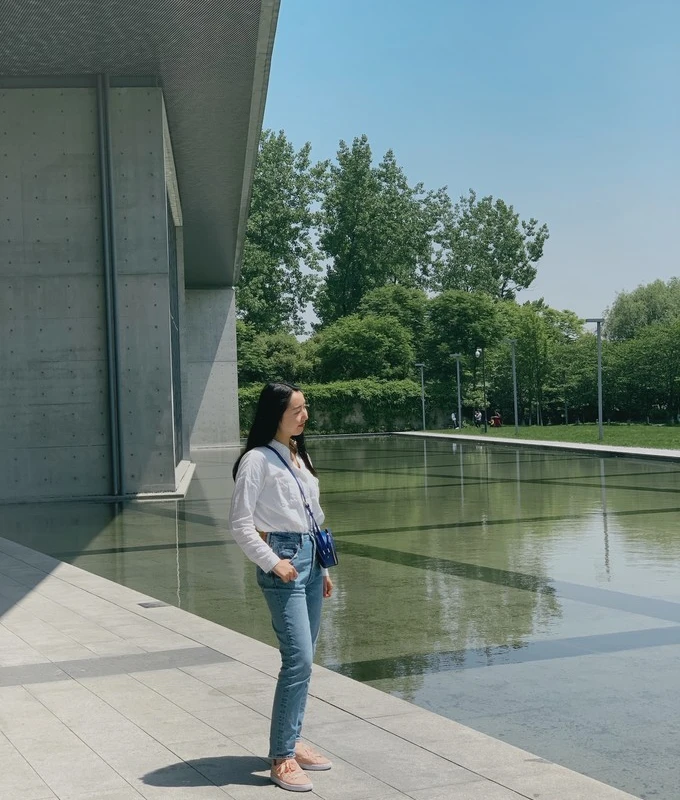
Liangzhu actually has deep cultural significance — a Neolithic site — so a Liangzhu Museum was specially built for introduction. Next to the museum is the Cultural and Art Center, and Xiaoshuguan is inside. It turns out the center was designed by Japanese master architect Tadao Ando, a big name who loves playing with light, skilled at using light and shadow to create atmosphere in architecture, and also fond of cool industrial tones, with his unique fair-faced concrete style being especially impressive.
Liangzhu Cultural and Art Center is divided into three main functional blocks: the southern exhibition block with gallery functions, the northern education block with training rooms, and the central cultural block containing a small theater, reading hall, and library functions. The three blocks are arranged under a large roof in an “H” shape. Creatively blending Eastern aesthetics with Western architectural theory, the design perfectly expresses Ando’s “emotion-based” spatial concept, emphasizing the inherent connection between people, architecture, and nature — one of his representative works in recent years. Ando uses simple language to create rich spaces and introduces abstract elements of nature, making the spatial experience compelling.
The visitor flow isn’t small; selfie-hunters come in endless streams. Inside, you can see logos of all partner organizations. It seems various cultural courses are often scheduled here — worth learning about. The first floor also has a café, co-located with cultural creative products.
This spiral staircase carries a heavy industrial tone. Light shines from above; as you move along the staircase, you feel the light shifting with you, making it a prime photo spot with queues. The center’s logo is displayed giant on the wall, another good photo spot. I quite like this master; missing his Church of the Light in Osaka in April is a regret. This spiral staircase leads directly to the parking garage. The first-floor platform is really spacious, shaped like a funnel — wide at the front, narrow at the back, very graphic.
In Ando’s series of works, light is embodied in shaping spatial environment and atmosphere. As he said: “A beam of light in architectural space lingers on the surface of objects, casting shadows in the background. With time’s passage and seasonal change, the intensity of light alters, and the object’s image changes accordingly.” Right here, two little sisters in ballet costumes were taking photos on the stairs — I call it “Dance of Light.” This open space subtly uses the effect of light and shadow, making photos vivid, appealing, and strongly three-dimensional. Ando captures ubiquitous light, letting pedestrians experience temporal and spatial shifts through unchanging building materials. He also uses architectural solids to separate light, making light seem a tangible volume. He once said: “In today’s world full of uniform light, I still pursue the interpenetrating relationship between brightness and darkness. In darkness, light glows like a gem; it hollows out darkness and penetrates our bodies, bringing life into the place.” In the glass-enclosed building center, such an open space emerges, like a hole hollowed out by light. The aluminum metal roof resembles a giant airplane wing, exuding modernity. Outside, vegetation is rich; here is Cherry Blossom Avenue (typical Japanese design — their genuine love for sakura). The entire grand roof is surrounded by over 100 Somei Yoshino cherry trees; sadly, the blooming period is short, only 7–10 days around late March.
Transport: Metro Line 2 to Liangzhu (terminus), then bus 389 for just 2 stops.
Hangzhou — Xiaoshuguan
The ultimate goal of this trip — Xiaoshuguan. I’m here, curator Gao Xiaosong. The library requires advance booking; on-site registration works too, just swipe an ID card to enter, but with crowd and time limits, you might have to wait without guarantee. Advance booking is recommended. On the gold wall at the entrance, books written by Gao Xiaosong himself are displayed — such as Fish and Sheep Wild History and Xiao Shuo.
The entire library spans two floors. First to catch the eye is a floor-to-ceiling window, a row of tables and chairs, bookshelves scattered throughout. These are said to be books personally selected by Gao Xiaosong, each one classic. Called the “most beautiful paradise library,” it features six-meter-tall bookshelves that connect the two floors into a continuous whole, blurring the existence of walls, immersing you completely in the world of books and forgetting the indoor space. The staircase linking the two floors, besides being an important circulation tool, also allows you to reach books on the high shelves.
The reservation system limits visitors to 300 per day, preventing overcrowding and noise inside. Over ten wood-tone bookshelves soar to the ceiling. To enter, first register your online reservation at the front desk and get a “Xiaoshuguan” reader’s card — all free. Those with internet access difficulties or the elderly have priority entry. With this card, you can stay all day, even going out for meals and returning. Remember to return the card when leaving.
Outside the floor-to-ceiling window is a shallow pool, matched with provided tables, chairs, sofas, and floor tatami cushions. Although many tourists take photos, they do so quietly, not disturbing genuine readers. There are over 50,000 volumes, all curated by Gao Xiaosong. The second floor has a dedicated children’s book area. Thoughtfully, though drinks, food, and bags cannot be brought in, free drinking water is provided.
I flipped through a book I actually have at home — Interviews from the Eighties, a classic. Indeed, due to the crowd limit, there were plenty of empty seats, so you could genuinely settle down and read, not just for photos. I read for at least half an hour before leaving; given our limited time in Hangzhou, the time given to reading was already a luxury.
Beyond the reading function, Xiaoshuguan will diversify in the future, such as inviting well-known intellectuals, writers, and entrepreneurs to compile book lists for readers. Soon a “Reading Companion Plan” will launch, with Gao Xiaosong himself as companion No. 001. “In the first half of my life, I traveled widely, roamed the jianghu, and met many people. In the second half, let me use these accumulated connections and resources to open libraries and do research,” said Gao. Next time in Beijing, I’ll definitely check out his Zashuguan.
Hangzhou — Three Major Temples on the Outskirts
Taking Metro Line 2 back to downtown Hangzhou, we headed to the area around the three major temples near West Lake — the so-called “Three Major Temples on the Outskirts.” The most famous here is Lingyin Temple, also the most crowded. We peeked at the gate and decided to pass. Actually, I don’t think you have to enter the temples; just walking around this area is very pleasant — lush and verdant, with various gardens, small bridges, streams, tea houses, and guesthouses, very tranquil and comfortable.
Walking from Lingyin Temple’s gate along Tianzhu Road, the first stop is Fajing Temple, which is the Lower Tianzhu of the three Tianzhu temples. It has the longest history, founded over 1,600 years ago. However, it was destroyed during the Xianfeng reign of the Qing dynasty and later rebuilt. Before 1949, most temple buildings were damaged; reconstruction began gradually in 1982, and after seven years of repair, new halls were restored. Most of what we see today was rebuilt then. Fajing Temple is currently the only Bhikkhuni (nuns) temple in Hangzhou. Throughout history, it has been a place for literati to pay homage or sightsee when visiting Hangzhou. Li Bai’s poem to a friend includes the line: “I hear again of Tianzhu Temple, dreaming longingly of the eastern Yue” — praising Lower Tianzhu.
Hangzhou has many well-known temples that are famous tourist and historic sites. The temples in this area all have yellow walls.
Shengyin Temple: located at the foot of Gushan Hill in Hangzhou, originally the imperial palace of Emperor Shengzu of Qing, renamed Shengyin Temple in the Yongzheng period. It has beautiful scenery and majestic architecture, housing many precious cultural relics.
Faxi Temple: located on Tianzhu Mountain in Hangzhou. Three famous temples — Faxi, Fajing, and Fajing — have stood here for over 1,000 years. Historically called the “Tianzhu Buddhist Kingdom,” they have a strong Buddhist cultural atmosphere.
Jingci Temple: a famous Hangzhou temple; the West Lake scenic spot “Nanping Evening Bell” refers to this place. The temple bell’s resonant tone makes “Nanping Evening Bell” one of the “Ten Scenes of West Lake.”
Lingyin Temple: mainly composed of the Hall of Heavenly Kings, the Grand Hall, the Medicine Buddha Hall, and the Five Hundred Arhat Hall, Huayan Pavilion, etc. The current abbot is Master Guangquan.
We just strolled here casually, with no strong purpose to visit every temple thoroughly. By the time we finished viewing the exteriors of these ancient temples, the sun was setting.
Hangzhou — Abutlamb Coffee
The last check-in before taking the bullet train back to Ningbo: Abutlamb Coffee. Finish this cup of coffee before leaving. With a La Marzocco espresso machine, EK43 grinder, and Bonavita pour-over kettle, it’s practically top-tier equipment for a Hangzhou café. Already with several branches in Hangzhou, this one is in the West Lake scenic area, closing at 18:00. At Abutlamb, many drinks are served in octagonal cups (bajiaobei), tying back to the name — steady and balanced, perhaps this down-to-earth attitude is the real approach to coffee. They also produce a range of peripheral cultural creative products. Besides coffee, this is the first café I’ve seen that actually serves shepherd’s purse and pork noodles (fried noodles). The girl kindly asked about your coffee preferences and gave recommendations. The cup design is quite fun, featuring motifs of Hangzhou’s West Lake temples!
Hangzhou — Kura Japanese Cuisine
I recommend a Japanese restaurant in Xiacheng District, Hangzhou called Kura Japanese Cuisine. 398 yuan for a twin set menu — absolutely delicious. Address: No. 11 Taohuahe Lane, Wulin Road (300m west of Guoda City Plaza, 200m from Hangzhou Tower), a small lane inside a residential community (420m walk from Exit D of Wulinmen Station on Metro Line 2). Kura is the kind of izakaya hidden just right. The ground floor has about ten counter seats around the open kitchen — recommended for solo diners. The second floor has several private rooms, suitable for groups of four or more.
Hangzhou — Bitao Bistro
This is a very distinctive restaurant a local brought us to. Built in the 1920s, it’s a genuine qingshui brick shikumen building — a real 100-year-old house. Time-worn retro vibes leave imitation antique decor far behind! The way to truly enliven an old house is to give it functionality! Eating here was fantastic!
Nestled among old houses near the bustling West Lake area, it offers quiet within the noise. Pure Republican-era style, without any forced, deliberate aging, you can truly feel history settle in this old house. The ambiance is beautiful; any casual shot yields great scenery. All the exquisite details speak of time’s polishing — old Shanghai vibes. Nestling among vintage furniture feels like time travel; even the restroom is charming. I’d read about it in newspapers: the owner collected antiques piece by piece; quality is evident in the details. It’s said to be the most artistic restaurant in Hangzhou.
At the intersection of Xihu Avenue and Ding’an Road stands a row of 1920s qingshui brick shikumen buildings; Bitao Bistro occupies one of them. Stepping over the old bluestone threshold worn by countless feet, it’s like stepping into a grand Shanghai household of yore — old wooden doors and windows, bronze dragon-head handles, worn wooden floorboards, colored wood walls and cabinets, antique ceiling fans, vintage radios, British telephones, old mantel clocks and wall clocks, old wooden trunks, antique mahjong tables, and old Shanghai banking lamps everywhere.
Bitao — not extravagant, but warm and romantic. Bitao adheres to a minimalist food philosophy: “Good ingredients, natural deliciousness.” The bistro aims to recapture the wonderful “home flavor” from the depths of taste memory: select the best ingredients, reject MSG, reject all unhealthy seasonings. I can only say, every dish I ate was delicious even without MSG — truly superb!
Bitao Bistro has more than one branch in Hangzhou, but only this one is in a real century-old building. Other branches, even if decorated in the same vintage Republican style, are in new buildings in commercial areas, clearly lacking so much character. Imitation antiques are not the same as genuine vintage.
Order via WeChat. The first and second floors are the dining area; the third floor (attic) is the waiting area. Anyway, this place always has a queue. Every painting on the wall bears the trace of time, as if instantly teleporting from a modern metropolis to the Republican era, with the distinctive ambiance of 1920s-30s “Little Shanghai” sweeping in. The decor is retro and artistic; a glass foyer separates inside from outside. The first floor has small black-and-white floored partitioned rooms; the second floor has a smoking area.
This shikumen old mansion dates from the Republican period; its design style mixes Chinese historical architecture with Western elements, casually eclectic. The perfect combination of art and cuisine across time and space — hard to imagine such a quiet, chic little villa in the city center. The retro, artistic environment lets you calm down and savor your own mood.
At the entrance stands a screen formed from four doors, covered with introductions to the dishes inside. Here you can have not only afternoon tea and coffee but also dinner.
Heavily vintage, old wooden floorboards with colored wood walls — I absolutely adore this style! The interior is decorated with an array of exquisite, elegant ornaments, filling the whole space with a petit-bourgeois atmosphere. The stairs creak underfoot — that’s truly the echo of time!
White walls, bronze-toned wooden tables, bowls and mugs that seem to have survived from the 1980s — with chipped paint everywhere, brimming with a rich sense of history.


