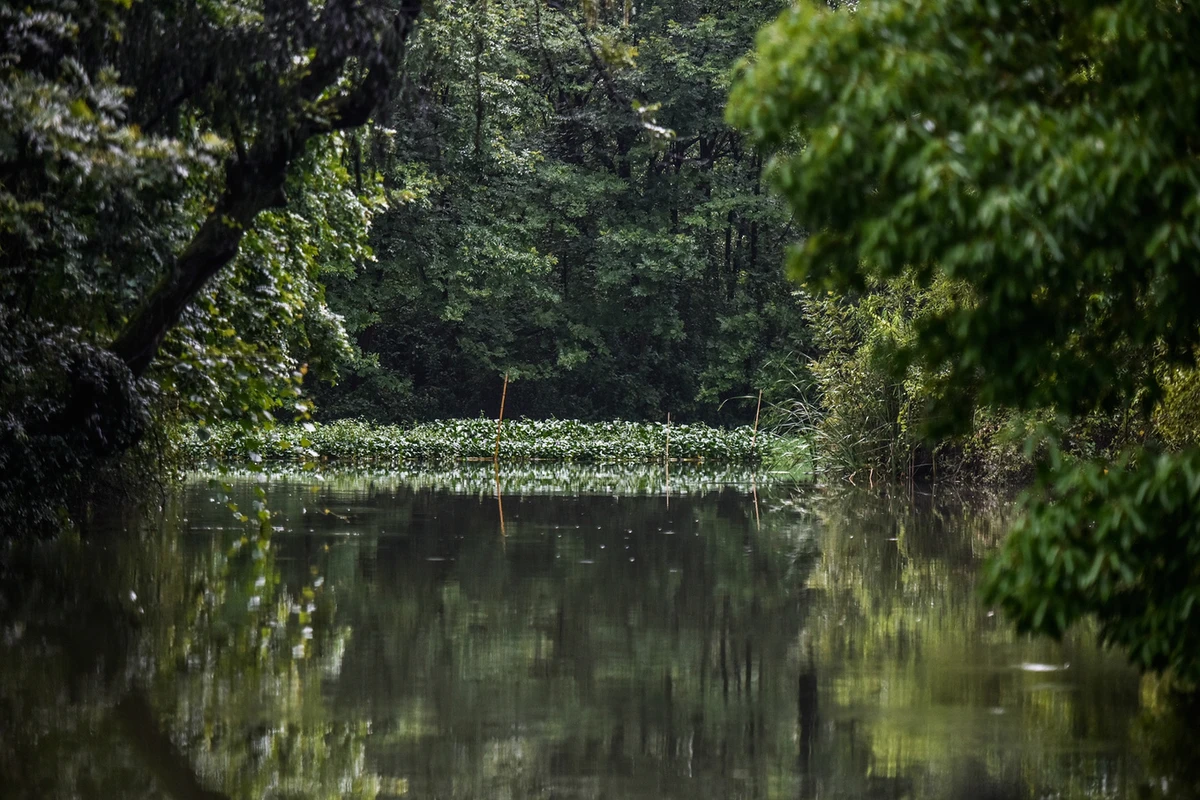
How beautiful is Jiangnan in the plum rain season? Come to Hangzhou for a relaxing escape and immerse yourself in the misty rain scenery.
【A sudden downpour during the plum rain season sways the quietly gliding sculling boat, creating the poetic charm of misty rain in Jiangnan】
In the plum rain season, Jiangnan is prone to rain and rather muggy. Yet this is the very moment when a landscape of lush green and delicate blossoms spreads out everywhere—every sight is soothingly beautiful. Hangzhou, the paradise on earth, becomes even more captivating at this time, almost without making a sound. Don’t just fixate on West Lake any longer. Why not embark on a leisurely getaway and discover a new way to experience this earthly paradise?
In Xixi Wetland, you can admire scenery like a living painting. I find it hard to describe such beauty. Perhaps it’s something to be seen and felt, not put into words.
Since Hangzhou’s Xixi Wetland is this gorgeous right now, how can one not enjoy it? So, my friend and I chose a sculling boat to take in this gracefully refined wetland scenery. The silent glide of the sculling boat over the mirror-smooth water created a poetic tableau, and I couldn’t resist capturing the moment.
While we were happily savoring afternoon tea on our sculling boat, we looked up and noticed rain starting to fall, growing heavier and heavier. Through the window, the sight of sculling boats moving in the rain exuded exactly the kind of poetic mood that Jiangnan should have.
What had been a peaceful journey on the water was suddenly broken by an out-of-nowhere downpour, but it added a dose of lyrical charm. Whether we were watching the people on the opposite sculling boats or they were watching us, it was itself a moment of Zen-like subtlety. In the heavy rain, the sculling boats carried the true atmosphere of misty Jiangnan—do you like it?
Hangzhou’s Xixi Wetland is a hidden gem on earth, with incredibly dense green vegetation and a high concentration of negative oxygen ions. It’s a rare urban wetland park not only in Jiangsu and Zhejiang but in all of China. Gliding on a sculling boat through this wetland truly feels wonderful!
Under a torrential rain, the sculling boat passed through a flooded forest—so beautiful. Such scenes you’d normally expect in the primeval forests of Yunnan, Guizhou, or Sichuan, but here in Hangzhou’s Xixi Wetland it appears everywhere. I absolutely adore this feeling—the sensation of a sculling boat drifting through a water forest.
The rain changes size magically: one moment it’s a deluge, the next it’s a fine drizzle. That’s exactly the plum rain season in Jiangnan—rainfall never settles. Every spot our sculling boat reaches brims with the flavor of misty rain Jiangnan.
Gradually the heavy rain turned light. The wetland plants, bent down by the downpour, wore crystal beads of rainwater on their leaves. This scene, too, is deeply evocative—beauty beyond description.
Sitting on the sculling boat, watching the other boats swaying in the rain is a wonderful feeling. Yet words can’t truly capture it. If I had to sum it up, “poetic” would be the word. And in the plum rain season at Xixi Wetland, even the word “poetic” seems not quite enough.
The rain finally stopped, and the temperature dropped a little, at least relieving the mugginess from before the rain. As you glide on a sculling boat, touring Xixi Wetland, you’ll discover hidden wonderlands within, mystical retreats you won’t find on foot.
If you take a sculling boat, you get to see many secret corners of Xixi Wetland that are rarely visited—landscapes as exquisite as poetry and painting, so ethereal they seem otherworldly. I wonder if you’d enjoy such scenery too.
Although it rains often during the plum rain season in Jiangnan, this very weather gifts us the poetic splendor of misty rain Jiangnan. Especially when you choose a sculling boat with afternoon tea and drift through Xixi Wetland—it feels absolutely wonderful. You’ll find yourself poeticized by this dreamlike environment!
【What exactly is the century-old sentiment of ‘Xixi, stay a while’? Come to Hangzhou and experience it yourself.】
Years ago, Hangzhou’s Xixi Wetland became a nationwide sensation thanks to the movie *If You Are the One*. The sight of Ge You sipping Longjing tea on a sculling boat and his exclamation “Xixi, stay a while” became a catchphrase that took the country by storm. However, the line “Xixi, stay a while” originally comes from an ancient poet’s lips and was only popularized by the reality dating show *If You Are the One*. So what exactly is the essence of “Xixi, stay a while”? Why not go to Hangzhou’s Xixi Wetland and feel it for yourself.
Many people seem to regard Xixi Wetland as a modern tourist development, but that’s not the case. As early as the Song dynasty, Xixi was already a prosperous part of Hangzhou and epitomized the fertile “land of fish and rice” of Jiangnan. Xixi was a vital part of Hangzhou’s agricultural culture, and its name literally means “western creek” because it’s located in the west of Hangzhou and crisscrossed by waterways. It was later described as “wetland,” giving us the name Xixi Wetland.
Most tourists probably know Xixi Wetland because of the dating show *If You Are the One*, right? The image of Ge You drinking tea on a sculling boat, admiring the view and saying “Xixi, stay a while,” etched this phrase into people’s memory. But this line “Xixi, stay a while” actually dates back to the late Qing dynasty, and it was not Ge You’s improvisation.
The phrase was born during the reign of Guangxu in the late Qing period. Legend has it that Emperor Gaozong of Song, Zhao Gou, passed through Hangzhou’s Xixi, was struck by its beauty, and exclaimed “Xixi, stay a while”—which later became the quintessential slogan of Xixi Wetland. After fleeing from Kaifeng in the Central Plains to settle in Hangzhou and establish the Southern Song dynasty, Zhao Gou was deeply moved by the ups and downs of life. Facing this dreamlike natural setting, he used those words to describe his ideal kingdom. So, presumably, to Emperor Gaozong, “Xixi, stay a while” represented a utopian realm. For modern people, it evokes an ineffably poetic state—how should one truly feel it? One must experience it in person.
How can you experience this “Xixi, stay a while” sentiment in Hangzhou’s Xixi Wetland? I’ve found a rather nice way: take a sculling boat with afternoon tea, enjoy the wetland scenery, and let that mood soak in. So I chose the sculling boat afternoon tea at Banyan Tree Hangzhou to recreate the scene Ge You had, and I could genuinely feel that vibe.
This kind of afternoon tea is best enjoyed with a friend or your partner—sipping tea while drinking in the views, the feeling is simply incredible. It’s something to be felt, not described. This is the true meaning of “Xixi, stay a while.” Would you like to experience it?
Riding a sculling boat is a world apart from walking through Xixi Wetland. Sitting on a sculling boat, admiring the superb ecology and scenery while indulging in a delightful afternoon tea—the sensation is beyond words. Even from the photos I took, doesn’t it look stunning? Even through a screen, you can sense the breathtaking natural ecology. Even in high summer, you stay comfortable on the sculling boat because the trees completely envelop the wetland, letting the boat glide freely in a serene, shaded world.
When you witness Xixi Wetland’s unique waterways and topography, you’ll marvel at nature’s wonder and grasp the true feeling of “Xixi, stay a while.” If West Lake is the quintessential paradise of Hangzhou, then Xixi Wetland is a pure land within that paradise. It’s truly fantastic!
In today’s world of industrial specialization and cooperation, cross-border investments and exchanges are more frequent than ever. The hospitality industry, as a key part of the service sector, plays an important role in the tertiary industry and the national economy.
Currently, China’s hotel industry is thriving, especially the high-end segment. There’s a very impressive hotel brand under Banyan Tree called Angsana. Ever since the first Angsana entered mainland China, it has been popular with both domestic and international travelers. So where is that first Angsana hotel in mainland China? It’s the Angsana Hangzhou.
Opened in 2011, Angsana Hangzhou is the first Angsana hotel in mainland China and the second Banyan Tree managed hotel in the mainland, second only to Banyan Tree Ringha in Shangri-La, Yunnan. Even though it’s been nearly 10 years, the overall décor shows not a trace of age, and the ecological environment is excellent. Just a glance at the hotel’s exterior reveals how wonderful Angsana Hangzhou’s surroundings are.
The interior of the lobby is very modern—a true flagship for Angsana in China, top-notch in both design concept and fit-out quality. Stepping into the lobby gives a warm and pleasant first impression, with a warm-toned base that also carries a touch of noble coolness; this beauty feels full of contrasting textures.
As with any five-star hotel, the service is first-rate, so no need to elaborate. The space in front of the reception desk serves as a guest lounge. Although the lobby combines the restaurant, lounge, front desk, concierge, and more, the design is scientific, the layout reasonable, and you won’t feel any sense of crowding or awkwardness—I really like that.
The feng shui of the public areas is well done. Both the lobby and the corridors are layered and well-arranged, and staying here felt great. Also worth mentioning is the elevator—it’s incredibly fast. It takes less than 5 seconds from the first-floor lobby to the guestroom on the fifth floor. Just imagine: a hotel opened way back in 2011 with this level of hardware is quite remarkable.
This is the room I stayed in, a view room on the fifth floor. Due to the architectural layout of the Xixi Paradise complex, the rooms here are not as large as those at Banyan Tree, but the atmosphere is excellent. For guests on a moderate budget, staying at Angsana is a great choice. Clean, tidy, bright, and comfortable—these guestroom qualities alone prove the hotel is very good. After nearly a decade since opening, maintaining this standard is truly commendable. Don’t you think so?
The room layout, functionality, and hardware are all very user-friendly. The bathroom has two doors that connect to the room and do not interfere with each other, so one person can use the bath while another uses the toilet without any awkwardness. That design is pretty great, right? I like this design and layout so much that I stayed for several nights in a row.
My fifth-floor balcony view room had a reasonably sized bedroom—neither too big nor too small, just right. I estimate it’s around 30 square meters, perfectly adequate for a business trip with a colleague or a family of three.
As for the overall layout, it’s hard to describe. I stood at the innermost part of the room and took a panorama, and this is what the room looks like. The positions of the entrance door, the bathroom’s main door and secondary door, and the hallway lighting can all be understood intuitively from this photo.
Entering from the main door, you directly face the bathroom’s front door, with the vanity, dressing area, and shower room visible. The room is designed with a wet-and-dry separation, and both hardware and soft furnishings are excellent. For a hotel that opened in 2011, such facilities are really impressive; they clearly put great care into building it, otherwise it might have become outdated by now.
Inside the dry-and-wet separated shower area, there’s also a large bathtub of superb quality, which took me by surprise. The door from the bathtub facing the bedroom and the shower area door form a relatively enclosed, private space. Normally, people sharing a twin room appreciate a bit of privacy; this bathroom design lets one person bathe without disturbing the other using the restroom.
【Hangzhou’s most traveler-friendly hotel: enjoy a thousand-yuan experience for a hundred-yuan room rate, a blessing for ordinary travelers】
When we travel, food and especially accommodation take up the biggest slice of the budget. Consumers choose hotels of different types and star ratings based on their financial situation, budget, and comfort requirements. Normally, the room rate is directly proportional to the experience. However, in Hangzhou, a world-renowned tourist city, there’s a hotel where a few hundred yuan room rate can give you an experience worth thousands, making it the most traveler-friendly hotel in Hangzhou and a true boon for everyday travelers. Do you know which hotel it is?
Rapid economic growth has brought prosperity to all industries, and tourism is a key pillar of Hangzhou’s economy. A West Lake–centric tourism economic belt has already taken shape, and close behind is the Xixi Wetland cultural tourism business district. To build an international resort destination, Hangzhou created Xixi Paradise at the southeastern corner of Xixi Wetland. Xixi Paradise is a tourism complex that gathers many high-end resort hotels, like the one you see here.
This hotel, named Angsana, is managed by the same company as Banyan Tree, and the property owner is Xixi Paradise. Don’t assume that just because it’s a five-star standard hotel, the room rate will be as high as you might think. Its rates are much friendlier, and the facilities can be shared with those of a hotel costing thousands—making it Hangzhou’s most thoughtful hotel.
Although Angsana Hangzhou doesn’t have a huge public area, it shares the public spaces of Banyan Tree. Angsana guests can enjoy the same top-tier facilities of Banyan Tree, such as its own private wetland garden within Xixi Wetland. Many people think you have to stay at Banyan Tree to access its private garden, but that’s not true.
On the way to the hotel’s boat area and private wetland garden, you may see a sign saying “Banyan Tree guests only.” That’s because Xixi Wetland is an open scenic area; although the hotel has a relatively independent garden, the wetland’s overall continuity hasn’t been severed, so the sign prevents non-guest visitors from wandering in.
At first, I thought I couldn’t enter the Banyan Tree’s garden area as an Angsana guest, but I asked and learned that guests of either Angsana or Banyan Tree are welcome to enjoy the Banyan Tree section. Yet Angsana only costs about 600 yuan per night while Banyan Tree is over 2,000 yuan—a noticeable difference. Apart from differences in room amenities, all other public facilities are shared. Isn’t that wonderfully considerate?
Once I learned that Angsana guests could also enter the hotel’s wetland garden, I immediately wanted to take a sculling boat and enjoy the breathtaking Xixi Wetland landscapes. Seeing this hidden paradise made my heart flutter.
This sculling boat experience is the only one of its kind in the entire Xixi Paradise. You have two options: just a boat ride, or a boat ride with afternoon tea. Guests of both Banyan Tree and Angsana enjoy the same price—isn’t that great? For ordinary travelers, it’s a huge blessing: you pay a hundred-yuan-level room rate and get access to thousand-yuan-level facilities and services. How can you not call this traveler-friendly design and management?
Now let’s take a look at the main areas of Angsana Hotel, starting with the lobby. The lobby’s atmosphere, décor style, and design concept are nearly on par with Banyan Tree’s. As soon as you enter, you feel the upscale vibe. I think for everyday travelers, choosing a hotel like this is really sensible, don’t you agree?
The lobby of Angsana is very rationally designed, achieving a harmony of feng shui and aesthetics. No matter where you stand, the views are good and aesthetically pleasing. Plus, the lobby is spacious and clearly demarcated into dining, lounge, and front desk zones—well-structured, well-classified, and stylish. I really like this kind of lobby style and design.
Now let’s look at the guestroom area. I originally thought a room priced between 500 and 600 yuan wouldn’t be very good, but it far exceeded my expectations. Although it’s been over ten years since opening, the advanced design concept and fashionable décor still don’t look outdated. Apart from being slightly smaller than Banyan Tree rooms, the design and functionality are comparable. With such an environment and such a room rate, how can it not be a great deal? How can it not win people’s hearts?
As Hangzhou’s most traveler-friendly hotel, Angsana isn’t just about the accessible room rate—there are also many luxurious shared facilities, like the restaurant, public areas, wetland garden, and the sculling boat afternoon tea.
【The only hotel in Hangzhou with its own dock, famous for sculling boat afternoon tea—visitors flock here】
Which hotel in Hangzhou has its own boat dock? Many would guess hotel areas along the Fuchun River, Qiandao Lake, or Tonglu, but actually that’s not the case. The only hotel in Hangzhou with a dock is not in Qiandao Lake or Tonglu—it’s inside a resort hotel at Xixi Paradise in downtown Hangzhou. Do you know which one?
Hangzhou is a city typical of the Jiangnan region, with numerous wetlands, and you can see lakes, marshes, rivers, and more almost everywhere. Xixi is the most representative wetland area, offering a delightful resort environment. Within the Xixi Paradise tourism complex, you’ll find many hotels, restaurants, and recreational facilities. Taking a sculling boat to view Xixi has become one of the most common activities, and sculling boats with Longjing tea are an indispensable part of the Xixi Wetland experience.
Although there are many hotels in Xixi Wetland, not many have their own sculling boat program, and even fewer have a private dock. The two hotels under the same management—Banyan Tree and Angsana at Xixi Paradise—offer this rare sculling boat experience, and they are the only hotels in all of Hangzhou with a dock. Experiencing the hotel’s own dock and sculling boat must feel special.
Here is the dock that leads from the hotel to the Xixi Wetland area. A short walk through the hotel garden brings you to a spot with superb ecology—the environment is so good; even looking at the colors in the photos, you can feel how comfortable it is. As Hangzhou’s only hotel with a boat dock, it provides guests a truly delightful experiential program.
Although Banyan Tree and Angsana are two separate hotels, they belong to the same family and share infrastructure. Whether you stay at Banyan Tree or Angsana, you can enjoy the hotel’s exclusive boat dock.
This is the public area of Banyan Tree Hangzhou—the environment is superb, brimming with classical Jiangnan garden charm that lingers in your mind. You can even board a sculling boat from the villa area; the overall experience is fantastic. Would you like to try?
Compared to Banyan Tree, Angsana’s room rates are far more attractive and accessible. If you’re on a limited budget but still want to enjoy Banyan Tree’s public facilities, choose Angsana and you can still savor a sculling boat with afternoon tea.
At the hotel dock, there’s great flexibility: you can opt for the afternoon tea cruise, enjoying tea and snacks while gliding through Xixi’s beauty, or you can skip the tea and simply enjoy a pure sightseeing ride. The choice is yours. The boat ride usually lasts between one hour and 80 minutes.
As the only hotel in Hangzhou with its own dock and sculling boats, wouldn’t you love to come check in, take a ride, and have afternoon tea? This unique experience is truly wonderful; personally, I love it.
【China’s first Angsana hotel, open for nearly a decade but still looking as good as new in style and environment】
In today’s world of industrial specialization and cooperation, cross-border investments and exchanges are more frequent than ever. The hospitality industry, as a key part of the service sector, plays an important role in the tertiary industry and the national economy.
Currently, China’s hotel industry is thriving, especially the high-end segment. There’s a very impressive hotel brand under Banyan Tree called Angsana. Ever since the first Angsana entered mainland China, it has been popular with both domestic and international travelers. So where is that first Angsana hotel in mainland China? It’s Angsana Hangzhou.
Opened in 2011, Angsana Hangzhou is the first Angsana hotel in mainland China and the second Banyan Tree managed hotel in the mainland, second only to Banyan Tree Ringha in Shangri-La, Yunnan. Even though it’s been nearly 10 years, the overall décor shows not a trace of age, and the ecological environment is excellent. Just a glance at the hotel’s exterior reveals how wonderful Angsana Hangzhou’s surroundings are.
The interior of the lobby is very modern—a true flagship for Angsana in China, top-notch in both design concept and fit-out quality. Stepping into the lobby gives a warm and pleasant first impression, with a warm-toned base that also carries a touch of noble coolness; this beauty feels full of contrasting textures.
As with any five-star hotel, the service is first-rate, so no need to elaborate. The space in front of the reception desk serves as a guest lounge. Although the lobby combines the restaurant, lounge, front desk, concierge, and more, the design is scientific, the layout reasonable, and you won’t feel any sense of crowding or awkwardness—I really like that.
The feng shui of the public areas is well done. Both the lobby and the corridors are layered and well-arranged, and staying here felt great. Also worth mentioning is the elevator—it’s incredibly fast. It takes less than 5 seconds from the first-floor lobby to the guestroom on the fifth floor. Just imagine: a hotel opened way back in 2011 with this level of hardware is quite remarkable.
This is the room I stayed in, a view room on the fifth floor. Due to the architectural layout of the Xixi Paradise complex, the rooms here are not as large as those at Banyan Tree, but the atmosphere is excellent. For guests on a moderate budget, staying at Angsana is a great choice. Clean, tidy, bright, and comfortable—these guestroom qualities alone prove the hotel is very good. After nearly a decade since opening, maintaining this standard is truly commendable. Don’t you think so?
The room layout, functionality, and hardware are all very user-friendly. The bathroom has two doors that connect to the room and do not interfere with each other, so one person can use the bath while another uses the toilet without any awkwardness. That design is pretty great, right? I like this design and layout so much that I stayed for several nights in a row.
My fifth-floor balcony view room had a reasonably sized bedroom—neither too big nor too small, just right. I estimate it’s around 30 square meters, perfectly adequate for a business trip with a colleague or a family of three.
As for the overall layout, it’s hard to describe. I stood at the innermost part of the room and took a panorama, and this is what the room looks like. The positions of the entrance door, the bathroom’s main door and secondary door, and the hallway lighting can all be understood intuitively from this photo.
Entering from the main door, you directly face the bathroom’s front door, with the vanity, dressing area, and shower room visible. The room is designed with a wet-and-dry separation, and both hardware and soft furnishings are excellent. For a hotel that opened in 2011, such facilities are really impressive; they clearly put great care into building it, otherwise it might have become outdated by now.
Inside the dry-and-wet separated shower area, there’s also a large bathtub of superb quality, which took me by surprise. The door from the bathtub facing the bedroom and the shower area door form a relatively enclosed, private space. Normally, people sharing a twin room appreciate a bit of privacy; this bathroom design lets one person bathe without disturbing the other using the restroom.
【What looks like an ordinary hotel lobby bar is actually a specialized restaurant with a poetic name and excellent food】
In the lobby of Angsana Hangzhou, there’s an area that seems like a regular lobby lounge but is in fact a distinctive hotel restaurant with a lovely, poetic name: Lu Ting (Reed Pavilion) Restaurant. Due to its early opening and the constraints of the building site, the restaurant appears relatively simple, yet it packs plenty of function. It serves as an afternoon tea lounge, and also as the main venue for buffet breakfast and à la carte dinner. The design is high-end, elegant, and classy. Despite being over a decade old, it doesn’t feel dated—in fact it looks stylish and comfortable, and the dishes are authentic and delicious. Enough talk; let’s go have a look at Lu Ting Restaurant.
The lobby of Angsana Hangzhou is quite versatile: besides handling check-ins, it also functions as an afternoon tea spot and a dining hub. Compared to the restaurant at Banyan Tree, Angsana’s restaurant may seem “petite,” but its décor is no less sophisticated, the environment is pleasant, and even though there aren’t hundreds of dishes, the quality and taste are excellent.
This is Angsana Xixi’s restaurant, mainly used for buffet breakfast, but also for afternoon tea and specialty dining. The design adopts a noble cool gray tone, creating a refined and cozy ambience.
Don’t think that this restaurant is just a part of the lobby—it is positioned as a serious dining venue and employs professional chefs. In the innermost area near the Xixi Paradise commercial street, you can see an elegant dining environment. The restaurant’s name is very poetic: Lu Ting Restaurant. The blend of classic charm, high-end elegance, and a poetic name makes it a popular choice among guests.
I had assumed it was a small place, but I was wrong. Deep inside there’s a medium to large dining area that can easily seat up to a hundred diners at once. At dusk, the restaurant takes on an air of antique charm and grandeur, laced with a hint of nobility. The dining atmosphere is truly wonderful. That’s why during my business trip, I dined here every day.
The entrance from the main door leads past the direction to the breakfast buffet area of Lu Ting Restaurant. Guests just come downstairs and present their room card or breakfast voucher to enjoy breakfast. Breakfast hours are 6:00–10:30 on weekdays, and 6:00–11:00 on weekends—fairly generous. The service deserves high praise: both the chefs and waitstaff are courteous, polite, and constantly asking if guests need anything. I was very pleased with the dining environment and service.
There are quite a few Japanese visitors in Hangzhou, and many overseas guests on business or vacation also prefer Japanese cuisine, so Lu Ting Restaurant offers a selection of Japanese dishes. The variety and categorization of the food are comprehensive, and the restaurant’s work is meticulous.
The Japanese food displays at Lu Ting’s breakfast area feature figurines that are vividly carved, much like the ladies from China’s Han and Tang dynasties, filled with historical, cultural, and artistic charm. I loved it. Under the influence of ancient Chinese culture, Japan has preserved and passed down decorative elements with Chinese flair that are especially endearing—don’t you think so?
During my stay at the hotel on this business trip, I ate here every day, rotating dishes. One favorite was this duck dish, which perfectly combines color, aroma, and taste—truly mouthwatering. Once you taste dishes like this, you’ll realize that this seemingly unassuming restaurant is actually a specialized gem, and its name even carries poetry.
Beef dices with pan-fried potato strips—very tasty, highly recommended. Best of all, its price is wallet-friendly. As the professional restaurant of a long-established five-star hotel, offering high quality at reasonable prices is the surest way to win hearts.
This dish may not be very clear in the photo—it’s a stone pot fish, absolutely delicious, delicately sweet yet not greasy, tender but not falling apart. Both in presentation and flavor it’s top-notch. This stone pot fish is the dish I’d recommend most; I’m sure you’ll all love it.
Lu Ting Restaurant has a wide range of dishes, offering both Chinese and Western cuisines. From meat to vegetable, they have it all, basically satisfying diverse palates. I salute this poetic and upscale restaurant.


