Tonglu Shanwanwan — Our ‘Green Freedom’
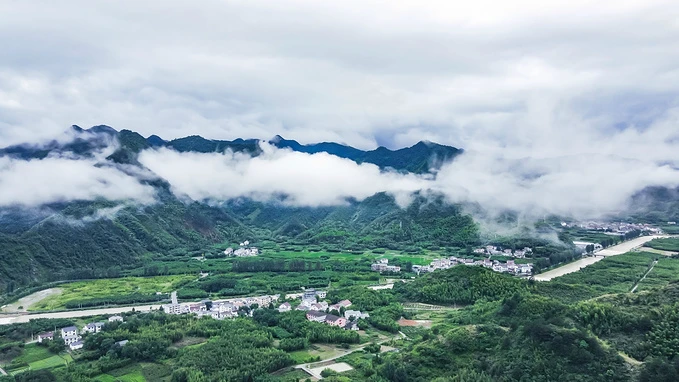
With just a few things in a small car, heading off with the one you love for a short getaway — that’s probably the most blissful way to spend a summer. This time, our road trip destination was Tonglu County, Hangzhou, in Zhejiang Province. I’ve been to Hangzhou quite a few times and know the surrounding scenery is lovely, but this was my very first visit to Tonglu, and doing it as a self-drive trip made me quietly excited. We were at the tail end of the plum rain season. The day we set off, the weather was drizzly. As we drove, mist and clouds unfurled, yet the sky didn’t feel gloomy; instead, it felt wrapped in thin clouds through which light filtered — a very wondrous sensation. The air was moist. Roll down the window and you could breathe in freshness and crispness: the fresh scent of grass and the crisp coolness of the river. As the car moved on, green mountains drew near and then receded, so the clouds and mists drifting around them came into clear view. From a distance, they seemed solid, the green peaks hiding their faces; up close, they felt half-real, merging with the sky’s clouds and the mist rising from the river into an indistinguishable whole. There seemed to be small islets on the river, lush with green plants, made indistinct by the water mist, giving it an almost fairyland feel. That’s really the only way to describe it — this was probably the best scenery I, as a southerner, have ever seen that perfectly captures the subtle, graceful beauty described in classical literature.
First glimpse of the dam
Entering the scenic area, we first walked across the dam in the upper reaches of the river. It was my first time seeing a hydraulic engineering project like those in geography textbooks. One side was a full storage reservoir; the other was the river’s lower course divided by the dam wall. Since it was flood season, the spillway in the middle continuously discharged water downstream. As it poured over the high dam, it produced a thunderous sound like a waterfall. Walking on top, I couldn’t help but marvel at the power of human endeavor.
A magical ancient road that bears witness to Huizhou merchant history
The first activity was a stroll along the Huizhou Merchants’ Ancient Trail. Beyond the woods, stone steps appeared, winding and twisting through the mountain forest, gradually climbing higher. The whole way, ancient trees blocked out the sky, stretching deep into the mountains. The trail was first built in the Tang Dynasty and perfected during the Ming and Qing dynasties as Huizhou merchants prospered. The Huizhou Merchants’ Ancient Trail was a vital trade route for Huizhou merchants entering Zhejiang in olden times. It is China’s third most renowned ancient trail after the Silk Road and the Tea Horse Road — a magical path that bears witness to Huizhou merchant history and culture. It starts in the west at Linxi, on the border of Jixi and Shexian counties, turns into a land route in Fuling Township, Jixi, then passes landmarks like Jiangnan First Pass and Xiaxuetang, finally ending in Zhejiang’s Lin’an City, Maxiao Township, Zhechuan Village, stretching over a hundred kilometers. Whether heading north or south, Huizhou tea merchants all had to travel this trail, which was essentially only passable on foot, crossing countless mountains and rivers. Along the way, bandits, epidemics, and natural disasters were constant threats; the tea trade was perilous, with fewer than one in ten succeeding — most perished far from home. The section of the trail within the scenic area is less than one-tenth of the original length, restored using traditional methods, so it’s much flatter and safer. Sturdy guardrails on both sides mean you won’t feel the danger even on steep parts. Yet from the massive stone steps underfoot, the sheer cliffs beside you, and the narrow “line of sky” at the tightest squeeze, you can still feel the hardships and toil of Huizhou merchants carrying tea out of the mountains, and understand the spirit passed down through generations.
Climbing the stone steps, they looked washed by the drizzle — glossy and spotless, as if untouched by centuries of wear. The trees along the path, the grass growing between the stones, were all gleamingly fresh from the rain. On the rock cliffs, “hanging springs and flying waterfalls” appeared from time to time, full of wild charm. The forest blotted out the sun, and moss grew thick on the stones by the wayside. Fallen leaves lay in a deep layer beside the ancient trail, soaked by rain, soft and springy underfoot. Before I knew it, the rain had stopped, but I still felt it was raining — the mountain mist, the gurgle of the streams, the spray from the waterfalls gave me that illusion. Walking slowly, looking here and there, touching and feeling things, it was easy to cast off all burdens and forget the noise of the world. All that remained was the view of green everywhere, the fresh air I breathed, and the coolness that clung to my skin.
The mountain path was both rustic and solid, the stone steps marked by age; the trees stood tall and lush, swaying in the wind. Mist that scattered one moment and gathered again the next quietly lingered in the forest. They were silent. The mingled sounds of birds gathering and flying off, and the intermittent chirping of summer insects, interwove along the trail. They were the spirits here. I was merely a traveler. Vicissitudes always work like that: one moment making you feel a touch of weight, the next telling you it’s an illusion, letting you indulge in the simple happiness of the mundane. Walking slowly along the ancient Huizhou trail winding deep in the mountains, my heart was calm and at ease, as if a thick cloud had dispersed.
Yunpiaopiao Glass Bridge
While walking the Huizhou Merchants’ Ancient Trail, you can spot the Yunpiaopiao Glass Bridge, but maybe because we were high up, it didn’t look too impressive. Once I actually stood on it, it felt rather thrilling. The glass bridge stands a hundred meters high, stretching across the gorge like a white ribbon. Below, turbulent river water rushes and lush trees grow. Looking around from the bridge, all you feel is your own smallness against the vastness of the mountains and rivers. Both ends of the bridge don’t lean against the mountain — they stand free — and the glass is so clean and transparent that looking down truly gives you a sensation of emptiness, of standing high in midair. The gorge seems bottomless, and with mountain winds howling past, a sense of peril hits you at once. But as long as you don’t look down and instead gaze out at the open spaces among the mountains, standing on the glass bridge makes you feel like riding the whistling wind and taking off. With a few photography tricks, it’s easy to snap photos that look like blockbuster shots — a real sense of accomplishment and a perfect Instagram-worthy spot.
Shuiliuliu Glass Slide
Shuiliuliu glass slide rafting runs right alongside the glass bridge. The entire slide is built following the valley, with a vertical drop of over two hundred meters. It was my first time seeing a rafting chute made of glass — sounded thrilling and fun right from the start.
Unlike the wild, irregular bumping against rocks in gorge rafting, the glass slide is a purpose-built route starting high on the mountainside and winding down to where the river flows gently. Before we even got onto our raft, from the high glass bridge we heard girls shrieking and laughing on the glass slide. Looking down from above, the rubber rafts rode the current along the long, see-through glass. Through the glass, trees and rocks below were clearly visible — looked pretty exciting. When I got on myself, it felt even more intense. Unlike on the glass bridge, where you can slowly walk and overcome your fear of looking down, the glass slide rafting gives you no time to conquer that fear. You face it head-on while experiencing speed and thrills. Before boarding, staff hand out free raincoats and rain pants, so your clothes don’t get splashed — very thoughtful of the scenic area. At first the slope didn’t look steep, and I thought, “Those screams earlier couldn’t have been fake, could they? I’m definitely not going to scream.” (Famous last words — cue the “you’ll eat your words” warning.) I was lulled by the gentle start. As the rafting progressed, the incline grew steeper, the speed picked up (the wind nearly blew my raincoat off), and the raft bumped against the glass walls on turns, spinning and colliding like a roller coaster. All while you could see the rocks below and hear the roaring river nearby. The thrilling sensation kept building, and I couldn’t help but scream out loud. Rafting turned into a roller coaster ride — impressive.
Bubujingxin High-Altitude Suspension Bridge
Next was the Bubujingxin high-altitude suspension bridge. The bridge is 108 meters long and exactly 108 meters above the valley floor — the first openwork suspension bridge in the Jiangsu-Zhejiang-Shanghai area. Once I put on the safety gear, I felt completely secure. Then I took my first step onto the bridge — and that sense of security vanished. The bridge shifted under my weight, starting to sway. Even though the safety gear meant I couldn’t fall even if I missed a step, it still felt like one wrong foot would plant a kiss on nature. Unlike the glass bridge, which looked scary but at least felt solid underfoot, this suspension bridge is completely open except for the footplates. As you walk, the wind brushes between your legs. The bridge’s flexibility made the whole crossing full of wobbles, especially when walking with others. One person takes a step and the sway hasn’t stopped before another takes theirs. I cautiously made my way step by step, my heart in my throat the whole time — no wonder it’s called “Bubujingxin” (step-by-step fright). Honestly, the fear of thrill is addictive. When I took the first step, fear got the upper hand, but I kept telling myself “It’s fine, it’s safe” while encouraging myself to take the next, and gradually a small sense of achievement for overcoming it emerged. After about a dozen steps, I finally had the composure to look up and enjoy the surrounding scenery. The mountain views were almost entirely cloaked in greenery, so pausing on the bridge felt like shuttling through a forest. I even sat down on the bridge, like when I used to sit on a swing as a child. My legs dangled in the air, and I gazed at the green around me, cleansing my eyes from the grime of daily life. The wind was so cool it seemed to blow right through my chest.
Shanwanwan Rafting Adventure
The highlight of the trip was, of course, Shanwanwan rafting — a longer, more thrilling, and more intense experience than the roller-coaster-like glass slide rafting. The Shanwanwan rafting course is 3.5 kilometers long with a vertical drop of 208 meters, the greatest drop of any whitewater adventure attraction within Tonglu and quite rare in the whole of East China. The whole rafting trip takes about one hour.
Putting on quick-dry clothes, a life jacket, and a helmet, we climbed into the rubber raft and set off on our rafting adventure. The current was quite swift. Following the mountain stream, our raft twisted and turned in the valley. The rafting channel was built with stones taken from the nearby riverbed, beaten smooth by the rushing water. Surrounded by green hills on all sides, we saw mixed trees all along the way, with branches hanging down overhead. Water cascading from above crashed against the rock walls, throwing up white spray — we rode those waves the whole time. This kind of irregular, natural channel rafting offers a thrill that the glass slide just can’t match. Constant bumping against rocks, the steep terrain, the spinning as the channel widened — the raft was totally out of our control except for following the water. My heart was out of control too. I’d involuntarily yelp when my side of the raft tilted forward, then laugh at my own nervousness once the water calmed and it was all safe fun. No matter who you’re with — your loved one, family, friends, or even strangers you meet on the journey — rafting is accompanied by laughter the whole way. After every rapid or shoal, when the excitement subsided, we’d almost always exchange a grin with the person at the other end of the raft. By the end, even strangers became friends. It’s absolutely the best bonding activity. The most hair-raising and exhilarating part was cutting through the gorge. As the terrain got steeper, the river ran faster and fiercer. The raft shot left and right, speeding along with the current. We were jolted in the raft while getting drenched by the water. Throughout this stretch, relentless spray slapped our faces again and again until our faces and bodies were covered in cool river water. Nobody got off the raft dry; we were all in a state where you could wring out a puddle from your clothes, as if we’d gone for a swim — and the raft was full of water too, haha. But that’s exactly the fun of rafting. Clothes just need to air-dry, and they won’t smell strange because the water quality here is excellent. On the rafting route, you can see the crystal-clear water. Reach out and you scoop up a handful of coolness; when it splashes on you, it’s pure refreshment. On a day over thirty degrees Celsius, a trip on the Shanwanwan rafting is like downing an ice-cold cola — exhilarating! You instantly want another go. To experience the big drops, the speed, the thrills all over again! The rushing water and changing topography fill the entire trip with screams and laughter. What maintains the water speed is the upstream reservoir we saw on our way into the scenic area. It’s not just a hydraulic engineering project; it also controls the consistency of the water flow during rafting, ensuring every visitor gets an ultimate and perfect rafting experience. The stream water is virtually impurity-free and incredibly clear. Everything before your eyes is a lush green, as if you’re floating through a painting. At the end, having a water fight in the pool is the ultimate fun. Whether you know the person or not, scooping up water and tossing it at them is a gentle greeting. Splashing each other and getting into a full-on water battle — that’s pure, unrestrained pleasure. Can adults experience a child’s joy? Absolutely. And as you get older, the fun doubles. One thing to note is protecting your electronic devices — bring waterproof bags. Also, if you’re a rafting veteran, remember to bring your water-fight weapon; the joy of splashing and spraying is measured in tons!
After finishing the Shanwanwan rafting, I was left wanting more. Though a bit tired, my heart was filled with huge, glowing happiness — the kind that makes you want to run and jump in the mountains or swim in the water for a while. I was so reluctant to leave that I lost track of time and forgot my growling stomach.
When here, naturally you must eat local food, so we went to the nearby Yanchun Farmhouse and experienced the local community hall culture. Flowers, red lanterns, and wooden decorations gave us a rustic yet unpretentious dining vibe before we even stepped inside. Once we sat down, the meat dishes came in generous portions — thick slices of beef and mutton on big platters. Tonglu creek fish, small fish raised in the clear local streams, were wonderfully tender and came in a whole pot. The duck stew and yellow braised chicken were both full of flavor, with thick, savory sauces. Many vegetables on the table came from the owners’ own garden — no pesticides, green, organic, and pollution-free. Stir-fried long beans with red peppers had that home-cooked taste, and I ate most of my rice with it. Steamed pumpkin, simply served with a sprinkle of chopped scallions and crushed peanuts, was soft, luscious, and sweet — delicious. I successfully stuffed myself here. The food tasted just like the meals of my childhood. Using easily available ingredients and simple, rustic cooking, it gave me a sense of being overstuffed that was more precious than any fancy Western restaurant — a rare sense of comfort. The portions were huge, the flavors good, and the prices fair. This is truly a great dining choice when you’re here to explore.
That evening, we stayed at our pre-booked guesthouse — Qinran Xiaozhu. It’s in a small town right by a tributary, next to the road, making it very convenient to drive to. The guesthouse courtyard sits close to the road. The fence outside is entwined with vines and flowers — no need for extra decoration, because red flowers and green leaves are the best adornment. Inside the courtyard, there were even more flowers. Instead of carefully tended potted plants, there was a long bamboo planter filled with red, yellow, pink, and white blooms, all jostling together, raindrops still clinging to their petals as they enthusiastically showed off the vitality and life of the place. The guest room was very clean. The ceiling was in natural wood tones, and the light fixture was a little star giving off warm yellow light, so the room looked cozy and inviting. Above the bedhead were pink and blue little houses — very cute. The window faced the mountain forest. Push it open and you’re greeted with an expanse of lush green; it felt like if you left the window open, birds might even perch right beside it. By the river, across the way, there are large bamboo groves, brilliantly green, a sight that instantly lifts your spirits. Standing on the second floor of the guesthouse, you can clearly see the river winding past a nearby green hill, stretching toward hazy distant mountains. The mountains were draped in milky white mist, like gauze scarves. Rooftops of homes scattered within view rose here and there. In my ears, there was only birdsong and the sound of flowing water; no other noise. The whole world of sights and sounds gave me a sense of serene yet vibrant tranquility. Far from the never-ending traffic, glittering skyscrapers, and bright city lights that know no night, here, greenery, streams, mist, insects, and birds form their own peaceful haven. Nearly every space you see is occupied by green. Because here, where there’s even a little soil, without deliberate planting, sunshine and rain urge wind-carried seeds to grow into trees, patches of grass, and flowers — it’s literally an ideal place of vitality and poetry. The guesthouse meals are simple, but healthful and reassuring, like coming home to your mom’s cooking. A bowl of sweet potato porridge that’s plain yet sweet and delicious; a big plate of qingtuan (green rice balls) almost too many to stack, made by the guesthouse aunty using mugwort juice — with a slightly bitter, refreshing aroma. I’d been craving qingtuan for a while and hadn’t managed to get any; I didn’t expect to happen upon them here, as if they were waiting for me. There was also homegrown waxy corn. As soon as the aunty brought it out, its sweet scent hit us. The plump kernels were so tender that chewing them gave a delightfully glutinous texture. Plus, the aunty stir-fried several seasonal vegetables, freshly plucked from her garden — fresh and healthy. Because I exclaimed at the table how sweet the corn was, as we were leaving, the guesthouse aunty insisted on stuffing a bag of fresh corn into our hands for us to cook back home. What a warm-hearted person. I’ll definitely go back when I have the chance.
This trip wasn’t long; we finished most of the activities in just one day, and spent the rest of the time strolling slowly with my loved one. On the ancient trail, we paused here and there to look and take photos. On the road across the river from the guesthouse, we measured the distance between street lamps with our steps. When we got a bit hungry, we simply walked to find a place to eat. Sitting on a stone bench, we watched the sky, clouds, and mountains… It seemed like we did nothing but eat, sleep, and space out, but I didn’t feel empty at all. Here, you can be a tree, a blade of grass, a flower; you can be a bird in the sky, a fish in the river, an insect in the grass. You can be anything, as long as you want. The wind can sweep through your chest and off into the distance, and so can my thoughts. Tonglu — a place for playing, for finding inspiration, for growing old. So, treat yourself to a trip like this. Give yourself time to empty your mind and daydream. Having been busy chasing ‘cherry freedom’ for too long, now I need ‘green freedom’!


