Taste Buds on the Road: Savoring Flavors – The 'Three Representatives' of Hangzhou Cuisine: Soft and Mellow Amidst the Storms of Time
Taste Buds on the Road: Savoring Flavors – The "Three Representatives" of Hangzhou Cuisine: Soft and Mellow Amidst the Storms of Time
Introduction: The four basic elements of human life are "eating, clothing, shelter, and travel." These four elements drive human progress and cycle on as civilization iterates. Now, the "travel" part of life has added travel. It's not just about pleasing the eyes and ears, but the taste buds on the tongue personally experience the sour, sweet, bitter, salty, and umami flavors of life. The dishes tasted on a journey shake with history and culture, so I'm writing a series about the dishes eaten while traveling. Title: "Taste Buds on the Road: Savoring Flavors."
Location: Hangzhou, Wuzhen, Qiantong, Xikou – June 2014
In June, I went out for a few days to Hangzhou, Qiantong, Xikou, Wuzhen, and other places, basically in Zhejiang. Along the way, I tasted a few Hangzhou dishes. I'm not really interested in food. Whenever I see travel posts online introducing local snacks, I'm indifferent. I rarely visit those snack streets because I think they're smoky and dirty. And I never have the habit of eating while walking. Why write about Hangzhou cuisine this time? Because I love West Lake Vinegar Fish.
Hangzhou cuisine refers to dishes that originated or flourished in Hangzhou. It's a main branch of Zhejiang cuisine, one of China's eight great culinary traditions. It emphasizes original flavors, select ingredients, seasonality, orderly cooking, exquisite presentation, and completeness of color, aroma, and taste. The characteristics are "light and moderate, select ingredients, seasonally fresh, diverse and new." "Light" is an important feature.
Today's Hangzhou cuisine is a "homeless cuisine" (also known as "mystical cuisine"). It can be traced back over a thousand years to the Southern Song Dynasty, when Lin'an (Hangzhou) was a bustling capital, gathering famous chefs from north and south, and merchants. The cuisine reached its peak. Historically, Hangzhou cuisine was divided into two schools: "Lake" and "City." The former mainly used fish, shrimp, and poultry, excelling in techniques like raw-frying, clear-stewing, and tender braising, emphasizing fresh, crisp, and tender flavors, preserving original tastes. The latter used more meats, with cooking methods like steaming, braising, quick-boiling, and roasting, emphasizing light oil, light sauce, light and fresh flavors, focusing on the unity of freshness and saltiness.
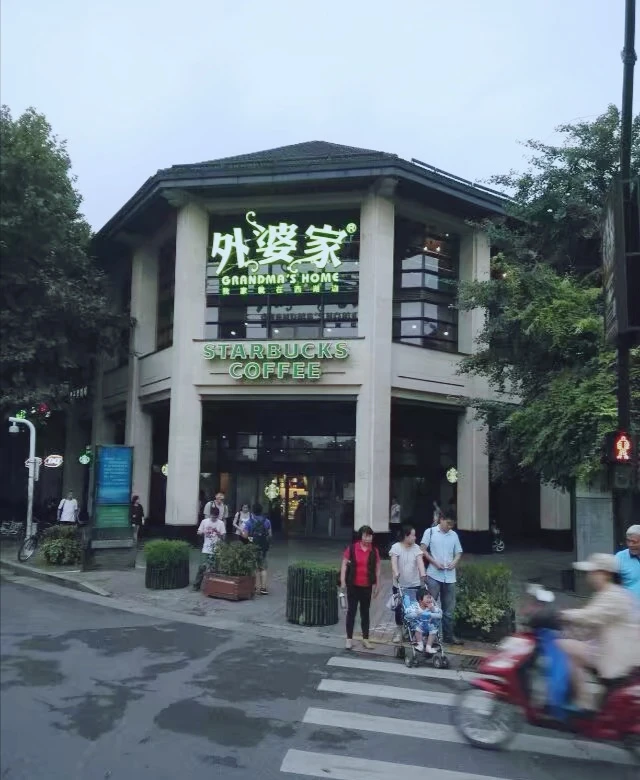
The most famous Hangzhou cuisine restaurant is Louwailou, but it's very expensive. The most popular is Waipojia, where you have to queue for a number every day. That afternoon around 5:30, I passed by Waipojia and saw a huge crowd waiting for numbers. I always avoid crowded places, so I just took a photo from afar and said goodbye to Waipojia. Instead, I went to a small street-side restaurant.
Beijing cuisine has a famous dish with an interesting name: "Beggar's Chicken," also called "Rich Chicken." There's a story behind using such contrasting words.
Beggar's Chicken originally comes from Hangzhou. It was made by poor, suffering refugees (beggars) who would steal or beg for a chicken and cook it in hot earth. It was a street dish not refined enough for the elegant hall. Legend has it that Emperor Qianlong of the Qing Dynasty was traveling incognito in Jiangnan and ended up in rags, wandering the streets. A beggar chief took pity on him and gave him this chicken, thinking it was delicious. Qianlong, starving and cold, found it exceptionally tasty and eagerly asked its name. The chief was too embarrassed to call it Beggar's Chicken, so he bluffed and called it "Rich Chicken." Qianlong praised it greatly. Later, everyone discovered the ragged wanderer was the emperor, and Beggar's Chicken became a famous dish thanks to the emperor's praise.
I ordered this dish at a small restaurant in Hangzhou. When it arrived, I wasn't impressed. First, the color was unappealing. After one bite, I lost interest—no chicken flavor, just salty.
In my hometown of Yongxiu, there's an unwritten rule: for any wedding or funeral banquet to thank guests, an essential dish must be served—Dongpo Pork.
There's a beautiful legend about its origin. One year, the great Song Dynasty literatus Su Shi, also known as Su Dongpo, visited his dear friend Li Gongze in Jianchang. On the way, he saw a farmer's son suffering from heatstroke in critical condition. Su Dongpo, who knew some medicine, immediately saved him. The farmer, grateful, went to the market and bought two jin of meat, tied with a straw rope. He asked Su what flavor he preferred, braised or stewed? Su Dongpo looked at the countryside scene and thought of a verse. Suddenly, a good line came to him, and he blurted out, "On lotus… pearls… exuding sweet fragrance." The farmer misheard it as "cook whole with straw to infuse heart fragrance," so he washed the meat with the straw and stewed them together. When the meat was ready, Su asked why, and the farmer explained. Su smiled and said, "I was composing a poem: 'Morning sun spreads color, half the sky brilliant; lotus fragrance on water, dew like pearls, so I recited 'pearls on lotus exuding sweet fragrance.' You misheard." Unexpectedly, the meat turned out tender and savory, rich but not greasy, plain yet not tough, carrying the fresh scent of the field from the straw—truly a unique flavor. Su Dongpo praised it highly. From then on, people in Jianchang would make this meat for any thank-you banquet, and it became an indispensable delicacy at folk feasts, named Dongpo Pork, passed down to this day.
Another story: When Su Dongpo was the governor of Hangzhou, he dredged West Lake, doing a great service for the people. After the dredging, the surrounding fields no longer suffered from floods or droughts. That year also brought favorable weather, and the crops in Hangzhou's four townships had a bumper harvest. Grateful to Su Dongpo, the common people brought pigs and wine to pay New Year's greetings. Su Dongpo received a lot of pork, ordered it cut into cubes and braised until red and tender. Then, according to the roster of laborers who dredged West Lake, he sent a piece to each household to celebrate the New Year. In that peaceful year, every family was having a joyful time, and when they received the pork from Su Dongpo, they were even happier. The old laughed, the young jumped. Everyone praised Su Dongpo as a good official and called the pork he gave "Dongpo Pork." At that time, a famous restaurant owner saw how popular "Dongpo Pork" was and consulted with his chef. They also cut pork into cubes, braised it red and tender, and called it "Dongpo Pork." As soon as this new dish came out, the restaurant thrived. Customers streamed in from morning till night; killing ten pigs a day still wasn't enough to sell. Other restaurant owners, jealous, also learned to make it. Soon, no matter big or small, every restaurant had "Dongpo Pork." Later, after the guild discussed, they officially made "Dongpo Pork" the number one dish of Hangzhou. Su Dongpo was upright and not afraid of the powerful. The corrupt officials in court already hated him. Seeing how beloved he was among Hangzhou people, they were very uncomfortable. One of them, a censor, disguised himself and came to Hangzhou to find fault, intending to frame Su Dongpo. On his first day in Hangzhou, the censor dined at a restaurant. When the waiter asked him to order, he saw the menu, and the first dish was "Dongpo Pork." He frowned, then suddenly slapped the table in joy and shouted, "I'll have this first dish!" After tasting it, he found it really delicious. He asked the manager and learned that "Dongpo Pork" was the guild-recognized top dish. So he collected all the menus from restaurants in Hangzhou and returned to the capital excitedly. Back in the capital, he immediately went to the emperor and said, "Your Majesty, Su Dongpo in Hangzhou is corrupt and does all kinds of evil! The people hate him so much they want to eat his flesh!" The emperor asked, "How do you know? What proof do you have?" The censor presented the stack of greasy menus. The emperor, a fool, looked at the menus and without distinguishing right from wrong, issued an edict to dismiss Su Dongpo and exile him far away to Hainan. After Su Dongpo was dismissed and exiled, the people of Hangzhou never forgot his goodness and still praised him as before. Thus, "Dongpo Pork" was handed down generation after generation, and today it's still a famous dish in Hangzhou.
In Hangzhou, Dongpo Pork isn't tied with straw; a small piece costs 12-15 yuan. In Wuzhen, it's tied with straw, each piece about three taels, priced 45-58 yuan per piece. In Wuzhen, I also ordered a vegetable dish, the portion smaller than a side dish in Guangzhou, costing 28 yuan—total rip-off.
West Lake Vinegar Fish is the most prestigious dish of West Lake in Hangzhou. Its creation dates to the Southern Song Dynasty reign of Emperor Gaozong. According to ancient records, it originates from the story "The Sister-in-law Passes Down a Treasure." Legend has it that during the Southern Song, there were two brothers surnamed Song, learned but unwilling to be officials, living a reclusive life by fishing. A local villain, Master Zhao, saw the elder brother's wife was young and beautiful, so he plotted and murdered the elder brother, intending to seize her. Thus, the sister-in-law and brother-in-law were struck by sudden disaster. Grief-stricken and outraged, they went to the yamen to lodge a complaint, but the officials colluded with the evil force. Not only did their accusation fail, they were beaten and thrown out. Returning home, the sister-in-law had no choice but to tell the younger brother to flee far away. At parting, she specially cooked a grass carp with sugar and vinegar, saying, "This dish is both sour and sweet. I hope you have a bright future and never forget today's bitterness." Later, the younger brother went away, served in the military against the Jurchen invasion, earned merit, and returned to Hangzhou, punishing the villain. But he couldn't find his sister-in-law. One day, attending a banquet, he tasted this dish. Upon inquiry, he learned that his sister-in-law had been working in the kitchen under an assumed name. Thus, they reunited. The dish "Sister-in-law Passes Down a Treasure" spread among the people along with the legend.
A Qing poet Fang Hengtai wrote a poem about it: "By West Lake's five-willow dwelling we moored, casting a net at the feast to get fresh fish. The sour taste I love best, silver knife and juniper, river carp and bream all fall short." This captures the cooking and deliciousness of West Lake Vinegar Fish. By the late Qing Dynasty, the one prepared at the Louwailou restaurant by West Lake was most famous, and so it remains today.
(A side note: I recently watched the TV series "Louwailou," which rekindled my memories of Hangzhou. I really want to eat the West Lake Vinegar Fish at Louwailou.)
Going to Louwailou for West Lake Vinegar Fish isn't impossible, just requires enough patience to queue. So we settled for the next best. That day, I ordered West Lake Vinegar Fish at a hotel in Hangzhou. The waiter told me they had no perch, only grass carp. When the fish arrived, it was drenched in a thick layer of sauce that was on the sweet side. The West Lake Vinegar Fish I love didn't seem as good as the sweet and sour fish I make at home. Also, the sweet and sour tenderloin here is prepared differently from Guangzhou—cut into chunks instead of slices, making it look like Guangzhou's sweet and sour spareribs at first glance. Bitter melon stir-fried with wood ear looked quite nice, bright in color, light and mild. What I really enjoyed were the green tea cakes—green on the outside, with sesame seeds on the edge, filled with pumpkin paste inside, sweet and fragrant, truly delicious.
Xikou has three treasures: peach, taro, and thousand-layer cake. The peach wasn't in season yet.
Taro, also called "yu nai," can be found everywhere in the Jiangnan water towns. But taro from other places are small. Compared with Xikou taro, they're like grandsons to a grandfather—the difference is huge. Xikou taro are big and fragrant, unforgettable to anyone who's tasted them, mainly because they're irrigated by the clear waters of the Shanxi River, and the local soil and climate are especially favorable. It's said that the mountains across the Shanxi River resemble two dragons playing with a pearl, and this big taro is the dragon pearl. Indeed, Xikou taro really do look like dragon pearls. They cost 15 yuan per jin; I picked the smallest one, spending 9 yuan. It was extremely starchy and fragrant, making you want to eat more.
When visiting the Former Residence of Chiang Kai-shek in Xikou, we had lunch at a restaurant designated by the tour guide. I ordered taro stewed with ribs—only a few pieces of taro, three bones that hardly qualified as ribs, yet it cost 48 yuan. And a stir-fried amaranth cost 18 yuan! Truly a rip-off without mercy!
Thousand-layer cake originated during the Qianlong reign of the Qing Dynasty, with over 200 years of history. Its main ingredient is flour, with sugar, sesame seeds, peanuts, and an appropriate amount of moss powder. It undergoes twelve preparation steps, especially the final baking which requires careful fire control to produce a product excellent in color, aroma, and taste. The thousand-layer cake is about two centimeters thick, with at least 27 overlapping thin layers, extremely crispy, well-balanced sweet and salty, leaving a fragrant aftertaste.
(I saw it being made on-site, and bought some to take home.)
By the way, Qiantong's three treasures: tofu, dried tofu, and hollow fried tofu. These are common on the table, but every visitor to Qiantong is captivated. The reason, besides the local organic early-maturing soybeans grown on mountains over 500 meters high and the top-grade water from the Grand Canyon of eastern Zhejiang, is the traditional secret techniques. Thus, Qiantong tofu is white, tender, smooth, fresh, and fragrant; dried tofu is smooth, fine, chewy, with a lasting aftertaste; hollow fried tofu is golden, crispy outside and empty inside. There are also many other varieties like thousand-sheet tofu, tofu skin, smoked tofu, five-spice tofu, tofu pouches, fried tofu puffs—with just tofu, one could make a whole banquet of color, aroma, and taste. To enjoy Qiantong's three treasures, you should eat them in their original flavor: pour a seasoned sauce over freshly made tofu, sprinkle a few chopped scallions, and the mouthful of tofu fragrance will linger for days. Follow it with a cup of freshly ground soy milk, showing the bean's pale yellow, a sip fills the mouth with smooth, rich flavor, an aftertaste to remember.
After returning home, I read this introduction online and really regretted not trying them in Qiantong—at least I should have had a cup of freshly ground soy milk! Unfortunately, my stay in Qiantong was very short, so I missed the food there.
Every trip has its regrets, and that's exactly why there's a next trip. I'd rather miss the food than the scenery. In truth, we are all walking ceaselessly, whether here or there, each walk leaving marks deep or shallow.
These "Three Representatives" focus the nexus of the tongue and the mind. The first, Beggar's Chicken, calls out a story linking a beggar and Emperor Qianlong. The second, Dongpo Pork, tells of the outstanding Su Dongpo of the Song Dynasty—a man of virtue, talent, and brilliance—who was toppled by a treacherous censor using this very "meat" as evidence. The third, West Lake Vinegar Fish, enacts the sour, bitter, and spicy struggle of the Song siblings against a villain. On the tongue of China, every dish is both a delicacy that satisfies taste buds and a marvel that awakens the mind!
(4328 1407)


