Seeking Seclusion in Jingshan, Inquiring about Tea at Luyu Spring – Encountering an Autumn Garden Party in Jiangnan
[A Park Both Ancient and New]
The first time I heard of the Tea Saint Lu Yu was from a line in Jay Chou’s song 'Grandpa’s Tea': 'The tea grandpa brews / Has a flavor called home / The tea Lu Yu brews / Like a splash-ink landscape painting…' A thousand years later, we can’t taste Lu Yu’s tea, but in Luyu Spring Park in Jingshan, Hangzhou, the spring that remains from his hermitage still exists. Luyu Spring nestles beside Shuangxi, surrounded by undulating tea hills—truly like a splash-ink landscape painting. Here, you can faintly savor the tea elegance of the prosperous Tang Dynasty, a glimpse of the tea-drinking heyday a millennium ago.
Tea lovers all know Lu Yu; in Jingshan, Hangzhou, everyone knows Luyu Spring, located northwest of the county seat. Lu Yu, author of The Classic of Tea, compiled the world’s first monograph on tea during the Tang Dynasty, ushering in an era of tea and penning a legend of tea culture. Legend has it that Lu Yu retreated to Jingshan to escape the An-Shi Rebellion. 'Yu wrote The Classic of Tea, ranked its waters, deeming it sweet, clear, and fragrant, worthy of competing with Zhongling Huiquan.' Thus, this spring was hailed as the 'Third Best Spring under Heaven'—today’s Luyu Spring.
Now, on the basis of the original Luyu Spring, a protected cultural relic, a brand-new tea-culture-themed park has been built. After restoration, Luyu Spring’s scenery is even more elegant: rockeries, pools, pavilions, and towers all exude the charm of tea culture.
To offer visitors an immersive classical garden experience, the day we visited featured a performance of the classical group dance “Beauties on a Spring Outing”—the very dance that once stunned the internet. Dancers in period costumes, graceful and peerless, perfectly recreated the grand Tang welcome ceremony.
After entering, there was a photo spot adorned with tassel curtains and classical lanterns bearing the three characters 'Lu Yu Quan,' full of Tang Dynasty opulence. Models in Tang-style Hanfu, with every smile and gesture, radiated classical grace and became shutter magnets.
In front of the bronze statue of Tea Saint Lu Yu, children in Hanfu were holding a veneration ceremony. Watching them, earnest and serious, holding scrolls and reciting the “Three-Character Ode to Tea” in unison, we felt that this millennia-old tea culture will surely be carried forward by the new generation.
The viral “tumbler lady” from Xi’an now has a Jingshan version. Twirling, waving, and smiling as she interacted with visitors, the park buzzed with excitement that day—making us eager to explore this ancient yet new tea-culture park right away.
Under the Yuquan Pavilion, a lady in Hanfu played Tang-style court music for passing guests. Slow songs, gentle dances, strings, and bamboo flutes—even before sipping tea, it was a feast for all senses.
Entering the park, my first impression was that it’s less a park and more a newly refurbished classical garden. Pavilions, terraces, towers, ponds, rockeries, dense woods, and slender bamboos—all present. Though small, the garden uses unique Chinese landscaping techniques to offer varied perspectives within a limited space, with a view at every step, seeing the grand from the small.
Viewing the garden from different angles reveals a well-proportioned, antique charm. Late summer to early autumn, the sky high and clouds pale, the heat already gone—perfect for slowing down and savoring the classical beauty in every blade of grass, every brick and tile. Even on the first day of the National Day holiday, compared to the crowds at West Lake, the visitors here still allowed you to gracefully enjoy the deep courtyards.
Unlike the delicate Suzhou gardens, Luyu Spring’s buildings are more Tang-style: grand, ornate, and full of meaning. Perhaps in a hundred years, this will become another outstanding historical building, passed down as a classic of ancient architecture.
[Classical Garden Tour? Start with a Hanfu Experience]
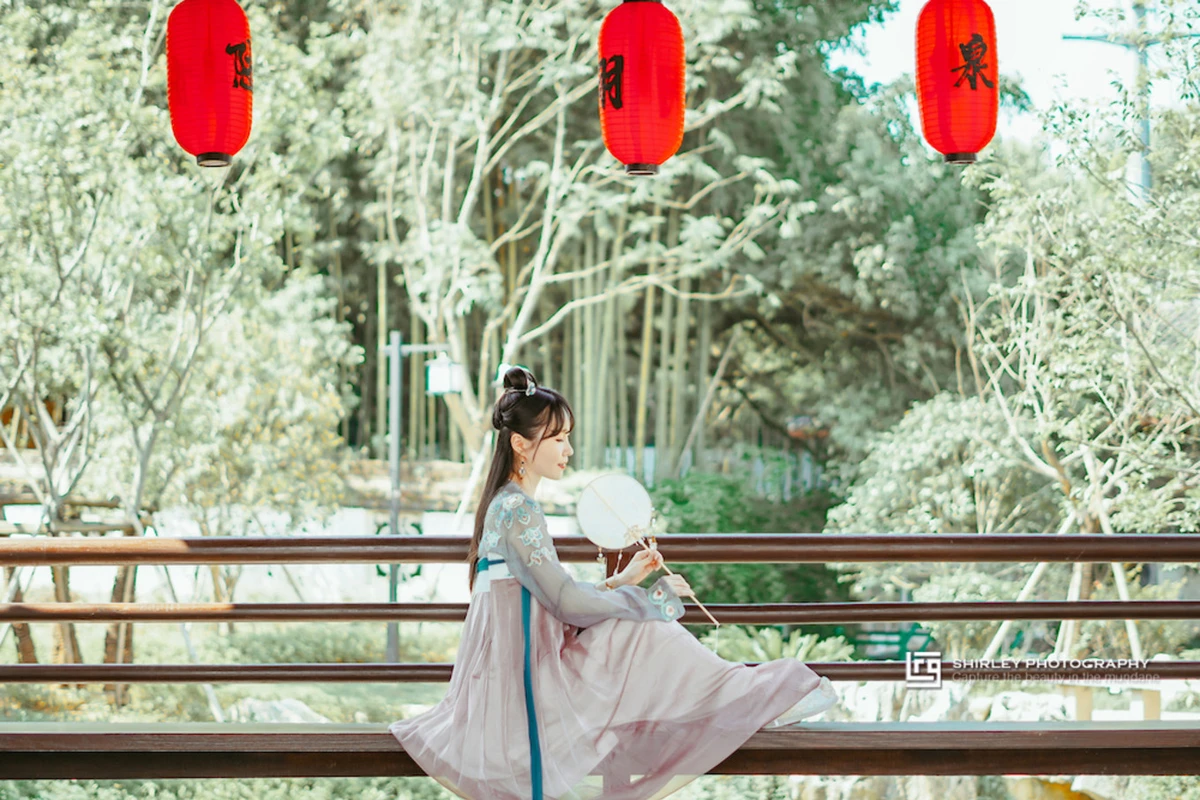
Without Hanfu, how can you talk about a classical garden tour? Perhaps all you lack for a truly immersive experience is a set of Tang-style Hanfu. Since the performers and staff are already in Hanfu, visitors naturally join in.
You see Hanfu enthusiasts everywhere on Hangzhou streets, and Luyu Spring Park also rents Hanfu and offers Tang-style hair and makeup. Because the park is new, many costumes are brand new with tags still on. As a Hanfu aficionado, I noticed that the outfits we picked came from well-known online original brands, so no worries about counterfeits—the quality concerns of fellow enthusiasts can be set aside. The park is truly sincere about Hanfu rental.
In a scenic area themed around Tang tea sage Lu Yu, nothing beats Tang-style high-waisted blouse and skirt. The service even includes Tang-style hairdos—a lifesaver for the clumsy-handed; no more early mornings struggling with your hair.
As a classical garden, there are countless Hanfu-photogenic scenes: the meirenkao (beauty leaning) under the eaves, lattice windows, archways, pavilions, and more. Bring some classical props, and you can shoot here all day. The winding corridor with custom red lanterns swaying overhead, each bearing the words “Lu Yu Quan,” was our favorite spot to photograph!
By the high walls and bamboo groves, there’s another sense of distant jianghu dreams. A cobblestone path leads into seclusion, lanterns flicker among bamboo leaves—there are always touching little corners that meet us unexpectedly.
—Recommend the most classic angles for Hanfu ladies to capture at Luyu Spring
Traveling in Hanfu has become a new fashion. Perhaps Luyu Spring Park in Jingshan, Hangzhou, will be your first or one of your Hanfu destinations. Now, a truly immersive classical garden tour begins.
Since it’s Luyu Spring, where is the spring?
According to Yuhang County Annals, where Lu Yu wrote The Classic of Tea, there was a clear spring. After arriving, Lu Yu dredged the spring mouth, making its water crystal clear. Thereafter, people came daily to fetch water and brew tea, and to commemorate his contribution, they named it 'Luyu Spring.'
Behind the white wall marked 'Third Best Spring under Heaven' is a round arched door, clearly separating it from the outer garden, and inside, a different world unfolds. An ancient camphor tree towers beside it, and there are two springs, one large and one small. The large one is rectangular, 2 meters wide on the south, 1.1 meters on the north, and 3.5 meters long from east to west. The name 'Luyu Spring' is inscribed in bold, vigorous strokes by the calligraphy master Sha Menghai.
Up close, the spring water is clear and jade-green, with fallen leaves rustling along its edges and creeping fig vines draping overhead—exceptionally tranquil. Through history, Luyu Spring has weathered many changes; it wasn’t rediscovered until the late 1970s, and after several renovations, it was preserved. In 1986, it was rated a Hangzhou City protected cultural site.
Beside Luyu Spring stands Tiaoxi Cottage, the former site where Lu Yu wrote The Classic of Tea. Inside, tables, chairs, a bed, and kitchenware recreate the simple living scene of the Tea Saint.
Standing outside the low bamboo fence, all was silent except for the wind. There was an illusion that the next minute, the thatched door would creak open, and Lu Yu, frowning, brush in hand, would slowly step out.
Inside Luyu Spring Park, there’s a two-story building called 'Hongjian Lou,' named after Lu Yu’s courtesy name. This modest yet elegant building brims with Jingshan’s memories of Lu Yu and tea. To study tea, Lu Yu traveled to famous mountains and rivers throughout the land, tasting the world’s teas and springs. Many places he stayed are now renowned tea-producing regions, and Jingshan is one of them.
The compact museum exhibition starts with 'Who is Lu Yu?' and moves to paintings and calligraphy about his life, using various display methods to introduce the legendary life of the Tea Saint in a simple yet profound way. I especially liked the new Chinese-style interior design: elegant, grand, yet textured and stylish, setting it apart from old, musty museums at first glance.
After Jingshan tea became famous in the Tang Dynasty, Lu Yu was drawn here. During his seclusion in Jingshan, he planted, processed, and researched tea, blending tea and Zen into one. It’s no exaggeration to say that without Lu Yu, there would be no Jingshan tea culture today.
Some exquisite details inside are enough to keep visitors examining and lingering for a long time.
Behind the circular lattice window at the far end of the first-floor exhibition hall stands a statue of Lu Yu in Tang robes, brush in hand, deep in thought. Perhaps a thousand years ago, he repeated this posture daily until The Classic of Tea came into being with earth-shattering impact.
The second floor is larger, introducing the origins and characteristics of teas from various regions, as well as displaying and explaining tea tools and utensils—a mini tea culture museum. Walking through, I felt almost transported back to the prosperous Tang era, where literati brewed tea and drank together, savoring life.
I photographed a small selection of tea-related vessels; every groove and line embodies the aesthetic of ancient life.
A trendy museum is incomplete without creative products. Since this place is linked to tea and Lu Yu, Luyu Spring Park’s most distinctive souvenir is the tea drink—“Lu Yu’s Brew.” The tea leaves naturally come from Jingshan, with flavors tailored to young people’s tastes. Bottled or cupped tea is also more convenient for outings. At lunch, we specially bought a 'World of Red Orange' drink—its base is the famous Jingshan black tea!
Stepping out of Hongjian Lou, Jingshan’s fresh air fills your lungs, along with a rich tea aroma. A few steps lead to another realm—Hangui Hall. Here, the most traditional and authentic Tang Dynasty tea boiling performance unfolds. Compared to whisked tea of the Song or steeped tea of the Ming, the Tang’s fashion was boiling tea, and Lu Yu famously boiled tea for Emperor Daizong.
The two tea artisans performing that day sat behind a tea table surrounded by landscape screens. The man wore a Tang round-collar robe with a leather belt and the classic futou headgear; the woman donned a high-waisted blouse and skirt with small floral patterns, her hair piled high. Their every move was a delight, like a vivid Tang miniature theater, separated from the audience by time.
When Tang people boiled tea, they first took out pre-stored tea cakes, roasted them briefly over a fire, then ground them in a mortar or mill into powder, sifted, and kept the fine powder in a tea box for later use.
They used a cauldron to boil water. When it first boiled, they added a little salt. At the second boil, they ladled out a scoop of water and set it aside, then added the tea powder to the boiling water. At the third boil, they poured the scooped water back in—called 'stopping the boil to nurture the essence'—and the tea was ready. So for Tang tea, 'boiling' was the very essence.
If you’re interested in Tang boiling methods, you can join a workshop at Hangui Hall and follow a teacher step by step—I think this is the most meaningful part of visiting Luyu Tea Park. I’d previously experienced Song whisking in Jingshan, and now trying Tang boiling felt like completion!
The tea utensils the teacher used were also extraordinary: recently reconstructed replicas of the 'Twenty-Four Tea Implements' based on artifacts unearthed from the Famen Temple crypt. The wind stove, gauze box, tea mill—all in gilt silver with flying phoenix patterns—were exceptionally ornate, proudly declaring their imperial origin.
The boiling experience for visitors is a simplified, easy-to-follow version. Tea cakes don’t need grinding; tea powder is already packed in small jars. Each person had three cups on the table—the teacher said one is for tasting your own brew, and the other two are to invite friends. This reveals much about the Tang character and their unique tea culture.
Tang tea boiling, aside from the elaborate and elegant ritual just demonstrated by the two artisans, has another feature: at the third boil, mint leaves and orange peel are added to the pot, while dates, walnuts, and other ingredients are placed in the cup. The hot tea is poured over them and drunk as 'eating tea.' This richly layered flavor is completely different from later dynasties’ tea culture.
A sip brings the uniquely Tang 'tea delight'; the aftertaste is a dream of the magnificent and sweeping Tang a thousand years ago. The unparalleled splendor of the Tang dynasty is all in this bowl.
A special 'recess'—Hangui Hall is also an ideal spot for Hanfu photos!
On the second floor of Hongjian Lou, there’s an elegantly arranged tea room where you can learn the Song Dynasty’s seven-step whisking method for tea, just like in the drama 'The Story of Minglan.'
Song’s Mengliang Lu records: 'Burning incense, whisking tea, hanging paintings, arranging flowers—these four leisure arts should not burden the household,' highlighting the four arts of refined Song literati life, elevating daily tea drinking to an artistic realm. The Song was a golden age for tea culture, when the whisking method became fashionable, dramatically changing Chinese tea ceremony.
Unlike Tang boiling, the whisking method involves placing tea powder in a bowl, adding a little boiling water to make a paste, then pouring in boiling water while whisking with a bamboo whisk until the tea and water blend into a creamy froth, sweet and mellow.
That day, a child came to learn whisking with the teacher. Whatever they absorbed, at least Luyu Spring Park offers children a window to traditional culture—something commendable.
Anyone who has tried whisking knows it’s not as easy as it looks; otherwise, Rulan in 'Minglan' wouldn’t have complained to her mother about the difficulty. Every step must be precise: the ratio of tea powder to water is crucial. Only a tiny pinch of powder, about the size of a fingernail, is used, while plenty of water is added in several pourings, fully whisked each time. The strength, direction, and even the contact between whisk and bowl require correct posture, patience, and care.
Only with a perfectly luminous, white tea froth can you create 'tea hundred plays.' This was the Song art of tea painting, using tea as ink to draw in the froth, much like Western latte art, but far more challenging. Using only tea and water, with just a small tea spoon—or even just the spout of a teapot—they could paint delicate patterns: a flock of birds, a solitary pavilion, or a few peach blossoms.
As the Zen saying goes: 'Drinking tea and practicing Zen are one flavor, one path—heart and mind connect.' When whisking tea, one must do so with mindfulness and a settled mind to achieve good color, aroma, and taste. Mindfulness is often the hardest part; with it, one can bring things to perfection, and only with mindful tasting can one find true flavor in the plain. Likewise, what we put our heart into in life yields the deepest savor.
Besides these experiences, Luyu Spring Park has set up many classic games loved by ancient people, enriching visitors' itineraries and adding to the immersive garden tour. In short, once here, don’t think of yourself as a modern person! Those wanting to try the games can get a 'passport' at the entrance ticket office, allowing them to experience three games: Flying Flower Puns, Pitch-pot, and Decorating with Floral Forehead Designs. Collect all stamps to exchange for a small gift!
Pitch-pot has appeared in many historical dramas, showing how much ancient people adored it. It’s a traditional Chinese ritual and banquet game, lasting from the pre-Qin to the late Qing, testing strength, aim, and the knack that comes with practice. Seemingly simple, it turns addictive after a few tries—you’ll understand why the ancients loved it.
That day was Mid-Autumn, so guessing lantern riddles, a seasonally limited activity, was naturally included. The custom has a long history in China, over 3,000 years, though often overlooked. After all, Chinese Mid-Autumn customs go far beyond moon-gazing and mooncakes! With so many beautiful and fun riddles at Luyu Spring Park, why not put your brain to work?
Floral forehead designs (huadian) were decorations ancient women applied on their temples, between brows, or cheeks, often in flower shapes. In the Tang Dynasty, designs varied far beyond simple circles. So after donning Tang-style Hanfu, adding a huadian makeup completes the authentic ancient look!
At night, lantern making showcased the ancient Mid-Autumn spirit and seemed to be the finale of the classical garden party. Through trial and error, you turn a pile of raw materials into exquisite, uniquely shaped lanterns. Such a Mid-Autumn night feels far more satisfying than watching a TV gala!
Though it looked simple, under the dim evening light, we really struggled to get the lantern into its proper shape. Once finished, I felt my hands-on skills had leveled up.
Many girls carried their just-made lanterns to the pond to set them afloat and make wishes. On the water, lanterns glimmered, casting hazy reflections under the hazy moon. Ancient life was both simple and vibrant, and modern visitors also get intoxicated.
In daylight, Luyu Spring is serene and fresh. At night, when lanterns are lit one by one, another scene unfolds. The upturned eaves are washed by landscape lighting, revealing the garden’s delicate beauty everywhere.
The nightscape design of Luyu Spring Park is the masterstroke of the whole garden, a fantastical and enchanting visual feast, a splendid sight under the night sky, and the most memorable moment of our full-day tour.
We were fortunate to encounter Luyu Spring Park on Mid-Autumn night, adding a festive warmth and joy to this usually elegant tea-culture park. After a day spent as 'ancient people,' dressed in flowing Hanfu, sipping tea, strolling the garden, praying, and moon-gazing, it was an unforgettable experience. The millennia-old tea culture, revived in the grand Tang atmosphere of Luyu Spring Park, grows ever more fragrant with time.
Address: No. 7 Shuangxi Zhuhai Road, Jingshan Town, Yuhang District, Hangzhou (near Shuangxi Drifting)
Transportation: By car—Hangchang (Yi) Expressway to Jingshan exit, then Pengchang Line to Zhuhai Road. Public transport—take the 'Play Yuhang Cultural Tourism Line 2' to 'Shuangxi Drifting' stop.
Tickets: Entry free, but experiences are charged. Below are the prices for each experience (during National Day holiday), for reference only.
Hanfu rental: 99 RMB
Hanfu + styling: 399 RMB
Tang Dynasty tea boiling: 99 RMB
Song Dynasty tea whisking: 68 RMB
Round fan making: 20 RMB
Passport (Flying Flowers, Pitch-pot, Floral Forehead Design): 20 RMB


