A Weekend in Jiande by the Xin'an River: Gazing at a Thousand-Year Ginkgo and Enjoying a Centuries-Old Tale — 'Clear River, Moon So Close'
The Qiantang River begins as the Xin'an River. And the Xin'an River was ancient Zhejiang. The murmuring Xin'an River rushes from the Tong and Fuchun rivers, surging for a thousand miles before becoming the mighty Qiantang. Over this vast watershed and through countless millennia, this river—Zhejiang—has nourished multitudes of beings on both banks, while generations of poets and scholars have left enduring odes along her shores. As ginkgo leaves fall, I ride the autumn wind to Jiande, midway on the golden tourism route from Hangzhou to Thousand Island Lake to Huangshan, upstream on the Qiantang, by the Xin'an River, to glimpse deep autumn.
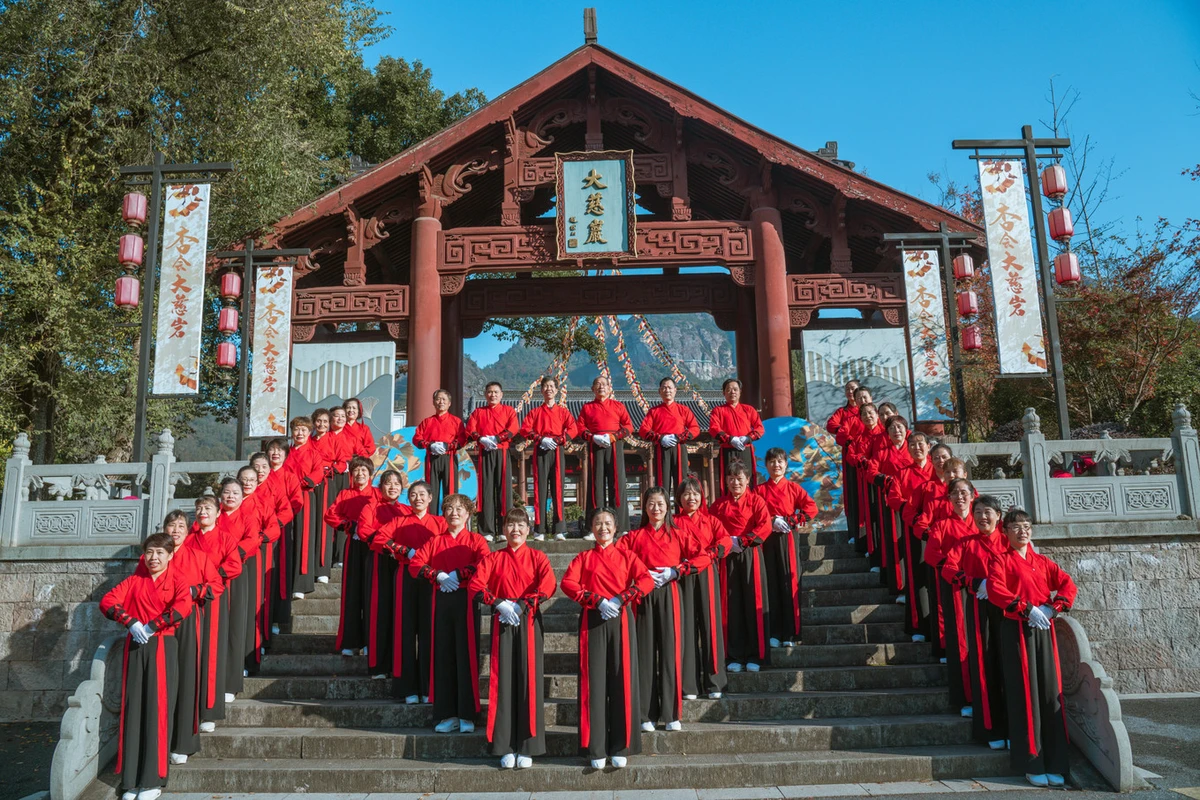
In Jiande there is a mountain called Daciyan. For autumn scenery, it is hard to find another place in Jiande that rivals Daciyan.
In the history of ancient Chinese architecture, there is a marvel: the hanging monastery. With astonishing wisdom and creativity, the ancients built awe-inspiring temples and walkways directly into the cliff face—half suspended, half embedded in the rock. Even looking up from below makes one’s legs tremble.
Even across the five-thousand-year expanse of Chinese civilization and its vast nine-thousand-mile breadth, such hanging temples are rare. There are ten in the north, five in the south, only fifteen in the entire country—a minuscule number compared to the tens of thousands of temples, monasteries, and shrines throughout China.
That ancient craftsmen could create wonders hundreds of meters up sheer cliffs, still astounding us today, is extraordinary. Each of the fifteen hanging temples is different, yet they share qualities of strangeness, suspension, and ingenuity. The closer you get, the more staggering they are. As the only hanging temple in East China, Daciyan’s hanging temple is over 60 meters higher than the famous one at Mount Heng.
Daciyan’s elevation is 586 meters—not especially tall, yet it is blessed with a spiritual beauty that echoes Liu Yuxi’s verse: “A mountain is famed not for its height but for the immortals who dwell there.”
The immortal here is a Buddha. On Daciyan there is a laughing double-faced gilded statue of Maitreya, seated among the mountains.
But the Buddha I speak of is not this statue, but Daciyan itself. The mountain is a Buddha; the Buddha is a mountain. Its main peak is rugged and majestic, its outline a remarkably vivid natural giant Buddha—face clear, features lifelike—untouched by human carving. According to the China Tourism Geoscience Research Association, Daciyan is the largest natural standing Buddha ever discovered in China.
Of course, here on the mountainside, the whole Buddha cannot be captured. The facial details can only be discerned from a distance. No matter; there is plenty to enjoy in the jagged, rock-strewn mountain scenery.
Stepping through the long plank bridge, climbing ever upward, the leaves on the hillside have not yet turned gold. The real autumn protagonist of Daciyan lies ahead.
The stream in sight flows from Jade Flower Lake in the summit valley. Mountain and water depend on each other—meandering into rivulets between stones, seeping into springs among rocks, or plunging as waterfalls over cliffs. Rushing or gentle, open or hidden, this stream winds 880 meters down from the peak, the loveliest scenery at Daciyan.
Climbing the cliffside stairs, the mountain wind howls in and fades out again, unrestrained and free.
Another autumn wind begins; leaves scatter all across Jiangnan.
One leaf falls and the world knows autumn. In the Xingxiang Study at Daciyan, the ancient ginkgo tree, over 700 years old, has again reached its season of falling leaves.
The most beautiful spring is among drifting cherry blossoms; the most beautiful autumn is amid swirling ginkgo leaves. Waiting for a gust of wind, golden leaves fill the sky—autumn cannot pause, sighing farewell.
Sunlight pierces gaps in branches, scattering dappled shadows, brushing softly against the cheek.
Looking up, half the sky is filled with golden ginkgo. This tree, as old as the hanging temple, has overlooked 700 years of Jiande’s history, its canopy now spreading like a great umbrella. The monk who planted it would never have imagined that today, this single ancient ginkgo could hold up half of Jiande’s autumn.
Pick up a ginkgo leaf, trace the veins like the lines of time. I remember you once said, when the ginkgo leaves fall, autumn has come.
The wind crosses mountains and water, brushes past, and echoes long in the open valley, like a profound farewell song.
Daciyan has not only cliffside walkways but also a glass walkway, connecting Feiyun Pavilion and Lotus Valley. In the middle, there is a viewing platform where one can gaze far at drifting clouds and the four seasons of the mountains.
**Night cruise on the Xin’an River, listening to the moon tell an ancient story**
For thousands of years, the ever-flowing Xin’an River has nourished countless living beings and stirred poets and scholars to leave moving legends and timeless verses.
Yan Ziling sits steady on his fishing platform, quietly observing the seasons; Li Bai extols the river’s clarity in verse, but the most profound poetic and philosophic moment is Meng Haoran’s “Spending the Night on Jiande River”: “Mooring the boat by misty islet, the traveler’s evening sorrows are new. Across the wilds, the sky presses low on trees; the river is clear—the moon comes close.”
Centuries have passed; that wilderness has grown into a modern city. The Xin'an River banks are now dappled with mesmerizing lights, the evening breeze intoxicating.
The misty sandbar beneath that old moon has become Xin’an River Moon Island. The island’s most enchanting attraction is the large-scale immersive live performance “River Clear, Moon So Close,” which lets the bright moon tell Jiande’s thousand-year-old poems and stories. Watching the clear river and bright moon through the mist, a moment stretches into a millennium—look back, and the world has changed.
**Scene 1: River – The Beginning of the Chase**
In primal times, Jiande was boundless wilderness. With a spring thunderclap, all life awakened, wild deer roaming freely through grass and trees. Primitive ancestors who once drank blood and ate raw flesh learned to make fire and use tools. This fertile land by the Xin’an River slowly became home to Jiande’s earliest people.
**Scene 2: Clear – Loving Mountains, Loving Waters**
Since ancient times, famed mountains have drawn hermits; Yan Ziling of the Eastern Han is among the most legendary.
Yan Guang, courtesy name Ziling, was a scholar of Huang-Lao Daoism, a man of letters, and a thinker, known as “Master Yan.” He hailed from Yuyao in Kuaiji. Renowned in his youth, he traveled to Chang'an to study and became a classmate of Liu Xiu, the future Emperor Guangwu of Han. After Liu Xiu defeated Wang Mang and took the throne, he repeatedly invited Yan Ziling to serve as an official, but Yan declined, hiding his name and retiring to Mount Fuchun for the rest of his life.
For centuries, Yan Ziling’s integrity in treating wealth and rank as fleeting clouds has remained a monument in the minds of literati. Fan Zhongyan, in his “Memorial for Master Yan’s Shrine,” praised him: “Clouds on the mountain so profound, water of the river so vast—the Master’s spirit endures like mountains high and rivers long.”
In the performance, Yan Ziling in a bamboo hat and straw rain cape fishes alone on the river, quietly observing the changing seasons and the wheeling stars and moon. His dialogue with an egret at the end captures the heart of a mountain-and-water hermit with piercing insight.
**Scene 3: Moon – A Road of Tang Poetry**
The southeastern terrain is exceptional; the Three Wu prefectures’ capital, Qiantang, prospered since antiquity. Misty willows and painted bridges, wind-shielded screens and emerald drapes, hundreds of thousands of houses. After the Tang dynasty, the region from Xin’an River to Qiantang River grew increasingly prosperous, especially after the Grand Canal was dug, making Yuhang a famous southeastern prefecture. The poetic waters and hills along the Xin’an were etched into Tang and Song lyrics. Zhejiang has two “Roads of Tang Poetry”: one by the Cao’e River and Mount Tiantai in eastern Zhejiang, the other along the Xin’an–Qiantang. The landscapes of field and stream are all found in the poems.
As Yan Ziling from the previous scene walks on, carrying his pole through the mist, he transforms into the High Tang representative of nature and landscape poetry, Meng Haoran. On the other side, the immortal poet Li Bai rides the wind and invites the moon; on the ground, pages of poetry flip open, lines of verse dance in the air like a hundred flowers blooming, step by step, lotus blossoms form. The background voice recites Meng Haoran’s “Spending the Night on Jiande River.”
**Scene 4: Near – Returning in the Wind**
Meng Haoran and Li Bai roam free. When they pass through a city gate, the scene shifts to panicked refugees. The performance enters its fourth act.
Now it is chaos: fires rage, the world in turmoil. A Huizhou merchant caravan stumbles miserably through the flames. Suddenly, a blaze lights up the wall ahead, and standing on the battlement is the doomed warlord Chen Youliang.
After Chen was defeated by Zhu Yuanzhang, his descendants and followers were banished by the Ming authorities to the banks of the Fuchun River, forced to live on boats for generations. Nine surnames were recorded, hence they were called the “Nine Surnames Fisherfolk.” Centuries slipped by; the former heroes and powerful dynasties eventually become but a handful of dust in history. Yet the Nine Surnames Fisherfolk lived on the water for generations, developing their own cultural traditions: dragon-boat bride-snatching, water weddings, and the famous Wujiapi medicinal wine. Their culture has been listed as national intangible cultural heritage.
**Scene 5: Person – Past Lives, Present Lives**
Everywhere, old legends are intertwined with beautiful love. The Nine Surnames Fisherfolk are no exception.
Drifting mist, wavering moonlight, the quietly flowing Xin’an River—how many joys and sorrows, how much laughter and tears have they witnessed? The Ming decree forbade the fisherfolk from entering any public place, marrying people on shore, or holding government office. In that age of feudal tyranny, countless heartbreaks and laments drifted away with the river’s eastward flow.
The love story of the Nine Surnames Fisherfolk presented in the performance is a miniature of human joy and grief along the Xin’an River over the centuries. And reassuringly, the ending is a happy one.
The ethereal natural setting and deep cultural history of the Xin’an River give this show profound richness. After the performance, gazing at the full moon, another poem came to mind: “Who by the riverside first saw the moon rise? When did the river moon first see a man? Life has passed from generation to generation without end; year after year the river’s moon remains unchanged.”
**Landison Hotel Jiande – By River and Mountain, Listening to the Sounds of Four Seasons**
“Strange mountains and strange waters, uniquely wondrous under heaven”—the Xin’an River rises in Huangshan, rushes seaward, etching countless mountains and waters across the Zhejiang landscape.
On Nanshan Road in Jiande, Hangzhou, sits the Landison Xinan Hotel: on one side, the murmuring Xin’an River; on the other, the lush peaks of Nanshan Park. Clear water and green hills could scarce be better.
On a small table, the authentic flavors of Jiangnan mingle on the tongue.
Luxuriously understated rooms, expansive balcony views, service that feels like coming home—every detail reveals the hotel’s thoughtfulness and care.
Wood accents and a clean wooden structure fill the room with a sense of time well aged—a feeling that perfectly complements the ancient city and the Xin’an River.
A quiet court amid hills and water, the sounds of four seasons. At night, gazing at the autumn moon from the balcony, a chill is already in the air. I long to ride the wind homeward, yet fear those crystal towers and jade halls, too high and cold to bear. Rising to dance with my own shadow—how can this compare to the mortal world?


