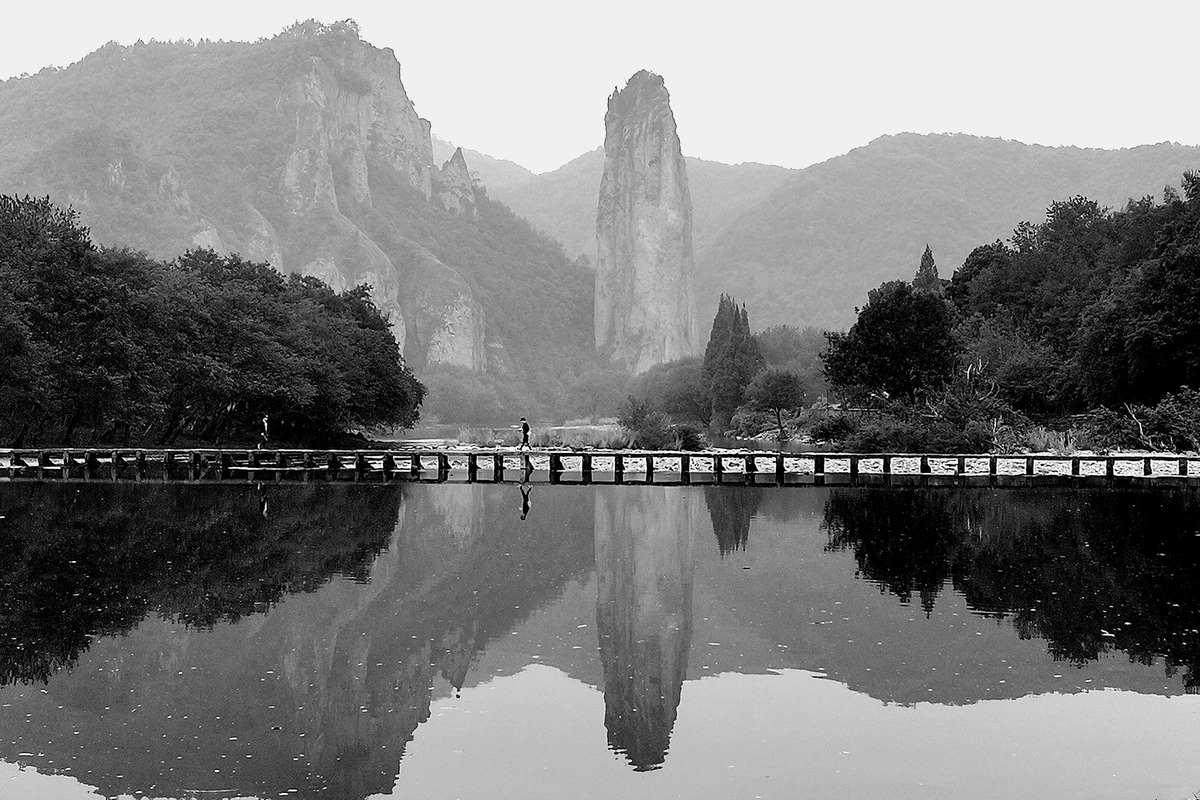
A Glimpse of Lishui's Emerald Mountains and Azure Waters
Lishui, in western Zhejiang, used to be difficult to get to, but now high-speed trains make it easy. In mid-October last year, with the pandemic under control, we took a trip to Hangzhou first, then continued on to Lishui.
Day 1 Shanghai / Hangzhou – Lingyin Temple
Day 2 Hangzhou: Zhejiang Library (Gushan branch) – Wenyuan Pavilion, Guo Zhuang, Pan Tianshou Memorial Hall, Qianjiang New City light show
Day 3 Hangzhou → Suichang: Tang Xianzu Memorial Hall
Day 4 Suichang → Nanjian Rock
Day 5 Nanjian Rock / Suichang: Gold Mine Park
Day 6 Suichang / Lishui: Guyuan Painting Village
Day 7 Lishui / Jinyun: Xiandu Scenic Area – Dingfeng Lake
Day 8 Jinyun: Heyang Ancient Village, Xiandu Scenic Area – Zhutan
Day 9 Jinyun → Shanghai
Suichang, Lishui, and Jinyun are all served by high-speed trains. The train from Suichang to Lishui takes a roundabout route, so we opted for a handy bus instead. Suichang's county bus station runs many services; besides intercity buses, there are also two daily buses to Nanjian Rock and several to the Suichang Gold Mine. These are rural buses where you buy tickets on board, not at the counter. From Lishui's high-speed train station to Guyuan Painting Village or from Jinyun's Xiandu Scenic Area to Heyang Ancient Village, public buses are sparse and time-consuming, so we used taxis or DiDi.
We stayed inside the scenic areas at Nanjian Rock, Guyuan Painting Village, and Xiandu; all the guesthouses were lovely.
In Hangzhou, Lingyin Temple is easy to reach: take bus #7 from the Children's Palace stop by West Lake and get off at Lingyin Temple. Inside the Lingyin Temple scenic area is Feilai Peak with its grottoes dating back to the Northern Qi Dynasty.
Lingyin Temple itself—
The bronze statue of the Living Buddha Ji Gong is a cultural relic, you know...
The stone pagodas and pillars are national treasures that miraculously survived the Cultural Revolution...
Lingyin Temple is vast, nestled among lofty peaks. The vegetarian canteens were closed due to pandemic rules, only selling a few pastries.
Day 2 Today we visited Zhejiang Museum (Gushan branch) near West Lake. Also catch the bus from Children's Palace: take #WE1314 to Baidi Causeway stop. (You can also stroll along the causeway to the museum.) By the edge of Gushan Hill and West Lake...
Zhejiang Museum (Gushan branch) is the old site; most of its collection has moved to the new museum outside Wulin Gate. We came mainly to see Wenyuan Pavilion, one of the seven original repositories of the Complete Library of the Four Treasuries.
The collection was scattered during wars, but after many hardships it was reassembled and stored at Zhejiang Library (a photocopy set is on display at Tianning Temple in Yangzhou). Wenyuan Pavilion's gilded roof enjoys royal prestige. There are other exhibitions too. We took bus #5 outside the gate to Guo Zhuang on Yanggong Causeway, getting off at Hangzhou Huapu stop.
A short walk brought us to this grand mansion of a scholar-official – a prime location right by West Lake.
Once a private residence, now it showcases flowers.
The garden is exquisite and comfortable,
cleverly borrowing West Lake as a borrowed scene, perfectly complementing each other...
The courtyard is tranquil, with pavilions winding gracefully.
At every turn, a new view unfolds, embracing the lake and mountain scenery. No wonder local retired folk adore it as a gathering place.
Guo Zhuang opened to the public only in 1991. The renovation deeply respected historical knowledge, inviting Professor Chen Congzhou, an expert in ancient architecture and gardens, to guide the restoration of this Jiangnan garden on Yanggong Causeway.
After Guo Zhuang, we planned to see Hangzhou's Drum Tower, which we hadn't heard of before. We took a bus along Yanggong Causeway for a few stops, then transferred to #315 and got off at Hu Xueyan's Former Residence. Let's first visit this famous businessman-official's home from the late Qing Dynasty.
The estate is huge, with large halls, including a nanmu wood hall. The garden décor is lavish, a different style from Guo Zhuang.
Across the street from the residence is a reconstructed Drum Tower, not a relic. The walking path behind leads to a preserved old street called Qinghe Fang. There are branches of time-honored restaurants; Hangzhou cuisine is not to be missed.
Qinghe Fang isn't too far from Pan Tianshou Memorial Hall on Nanshan Road. Because the nearby Wugong Square was under renovation, buses were rerouted, so we walked. Passing by a Confucian temple and through narrow alleys, we reached Nanshan Road and the China Academy of Art.
Right next door is Pan Tianshou Memorial Hall, converted from the former dormitory where the old principal and two professors once lived. Pan Tianshou was a master of Chinese painting who died during the Cultural Revolution. The surviving works on the second floor were donated by friends for this memorial.
His paintings are powerful and majestic – a master of Chinese landscape brushwork pouring out his passion...
The gate of the Art Academy is itself a work of art...
The adjacent art museum had several exhibitions. I saw how the woodblocks for printing are actually carved...
Hangzhou has expanded from the lake to the river, building a new city along the Qiantang River. On Tuesdays, Fridays, and Saturdays, there are two 20-minute light shows (19:30 and 20:30). Take Metro #4 to Citizen Center Station. After walking through a huge outlet mall, take the escalator up to the viewing spot – "City Balcony."
First there was the West Lake music fountain, then Impression West Lake, and now the Qiantang River light show – Hangzhou never stops expanding its tourism offerings...
The high-speed train from Hangzhou to Suichang is newly opened, taking just over an hour. But Suichang station is 10 kilometers from the city center. We took the bus from the station; there weren't many passengers yet, so service was infrequent, and the minibus was jam-packed. No wonder there were so many taxis at the station exit.
The city bus station is 600 meters from the Culture Hotel. As newcomers, we didn't know the hotel had a free shuttle cart. In the afternoon, we visited Tang Xianzu Memorial Hall in the city center – commemorating the man who served as Suichang magistrate for five years, promoting culture and earning a sterling reputation. The hall is a converted old residence of the Chen family.
Suichang has many attractions, and the bus station promotes local tourism... We chose two: Nanjian Rock and Suichang Gold Mine.
The bus station's tourism info gave us just the transport details we needed.
Day 4 After storing our big luggage at the hotel, we took the hotel's shuttle cart to the bus station, bought tickets on board, and caught the 7:30 bus to Nanjian Rock. It took a little over two hours. After passing Shilian Town, the road curved and wound through the mountains. The terminal is at the village entrance. Our guesthouse, recently renovated, was ready, so we checked in and set off on the mountain path.
From the village road, you can glimpse the innovative glass bridge at Nanjian Rock.
For visitors over 60: the bridge fee plus a half-price senior ticket came to 125 yuan per person. We entered at the visitor center, descended the steps toward the glass suspension bridge...
The terraced fields ahead would look different if they were flooded in spring...
The wind was strong on the bridge. Shoe covers protected both the glass and prevented slipping. The bridge swayed gently, adding charm to the misty valley.
Looking down, the paths wound up and down; we admitted defeat and just walked back and forth across the glass bridge.
The scenic area set up a photo spot called "Mirror in the Sky."
No sea of clouds at Nanjian Rock today – bad timing. The village street was lined with farmhouse restaurants; mountain produce was easy to find.
Day 4 Morning light in the little village
The guesthouse owner happened to be driving to town to pick up his older son from boarding school in the county seat. He kindly offered us a free ride straight to the Culture Hotel. After checking in, we took the shuttle cart to the bus station and caught a bus to the Gold Mine Museum Park. The bus passed two other sights on the way: the China Bamboo Charcoal Museum and Changlian Ancient Village. At the park gate, we bought tickets for the sightseeing cart and took route #2 to halfway up the hill. Going up leads to a Tang Dynasty mine; we only went down to see the Ming Dynasty site (reversing the usual route).
Entering the cave, we were told this was the Ming Dynasty mining vein... There was also a cave-in point and several ventilation shafts.
We rode the sightseeing train, converted from mine carts.
Then visited the Gold Mine Museum... According to the exhibits, Suichang Gold Mine was reopened in 1974 and mostly shut down a few years ago.
Maybe development isn't complete yet. If they created an industrial tourism route, the Gold Mine Park would be more vivid.
While waiting for the bus, a taxi happened by, so we took the comfortable ride back to the hotel...
Day 5 Suichang to Lishui is easy by road. The bus stops right at Lishui High-Speed Train Station, and the bus hub is in front. There are buses to Guyuan Painting Village (Dagangtou Town), but the 30-something-kilometer journey takes over two hours. To save time, we took a taxi.
Our guesthouse was right at the edge of town; a turn around the corner and we were at the scenic area gate. The farmhouse meal was good – stir-fried peanut sprouts, a local innovation, the owner's wife told us.
The Ou River divides Dagangtou Town in two. For visitors over 70, only a sightseeing boat ticket is needed. We first explored the ancient weir area –
The boat's first stop is "Ancient Weir Spring Dawn." After landing, we first saw Wenchang Pavilion.
Eleven millennia-old camphor trees survive here – truly rare...
The lanes are still paved with cobblestones.
Many art students were sketching...
The ancient weir, a 1,500-year-old mark of wisdom...
On the way back, a quiet bamboo grove path...
Then we took the boat back to the Painter's Village dock.
By the river are old buildings lining the commercial street...
Day 7 Early morning stroll by the river.
A landscape painting come to life, isn't it?
The commercial street was still "sound asleep."
At the street entrance is the Double Trees Pavilion, guarded by two centuries-old camphor trees...
After breakfast, we planned to take a high-speed train to Jinyun. We tried calling a DiDi to Lishui High-Speed Train Station but no car came – maybe too early. So we took bus K612 at the door. It made dozens of stops, but because it was early, the trip took only an hour or so (usually over two); just 2 yuan to the station – saving over 90 yuan...
The high-speed train from Lishui to Jinyun took about an hour. Jinyun High-Speed Train Station has a shuttle to Xiandu Scenic Area, about five kilometers away. Not knowing, we called a taxi, only to find taxis can't enter the scenic area. Visitors must take the sightseeing cart from the visitor center at the park entrance, but we didn't know which stop to get off at for the guesthouse, so we had the guesthouse owner pick us up. Our guesthouse was on Xuanyuan Culture Street, a commercial strip built for the scenic area. Guesthouses are everywhere, each with its own charm. Private cars can enter if the guesthouse informs the gate guard in advance.
Our guesthouse was mid-street, not far from Dinghu Peak. After checking in, we walked there.
The commercial street at the entrance of Dinghu Peak was bustling – perfect timing for a meal. The restaurant owner was excited and full of enthusiasm: visitors were back.
For over-70s, entrance is free, but sightseeing cart tickets (valid two days) still need to be bought at the ticket window.
The plank bridge over Hao Creek
Dinghu Peak, 170 meters tall...
Crossing the bridge, it turns into Thumb Peak
Yellow Emperor Xuanyuan Temple, rebuilt in 1994 after being destroyed during the Taiping Rebellion. Northern mausoleum, southern temple...
The ancestor of Chinese people – what's your surname? Where does it come from?...
The sky was drizzly and gray. We didn't climb further to the cable car station to take in the views. We hopped on a sightseeing cart back to Culture Street. At "Jinyun Shaobing Main Store," not only is the shaobing (baked flatbread) the best, but there are many other Jinyun dishes...
Day 6 In front of Culture Street is Hao Creek, which runs through the scenic area.
By the river is a greenway – a path for cycling or walking, lined with camphor forests planted since the 1950s...
After a meal, we took the shuttle bus to Zhutan Mountain; it loops through the scenic area.
Standing midway on the bridge, the flowing water gurgled swiftly...
Wangfeng Pavilion...
Looking at the distant stone spire
Thick morning mist – this is the scenic area's signature image.
A restful stroll along the bank, then we took the bus back to the visitor center at the main gate. A DiDi came quickly and took us all the way to Heyang Ancient Village...
With a map in hand, we wandered. Few visitors, thanks to pandemic restrictions.
A large clan, with many remaining ancestral halls.
Also structures for family instruction.
Exquisite wood carvings are everywhere.
Horse-head walls – a hallmark of Huizhou style
People still live here. Residents told us the old houses can't be altered at all, but couldn't protective renovation add some modern convenience?
Huizhou-style poetic drama...
On the commercial street, only elderly folks were minding the shops...
Back at the main gate, we saw direct shuttles to Jinyun High-Speed Train Station.
We called another DiDi, returned to the visitor center, and went back to Culture Street for another meal at the shaobing main store. Then we took a bus to Little Red Cliff...
Huge boulders lie in the river – probably original forefathers of the mountain, then split. How many years must that cleaver-like rock have endured?
Looking up at the Red Cliff...
We passed through to Big Belly Rock... but didn't climb to see another site – Xiandu Temple.
At the intersection was a sightseeing cart stop, so we rode to Zhutan Mountain again. The sky seemed to clear a little...
This was where Zhu Xi lectured; it couldn't be without an aura of wisdom...
October 20: The river channel in front of our street. With time to spare before departure, we took another leisurely walk.
This is just a short stretch of the scenic area's greenway –
We ran into a farmhouse owner busy in his own fields. Visitors had returned, and his place was bustling too, hoping to reap a few more buckets of grain to make up for pandemic losses...
The guesthouse owner kindly took us to Jinyun High-Speed Train Station. The train zipped through Jinhua and Hangzhou...
Lishui, with its emerald mountains and clear waters, is well worth exploring...


