Where to Celebrate Chinese New Year in Hangzhou: Seeking the Taste of New Year in Jiande, Love at 17 for a Grand New Year
The 2021 Chinese New Year was still a bit special. In this season of biting cold yet lingering warmth, many chose to celebrate where they were. I had been in Hangzhou all along and thought of taking a trip nearby. I had wanted to visit Jiande since the previous year, so my partner and I set off together. While capturing beautiful scenery, we also got an early taste of the strong festive atmosphere already filling the air here.
Day 1: Hangzhou self-drive – Jiande Museum – Meicheng Ancient Town – Kaiyuan Fangcaodi Village Hotel
Jiande isn’t far from downtown Hangzhou. After about an hour and a half of driving, we arrived at our first stop—Jiande Museum. As the saying goes, when visiting a new place, start with a museum; it's a magical place to quickly understand the local culture. Though not as profound as immersing yourself in the customs over time, it’s certainly more systematic and thorough.
My first impression of the Jiande Museum was its liveliness. The architectural design is said to be based on the concept of 'unity between man and nature,' aiming to authentically reflect Jiande’s natural evolution, history, culture, and social landscape across all dimensions. The exhibition area covers nearly 10,000 square meters, about half of the total floor space.
To let everyone spending the holiday in Jiande feel the warmth of home, the museum set up a stage in the exhibition hall and specially invited performers from the Wuju Opera troupe to present folk tales, Kunqu, and Yue opera brimming with local color and rustic life. Though we weren’t familiar with Jiande, watching their performances gave us an instant sense of Jiande’s cultural heritage and homegrown charm.
But since we came to get a head start on the New Year flavor, the top priority after sightseeing was to try the local food. After all, when you eat well, you have energy for anything, and delicious cuisine makes the scenery even more enchanting. So after leaving the museum, we compared several options and settled on lunch at Zhangshudi Restaurant. With a lucky-dip kind of anticipation, we ended up having an amazing culinary experience. Following the waiter’s enthusiastic recommendations, we ordered the house specialties to try.
Zhangshudi Restaurant is famous for its authentic Jiande home-style cooking, and after tasting it, we couldn’t help but praise the delicious local dishes. We had long heard that the sliced black fish here is unforgettable, and it certainly lived up to its reputation—beautifully plated, irresistibly appealing, the fish was silky and flavorful, with not a hint of fishiness, just a delicate savory-sweet freshness. The three-yellow chicken was tender with exceptional flavor. The restaurant’s salt pork tofu, stir-fried beef, and triangular dumplings were also excellent value, truly dishes that delight both the eye and the palate.
The afternoon sun grew warmer, lifting our spirits. Having long heard that the 'Half-Plum-Blossom City' boasts a thousand-year history, we took this opportunity to visit Yanzhou Ancient City. Despite its age, Yanzhou Ancient City is understated. I remember a book titled Yanzhou Ancient City – Meicheng; this ancient city, together with Meicheng, has retreated into the mists of time, offering every visitor a sense of serenity and dignity.
This was originally the seat of Yanzhou Prefecture, established in the fourth year of Wude in the Tang Dynasty. After the Muzhou government moved here in the second year of Wansui Tongtian during the Wu Zhou period, it was renamed Jiande Prefecture. Then, in the eighth year of Longfeng, Zhu Yuanzhang changed it from Jiande Prefecture to Yanzhou Prefecture. The ancient Yanzhou city wall is the best testament to this history. The location sits at the confluence of three rivers, evoking the poetic beauty of 'open fields, the sky lowering the trees; clear river, the moon drawing near.' Standing beneath the wall, you can take in the full expanse of mountain and water. The battlements are shaped like plum blossoms, and the gate tower bears the name Yanzhou.
The Tang dynasty poet Li Bai once wrote: 'The clear stream cleanses my heart, its water unlike any other. Tell me, Xin’an River, how can you be so transparent? People walk as if in a bright mirror, birds fly as if through a painted screen. At dusk the gibbons cry, in vain grieving for the far-flung wanderer.' Today, centuries later, Yanzhou Ancient City still stands where three rivers meet, but perhaps the wanderers are no longer so forlorn.
Today, the Xin’an River hosts a major hydropower station that holds a special place in China’s modern history, and the loneliness on the clear stream has been replaced by prosperity. Corn cakes, stinky tofu dumplings, dried mustard green baked buns, Granny’s rice cakes—these are all local snacks here. Wandering hand in hand with my partner through the quaint, lively streets in search of tasty treats, time seemed to slow down against this poetic landscape, adding a unique stroke to the canvas of life. As dusk fell, the red lanterns glowing in the twilight made me wonder if a thousand years ago the New Year here was just as bustling.
In Yanzhou Ancient City, the most memorable thing is the snacks—not only delicious but each with its own story. For example, the baked flatbread here takes crispiness and flakiness to the extreme; it’s said to be a local Jiande specialty called Yanzhou shaobing, carrying on a tradition just like the ancient city itself. Then there’s the savory tangyuan, created long ago by the wife of a scholar in Yanzhou. Because of its unique salty flavor, different from other tangyuan, it has been passed down and can only be enjoyed here as Yanzhou salty tangyuan. Locals say the breakfast options are also extensive, leaning towards salty and spicy, with delicious oil-dipped rice dumplings, distinctive tofu buns, and round meatballs symbolizing reunion...
After spending the day sightseeing and eating, our fondness for Jiande’s cuisine had grown immensely. Dinner was a perfect end to the day. Not too far away, we went to Muzhou Restaurant, the top-rated local eatery in Meicheng Town, for some homestyle dishes. I had actually picked this spot earlier while planning our little trip; many visitors to Jiande come here, and after tasting the food, we could see why it’s so highly rated. The restaurant isn’t large, but its architectural style blends nicely with Yanzhou Ancient City. It’s a time-honored establishment where every dish is made with care, and the service is warm. The braised duck was rich and savory, the boiled chicken just right, and the fish head tofu soup fragrant and delicious. If you visit Jiande for the New Year, be sure to try these dishes.
Before we knew it, night had fallen, but Jiande’s evening had a unique charm. From the lanterns in the ancient city to the neon lights along the roads, the New Year atmosphere had quietly crept into the city, bringing, on this cold winter night, a sense of hope that only Chinese people truly understand.
We chose to stay at Jiande Fuchun Kaiyuan Fangcaodi Village Hotel. The hotel is at 88 Yandongguan Road, Meicheng Town, 18.5 kilometers from Jiande Station, about a 27-minute drive. It's conveniently located for nearby attractions, with plenty of price options and complete facilities.
Depending on the room, you can enjoy different views: river, mountain, garden, or treehouse. The pristine environment paired with modern amenities provides a home-like experience while maintaining the elegance unique to Jiande’s landscape. The hotel offers wake-up calls and a special breakfast, with 24-hour lobby and concierge services ensuring a VIP experience. The current decorations also have a nice New Year’s feel. After a soft awakening and breakfast, we headed to the nearby Qili Yangfan Scenic Area, kicking off another day of flavor-seeking.
Day 2: Qili Yangfan – Sandu Nine-Surname Fishing Village – Strawberry Town – Shouchang 909 Food Street – Aviation Town Hot Spring Hotel
As the first stop on day two, the Fuchun River Qili Yangfan Scenic Area is a key part of the Fuchun River–Xin’an River–Thousand Island Lake National Scenic Area. Known for its 'green mountains, clear water, long history, and secluded atmosphere,' it represents the essence of the Fuchun River and is often called the 'Little Three Gorges.' We took a boat to the island. The riverside was cold in winter, but it carried a mood of 'boundless sea, a light boat beyond the world.' The spectacular mountains and waters are truly unique. Here you can genuinely experience the promise of 'sail by boat through Qili Yangfan; hike the gorge to see Hulu Waterfall; climb the ancient pagoda to appreciate Yanling culture; enter the fishing village to savor a fisherman’s feast.'
Besides admiring the beauty, there’s a riverside swing for an adrenaline rush—great stress relief—and a zipline across the river for speed and thrills at every step. It’s no wonder this is one of the historic 'Eight Scenic Spots of Yanling.' It’s worth noting that Qili Yangfan has two boat piers: one at Qiantan Town and another at Meicheng Tourist Pier. Most people use Qiantan, but if you want to visit Meicheng and the Fuchun River in one go, the Meicheng Tourist Pier is the best choice.
Jiangnan Secret Land International Resort, centered on 'nature, art, and life,' lies in the 'Two Rivers, One Lake' National Scenic Area east of Jiande. We visited the Qili Yangfan Zixu Ferry site. The landscape here is not just mountains and water but something more; in a place like Jiande rich in natural layers, the local customs are equally fascinating.
Sandu Nine-Surname Fishing Village is a place that perfectly blends Jiande’s topography with its unique human warmth. The Nine-Surname fishermen have lived on the water for generations, so their wedding customs are infused with aquatic features. We were lucky to witness a fisherman’s water wedding; the entire celebration was joyous and fervent, and we were deeply moved by its pure, heartfelt sincerity. The water has its own tenderness, and the people their romance. After watching the water wedding, you can also join locals in pounding glutinous rice cakes (ciba) to prepare for New Year’s fare. I rarely get the chance to experience such rustic, handmade food production, so this was a perfect opportunity to get a taste of the festive spirit.
What’s also notable is that besides wedding customs, the Nine-Surname Fishing Village has a unique food culture. Legend has it that at the end of the Yuan Dynasty, after Zhu Yuanzhang defeated Chen Youliang, he banished the families of nine generals surnamed Chen, Qian, Lin, Li, Yuan, Sun, Ye, Xu, and He from the land, forbidding them from living ashore—hence the name 'Nine-Surname Fishermen.' To commemorate them, later generations incorporated the nine surnames into dish names, creating the 'Nine Surnames, Nine Dishes' all-fish feast. Perhaps because they live by the water, no matter where you go in Jiande, the restaurants excel at cooking fish.
Time flew by, and only the last half-day remained of our two-day trip. With so many interesting places still unvisited, we had to pick the best. After lunch, we quickly drove with my partner to the most anticipated stop of the journey—Strawberry Town. To pick 'sky strawberries,' embrace fresh living, and soak in romance and sweetness.
Picking strawberries in winter is a delight in itself. Jiande Strawberry Town, located in Yangcunqiao Town, Jiande City, Hangzhou, is a digital farm that uses an 'agricultural brain' to create a digital platform for the strawberry industry. Thanks to advanced technology, the town has also given local strawberry farmers more reason to stay put for the New Year. The town is right by the Hangzhou-Huangshan High-Speed Rail Station and the Hangzhou-Xin’an River-Jingdezhen Expressway Yangcunqiao exit, covering an area of 3.33 square kilometers. Its architectural style is simple and fresh, with a dominant theme around 'strawberry' and 'Jiande,' plus a strawberry festival and a host of events.
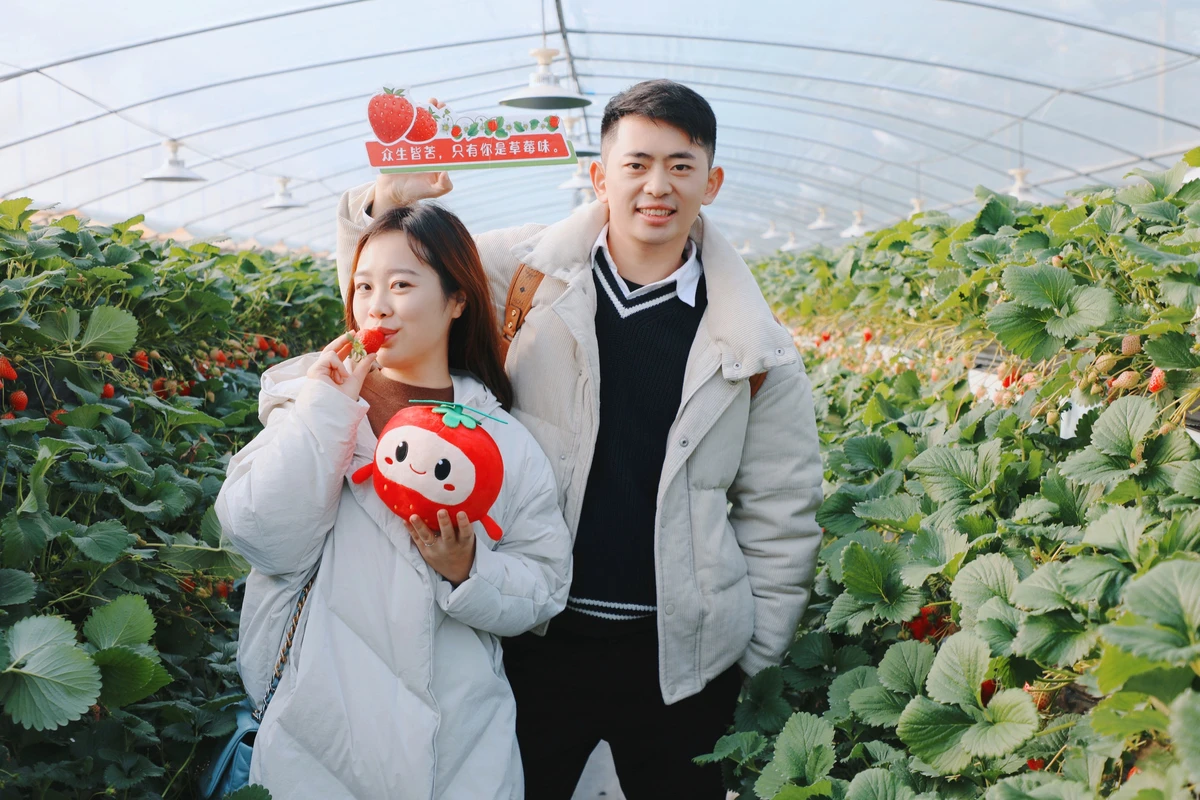
Upon entering the town, the cute red-and-green color scheme and the fragrance of vast strawberry fields lend a hint of sweetness to the winter. That sweet taste is the New Year flavor in Strawberry Town. There are a strawberry mobile castle, Strawberry Town signposts, a stone gate proclaiming the Home of Strawberries, a Strawberry Smart Forest, a Strawberry Technology Corridor, a Strawberry Time Tunnel, and a Strawberry Sky City, filling the air with strawberry scent. But we found the most fun part to be the strawberry-picking area. Strawberries, white, red, or bi-colored, dangle playfully from the plants. For a foodie, picking and eating at the same time is the ultimate happiness. Life is bitter for all, but you are strawberry-flavored.
Jiande is one of the first counties in China to develop large-scale greenhouse strawberry cultivation, earning the reputation as the 'Home of Strawberries in China.' Visiting Strawberry Town today truly made us understand why the strawberry is a 'golden calling card' for Jiande. The strawberries we picked had a rich aroma, tender flesh, and abundant juice; one bite released a sweet-sour burst that lingered, irresistible. We hadn’t planned to stay long, but the strawberries were simply too delicious—just that pure, natural fragrance and sweetness, neither too sour nor sickly sweet. The more we ate, the more we wanted. So we lingered, playing and eating, for quite a while. If we get another chance to visit Jiande, we’ll definitely return to Strawberry Town; it’s perfect for couples.
After leaving Strawberry Town, we unexpectedly found ourselves in another culinary paradise—Shouchang 909 Food Street. Jiande’s snacks are always so good; we practically ate from dusk till dark, trying tofu buns, Shouchang fried noodles, soul-stirring beef hooves, lamb bone soup, and specialty barbecue… Even when we were completely full, we still craved more. Amid this world of food and cheer as the New Year approached, we savored a one-of-a-kind Jiande festive flavor.
Strolling through Shouchang’s snack street, only one thought remained: Jiande locals are so lucky! I had thought tofu buns were only available at breakfast, but here they were in the evening market too. Silky white tofu filled the buns, topped with red chili and green scallions—a clever blend of colors and flavors. No wonder so many rave about Jiande’s tofu buns. The old-style pastries, just the right sweetness and so homely, paired with a milk tea, make a sweet-toothed New Year’s dream. Along the street, fried rice noodles, assorted hot pots, claypot rice, stir-fried meat… the dazzling array made us wish we had extra stomachs to try it all again. Every little shop had that Jiande feel, and everything was delicious!
Shouchang, like Yanzhou, is a millennium-old town, having been established as a county during the Three Kingdoms period by the Wu Kingdom and continuing ever since. The ancient street centered on Huitong Bridge intertwines water and history. The Shouchang River beneath the Zhuangyuan Corridor Bridge would surely be more graceful in summer, but the approaching New Year in winter adds a brushstroke of ink-wash sentiment. Shouchang Town is in southwestern Jiande, near Daciyan, Xuankong Temple, Lingqi Cave, Aviation Town, and Xin’anjiang Jade Hot Spring. I had visited Daciyan Xuankong Temple before; built according to the Taoist principle of 'not hearing the crowing of roosters or barking of dogs,' it features architectural marvels of 'oddness, suspension, and ingenuity.' From a distance, it looks like an exquisite relief carving wedged into the sheer cliffs; up close, it seems ready to soar into the sky.
The food street we visited is in Shouchang Ancient Town itself. Though Shouchang Ancient Town is a lesser-known gem near Hangzhou, its food is anything but niche, and its streets blending old-world charm with modernity are just as remarkable. Especially after dark, when the stall lights and street lamps glow together, reflecting the steam of freshly cooked food in the cold winter air, you can’t help but feel this is the true taste and warmth of life.
Reluctantly leaving the snack street, we headed to Xin’anjiang Jade Hot Spring and Aviation Town, planning to rest there.
The distinctive Aviation Town is right in Shouchang, with a train-themed hotel, airplane-themed restaurant, and more. Here you can also experience skydiving, helicopter rides, hot air balloons, model aircraft flying, and other activities that have been carefully designed to brim with New Year cheer. Xin’anjiang Jade Hot Spring is on Hengshan Road in Shouchang, very close to the spots we visited that afternoon. By the time we arrived, it was night, and the day’s fatigue was gently washed away in the warm spring waters fragrant with flowers under the starry sky. Closing my eyes in the pool, I suddenly felt that everyone spending the holiday in Jiande is extraordinarily lucky; such a hot spring may be enough to melt a whole year’s weariness.
Our flavor-seeking journey in Jiande was fulfilling but not tiring. We found the heartfelt warmth of the New Year on the museum’s specially built stage for Jiande residents, the deep-rooted tradition in Yanzhou Ancient City’s history, the sweet delight brought by technology in Strawberry Town, and the joyful spirit in the wonderful spots of Shouchang Town.
After all, the place where the heart finds peace is called Xin’an; a peaceful heart is its home. As long as you’re with love, the rivers flow long and every day is full of flavor. Spending the New Year in Jiande, eating, drinking, and enjoying yourself, will be a beautiful and delicious affair.


