Beyond West Lake in Hangzhou: A Two-Day Tour of Yuhang
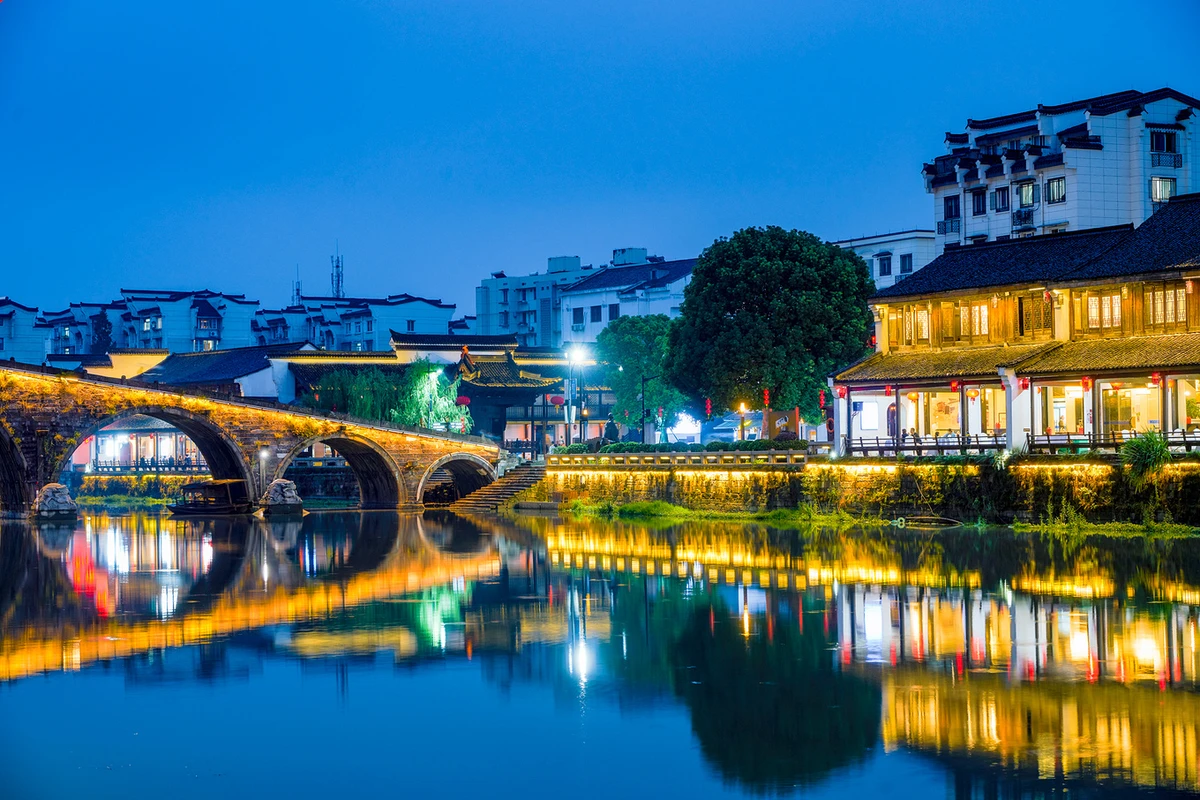
The only surviving seven-arch stone bridge on the Beijing-Hangzhou Grand Canal stands in Tangqi. Built in 1498 during the Ming Dynasty, it has endured for over five centuries, making Tangqi a shining pearl along the historic waterway.
The ancient town is compact, taking just about an hour to wander through. Two local pastry shops greet you right after the bridge, and further along, you'll find a square-cake shop. The zongzi (sticky rice dumplings) here are also excellent.
The Qianlong Imperial Stele is also on Shuibei Street—worth a look.
Located in Yuhang, Tangqi Ancient Town marks the starting point of the Hangzhou section of the Grand Canal. The canal cuts through the town, flanked by old-style houses and linked by ancient bridges. Tangqi is famous for its loquats and traditional pastries. Every late May, when the loquats ripen, the town bustles with visitors, many from Hangzhou, coming to savor the fruit.
The town is an open area; strolling the old streets is free, with only a few sites charging admission. The highlights are genuine relics: Guangji Bridge spanning the canal, Qianlong Imperial Stele, Guo Pu Well, and the Canal Granary Museum—the museum is stylishly curated.
Shuibei Street and Shuinan Street along the canal are the main visitor areas. Shuibei boasts more landmarks: Tangqi Shuibei Granary, a Christian church, and the notable Qianlong Stele.
Across Guangji Bridge, Shuinan Street and its surrounding blocks teem with snack shops, cafes, and Hangzhou-style eateries—perfect for leisurely bites and browsing. Local confections like mung bean cakes and Lixia (Start of Summer) cakes are the most renowned; many old Hangzhou residents still make a special trip to Tangqi just to buy them. During loquat season, fruit vendors pop up everywhere, even at the market by the bridge. The priciest white-flesh loquats go for about 12 yuan a pound.
Since ancient times, Chao Mountain has been a prime plum-blossom destination, easily accessible just over ten kilometers from downtown.
Its plum blossoms are famed for being ancient, abundant, and extraordinary. The oldest trees date back to the Tang and Song dynasties. While ordinary plum blossoms have five petals, some here boast six—perfect for brewing a fragrant, refreshing plum tea.
On the mountain, Yimei Shanjü (Remembering Plum Cottage) offers a varied menu with artful presentation, a good choice for lunch.
Jingshan Mountain, in Jingshan Town of Yuhang District, is a northeastern peak of the Tianmu Mountains. Two winding paths coil up to Tianmu, giving the mountain its name. Ancient woods tower, bamboo groves cascade, springs gurgle, and mist swirls—a serene, majestic retreat for summer escapes.
Jingshan boasts two superlatives. First, the ancient Jingshan Xing Sheng Wan Shou Chan Temple, founded in the Tang Dynasty, was ranked first among the “Five Mountains and Ten Monasteries” of Jiangnan Buddhism in the Southern Song, earning Jingshan the title “Number One Mountain in Jiangnan.” The temple flourished in the Song and is the ancestral home of the Rinzai school of Japanese Buddhism. Second, the renowned “Jingshan Tea Ceremony” is said to be the origin of the Japanese tea ceremony.
The Tang Dynasty temple was built in 742 AD (first year of the Tianbao era). Legend says Master Faqin settled here, was honored as “National First Chan Master.” At its peak, halls and pavilions abounded, housing 3,000 monks and hailed as the “Foremost Chan Temple of the Southeast.”
Fine tea, pure spring water, and boiled bamboo shoots are Jingshan’s three treasures. Jingshan Cloud Mist tea is nationally celebrated. Jingshan also has a long friendship with Japan; it is the founder’s hall of Rinzai Zen, and the Japanese tea ceremony traces back to the Jingshan Tea Ceremony. Northeast of Jingshan, Shuangxi also produces top-grade tea. Legend has it that Lu Yu, the Tang tea sage, studied tea here while writing The Classic of Tea, and Lu Yu Spring still remains.
Yishang Town is a fashion-focused hub, built around the garment industry. It consists of four zones: East Lake Culture and Art Center, Fashion Culture Block, Fashion History Block, and Fashion Art Block.
Here you’ll spot many top designers and stylish young people, some coming to shop. As a production base, clothing is relatively inexpensive with generous discounts.
Yuhang Grand Theatre is a large public cultural venue in Yuhang District, Hangzhou. It houses a 1,200-seat main hall, a 500-seat small theater, and an exhibition center. Now an internet-famous building, it draws many visitors for photos.
Set by and seemingly through the water, the theatre features a unique cracked-ice facade and a sloping roof, resembling a ship from afar.
Just outside is East Lake Park, and it’s right next to Yishang Town—if time allows, you can easily stroll both spots, very relaxing.
Lang Lang’s piano is still inside the theatre; with luck, you might even see it!
Liangzhu Ancient City Ruins, dating back roughly 5,300–4,300 years, lie in Yuhang District, Hangzhou, Zhejiang Province. Set on the river-net plain at the eastern foot of the Tianmu Mountains in the lower Yangtze River and Lake Tai region, it is a major representative of early Chinese regional civilization. As the political and ritual center of Liangzhu culture, the site features a massive city, a sophisticated peripheral water conservancy system, hierarchical burial grounds (including altars), and unearthed jade artifacts symbolizing belief and power. It fills a gap in the World Heritage List for Neolithic urban archaeological sites in East Asia and provides unique testimony to China’s 5,000-year civilization, thus hailed as the “sacred site that proves China’s five-thousand-year civilization.” On July 6, 2019, the Liangzhu Ancient City Ruins were inscribed as a World Cultural Heritage site.
Liangzhu Ancient City Ruins Park, located in Pingyao Town, Yuhang District, covers about 14.33 square kilometers and includes the city site area, Yao Mountain site, and the outer water conservancy system within the heritage zone.
The city site area is the park’s core, with a concentric triple structure of palace area, inner city, and outer city, traversed by ancient waterways. The palace area occupies the highest ground at the center—the main residential and activity hub of the highest ruler. Around it, the inner city holds tomb sites, residential (including craft workshop) platforms, and ancient river channels.
The park also introduced deer; the deer enclosure is spacious, letting you feed them without leaving the country.
At the foot of Jingshan Mountain lies the Lu Yu Spring Cultural Theme Park, built to honor the tea sage Lu Yu and explore his legacy. A spring here was used by Lu Yu for tea; you can also experience tea brewing on-site.
If you visit Tangqi and want to stay overnight, consider Tangqi Renjia Inn on Shuinan Street. Once the town’s largest pawnshop, it’s now a guesthouse with an impressively vast interior—a treat for lovers of ancient architecture.
Wang Yuanxing is a well-known time-honored restaurant in Tangqi, serving both traditional and innovative dishes with great flavors. Located on Shuinan Street, it offers lovely views of Shuibei Street from its windows. The second floor has private rooms, while the ground floor mixes large and small tables.
In this tiny ancient town, two branches of Wang Yuanxing have already opened—a sure sign of its booming popularity.


