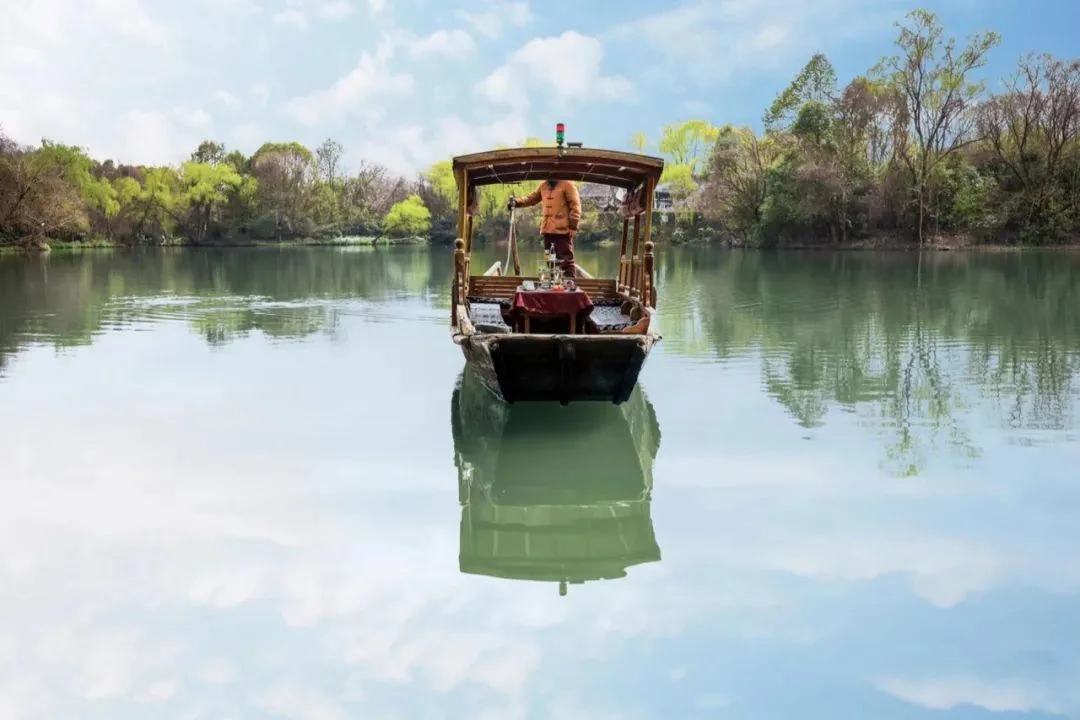
The Best of Hangzhou: A Food & Drink Writer's Water Tour of West Lake
[West Lake]
What is West Lake like in spring?
Xu Xian knows that spring rain is like wine,
and Lady White Snake knows that willows are like mist.
Whenever a good friend comes to Hangzhou, I always suggest brewing some Mingqian Longjing tea and joining me for a trip around West Lake, a trip back to "my childhood."
Sunny West Lake is not as good as rainy West Lake, and rainy West Lake is not as good as misty West Lake. Few out-of-town friends have braved the chilly wind to experience West Lake the way ancient literati and poets saw it, but those who have all exclaim it was worth it.
When comparing West Lake to Xi Shi, it should be like a bud, half-hiding its face, quietly waiting to bloom.
Gazing from the boat's side, the misty rain blurs West Lake, as if in an ink wash painting with a touch of cyan and gamboge, then dots of rouge—those are crabapple blossoms. Lucky the crabapple has no fragrance, or Su Shi might not have praised it: "A charming smile among bamboo fences, while peaches and plums everywhere seem coarse."
Personally, I don't like a West Lake full of song and dance. The West Lake of my memory has light and shadow, sparse and dense elements, and a natural, unadorned space. In autumn and winter, the lake has the texture of a Song Dynasty painting, with sophisticated yellows everywhere—I’m not worried about that. But even in spring and summer, the colors must be vivid yet unsaturated to be beautiful.
In spring, West Lake can truly resemble Lin Fengmian's "West Lake Scenery"; in summer, it seems like Guan Zilan's Republican-era painting "West Lake." Charter a pleasure boat, and I really feel like I'm traveling within a painting. After disembarking, it’s even better if you can find a cozy restaurant or teahouse to soothe body and soul!
I, this old lady, have carefully selected three exquisite Hangzhou routes that are both "a feast for the eyes" and "edible"—all reachable by boat.
Beishan Road - Lingyin Scenic Area
Tip: Board a boat from the shore to cover Gushan – Xiling Seal Society – Mid-Lake Pavilion all in one go.
Beishan Road is a place worth strolling along in a drizzle. It stretches from Baisha Road in the east to Lingyin Road in the west. Baoshi Mountain, Ge Hill, and Yue Fei Temple are all along this road, with Buddhist and Taoist temples everywhere, and countless former residences of celebrities. You can find traces of Lin Fengmian’s and Guan Zilan’s paintings here.
Take a boat from the Shangri-La Pier on Beishan Road, and you can tour almost all the famous West Lake scenic spots within sight. Many stories of literati and poets are told around the lake—some gossip, like Wang Shizhen and "The Plum in the Golden Vase", and some idols, like the noble recluse Yan Ziling.
In the season when winter bamboo shoots are unbelievably tender, the menu at Xinxin Hotel is a pleasant surprise, allowing you to taste both Chinese and Western highlights from master chefs Chen Jianjun and He Xiao. The bass is delicate and fresh, the "Napoleon" stuffed with king crab is satisfying, and the combination of nine-segmented shrimp with scallions and salted mustard greens is a stroke of genius. I had planned to resist carbs heartlessly, but the aroma of belt noodles is irresistible—I’d rather loosen my belt than let the new dessert go to waste. How could a Valrhona chocolate lava cake with Chantilly cream and seasonal berries make me fat? And anyway, since I’m here, maybe a bowl of bamboo-skin orange cup soup will make me slim as a bamboo pole again!
Oh, and here you can also enjoy a collab coffee from Xinxin Hotel x "Shenpo Aichi" in the "Madame’s Drawing Room"—each cup comes with stories of Republican-era literati who once lingered in West Lake’s landscape. One time, I also met Ms. Zhu Yufang, founder of Xiaofeng Bookstore, in the "Master’s Study," and found out that the out-of-print Republican-era books here are all from her collection!
The Xinxin Hotel dates back to 1913 and is the only extant century-old modern hotel in Zhejiang Province. In the old days, countless celebrities and scholars once gazed at West Lake from here: Hu Shi and Cao Chengying, Shi Liangcai and Shen Qiushui, Xu Zhimo and Lu Xiaoman, Lu Xun and Xu Guangping, as well as Feng Zikai, Li Shutong, Chen Yinke, Wu Changshuo, Yu Dafu, Zhang Ailing, Lin Huiyin, Ba Jin, Ai Qing, Mei Lanfang, John Dewey, and Akutagawa Ryunosuke, among others.
In its early days, the Xinxin Hotel boasted a Western restaurant, a library, a billiard room, a dance hall, and an open-air cinema, with a bar and dance hall on the top floor. The furniture was classic Shanghai-style, blending Chinese and Western cultures from the Republican era, featuring exquisite hand-painted and carved designs. Its retro-modern ambience gives you the feeling of time travel.
Who would have thought that China’s first West Lake Expo was held right here by the lake on Beishan Road, downstairs from this hotel?
To the south of Xiaoyingzhou Isle, amid blossoming plants, three stone pagodas resemble a giant incense burner capsized in the lake, exposing three feet. This is the world-famous "Three Pools Mirroring the Moon," the most iconic of the "Ten Scenes of West Lake"—"one moon in the sky, three reflections in the lake." In fact, "Three Pools Mirroring the Moon" was originally a warning sign erected by Su Dongpo in 1090 during the Northern Song Dynasty when he dredged West Lake, saying "No planting water chestnuts or fox nuts here."
Source: WeChat official account @Hangzhou West Lake Xixi Scenic Area
Even more legendary, from ancient times to the present, some people have managed to count 33 moons around the "Three Pools"! Do you know about Yayoi Kusama's polka dots?!
Zhang Dai’s "Watching Snow at Mid-Lake Pavilion" made snow gazing here a refined pastime and brought fame to this little island. "The rime was thick, sky and clouds, mountains and water—all was white above and below. The only traces on the lake were a line of the long causeway, a dot of the Mid-Lake Pavilion, a speck of my boat, and two or three grains of people in the boat." Few know that in rain and mist, there is also a stirring mood.
Source: WeChat official account @Hangzhou West Lake Xixi Scenic Area
The island is exquisitely laid out. On its southern side stands a Taihu Lake stone tablet inscribed with "Chong Er"—legend says Emperor Qianlong of the Qing Dynasty, on a night visit to Mid-Lake Pavilion, wrote these two characters, which mean "Wind and Moon Without Bounds" (the Chinese character "风" and "月" when partially removed suggest boundlessness).
Legend has it that in the Tang Dynasty, Gushan was a Buddhist sanctuary far from the city. Yuan Zhen wrote in "Record of the Lotus Sutra at Yongfu Temple's Stone Wall": "Yongfu Temple is also called Gushan Temple, located on Gushan Hill by Qiantang Lake in Hangzhou."
Source: WeChat official account @Hangzhou West Lake Xixi Scenic Area
The story of Lin Hejing of the Song Dynasty, who "took the plum as his wife and the crane as his child," and his self-assessment before death, "I'm glad I never wrote a memorial for imperial sacrifices," established a Confucian model of a scholar living in simple, lofty detachment on Gushan. Yet his melancholic poems hint that "plum wife" was just a way to escape heartbreak.
The rock inscription "Gushan" is on the stone wall directly opposite the main gate of Zhongshan Park, in vermilion regular script, unsigned, said to be by a Song Dynasty hand. The character "孤" is missing a stroke; legend says this is because of a West Lake saying: "Gushan is not solitary, the Broken Bridge is not broken, the Long Bridge is not long."
Source: WeChat official account @Hangzhou West Lake Xixi Scenic Area
Xiling Seal Society is located on the southern slope of Gushan in West Lake, founded in 1904. It is the premier art society for seal carving and epigraphy studies at home and abroad. Wu Changshuo, a master of poetry, calligraphy, seal carving, and painting, was its first president. At age 35, Master Hongyi joined Xiling Seal Society. Before becoming a monk at Hupao Dinghui Temple at age 39, he donated his lifetime of seal carving works and collections to the society, which later built an "Seal Tomb" in his memory.
Lingyin Temple – Yongfu Temple – Upper Tianzhu Faji Temple
The Lingyin area was called "Wulin" in ancient times. For me, Hangzhou's temples are not only places of faith but also a vessel for beauty.
Source: WeChat official account @Lingyin Temple
Lingyin Temple, Yongfu Temple, and Faji Temple at Upper Tianzhu all have histories of over a thousand years; emperors Kangxi and Qianlong were fans. Gazing at the ancient towering trees in Lingyin Temple, and the calligraphy by Dong Qichang and plaques by Sha Menghai, cleanses the soul.
Visit the "art gallery" Wenjing Pavilion in Yongfu Temple, the "Number One Blessed Place of Qiantang" during the Song dynasties, and you'll discover its deep connection with Japanese Zen Buddhism. The Chan master Donggao Xinyue traveled across the sea to Japan, where he was honored as the "Father of Seal Carving." If you get hungry, Yongfu Temple's vegetarian restaurant "Dayin Qingxin" is worth a try. I'm lucky enough to enjoy vegetarian mooncakes at Faji Temple every year. But now, outside autumn, the queue isn't for food—it's for matchmaking charms. The power of a protective amulet has drawn influencers from across the country. I can only say, this is a temple full of beautiful women.
The Jiangsu-Zhejiang-Shanghai Instagrammable restaurant "Jiangnanyi" isn't far either. Since you're near Lingyin, you can visit "He Teahouse" and find tea master Pang Ying. Sipping a pre-Qingming Longjing tea brewed in a Kangxi-era teapot at her place will make your temple visit truly worthwhile.
At "Jiangnanyi," Sister Tuzi's peppery duck tongues will make your lips tingle, and then at Teacher Pang Ying's, the tea sweetens your throat. The deliciousness goes without saying, but the real kick is the conversation. Mr. Chen Xiaoqing said that among the three "tough ladies" of Upper Tianzhu in Hangzhou, one is Tuzi, one is Pang Ying, and one is Qiu Jin… indeed.
Teacher Pang may be sharp with words, but she has a gentle temperament and makes excellent dumplings. Listening to her talk about tea, you feel that life doesn’t need to be rushed; having one passion is enough to love for a lifetime. With tea alone, plus the vessels, water, food, methods, and the changing landscapes of the four seasons, it’s already vast enough.
Amanfayun – Lanxuan Village Restaurant
Guests at Amanfayun invariably fall in love with the feeling of enjoying forest Zen beside an ancient temple. I especially love practicing calligraphy there with the calligrapher Teacher Yonghui.
If you want a nearby Black Pearl meal, nine times out of ten people go to Lanxuan Village Restaurant, which is practically a neighbor of He Teahouse. The owner, Chen Zhenhao, is a sake sommelier, so you can enjoy various high-end private-label sake there. Dishes like pomfret braised with preserved radish or mandarin fish with wild rice and lemongrass soup are all wonderfully smooth. The signature tea, Xuelan white tea, has an extraordinary fragrance. A little spoiler: the "Huyue" restaurant on the upper floor of the Friend Hotel, with a frontline lake view, also belongs to Mr. Chen and isn’t far from Beishan Road.
Jinsha Hall at Four Seasons Hotel Hangzhou at West Lake
My foodie friends always ask me the same favor when they visit Hangzhou: Can you book Jinsha Hall? Just recently, the 2021 Asia's 50 Best Restaurants 51-100 list was announced, and Jinsha Hall at Four Seasons Hotel Hangzhou at West Lake ranked 89th.
Master Wang Yong of Jinsha Hall has long been famous for his "abalone braised pork belly." He is a celebrity chef from the TV show "The Restaurant I Can't Forget" and a pork cuisine master with extraordinary skills. In early spring, Master Wang’s circle of friends gathered for what looked like a spring kickoff meal, with dishes like salted pork and old chicken roll-ups, oil-trotters, shrimp paste pork neck with yellow croaker, and crab roe pork buns (the most expensive buns in China)... It felt like a New Year’s Eve feast. I had no fear of not finishing—after all, Jinsha Hall is hard to book, and every meal there is a blessing.
Master Wang's dim sum and small dishes are also famous: water chestnut cake, crab-shell pastries, drunken whelks, and drunken razor clams are must-orders at almost every table. Jinsha’s versions of classic Hangzhou dishes like West Lake vinegar fish, Sister Song’s fish soup, and Longjing shrimp… will certainly make visitors’ trips worthwhile.
Staying at the Four Seasons Hotel, I find the pavilions, courtyards, and garden landscapes a feast for the eyes around the clock.
If you have time during the day, enjoy a West Lake secret waterway afternoon tea, taking a carefully designed private boat ride along the lake’s hidden routes—it’s also extremely beautiful.
Source: @Four Seasons Hotel West Lake
Many say Hangzhou is like Kyoto. If you really want to pretend you're having tea in Kyoto, go to Qingzhu.
Outside the window, tea fields; inside, calligraphy by Master Hongyi. It’s nice to sip Longjing tea or enjoy low-bottom beef.
Yanggong Causeway – Santai Mountain
Tip: Take a taxi to visit Yuhu Bay and Gui Pond (Turtle Pond) in one go.
When in Hangzhou, visiting the once-popular Prince Bay Park or Viewing Fish at Flower Harbor might be nostalgic, but exploring Yanggong Causeway – Santai Mountain area is definitely the trendy thing to do.
Source: WeChat official account @Hangzhou Flower Harbor
Yuhu Bay isn’t large; it lies east against Yanggong Causeway, west along Santaishan Road, north to Santai Mengji, and south to Chishan Port. This year the crabapple blossoms are brilliant. Huang Gongwang’s former residence, Xianxian Hall, Huangmie Lou Waterside Pavilion, Wu Zhuangyuan Archway, and Jihong Bridge have all been restored.
Source: WeChat official account @Hangzhou West Lake Xixi Scenic Area
Source: WeChat official account @Hangzhou West Lake Xixi Scenic Area
Unless you’re interested in Yu Qian Shrine and Yongfu Bridge, or obsessed with waterside thatched huts, Turtle Pond is probably your only destination. A small hill in the pond looks like a turtle from a high spot (like Santai Pavilion). A wooden winding bridge links to the shore, and via the restored Jingxing Bridge it connects to Xili Lake, creating an open water expanse. Sightseeing boats from the neighboring Zixuan Resort always pass by.
Source: WeChat official account @TipOverLife
Source: WeChat official account @TipOverLife
Source: WeChat official account @KnowingWhenToStopAndPrudence
Daylilies, called "wangyoucao" (forget-your-worry grass) in Chinese. In the "Book of Songs" it says: "How can I get a daylily, to plant behind the house?" The "Selected Works" cites Ji Kang of the Wei dynasty, who said, "Daylily forgets worries, known to both the foolish and the wise." Thus the name Zixuan (daylily resort).
Relais & Châteaux Zixuan Resort currently operates Jiexianglou (Chinese cuisine), Sanyange (French cuisine), Manshu (Japanese cuisine), Xiaoqing (spa), as well as guesthouses and villas (accommodations). It is surrounded by famous scenic spots like Lotus in Breeze at Crooked Courtyard, Jinsha Harbor, Hangzhou Garden, Maojiabu, Turtle Pond, Yuhu Bay, and Viewing Fish at Flower Harbor.
Master Yu Bin, as a representative of creative refined Jiangnan cuisine, presents a menu at Jiexianglou that not only features his signature "slow-cooked beef cubes," the endless seasonal flavors of Jiangnan, but also the "cloud and moon of eight thousand li."
Manshu’s counter seating is a flagbearer in Hangzhou’s Japanese cuisine circle.
Bajiaobei · Liyuan
As one of the hardest restaurants to book in Hangzhou, you must confirm a time in advance to dine at Liyuan; otherwise, you’ll only have afternoon tea at the coffee shop downstairs. Last time I ate there, the old Hangzhou dish "yellow croaker and water-dried fish, balance of half a catty and eight taels," left a vivid impression. If you get the chance, order ancient Hangzhou dishes like "fish fillet pot sticker," "honey-glazed ham," and "butterfly-style eel slices"!
Without heavy seasoning, like a forest breeze, that's "Qinglan." In its culinary expression, Qinglan is dedicated to research on dual-wave cooking, exploring low-temperature slow cooking and oil immersion, sous-vide and terrine water bath, paired with salted mustard greens or dried plum vegetables… In short, you’ll taste surprise.
Lakebell
This is an art restaurant by West Lake in Hangzhou, hosting major exhibitions from time to time. I once made classic Italian spaghetti bolognese there with top artist Teacher Chang Qing. Lakebell, invested in by the boss of Xinyada, is a place where, dining on the banks of Yanggong Causeway, beauty never ceases.
Experience authentic Southern Song natural scenery
If you want to see Hangzhou’s natural scenery of a thousand years ago—cool, wild, understated, and elegant—Xixi Wetland is the top choice. When Emperor Gaozong of the Southern Song first fled to Hangzhou, he was captivated by Xixi's beauty of "a meandering stream with a wisp of mist," and even thought of building an imperial city here. Later, after finding Phoenix Mountain, he said, "Let Xixi stay."
In my book "Seafood Love Notes," I opened with a bighead fish hotpot enjoyed on a rowing boat right here, using authentic wetland ingredients. For elegant dining, go to Fangxishang, and stay at Mushou. At night, listen to vinyl records and sip tea at Mushou’s Persimmon Room. For tranquility, spend a night at Xixi Manor by the water, where dining rooms are almost standalone villas. For foodies seeking higher refinement, Xinrongji is not to be missed!
Xixi Wetland rowing boat fish hotpot
Exploring Xixi in the rain, you can see the sophisticated desolate yellow of Song Dynasty paintings. I remember another rainy day visit, when ours was the only wooden boat; a motorized patrol boat zipped through the rushing water, and our boatman was still laboriously rowing. The crew on the opposite boat had a "Star Trek" expression, as if they had encountered four madmen who weren’t afraid of cold wind.
The reeds are old, wild ducks are few, and the fish hotpot is fragrant. A meal like this may never come again, but it certainly won’t be forgotten easily.
The third event of the 2019 China International Food Expo's "Zhiwei Gourmet Journey"—"Paddles Delicacy Feast"—I served as the general food consultant and held the event right here in Xixi Wetland, where egrets glided and water merged with the sky. It was indescribably beautiful!
The wild bighead fish hotpot is smooth, the handmade fish balls are tender—Hangzhou’s natural beauty and flavors together in one place.
Mushou – Fangxishang
Staying at Mushou, I found both sunrise and sunset stunning, finally understanding "Let Xixi stay."
The food at Mushou in Xixi is delicious. When it’s still chilly but warming, Chief Advisor of "A Bite of China" Teacher Chen Li came to a meal here. He talked from the origin of persimmons to sheep-producing regions, like a video version of "Night Talks Around the Stove."
When the weather gets hotter, sip some dried vegetable and pickled radish soup at Mushou, bite into smoked blood duck, and wash it down with a dry white—utterly comforting.
If you want a change of taste, you can dine next door at Fangxishang with friends. The sticky lotus root shreds from Wuhan symbolize a bond, accompanied by river clams and dried boletus with Hangzhou peppers. That Inner Mongolian lamb consommé is sweet, with only salt, no additives.
The boss, Brother Bin, and Jilai, one jokes about culture, the other plays Bach, then they say the plum wine on the table was brewed from plums picked by 50 monks—most people can’t resist it.
In the Persimmon Room, an ancient lantern is lit; under it, you can taste Jilai’s three-year Wuyi Mountain core-region narcissus tea, rich and mellow, more fragrant than orchids. He and Xiaojun are both teapot connoisseurs; every time I go for tea, every piece of teaware presented is exquisite and just right.
After going there, you’ll understand the feeling of leaving before all pleasure is exhausted, with the certainty of future meetings.
It’s like a "folk dwelling" museum; almost every day, senior Alibaba executives book out the place. Spend an afternoon there, enjoying tea and taking photos—it’s all good.
If you’re gathering a group of friends or colleagues, Xixi Manor is the ideal choice—tranquil yet warm! Private floating pavilions are spaced apart, each with an independent balcony overlooking Xixi’s beautiful scenery, comfortable and private.
By Xixi Wetland, you can eat from golden sunset to twilight to nightfall. Spring is so lovely, I’d order the wine-fermented steamed shad.
I once attended Chef Hu Hongfu’s 30-year culinary milestone event at Xixi Manor; he brought unique dishes to the manor. His chef friends ate with gusto, their spoons and chopsticks like weapons in a martial arts manual—the world’s best skill is speed to avoid hunger. I’m clumsy with my hands; I couldn’t even take photos. Before me, chicken testicles, ox penis, sea cucumber, and soft-shell turtle, simmered with shrimp brains, the bowl shining. The chicken testicles had a crisp exterior and rich interior, and a sip of fresh soup was soul-penetrating. Master Yu Bin named the dish "Stand Up." It’s one of those things I don’t fully understand but feel awesome about.
Master Zhang Yong single-handedly changed the world’s perception of Chinese cuisine. Xinrongji is the Taizhou cuisine powerhouse steering Chinese gastronomy, an indisputable fact. Every meal at Xinrongji is unforgettable. Stewed yellow croaker lion’s head with fish maw, stir-fried Jiangxi-style blood duck, pomfret with bean thread noodles, red-wine-lees prawns, butter crab, Yongji-style raw rice and pickled vegetable fried rice… The chef’s ethos is to make guests feel at home.
When in Hangzhou, choose a waterside abode, and both your eyes and stomach will feast!
Where do you like best in Hangzhou?
"Bring out the flavor where it exists,
and infuse flavor where it does not."
—"The Suiyuan Food List"
Food Bless You!
Consultant, China International Food Expo
Producer of "Godly Tables"


