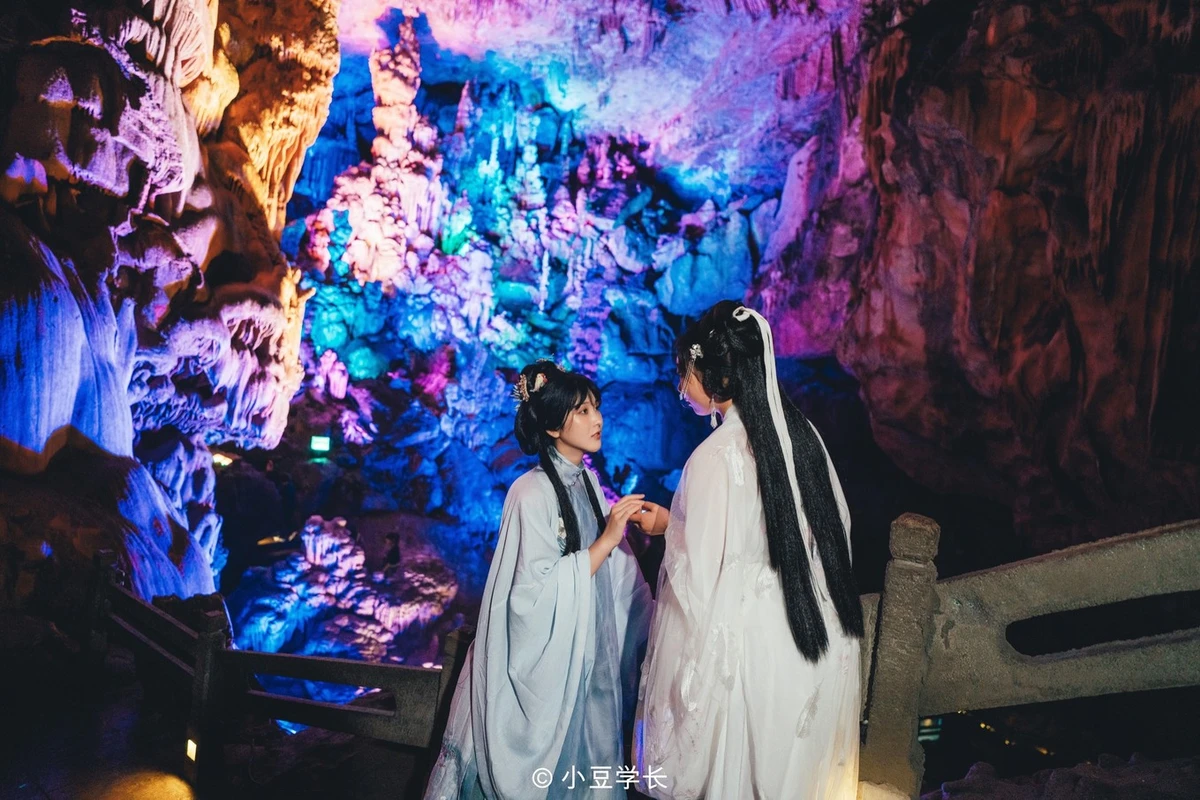
Tonglu Weekend Getaway | Into the Dreamlike Yaolin Wonderland
Tonglu has been known since ancient times for its 'verdant mountains, clear waters, long history, and serene environment,' and is often praised as 'a land of extraordinary mountains and waters, unparalleled in the world.' Within Tonglu, lush peaks and elegant ridges abound, caves are fantastical and rocks beautiful. The Fuchun River and Tianmu Stream, both 'unmatched under heaven,' wind through the county like jade ribbons, with picturesque scenery everywhere. Surrounded by green hills, embraced by clear waters, the city and rivers complement each other in a kaleidoscope of colors, creating a poetic and vivid ink-wash painting.
The city here is shaded by trees, clean and fresh; the countryside features white walls and grey tiles, harmonious and cozy. Birdsong can be heard everywhere, and the scent of flowers fills the air at all times. Everything you see is a painting, as if you are walking through a living scroll. Let's stroll through this picturesque town, savor the pristine beauty of the Fuchun River landscape, experience the elegance of China's most beautiful county, and enjoy the leisure of slow-paced village life. Choose a weekend to come and feel the unhurried forest life far from the city.
The scenic spot recently visited by Deng Chao and Sun Li has also become a hot travel destination, with many travelers rushing to check in and take the same photos.
Day 1: Hangzhou – Check into Red Lantern Cabin Resort – Yaolin Wonderland – Tonglu – Tongjun Mountain. Day 2: Yan Ziling Fishing Terrace – Daqi Mountain National Forest Park – Return to Hangzhou.
We chose to stay at the Red Lantern Cabin Resort, located far from the city. The cabins offer a particularly peaceful environment, with over 50 cottages nestled among the mountains—a real lung-cleansing oasis of negative ions. It is also quite close to Yaolin Wonderland and other attractions, making it perfect for a weekend getaway with friends. The resort has more than 50 cabins, each with elegant surroundings and surrounded by trees and forests. The air is fresh, and the feeling is a bit like a Nordic cabin retreat, as if you are vacationing in Northern Europe.
Some cabins are enveloped by the forest, ideal for a summer retreat as the temperature here is a bit cooler than in the city. It can be chilly on rainy days.
The rooms are spacious, with plenty of heating, clean and tidy. Each room has a large balcony; when you open the window, fresh air rushes in—truly perfect for a vacation. The resort also has the Red Lantern Restaurant, serving authentic farmhouse cuisine with fresh ingredients. Be sure to try the local dishes—not to be missed!
After a meal, you can climb the rear hill to overlook the cabins and river scenery. Green waters and lush mountains stretch as far as the eye can see. Slowing down life in this way—that's where true happiness lies.
All cabins here are suites, with one building containing several units. Each suite has a bedroom and living room, quite spacious. Some living rooms even have a mahjong table, perfect for friends and family to play mahjong together.
The entire cabin is surrounded by nature—a single breath of oxygen here truly nourishes the lungs!
Yaolin Wonderland is located in Tonglu County, Hangzhou City, Zhejiang Province, China, 80 kilometers from downtown Hangzhou and 23 kilometers from the county seat. It is a typical karst cave in the subtropical humid zone of the central East China coast and a national scenic area. The most famous stalactite cave here, formed around 100,000 years ago, is one of China’s top forty tourist destinations. The entire cave is hidden underground and is renowned as the finest solution cave in the country for its intricate, deep passageways and stunning rock formations.
In 1979, a very beautiful karst cave was discovered about 23 kilometers from Tonglu County, Hangzhou, Zhejiang. The cave is 1 kilometer long and covers an area of 28,000 square meters. Astonishingly, about 20 meters from the cave’s center, the entrance is engraved with the four Chinese characters 'Yaolin Wonderland,' and on the left cliff, there is an inscription by Yang Baoyi, the county magistrate of Tonglu in the 12th year of the Guangxu reign (1886). This shows that the cave had already been discovered as early as the Guangxu period of the Qing dynasty, but the entrance later collapsed and was buried. That is how we see today's Yaolin Wonderland, acclaimed as the 'crown of all caves in the country'.
Yaolin Wonderland is a typical karst cave, a masterpiece of nature from hundreds of millions of years ago. Its formation required certain conditions. It is said that 270 million years ago, the area was an ocean, and through multiple crustal movements, today's karst landscape took shape.
Soluble limestone, permeable fissures, and the endless flow of water year-round have given Yaolin Wonderland its beauty. The magnificent stalactites and stalagmites in the cave were all formed through tens of thousands, even hundreds of millions, of years of accumulation.
Upon arrival, I realized that colorful lights are projected onto the stalactites, creating a stunning display. Combined with the naturally diverse shapes formed by water erosion over time, the cave is divided into three halls, with a constant temperature of around 17–18°C. The four highlights not to be missed are the Galaxy Waterfall, Sky-High Jade Pillar, Thirty-Three Heavens, and the Yaolin Jade Peak.
As we passed through the halls one by one, we were awestruck by nature's craftsmanship. There is a stalactite waterfall that seems to 'plunge three thousand feet,' and a towering column of calcite. Some stalagmites are as delicate as undersea coral, while others create broad platforms reminiscent of the Moon Palace. Every scene sparks the imagination.
😊 Near the exit, there's a 3D show about how stalactites form, from volcanic eruptions 🌋 and the age of dinosaurs 🦕 to ocean drifting, rock collapses, crustal movements, and the slow dripping that shapes the formations—it’s the only takeaway from the movie! A perfect summer retreat, the cave stays at 18°C, and the entire tour takes about an hour. The cave floor can be damp and slippery, so watch your step.
After exiting the cave and returning to the surface, it was back to summer temperatures in the 20s, making me want to go back inside. On the way out, we passed a tree-lined avenue; it looked beautiful for photos when there was no one around.
A few steps further, we came across an abandoned small train, which used to be a restaurant. Now left to nature, it has a nostalgic charm.
Yaolin Wonderland is 80 kilometers from Hangzhou, Zhejiang, and 23 kilometers from Tonglu county seat. You can take a bus from Hangzhou South Bus Station or West Bus Station to Tonglu, and then a direct minibus from Tonglu to the cave. Add it to your travel itinerary.
Tongjun Mountain is covered with dense vegetation and lush trees, providing cool shade. You can't see much of the outside world until you reach the summit, where the view opens up. Through gaps in the leaves, you can see the entire city of Tonglu and catch a glimpse of the mighty Fuchun River. At the peak, Siwang Pavilion (Four-View Pavilion) is the best spot for taking in the scenery. Perched on a cliff, it offers a panoramic view of Tonglu city.
Tongjun Mountain, with its lush woods and beautiful scenery, is one of the famous historical sites along the Fuchun River and a renowned tourist spot within the national scenic area of 'Fuchun River – Xin’an River – Qiandao Lake.' Here, two rivers converge, and a single peak rises abruptly. Behind are deep valleys and rolling mountains, with modern high-rises in front and the mighty river below. The terrain is both dramatic and beautiful. Ascend the mountain and gaze into the distance to behold the splendid views of the Fuchun River.
After leaving Tongjun Temple, you arrive at Siwang Pavilion. Gaze into the distance, and the Fuchun River is a clear sweep of blue, merging with the sky. Through the colorful foliage, the cityscape of Tonglu with its facing high-rises comes into view. Standing on the painterly Tongjun Mountain, overlooking this poetic, charming city, you feel especially refreshed in the crisp autumn air.
Tongjun Mountain lies at the junction of the Fuchun River and the Fenshui River, just a river away from Tonglu county seat, making it the closest scenic spot to town. The area is serene and secluded. Legend has it that this is where Tongjun, the 'father of Chinese medicine,' built his thatched hut. Not only are many sights on the mountain connected with him, but the very name 'Tonglu' derives from this story.
Along the hiking trail, you'll pass buildings like the Sifang Pharmacy, Tongjun Temple, and Tongjun Pavilion—just a brief visit is enough. Not far from the Baicao Garden at the foot of the mountain is the 'Qili Yangfan' (Seven-Mile Sail) dock. Compared to Yan Ziling Fishing Terrace and Jiande’s Seven-Mile Sail, which also offer boat tours on the Fuchun River, Tongjun Mountain usually sees fewer visitors.
Tongjun Mountain itself is a fairly small peak, only about 60 meters high, so it can be fully explored in less than an hour. It's perfect for a leisurely outing with the elderly and children. Standing at Siwang Pavilion on the summit, you can see the two rivers' green waters merging into one below, a scene full of poetic charm.
A brisk walk of half an hour will get you to the highest point, where you can overlook the beautiful Fuchun River below.
From Hangzhou to Tonglu county seat, it's still another 15 kilometers to Yan Ziling Fishing Terrace. Drive to the Fuchun River Dam, then take a boat downstream along the river to reach the Terrace.
Located on Mount Fuchun, 2,500 meters west of Fuchunjiang Town, the Terrace is named after Yan Ziling, who lived in seclusion here during the Eastern Han Dynasty. Yan Ziling, also named Guang, was a native of Yuyao in Kuaiji and a recluse of the early Eastern Han.
From ancient times to the present, countless famous scholars and literati have visited this place, including Li Bai, Fan Zhongyan, Meng Haoran, Su Shi, Lu You, Li Qingzhao, and many others. The poems and prose they left behind are countless. The most famous is what Fan Zhongyan wrote here: 'Vast are the cloud-clad mountains, wide flows the river; the master’s spirit endures as long as the mountains and waters.' Here, 'master' refers to Yan Ziling, and the phrase 'as long as the mountains and waters' is even inscribed on the memorial archway.
According to legend, after Liu Xiu became emperor, he sent envoys three times to invite Yan Ziling to the capital. They reminisced about their friendship and even shared a bed. While sleeping, Yan placed his foot on Liu Xiu's stomach, and Liu did not mind at all. Ever since the Han Dynasty, Yan Guang’s integrity—content with poverty and indifferent to fame—has been admired by later generations.
The area is often crowded. This is Deng Chao’s photo-op spot, so you’ll need to wait until it’s empty to get the same shot.
'After traveling through all the mountains and rivers of the Three Wu regions, I still say that Tonglu’s scenery is the most beautiful.' This poem was written by a great Song Dynasty writer after visiting Tonglu. However, I believe the beauty of Tonglu’s rivers lies in the interplay between green mountains and clear waters. The spring water is like jade, the ripples like brocade—a truly enchanting sight.
The interplay of light and shadow under the sun is captivating. When sunlight falls on your face, it creates a dappled effect. Green is a photographer's favorite color here.
Yan Ziling Fishing Terrace is a large water-based leisure area on the Fuchun River, combining thousand-year-old cultural relics with modern relaxation experiences. It consists of three sections: the Fishing Terrace, the Fuchun River Lesser Three Gorges, and Jiangnan Longmen Bay. The Fishing Terrace is the historic site where the Eastern Han sage Yan Ziling lived in seclusion, farmed, and fished, and it is honored as the foremost of China's 'Top Ten Fishing Terraces'.
Within the scenic area, there are spots like Double Terraces Fishing, Kexing Pavilion, Master Yan’s Shrine, the Nineteenth Spring under Heaven, and Eastern China's No. 1 Stele Forest. The stretch of the Fuchun River in front of the Terrace bears a strong resemblance to the Yangtze River’s Three Gorges, hence its nickname 'Fuchun River Lesser Three Gorges.' Jiangnan Longmen Bay is a natural harbor on the river, integrating gorges, a placid lake, a solitary islet, cliffs, waterfalls, and rare pine trees.
Inside Yan Ziling Fishing Terrace, a stone stele of the 'Dwelling in the Fuchun Mountains,' one of China's ten greatest masterpieces, is a highlight. The 'Dwelling in the Fuchun Mountains' is an ink painting on paper by Yuan Dynasty artist Huang Gongwang, known for its elegant use of ink, well-balanced composition of mountains and waters, and masterful variation in ink density and wetness.
A young lady in traditional Chinese dress matches this setting perfectly—every photo comes out beautifully!
About 80% of the scenery depicted in 'Dwelling in the Fuchun Mountains' is located along the Fuchun River within Tonglu, with the remaining 20% in Fuyang. The painting is hailed as 'the Orchid Pavilion of painting' and is a national treasure.
I also took a photo at the exact spot where Deng Chao once stood.
Within Tonglu, there are splendid peaks and ridges, fantastic caves, and beautiful rocks. Apart from Yan Ziling Fishing Terrace visited by Deng Chao and Sun Li, Daqi Mountain National Forest Park is another must-see destination. Located 7 kilometers southeast of Tonglu county seat, it's practically in the backyard of Hangzhou residents. From here, you can see Longmen Ancient Town to the east, the Baiyunyuan Scenic Area to the south, Yan Ziling Fishing Terrace to the west, and Tongjun Mountain to the north.
Daqi Mountain National Forest Park lies on the south bank of the Fuchun River, combining Jiangnan's typical landscape of mountains and waters with grassland scenery. It features peaks, bizarre rocks, and gorges. The pools here are crystal clear, reflecting the surrounding green trees, somewhat reminiscent of Jiuzhaigou. Daqi Mountain, also known as 'Saiji Mountain,' is even hailed as the 'No.1 Mountain of Jiangnan,' but it remains quite low-key.
The park consists of areas like Shijingyuan Gorge, Jinniu Wenqiju, and Qingqing World, as well as a treetop walk. It is known for its grandeur, steepness, uniqueness, beauty, and vastness. The moment you enter, you feel as if you've stepped into another world—a world without noise, only birdsong and fragrant flowers, quiet and comfortable.
Together with Tongjun Mountain, Seven-Mile Sail, Fuchun River Lesser Three Gorges, and Yan Ziling Fishing Terrace, Daqi Mountain Forest Park forms the Fuchun River Tourism Zone. Surrounded by all this greenery, your mood instantly lifts. Walking through the bamboo grove feels like the start of a new journey.
Even though it was my first visit, I felt an odd sense of familiarity, like I had been here before. I suppose it must have appeared in my dreams—a true utopia.
Inside the park, mountains are clear and waters beautiful at every turn. Gurgling streams, bizarre peaks, strange rocks, clear brooks, and cascading waterfalls present themselves in endless succession. A spring drizzle washes the lush green leaves, and a variety of rock formations stir the crystal-clear mountain spring. On both sides, green hills face each other, trees dripping with emerald; above, strange peaks tower overhead; below, clear water murmurs by, with odd-shaped rocks lying in the shallows.
Strolling here, you see dense forests and green mountains, turquoise waters and fantastical rocks, and waterfalls of endless variety—drifting like snow, hanging like curtains, or snapping like ropes. Mist fills the caverns, and the thunderous sound shakes your soul, leaving you in awe.
What is most stunning here are the large and small lakes, so clear you can see the bottom. Under the sunlight, they refract a kaleidoscope of colors, rivalling those of Jiuzhaigou. A pleasant surprise is the many colorful fish swimming freely about.
Walking here in traditional costume truly feels like time travel. Gradually, the sound of water grows more turbulent. A waterfall cascades from the mountain top, like a beautiful silk ribbon drifting down from mid-air, just like a living landscape painting. Many say the scenery of Jiangnan is gentle and soft, but here it also has a touch of rugged strength.
When hiking and crossing streams, remember: don’t sightsee while walking, and don’t walk while sightseeing. Safety comes first during travel.
Every day is a new journey, and everyone who walks a stretch of the road with us deserves gratitude. Life is neither too long nor too short—just enough to truly see the world. Join me, Xiaodou, as I tell stories through the lens.


