Journey into Tonglu: Admire the Fuchun River, Walk Through an Ancient Cave
Visit Tonglu, savor the Fuchun River
Tonglu, the backyard garden of Hangzhou's outskirts and an internationally recognized garden city, is a place steeped in history and culture, a land of natural beauty and refined civilization. The spring river flows east; Tonglu's most famous attraction is undoubtedly the Fuchun River. Along its banks, the scenery is rich and varied, and once spring arrives, it enters the most beautiful season of the year. In the warm March of early spring, I made Tonglu my first spring outing destination, inspired by a set of photos posted on Weibo by actress Sun Li. The pictures were taken at Yan Ziling Fishing Terrace in Tonglu, capturing stunningly beautiful views. Enchanted by the spring river, I traveled to this lovely city.
Nowadays, for many scenic spots in China to gain popularity, aside from outstanding natural or cultural features, a celebrity visit with their star power can quickly put a place on the map. Not long ago, Sun Li and her husband Deng Chao visited a fairyland-like spot on the outskirts of Hangzhou. Before their visit, the place was little known, but afterward, the locations they photographed became internet-famous check-in spots.
This place is Yan Ziling Fishing Terrace in Tonglu, Hangzhou, facing the most beautiful stretch of Zhejiang's Fuchun River and a major scenic area along the river. The terrace is named after Yan Ziling, a hermit from the Eastern Han Dynasty who lived here in seclusion. Yan Ziling was a recluse from the early Eastern Han; in his youth, he studied with Liu Xiu. When Liu Xiu became emperor, Yan Ziling refused to take office, changed his name, and lived in seclusion in these beautiful Fuchun Mountains.
Though Yan Ziling Fishing Terrace is not large, it offers abundant sights and is highly photogenic—no wonder it caught Sun Li's eye. The site comprises East Terrace, West Terrace, Yan Ziling Shrine, stone archways, a stele garden, Fishing Island, and the Lesser Three Gorges of the Fuchun River, each step revealing a new scene. To reach Yan Ziling Fishing Terrace, you first board a cruise boat and sail upstream. On both banks, graceful hills stretch in overlapping greenery, the river water shimmering. Amid the glorious water and mountain scenery of the Fuchun, you arrive at the enchanting Yan Ziling Fishing Terrace.
In China, there are many culturally rich fishing terraces, such as Han Xin Fishing Terrace in Huai'an, Jiangsu; Zhuangzi Fishing Terrace in Han County, Shanxi; and Jiang Ziya Fishing Terrace in Nanpi County, Hebei. However, Yan Ziling Fishing Terrace is more famous for three reasons: Yan Ziling's noble character, despising fame and living unrestrainedly, commands respect; the beautiful Fuchun River scenery perfectly complements his story; and the site has attracted countless literati and poets through the ages who came to admire the view and compose poetry.
This is the first photo spot Sun Li and Deng Chao checked in at, leaning against the Fuchun Mountain and overlooking the Fuchun River. You have to admit, Yan Ziling really knew how to pick a hermitage. His presence added a touch of literati atmosphere to the landscape.
Under the archway inscribed 'Mountains high, waters long,' recreate the same poses as Sun Li and Deng Chao. Beside modern celebrities, many ancient luminaries also visited here. Famous poets like Xie Lingyun, Meng Haoran, Wang Wei, Li Bai, Bai Juyi, Fan Zhongyan, Su Dongpo, Lu You, and Zhu Xi all left renowned verses. The most celebrated is Yuan Dynasty painter Huang Gongwang, who spent ten years carefully observing the enchanting Fuchun River before creating the national treasure-like painting 'Dwelling in the Fuchun Mountains.'
On Yan Ziling Fishing Terrace, there once stood a Yan Ziling ancestral hall containing a memorial archway, a horse trough, and 120 stone steles. After a hydropower station raised the water level, these structures were submerged, but over 100 steles were salvaged and preserved. They now form the Fuchun River Poetry Stele Corridor, where many masters have left their calligraphy and poems that will flow through the ages.
Sitting on the tea house terrace by the Fuchun River—the same spot where Sun Li and Deng Chao sipped tea—you are treated to a uniquely beautiful vista. Distant peaks appear faintly, and the emerald Fuchun River ripples gently, composing a picture of serene beauty. Sipping tea here leisurely, you feel utterly at ease.
Speaking of Hangzhou's natural scenery, I believe we can hardly count them all on two hands—West Lake, Xixi Wetland, and so on. Yet today, there are many natural spots around Hangzhou that surpass the city's own in beauty and are not as crowded. So, many people now prefer to explore the mountains and waters on the outskirts and get close to nature. Tonglu, with its distinctive landscapes, especially stands out. In this international garden city lies a mysterious karst cave, beautifully named Yaolin Wonderland.
Yaolin Wonderland is located in Tonglu, Hangzhou. The name itself suggests a fairyland, and it indeed is a famous stalactite cave, said to have formed 100,000 years ago. The cave extends one kilometer in depth, covering a total area of 28,000 square meters. Deep underground, the winding caverns and spectacular rock formations are acclaimed as the crown of all caves in China.
Stepping into the cave, the sight is astonishing and left me marveling nonstop. Multicolored lights illuminate the stalactites, making them glitter as if in a real fairyland. The oddly shaped rocks are imbued with legendary colors and stories. It was my first time seeing such cave scenery—walking among varied stone formations, with bizarre stalactites hanging overhead, the atmosphere was dreamlike and fantastical.
It's wonderfully cool inside, a constant 18°C. Walking along paths flanked by stalactites, you're surrounded by an array of bizarre formations—nature's incredible craftsmanship on full display in the Yaolin Wonderland cave. Modern stage sets, lighting, and sound effects enhance the stalactites, presenting nearly 20 Chinese myths and legends, turning the space into a realm of mythology.
When the artificial lights fade, the stalactites reveal their true appearance, like a hanging waterfall cascading down—a magnificent sight. The cave's stalactites are magnificent and diverse, exquisitely wrought by nature, characterized by seclusion, depth, strangeness, and elegance, making them stand out among all caves in China.
Yaolin Wonderland is a relatively early-developed karst cave. Stalactites of various shapes hang from the cave ceiling, creating a spectacular sight. Under colorful lights, they are beautiful from every angle, sparking boundless imagination—they resemble people, objects, and animals, imbuing the stones with a sense of spirit.
Yaolin Wonderland is truly beautiful everywhere. The name originated from Song Dynasty poet Ke Yuezhai, who likened the cave to a fairyland, thus the name Yaolin Wonderland. The scenic area comprises seven interconnected chambers, with over 30 scenic clusters and 200 spots. The most iconic sights are Galaxy Waterfall, Pillar Propping Up the Sky, The Thirty-Three Heavens, and Yaolin Jade Peak.
The most spectacular sight inside the cave is the Thirty-Three Heavens, layer upon layer of colorful stalagmites in myriad poses. It feels like stepping into an ethereal land of immortals. Some compare it to the grand Dunhuang frescoes of the Tang Dynasty, filling the mind with fantasy.
There is also a naked-eye 3D light show inside the cave. It was my first time watching a movie projected onto rocks. The dazzling 3D images cast onto the stalactites, taking advantage of the stone's ever-changing shapes, create a heightened sense of reality. You can see this show at both the entrance and exit—well worth enjoying.
Zhejiang boasts many famous mountains, each with its own charm that draws visitors to explore. Hidden in Tonglu, Hangzhou, is the number one mountain in the Jiangnan region—Daqi Mountain. Located on the southern bank of the Fuchun River in Tonglu, it is a national forest park that blends Jiangnan's mountain-and-water scenery with grassland vistas. Not very high, it's a peak suitable for all ages, where one can stroll and breathe the fresh air of nature.
Daqi Mountain National Forest Park is a comprehensive forest park, offering both Jiangnan's mountain-water landscapes and grassland views. The mountain is low and easy to walk, and the scenery is infused with the vibrant greenery of spring. Right after entering the gate, you see a vast bamboo forest, especially evocative of Jiangnan's charm, giving the feeling of a secluded hermitage.
Strolling in Daqi Mountain, you can smell the fresh, crisp air so different from the city. What impressed me most were the many small waterfalls, each with its own character. Thick greenery abounds. To venture deeper into the mountain, you pass these cascades one after another. Cool spray from the falls dispels the stuffiness of hiking.
Daqi Mountain is rich in scenery—mountains, bizarre rocks, gorges, you name it. Amid the picturesque landscape, the pools here are crystal clear, reflecting green trees on the surface, somewhat reminiscent of Jiuzhaigou's beauty. Fish swim freely in the water, so carefree and joyful. The moment I saw this pristine water, I was captivated. I never expected water so well-preserved could exist so close to a big city.
Da Qi Mountain's natural scenery is so beautiful it resembles a fairyland on earth, renowned for its grandeur, precipitousness, uniqueness, elegance, and openness. Thus, together with Tongjun Mountain, Qili Yangfan (Seven-Li Sail), Fuchun River Lesser Three Gorges, and Yan Ziling Fishing Terrace, it forms the most beautiful scenic corridor along the Fuchun River. During my visit, I mainly explored the Shijingyuan Gorge Scenic Area, where mountain streams and gorges abound. Various pavilions and bridges have been built along the trails, accenting the distinctive forest scenery.
Daqi Mountain isn't high, and the walk is effortless. The bridges connecting both ends come in stone, wood, cable, and net varieties—none are repeated, which is quite interesting. Some sections are narrow, so caution is advised. Here, admiring waterfalls, pools, and the verdant scenery on both banks makes it an ideal leisure destination.
In Daqi Mountain, the waterfall-and-pool scenery changes with every step. Notable spots include Golden Ox Pool, Guanyin Peak, Dragon Pool Waterfall, and the Twelve Zodiac Pools. The atmosphere is fresh and elegant, with murmuring water and the sound of waves. The deeper you go, the more pleasant the sounds of nature become. Throughout the mountain, clusters of waterfalls resound with clear spring water; deeper in, the sound of water hitting the rocky bed grows crisper. Cascades echo each other, and secluded pools are scattered like stars.
During my hike, I saw many visitors coming to the forest to breathe in the oxygen-rich air. Beneath the waterfalls, various shaped stones lie, and clear springs flow over them. It turns out Daqi Mountain also features such jade-like ripples.
There's also a stone house in the mountain, located halfway up. Its buildings are entirely made of stone; you can rest here if you get tired.
Leaning on the railing and looking around, you see deep serene valleys and lush forests. Resting against a rock and listening, you hear the roar of cascading waterfalls and the singing of streams. Sunlight pierces the dense foliage, dappling the ground with colorful patches. All the green reflects into the pool, creating a picture of tranquility. Have you ever been to Daqi Mountain in Tonglu? What do you think of the environment here? Feel free to leave a comment and share your thoughts.
Living amid skyscrapers, heavy traffic, and the noisy city, fast-paced life loses some of its essence. I always yearn for a slow-paced place to savor life, and an ancient village is a great choice. This time, we chose Shen'ao Ancient Village, a 3A-level scenic spot in Zhejiang Province. Here, I immersed myself in the historical and cultural atmosphere of the Qing Dynasty and enjoyed the tranquility and elegance of slow living.
Shen'ao Ancient Village is located in Tonglu County, Zhejiang Province, within the realm of Jiangnan's ancient villages and is one of the major ones. It was founded during the Southern Song Dynasty and still retains its original village appearance. Ming, Qing, and Republican-era architecture can be seen everywhere, all kept in their original style. The best-preserved feature is the ancient water system from the Ming Dynasty, which holds immense scientific and cultural value.
The ancient village is built against the mountains and by the water. Most dwellings are courtyard houses with a central skywell, balancing privacy and neighborly closeness quite well. The Ming-Qing and Republican-era buildings are the most distinctive, with some featuring unique designs. Walking through the village's narrow lanes, you're surrounded by the mottled traces of time. Plants creep freely over walls, adding to the atmospheric charm. As you wander these quiet alleys, you always feel a pleasant surprise awaits at the end.
Shen'ao Old Street is just over 200 meters long, a short walk that doesn't take much time. It's the most bustling area with a strong commercial atmosphere. The street is about three meters wide and runs north-south. Historic buildings on both sides sell souvenirs and snacks. Red lanterns hung at short intervals perfectly accent the ambiance.
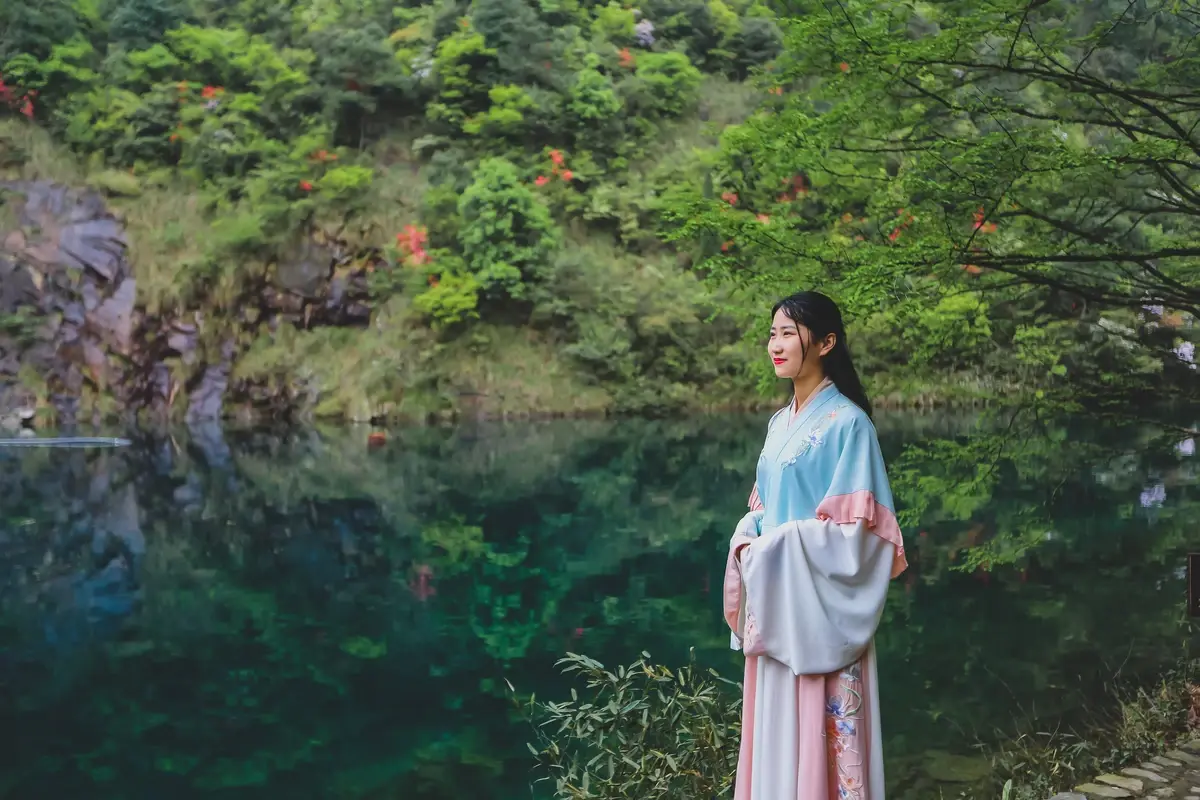
Wearing Hanfu while touring the old street is wonderful. Posing for photos in corners filled with traces of time is extremely picturesque. Pictures taken in the alleys feel like time travel to that era, brimming with a sense of serene nostalgia.
The village has numerous cultural relics and many protected ancient buildings, such as Huaisu Hall, Jinsong Hall, and Shangzhi Hall, all important heritage sites. I visited several of these protected spots; the most memorable was Chunde Hall. I felt its aesthetic perfectly matched the Hanfu I was wearing, so I captured that moment of poetic beauty.
The most characteristic buildings are the courtyard residences. These courtyards have interconnecting side gates and back doors. Though outwardly simple and elegant, the windows and doors are exquisitely crafted. When I walked out through the back door of such a courtyard, I felt like a young lady from a wealthy family sneaking out to play.
Shen'ao Ancient Village fulfilled all my imaginings of an ancient village's timeless serenity. Having weathered the erosion of years, it still holds captivating charm—from the private residence of a Grand Tutor a century ago to the Dai Mansion of the Republican era. The village truly lives up to the phrase 'deep mysteries in the sunset clouds.' The charm of the ancient village can only be understood by experiencing it firsthand.
Dipu Flower Sea Scenic Area is located in Dipu Village, Tonglu County, Hangzhou, Zhejiang Province, covering a total area of 180,000 square meters. Dipu Village itself is a scenic spot; every spring and summer, colorful flowers bloom, turning it into a world of blossoms. The flower sea also features tent hotels, barbecue areas, bonfire event grounds, outward bound training sites, and a photography base, making it an internet-famous check-in destination in Tonglu's floral world.
This time I stayed at the Red Lantern Log Cabins by the Tianmu Stream, just 2 kilometers from Yaolin Wonderland. It's a scenic spot that combines sightseeing with leisure vacationing. Its four main features are: a serene and beautiful landscape, a cozy homely atmosphere reminiscent of a grandmother's house, quaint and elegant wooden huts, and rustic country-style cuisine.
Every building here is a log cabin. Each cabin has four rooms, and guests are mostly accommodated on the second floor.
Outside the cabin, spring-like natural scenery unfolds, with greenery so pleasing to the eye.
The rooms are standard, with a living room connected to a bedroom. Surprisingly, there's a mahjong table in the living room—probably because many seniors come here to play.
Red Lantern specializes in local farmhouse cuisine, using the freshest seasonal ingredients. Perhaps because I was tired after a day of fun, everything tasted especially delicious.
At night, the red lanterns light up, glowing warmly in the darkness, as if it were Chinese New Year.


