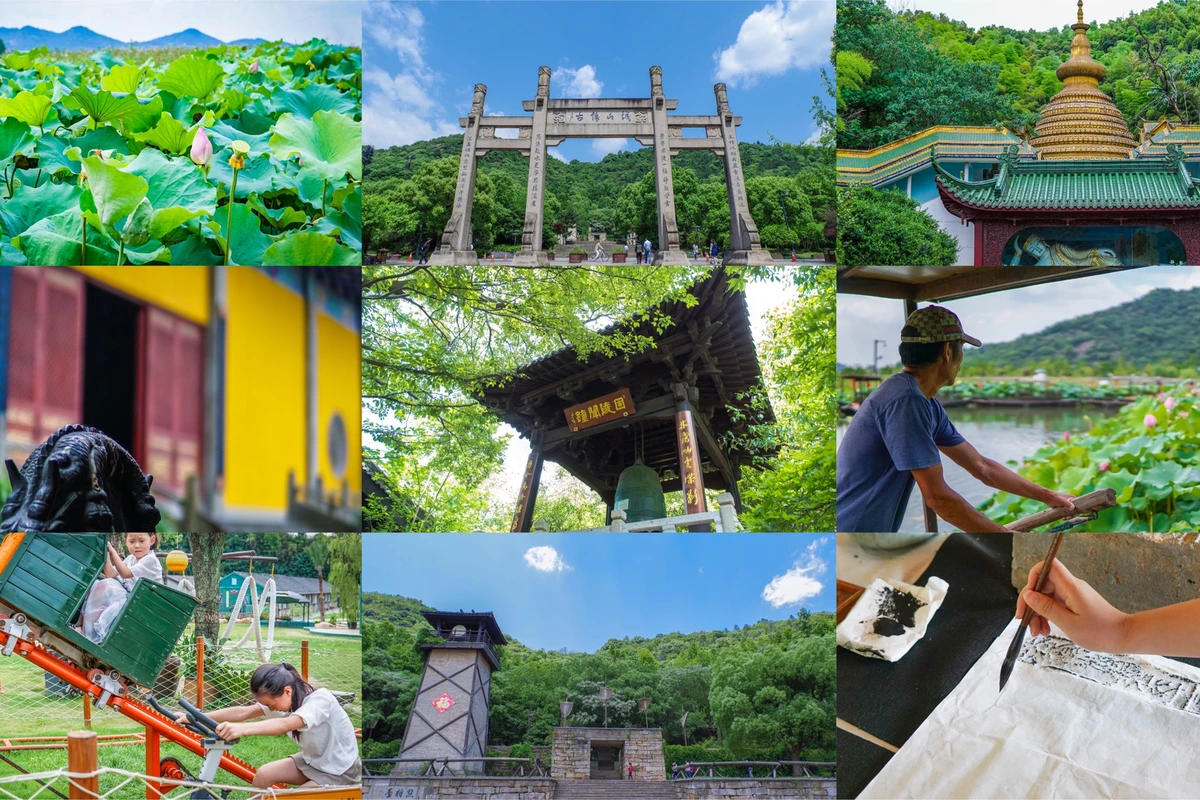
A Xiaoshan Local Explores Xiaoshan, Uncovering Fresh Beauty Every Visit
Xiaoshan is located on the Hangjiahu Plain, between Hangzhou and Shaoxing, on the southern bank of the Qiantang River in Hangzhou Bay, in the southern wing of the Yangtze River Delta, the most economically dynamic area of China’s counties. It boasts the 8,000-year-old Kuahuqiao Culture, some of the earliest private enterprises in the country, the mighty Qiantang River tidal bore, and the massive sea reclamation project. Local specialties include world-renowned hand-woven lace, distinctive Xiaoshan dried radish, Xiaoshan Sanhuang chicken, and Xiaoshan meigancai (preserved vegetable).
This time, with a chance to tour Xiaoshan as a local, over two days and one night, I’ll take you to some of its more special and fun spots.
AAAA-rated Oriental Culture Park is located at the confluence of the Qiantang, Fuchun, and Puyang rivers, at the foot of Yangqi Mountain in Yiqiao Town, Xiaoshan. It is a stunning creation that blends garden culture, religious culture, and wellness culture, and is a key tourism project of Hangzhou and Xiaoshan. It is 15 km from downtown Hangzhou and Xiaoshan urban area, and 20 km from Hangzhou Xiaoshan International Airport, boasting an excellent location. Neighboring Xianghu Lake to the left and Yupu to the right, with pastoral villages, singing birds and flying grass, low hills and clear waters, the scenery is beautiful.
Above the grand hall, a plane happens to fly past. Xiaoshan International Airport now offers flights to 104 destinations and is a major transport hub in East China. Apart from Shanghai, Hangzhou Xiaoshan Airport has the most international flights.
The temple has kept its original colors over the years, exactly the same as when I first visited, showing that the buildings are very well maintained.
The architectural layout features a drum tower on one side and a bell tower on the other, much like the traditional layout of many cities. In the past, cities had drum and bell towers to disseminate important messages so that everyone could hear.
A distinctive feature here is an underground palace that is resplendent and magnificent. Even the floor tiles are gilded with gold leaf. To enter, you need to put on shoe covers, and the inside truly glitters with gold.
By looking at the plumpness and color of a Buddha statue, can you tell which dynasty it's from? If it's plump, it's definitely Tang Dynasty; if it has a large head and a small body, it might be from the Han Dynasty.
In the center of the underground palace, on a lotus pedestal, many Buddha statues are enshrined, exuding both solemnity and dignity.
The walls are carved with various scriptures, and the characters are traced in gold powder, revealing the immense cost and effort involved in the original construction.
There are murals painted here. The patterns on the corridor ceilings are very beautiful, quite similar to the Long Corridor in Beijing.
Time for another guessing game: What is the name of this mythical beast? Which son of the dragon is it? In fact, the dragon had nine sons, each with different functions. The one carrying a stone tablet on its back like a turtle is also a dragon’s son. The one warding off evil at bridgeheads is another dragon son.
The grand hall enjoys a thriving incense offering all year round. Many men and women come here to pray for blessings on special occasions.
If you haven't had your fill here, cross the road to the bank of the Qiantang River at the confluence of three rivers—another excellent spot for watching the tidal bore.
These waterways in Xianghu Lake Phase 3 are designed for rowing boats, priced at 30 yuan per person. Visitors can get up close to the coolness and fragrance of summer lotuses. When the oar-powered boat creaks and squeaks through the meandering lotus pond, it’s truly a summer delight.
The scenic area management thoughtfully provides a boat ride experience amidst the lotus flowers.
Lotus leaves spread in lush abundance, with rolling hills beyond.
Amid the swaying lotus leaves, each lotus flower is slowly blooming—some in full bloom, some in bud. Beautiful to behold, with cooling lotus leaves. The lotus root is a delightful delicacy. The tender lotus root stem is the ingredient for sweet-and-sour lotus stem. So the whole lotus plant is a treasure.
Paddle a small boat with your beloved, drifting leisurely on the lake, startling a flock of gulls and egrets, and forgetting all worldly troubles.
The water quality here is excellent. At certain times, they catch fish and sell them by the lake—bighead carp, silver carp, softshell turtles, etc., all at very affordable prices. Most importantly, because of the good water, Xiaoshan's protected water source ensures the fish taste superb with no fishy smell.
Speaking of Shanli Renjia (Mountain Village Home), I visited over 20 years ago. It’s a bit different now; back then it was more like a huge agritainment park where you could see all kinds of replicas of old rural tools and items. Ah, now I’ve given away my age.
Shanli Renjia is modeled after the well-preserved Dawang Village, a small mountain village from the late Qing and early Republic periods, inviting you to lose yourself in the poetic realm of 'deep in the mountains one feels secluded, as if wandering in a painting.' It is Hangzhou's most distinctive agricultural tourism area. Here, everything from slash-and-burn farming to high-tech agriculture is on display. The century-old village still has smoke rising from chimneys; the 'educated youth' camp that carried the youth and dreams of an entire generation still stands. Stay overnight, taste fruits you pick yourself, plant your own orchard or vegetable garden, and share the joy of harvest with villagers.
Now there's a children's play area. This mini train is not just for kids—adults can happily ride it around a small pond and then through a tunnel; it's a lot of fun.
The train has arrived at the station, but the little ones won't get off—looks like they're not ready to leave!
This parent-child activity is quite interesting: a curvy little train that adults pedal alongside; as you pedal, the train climbs uphill and then zooms down. It's definitely a family activity. Seeing the kids so happy, laughing so brightly.
Don't underestimate these bumper horses on a small playground—they're actually quite fun. I'd highly recommend them.
There are some animals raised here: pigs, goats, little dogs, and the like.
When buying tickets, you can get a combo ticket that includes the little yellow duck boats. You can pedal with four people or two people, not too strenuous, and it's a fun family activity. The lake even has swans that will chase after you.
If the kids are a bit older, they can play with model boats on this pond.
The electric go-karts are also fun and relatively slow, making them safe.
Another guessing game: what are these yurts for? I hope when you visit next time, you'll tell me what they are!
Compared with the high-rises and bustling traffic of downtown Xiaoshan, Heshang Old Street emerges like a modest, graceful maiden from bygone days, bringing calm and delight. On both sides of the lanes stand ancient-style buildings from the Ming and Qing dynasties, with cobblestone paths, carved window frames, upturned eaves... a view at every step. Xutongtai Sauce & Pickle Shop is located right here. Despite declines and transfers, it ultimately revived its century-old spirit and reopened.
Heshang Ancient Town (its original name literally meaning 'Monk Town')—the local folk are rugged and fond of dog meat. The papermaking tradition here is also well-known; in the past, most of Xiaoshan's homemade paper came from here. Xuan paper and yellow-label paper are the main products. The most famous is probably Daolin paper.
The ancient town here still preserves some old traditional things. Just like the name Heshang Town—it used to be called Monk (和尚), but later they thought it was too unpleasant and changed it to Heshang (河上).
The old street has been renovated, looking especially refined without any sense of dilapidation. I hope it can be restored to its original look.
This is a very distinctive tea shop, though unfortunately it hasn't opened yet. The decorations are quite interesting. Maybe it will become an Instagram-worthy spot in the future.
Tall horse-head walls are everywhere, embodying the charm of the Jiangnan region.
Xutongtai Sauce & Pickle Shop here has a history of several hundred years. Now, after reforms, its soy sauce once again gives off the aroma it should have.
With the development of modern industry and the introduction of assembly lines, these traditional manual workshops have fallen into difficulties. Discovering and protecting these traditional crafts is something our generation should do. I hope we can do better so that these products made with ancient methods have a bigger market.
Do you know where the name Guali comes from? Guali is on sandy land, so the watermelons grown here are particularly sweet—hence the name Guali ('melon' + 'drip').
Ren Bonian Memorial Hall: tracing the footsteps of a generation's painting master. Ren Bonian was a leader of the Shanghai School in modern Chinese art history, a 'grandmaster,' skilled in figures, flowers-and-birds, landscapes, and animals. Cai Ruohong called him 'a giant of modern Chinese painting,' and Xu Beihong praised him as 'the foremost Chinese painter since Qiu Shizhou.' He is a local worthy of Xiaoshan, the pride of Guali.
The memorial hall is now fully utilized. Summer and regular classes are held here, teaching calligraphy, painting, and art, passing on Ren Bonian's spirit and style.
There are also books and albums related to Ren Bonian. You can browse or purchase them. If you have time, you can come here to learn art.
This exhibition hall displays Ren Bonian's life, his ancestors, and his paintings.
An elderly Mr. Zhou has placed bricks from different dynasties here—some from the Han Dynasty, some from the Ming Dynasty, all carved with characters. You can learn to make rubbings with him.
The old gentleman teaches very carefully, step by step, and you'll quickly get the hang of it.
Look, the characters appear.
Even such a young child can't resist trying it out, taking the rubbing home as a souvenir of the visit.
The young lady with long legs also wrote long characters; as an experience, she learned about Chinese traditional culture—calligraphy and rubbing.
Just outside the door, there's this modern building.
What's giving employees an iPhone 11? Hangmin Village gives gold bars to its villagers! Have you ever seen such a lavish village? In 2019, Tencent gave its employees iPhone 11s, but the villagers of Hangmin Village each received gold and silver bars.
Hangmin Village in Guali Town, Xiaoshan, went viral on social media: 'Through great hardships, build the great enterprise of Hangmin; thousands of gold and silver, benefit the villagers.' To celebrate the 40th anniversary of Hangmin's founding, the village sent welfare gifts—each villager received one gold bar and one silver bar. The bars are half the size of a hand, with a phoenix on the front and the words '40th Anniversary of Hangmin Entrepreneurship' engraved on the back.
Hangmin Group now has 28 wholly-owned, controlled, or invested industrial and commercial enterprises, with total assets of 10.2 billion yuan and 12,000 employees. In August 2004, the group's controlled Hangmin Co., Ltd. (600987.SH) was successfully listed on the Shanghai Stock Exchange. In May 2016, the invested First Capital Securities Co., Ltd. (002797.SZ) was listed on the Shenzhen Stock Exchange. So calling Hangmin Village the No. 1 village in Zhejiang is no exaggeration.
I remember when I was in junior high school, passing through Hangmin Village: every household was a villa, golden wheat fields stretched everywhere, and it was named by the UN as one of the best places for human habitation. This was back in the early 1990s!
It is an important production base for China's gold jewelry industry, with gold jewelry processing volume ranking third in the country. It has long provided processing services for brands like Lao Miao Gold and Lao Feng Xiang.
I remember the year before last, or some year—because gold in Hangmin Village was so cheap, wholesalers from all over the country rushed to buy. The counters were practically swept clean. Gold necklaces were taken out in bundles, as if they were as cheap as meigancai.
These are special products authorized by the Olympics. They are: a Liangzhu jade artifact, the Three Pools Mirroring the Moon of West Lake. And this one below is a mini Gongchen Bridge.
This one is named 'Towards the Future.'
This is the only time I've been so close to so much gold.
A worker is struggling to lift a thick gold bar, getting ready to cut it down for further processing.
These are rolled many times, turning gold bars into gold foil. But more accurately, these are gold sheets.
Your ring will be adjusted here before leaving the factory—roll, roll, roll.
Such gleaming gold just lying here is truly captivating.
The worker here uses a welding torch to link gold rings one by one. What a great job! Let me also rub off some fortune.
These are gold recovered by the manufacturer from various places, then melted down to make jewelry.
This corn-like thing—I don't know by what process it's made. A whole string of gold. Then they use pneumatic shears to cut them off one by one and make them into necklaces.
A dazzling sight of gold.
The gold bar feels quite heavy in the hand—this one is a full three kilograms.
White Dragon Temple is located on the peak of Hangwu Mountain in Dong'en Village, Guali Town, Xiaoshan District, Hangzhou, Zhejiang Province. It was first built during the Xining era of the Northern Song Dynasty (1066–1070). Legend has it that Master Longguang traveled to this mountain, saw a white dragon on the ridge, and built a thatched hut there. In the third year of Shaoxing in the Southern Song (1133), he raised funds to build the temple. The mountain offers broad views and fresh air. The vegetarian meal here costs only 10 yuan per person and is truly well-cooked. When autumn comes, a hike up the mountain and a vegetarian meal make a nice leisure outing.
This White Dragon Temple also enjoys thriving incense. There must be a legend—a white dragon came here, and so the temple was built.
The environment on the mountain is also quite good, tranquil, with panoramic views.
At the foot of the mountain, there's also a Kṣitigarbha Bodhisattva temple.
Blue Sea Town is located in Suoqian, Xiaoshan, a place with convenient transport. It's also called 'Biubiu Amusement Park.' The family farm here lets you enjoy parent-child time and leisure. Kids can put down their phones, stay away from computers, and run wild in nature with their parents.
It covers a large area, divided into several functional zones. Camping here would be fantastic—listening to frogs and insects chirping, spending a pleasant night on the grass.
With beautiful mountains and clear waters, gentle breezes on your face, wafts of floral fragrance, it's like a rustic paradise. Expanses of natural greenery stretch endlessly before your eyes, and the scent of grass after rain is refreshing.
This insect hotel is where bugs can stay—putting rotten apples inside attracts various insects to check in. It makes it easy for kids to observe them closely: how they live, what they eat, and what they do all day. They can study them thoroughly.
There's also a large grape corridor, draped with Cream Grapes, Beauty Finger Grapes, and other varieties. The grapes you pick yourself must taste even sweeter.
Professional instructors are available to explain farm tools and their uses to the children. Under the guidance of parents and teachers, kids can experience labor they've never tried before. Together with their parents, they harvest fruits, experiencing the satisfaction of self-sufficiency.
Popularizing science knowledge for children, learning about tools, experiencing the farmer's hard work, and enjoying the fun of picking. Here, Malabar spinach is grown, and it just grows like this.
Not only beautiful pastoral scenery but also vast farmland where kids can pick and farm with their parents, experiencing the joy of labor. They grow all sorts of crops year-round: sweet potatoes, peanuts, corn, tomatoes, pumpkins, loofah, and more.
Kids can also plant a seedling in the soil, care for it carefully, and watch it grow, learning patience and responsibility, and the joy of harvesting their own fruits of labor. In the petting zoo, many small animals are fed natural, tasty food, and they grow up on green vegetables. There are also various activities like tofu grinding, plowing, and jungle trekking—all waiting for you.


