Qiandao Lake: A Beauty Rarely Found in the World
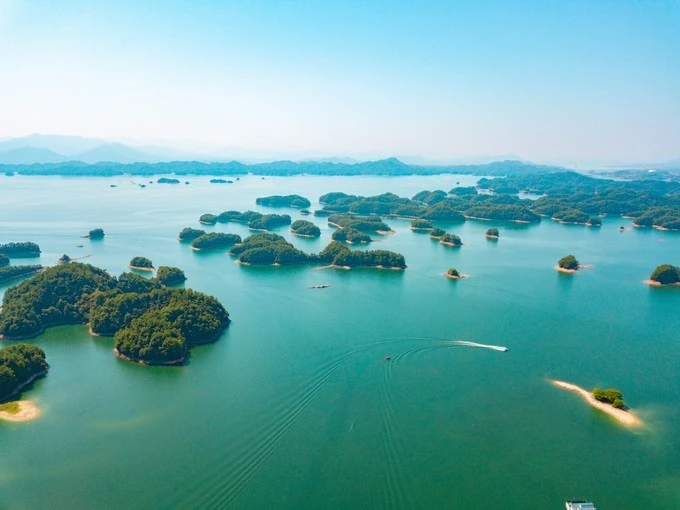
There are many kinds of beauty in this world, but one kind makes you miss it so much. I just left Qiandao Lake, and I'm already missing it, missing its vast expanse of azure blue that refreshes the heart and spirit, missing its islands big and small, scattered in a pleasing arrangement, lush and vibrant, and missing the delicious fish and shrimp in the lake, so tender, smooth, and unforgettable.
Qiandao Lake is famous for its many islands, 1078 in total, so the lake scenery is its highlight. The lake area is divided into two scenic zones: Central Lake Area and Southeast Lake Area. The Central Lake Area attracts more visitors, with famous islands like Meifeng Island, Yule Island, and Longshan Island. The Southeast Lake Area has slightly fewer tourists and features Huangshanjian, Monkey Island, and Bird Island. The choice depends on personal preference. We chose the two most classic islands, Meifeng Island and Longshan Island. Tickets were booked online in advance; we paid 280 yuan for the combo ticket including cable car. I recommend starting as early as possible to avoid delaying your subsequent itinerary.
Meifeng Island offers the best panoramic views among Qiandao Lake's many islands, the perfect spot to overlook the archipelago. It justifies the trip. 'Without ascending Meifeng to see the islands, you cannot grasp the true face of Qiandao Lake.' From here, you can overlook over 300 islands, making it the best high vantage point. There's a cable car to ascend directly; those with good stamina or wanting to exercise in the fresh air can also hike up. Whichever way you choose, you'll reach the summit and enjoy different scenery. Just do what suits you. We rode the cable car upward slowly, the sun's rays making everything dazzling. Lush trees covered the hillsides, dappling the bustling crowds. Blue sky and white clouds added charm to the picture. At the summit, I stood on the terrace, gazing out at the countless islands scattered like stars. The clear lake surface gleamed like a bright silver mirror. Sky and water seemed to merge. The breathtaking scenery was stunning. Meifeng Peak has an east viewing platform and a west viewing platform, with the best views on the west side. Looking down, islands cluster densely, the scenery superb—you can personally experience the poetic charm of 'green hills, clear waters, a golden belt.' Overlooking Qiandao Lake, the islands look like plum blossoms floating on the water, like stars in the Milky Way. Larger islands have crisscrossing harbors, painting a white arc of sandy beach between green islands and blue water.
Over five thousand plum trees of various types are planted here, mainly red, green, white, and wintersweet. When plum blossoms are in full bloom, this becomes a superb spot for viewing them. Unfortunately, we missed that sight, but there's always next time. One visit to Qiandao Lake is definitely not enough; you'll miss it when you leave. In the distance, layer upon layer of mountains undulate endlessly. The lake is so clear you can see the bottom. Sunlight glitters on the rippling water, with gentle breezes occasionally stirring up waves. Surrounded by mountains and rippling blue waves, the scene is so poetic that we felt completely refreshed and deeply intoxicated.
Longshan Scenic Area is located in the Central Lake Area of Qiandao Lake in Chun'an, about 5.5 km from the lake, with an altitude of 201.8 meters and covering 525 mu. It is a renowned clean-government education base in Zhejiang Province and a creative center of the China Artists Association at Qiandao Lake. The island blends cultural and natural scenery. Its name comes from the island's shape, which from afar resembles a black dragon playing on the water. Moreover, during the Southern Song Dynasty, Fang Fengchen, a zhuangyuan (top scholar) from Chun'an, built a hut on the southern slope of Longshan to give lectures. He was called 'Jiao Feng' (Dragon Peak), combining 'jiao' (flood dragon) and 'feng' (peak), and the island was named in his memory. Since ancient times, locals have viewed Longshan not only as a place of natural beauty but also as a symbol of Chun'an's talented and prosperous people. Visiting Longshan Island truly lets you appreciate the saying: 'Copper bridge, iron well, little golden mountain; stone gorge academy, lively Longshan.' Climb the bell tower to gaze upon the thousand islands, as if treading on a dragon to enjoy the scenery.
I was puzzled when I saw so many statues, but the tour guide said that Qiandao Lake is a place blessed with talented people, producing many famous scholars, all of profound knowledge. Longshan Island has an academy, and it's said that many students who studied there became juren (provincial graduates) or jinshi (imperial scholars). You have to admit the island has great feng shui for studying—likely a perfect combination of favorable timing, geographical advantage, and harmony. Unfortunately, there's no accommodation on Longshan Island; otherwise, many students would stay for a while, absorbing the spiritual energy while studying, then ace their exams. But since you can't stay on the island, staying right in Qiandao Lake works just as well. Housing in Chun'an County is much cheaper than in Shanghai or Hangzhou—just over 10,000 yuan per square meter. Or you could rent for a little over 1,000 yuan a month (I asked a local taxi driver, and he said a two-bedroom apartment costs just over 1,000 yuan per month). If your child can get into their dream school, what's that little money worth, right?
Hai Rui Shrine: Hai Rui, a native of Qiongshan, Guangdong (present-day Haikou, Hainan), was a famous incorruptible official of the Ming Dynasty, 440 years ago. He served as the magistrate of Chun'an from the fifth month of the 37th year to the seventh month of the 41st year of the Jiajing reign. To forever remember this upright official who dared to speak up for the common people, locals built a 'Hai Gong Shrine' in the old county town the very year he was transferred. In September 1959, when the reservoir area was relocated, the shrine's site was submerged. In the 1980s, the Chun'an County People's Government, to honor Hai Rui's clean governance and for tourism development, rebuilt the 'Hai Rui Shrine' using materials from an old shrine in the countryside, a restoration of the original. This shrine is the essence of Longshan Island. Four features stand out: First, the architecture with its carved beams and painted rafters, especially the exquisite wood, brick, and stone carvings (collectively called the 'three carvings'), is breathtaking. Second, the statue of Hai Rui inside the hall, the woodcarving murals on both sides, and the couplets and poems on the columns all manifest his unwavering integrity and righteousness, still relevant today. Third, the garden vignettes in the courtyard, themed 'lofty spirit' and 'upright character', are open and bright, well-arranged, with a pleasing mix of flowers and trees, making you linger.
Standing straight opposite the main entrance in the central hall is the famous 'Going-Away Remembrance Tablet'. 'Going-away remembrance' means that when Hai Rui left his post and bid farewell to the people, they continued to miss him. The tablet's history dates back to the 40th year of Jiajing (1561), when Hai Rui's term in Chun'an ended. As he set off for Jiaxing, the folks of Chun'an lined the roads to see him off. They also entrusted Chun'an's jinshi Xu Tingshou to write the 'Essay on the Going-Away Remembrance Tablet' and erected a stone tablet engraved with 'Going-Away Remembrance Tablet' in his memory. The Ming Dynasty tablet is now submerged; this one is a re-erected version, with calligraphy by Mr. Shao Huaze, former president of the People's Daily.
Hai Rui Shrine consists of five parts: Lake Viewing Platform, Gate Tower, Main Hall, Central Hall, and Si Xian Courtyard. It covers 625 square meters, with a building area of 547.1 square meters, and the main structure is 12 meters high. The architecture preserves the residential style of Chun'an while incorporating Huizhou-style features, with painted beams, carved rafters, and upturned eaves. Especially when standing on the Lake Viewing Platform, you can admire the shrine's architectural charm up close and gaze out over Qiandao Lake: a city among mountains, half the city is the lake—truly delightful and pleasing to the eye.
Hai Rui Calligraphy Corridor: These stone tablets feature poems by Tang Dynasty poets, re-carved based on surviving calligraphy of Hai Rui, hence the name. One standout is a uniquely charming wild cursive character for 'longevity' (寿). Popular legend says this character is composed of the four characters '生' (life), '母' (mother), '七' (seven), and '十' (ten). According to the History of Ming, Hai Rui, in his second year as Chun'an magistrate, 'bought two jin of meat for his mother's birthday.' Thus, judging from the character's form and strokes, it was written for his mother's 70th birthday. Moreover, when you turn this 'longevity' character upside down, it still reads as 'longevity'. With the guide's help, we even noticed the magic within: the character '母' (mother) is truly embedded inside the 'longevity' character, in the lower part where you'd find '寸'—take a close look and you'll see it. This shows Hai Rui's solid calligraphy skills and superb technique, which deeply impressed us. A talented scholar, a filial son, and an incorruptible official—such a person is truly rare!
The Unstained Pond: 'Stuck in the mire yet unstained by mud, the clear pool and green mound know each other well. Now officialdom is heavy with dust and filth, how many officials come to wash their clothes?' The name 'unstained' derives from this, signifying purity and elegance, walking through the world untainted by the muddy waters—this was Hai Rui's character as a politician and official. Viewing this pond naturally reminds visitors of Hai Rui, who worried for the country and people, unwaveringly maintained virtue, and remained spotless. His good name 'Hai Qingtian' (Blue Sky Hai) thus endures forever.
The Bell Tower symbolizes a warning bell constantly ringing. Alongside Hai Rui Shrine, the famous Song Dynasty Bell Tower echoes the spirit of Longshan. Standing in the center of flat ground, the tower has four floors. The base is shaped like a plum blossom geometric pattern, with the central courtyard 8 meters square. At each corner of the diagonal lines sit four small squares 4 meters square, symbolizing 'plum blossoms presenting five blessings', meaning good luck and auspiciousness. The tower's main structure is reinforced concrete, while the stairs, doors, windows, and railings are decorated entirely with mixed hardwoods, combining elegance and simplicity.
Another way to enjoy Qiandao Lake is to cycle around it. There are bike rental places; I recommend the 'Leyou Cycling' shop in Chun'an County. They have four-person canopied bikes, two-person bikes, and single bikes, all reasonably priced—perfect for young people. Check the price list: a single bike is 10 yuan per hour. What more could you ask for?
When tired, stop to rest and admire Qiandao Lake's beauty. Feel the gentle breeze caress your face, and the bright sunshine dispel your gloom. The endorphins from exercise lift your mood, making life feel wonderful and worth living. Taking pretty photos with your besties is also a joy!
Warm Tips: [Note] Depending on the season, Qiandao Lake's boat tour routes are divided into spring-summer and autumn-winter routes (separate routes apply on major holidays like May Day, National Day, and Spring Festival). Spring-summer routes run from April 1 to the end of October; autumn-winter routes from November 1 to the end of the following March, subject to change due to weather. Boat tours generally depart from two areas: Central Lake Area and Southeast Lake Area. Boarding points: Central Lake Area Wharf for the central zone, Southeast Lake Area Wharf for the southeast zone.
It miraculously 'revived' the ancient Chun'an Lion City, which had been sleeping underwater for 60 years with over 1400 years of history. The once-bustling streets, shops, and seven memorial arches (including the Yao family, meritorious service, chastity arches) have been recreated. Here you can experience ancient culture, taste traditional cuisine, and embark on a journey to uncover the past and present lives of the underwater city. In 1959, to build the Xin'an River Hydropower Station, the dam was built and the surging eastward Xin'an River was stilled. Lion City and He City, two thousand-year-old cities, sank to the bottom of Qiandao Lake together, and 290,000 people were relocated overnight.
My only impression of Lion City came from a set of underwater photos published by National Geographic, showing the ancient city sleeping at the bottom of Qiandao Lake. It was astonishing that many archways, houses, and courtyard walls still stood erect, not decayed, with sunlight penetrating the water like Buddha rays, making them look lifelike. It's a pity we can't see it in person due to the water. However, the Wen Yuan Shi Cheng (Cultural Lion City) in Jiangjia Town now revives the 1400-year civilization of the underwater Lion City, recreating its original scene.
The main street of Wen Yuan Shi Cheng is East Street, a straight avenue that runs through the entire area, with branching streets on both sides—one side leads to the lake, a short walk away, and the other to residences. Pause, lean on a railing, and look around. Memorial arches stand along the flagstone road, lined up in the lanes. Rows of tables and chairs line the street, with buildings on both sides mostly two stories high, varying in detail but consistent in color. Being in this ancient town feels like stepping back into the Republican era. The main street is full of shops. Along the street, there are free shadow puppet shows, and at set times, lion dances, flying knife performances, and bamboo horse dances, all distinctive. Recall that before 1959, Qiandao Lake was a vast area of peaceful villages, brilliantly lit at night. In Wen Yuan Shi Cheng, you can see embroidery workshops, shadow puppetry, and traditional hall performances. It's full of antique charm and deep heritage. There are scheduled lion dance performances that are spectacular—ask the staff upon entry.
What attracts me most about the architecture here are the upturned eaves, majestic, in typical ancient Huizhou style. I don't want to use clichés like 'white walls and gray tiles, high walls and deep lanes'—one glance says it all. Even though these buildings are reconstructed, I didn't tire of them; instead, the exquisite carvings and murals give a rich sense of history and culture. The street life murals seem to slowly transport me back to that sleeping underwater city. By the roadside are various lion statues—waving, bending down, lively or adorably clumsy.
Wen Yuan Shi Cheng tickets: Available on various online platforms for 70 yuan (excluding VR). Opening hours: 9:00–21:00. Travel tips: Best visited in any season. Suggested visit duration: half a day to one day.
Han Hong Mo Xiang Guan (Red Ink Fragrance Hall) is located at the foot of Kuiwen Pagoda in Jiangjia Town, right next to Wen Yuan Shi Cheng. After visiting Wen Yuan Shi Cheng, drop by and rest. This is currently the only museum in China that uses old newspapers as carriers, with multimedia exhibitions, to review the glorious journey of the Chinese nation standing up, growing rich, and becoming strong, and to show the development of Socialist Thought with Chinese Characteristics for a New Era. Invested with about 5 million yuan, it is planned and operated by Yanggu Cultural Development Co., Ltd., with three sections: 'Memories of That Time', 'Impressions of Old Times', and 'Miracles of Today', aiming to become the first national 'China in Newspapers' social media hot spot. Newspapers from the late Qing Guangxu period like Shen Bao and Jing Bao, from the Xuantong period like Beiyang Guan Bao and Shenzhou Pictorial, and from the Republic of China era like Ta Kung Pao and Jiuwang Qingbao... Walking into the exhibition hall, precious newspapers from different eras greet you. Historical events such as the founding ceremony and the resumption of college entrance exams are reproduced along a timeline. The heavy scent of ink lays out a red foundation; the lingering ink marks the path to national strength. From 1886 to 2019, thousands of old newspapers spanning 133 years are gathered here on exhibition. Ink and paper travel through time to narrate a century of China's development and recreate the great rejuvenation of the Chinese nation.
Xiashan Village Scenic Area is located in Xiashan Village, Fengshuling Town, Chun'an County, about a 40-minute drive from Qiandao Lake town. It is known as the 'place where dreams begin'. From 2003 to 2007, the then Secretary of the Zhejiang Provincial Party Committee visited Xiashan Village many times to conduct field investigations, acting as a guide for the village's poverty alleviation and prosperity, and wrote four letters to the villagers expressing deep care. It also served as a grassroots contact point for four provincial party secretaries, including Zhang Dejiang, Zhao Hongzhu, and Xia Baolong, always embodying the earnest hopes of higher-level leaders. It has received a series of honors: 'National Advanced Primary-level Party Organization for Striving for Excellence', 'Zhejiang Province Beautiful Countryside', 'Zhejiang Province Farmhouse Cluster Village', 'Zhejiang Provincial Party School Field Teaching Demonstration Base', etc. 'Xiashan Dream Pursuit' was named one of the New Ten Scenes of Qiandao Lake tourism, and Xiashan Village is now a national AAAA-level tourist attraction.
Our guide told us that Xiashan Village used to be extremely poor. Now, this once-notorious impoverished village has turned itself around, becoming a 'green, wealthy, and beautiful' village. Transforming from a mountain hollow into an industrial base and from a poor village into a beautiful countryside, it vividly demonstrates the principle 'lucid waters and lush mountains are invaluable assets' and sets a real benchmark for how rural areas in the new era can coexist harmoniously with nature and how farmers can achieve prosperity and well-being. The Xiashan Village we saw is truly beautiful. Uniform white walls and black tiles, surrounded by lush greenery, with a clear river flowing through.
Without the noise and traffic of the city, the village feels tranquil and clean. I could hear the crisp chirping of birds. Flocks of sparrows twittered, sometimes landing on wires like notes on a musical staff, sometimes hopping among branches, singing, and sometimes flying in the sky, tracing beautiful arcs.
In the countryside fields, the eye is filled with either yellow or green. Yellow for the vast rice paddies. In spring, they are lush green, like adorable grass or dressed in tender green attire. In summer, the wheat fields put on a dazzling light yellow new outfit, each stalk bearing plump ears, truly delightful. Almost every house has a vegetable garden beside it, growing organic greens that everyone loves—no pesticides or fertilizers, sweet and delicious. Spotting a ripe cucumber, we got permission from the local to break one off and taste it. That crisp freshness was amazing! A long-missed flavor, superb!
Recommended Boutique Itineraries: The scenic area offers abundant tourism activities, with free admission. There are three industrial parks: vineyards, strawberry farms, and peach orchards, forming a four-season fruit garden of 'peaches in spring, strawberries in winter, grapes in summer and autumn', where visitors can pick fruit in different seasons. The standard-built Wulangwu Hiking and Camping Base offers mountain climbing and scenic views. Activities include canyon cycling, water recreation, waterfront leisure, mochi-making experience, tofu grinding, bamboo crafts, and brewery workshops. You can easily spend a day or two here; it's perfect for a weekend trip with family to experience the beautiful new Chinese countryside.
We passed the village canteen. Our guide said it's a great benefit for the elderly: seniors over 60 eat for 3 yuan per meal, over 70 for just 2 yuan, while young villagers pay 10 yuan. The meal includes two meat dishes and three vegetable dishes, and tastes pretty good. Such prices are truly pro-people. We all loved this village and jokingly asked if they needed more residents.
This was also a filming location for director Xu Zheng's TV drama. The warmest episode of the movie 'My People, My Homeland', titled 'The Last Class', directed by Xu Zheng and starring Fan Wei, Zhang Yi, and Han Haolin, was shot at Qiandao Lake in Hangzhou. The main set was in Xiashan Village, Fengshuling Town, Chun'an—'where dreams begin'. We visited the classroom where Fan Wei's character taught, a simple space with the teacher's living quarters right next door, quite basic. This was a set built by the crew and now preserved for visitors. 'Some recent tourists said they came to Xiashan after watching the drama 'We Began at the Dream Place', to see this famous little village,' our guide said. Actually, Xiashan has always been well known, previously for its poverty—a local saying went: 'Mud-walled houses, half a year's grain; no girl will marry a Xiashan man'; now it's known as 'green, wealthy, and beautiful'. Xiashan has become a model village for beautiful countryside leisure tourism and a nationally renowned eco-tourism destination.
Currently, there are 23 farm stay and guesthouse businesses in the scenic area, including two boutique guesthouses, with 398 beds and over 1,000 dining seats. There are three meeting rooms of varying sizes, totaling about 600 square meters. The specialty dining features the Xiashan Family Banquet, made from local agricultural products.
Recommended Quality Agricultural Products: Dried sweet potato is a specialty of the 'Greater Xiashan' area, with a sweet, sticky texture and natural taste. These delicious strips bring real income to Xiashan Village; in just two months, a thousand elderly residents generated up to 20 million yuan in dried sweet potato sales. With abundant bamboo, dried bamboo shoots are a local specialty, along with dried plum vegetables and, by the way, sun-dried small river fish, which is also a hot-selling local product.
Huma Adventure Park Qiandao Lake: Those who have been all say 'the trip was definitely worthwhile' and shout 'I want to play again!' Located deep in the mountains of Chun'an at an altitude of over 800 meters in Qiushan Village, Jiangjia Town, Huma Adventure Park was built with an investment of 260 million yuan by Zhejiang Huma Tourism Development Co., Ltd. It's an international-standard, high-altitude mountain adventure park themed on outdoor thrills. Leveraging Qiandao Lake's unique natural landscape, it features many highly experiential, trendy adventure projects: the Cloud Top Skywalk observation deck with a span exceeding the previous Guinness World Record; a 4.6 km super-long track for mountain scooters; a free-speed glass slide; colorful cable cars soaring through the air; a screaming rainbow slide; childlike bouncing clouds, various swings, a viral shouting spring, lucky sandbags, a non-powered Ferris wheel, a viral body-print wall, and many other Instagrammable spots.
Amusement Projects: TOP1 Super Scooter: The track is 4.6 km long, winding around the mountains, both thrilling and joyful. The full ride takes about ten-plus minutes; the fastest reportedly finishes in 8 minutes. With unique brakes, riders can fully control the speed. It's the only unpowered vehicle experience in Chun'an offering such excitement.
TOP2 Glass Cantilever Viewing Platform: A must-visit spot at Huma Adventure Park. Truly the world's number one sky corridor, the platform extends 108 meters, over 40 meters longer than the previous Guinness record holder. Located on the peak of Jinshanjian, the highest summit around Qiandao Lake at over 800 meters, it is the best photography point. Built from welded steel structures, the platform floor uses three layers of tempered laminated glass, each pane capable of bearing up to 1 ton. Visitors can enjoy a 720° panoramic view of Qiandao Lake.
TOP3 Soaring Cable Cars: The best way to enjoy Qiandao Lake's scenery, which hiking can't capture. It's the longest cableway in Chun'an: Cable Car 1 is about 2 km long, taking around 30 minutes; Cable Car 2 is about 1 km long, taking 10 minutes. Each cabin seats 4, with no glass on the sides, allowing 360-degree views of Mount Qiu and beyond. The car's exterior has playful lettering and designs that will make you laugh, instantly dissolving any worries—hilarious!
TOP4 Dry Glass Slide: One of the scream-inducing attractions. In just two minutes, you glide down to the halfway point, replacing a 15-minute cable car ride. The first high-altitude, fully transparent glass slide in Chun'an, 480 meters long, from Jinshanjian peak to Gaoqiu Mountain. The ride takes about 4 minutes, with an S-curve design and double-layered tempered glass on the sides. Speed is fully controlled by you.
TOP5 Rainbow Slide: Not for the faint-hearted—this is a heart-pounding, thrilling ride. About 100 meters long, the drop from top to bottom takes just seconds. The feeling of rapid descent requires courage to try.
There's also an archery range, unpowered Ferris wheel, multi-person swing, shouting spring, bouncing cloud, and more fun activities waiting for you to discover. Archery is interesting; even beginners can easily pick it up—compare, draw, shoot, all in one breath, making you feel momentarily possessed by a Mongol archery master. The newly introduced rocket bungee is especially captivating. Two people sit, then shoot upward at rocket speed, do a flip in the air, and descend, experiencing the weightless thrust. You'll hear screams and shouts from above, and see two people suspended upside down, hair and feet aligned—a bizarre sight that makes onlookers gasp as well.
According to staff, future projects to be built include ATV off-road motorcycles, live-action CS, jungle adventure, slingshot participants, and camping areas. These are already in preparation. Huma Adventure Park is set to become a new landmark for Qiandao Lake tourism.
Friendly Reminders: Some attractions involve a certain level of excitement and are not recommended for those over 55; visitors aged 70 and above are kindly asked not to participate. Tickets available online: adult ticket 260 yuan, child ticket 140 yuan. For self-drivers, navigate to Danlingshang, Jiangjia Town, Chun'an County, or simply search for 'Qiandao Lake Huma Adventure Park'. Parking: approximately 10 yuan per hour, 50 spaces. Address: Qiandao Lake Huma Adventure Park Parking Lot.
Currently, the only water-stage nighttime live performance in China. Actors and audience feel as if they are at the bottom of Qiandao Lake. The show is divided into five acts: 'Ancient River Road', 'Majestic Mountain Tribes', 'Scenic Wen Chang', 'Great Undertaking of Mountains and Rivers', 'Elegant Waters, Splendid World'. 'Ancient River Road' tells the love story of boat trackers and tea-picking girls, recreating the tender stories behind the bustling Hui-Hang Ancient Road. 'Qiandao Lake: The Spirit of Water' is themed on water, set against the backdrop of 'Beautiful Jiangnan, Renowned Cultural Place', combining Qiandao Lake's landscape, local culture, and top Chinese artistic achievements into a signature performance. It blends artistry, shock, national character, and visual spectacle, creating the perfect pairing of daytime lake touring and nighttime 'Spirit of Water' viewing, elevating Qiandao Lake tourism culturally. Using top domestic creativity, technology, martial arts, acrobatics, dance, and Jiangnan folk music, it's a regularly staged show. With a surrounding giant screen, glasses-free 3D, internationally leading digital imaging technology, and a real-life 3D panoramic stage with the latest tech.
Act 1: 'Ancient River Road' – Through the love story of a boat tracker and a tea-picking girl, it tells of the bustling commercial route past Chun'an County on the Xin'an River waterway.
Act 2: 'Heroic Breeze of Qingxi' – In 1120 AD, Fang La's uprising pushed history forward, showcasing the resolute and fearless spirit of Chun'an people.
Act 3: 'Famous Cultural Place' – With Hai Rui's honest governance, the burdens on Chun'an farmers were lightened, and many fleeing households returned. People lived in harmony and joy, singing and dancing.
Act 4: 'Great Undertaking of Mountains and Rivers' – In 1959, to build the Xin'an River Hydropower Station, the dam impounded water, and 300,000 Chun'an residents left their homeland, giving rise to the 'underwater ancient city'.
Act 5: 'Elegant Waters, Splendid World' – The history underwater, the Qiandao Lake above; today, people live happily, enjoying the water. The waters show elegance to the world, and the world pursues elegant waters.
Address: 20 Zhenzhu Avenue, Qiandao Lake, Chun'an County, Hangzhou City, Zhejiang Province. Transportation: Bus 1. Tickets: 180 yuan/person. Opening Hours: Show starts at 20:00 every day.
During our days at Qiandao Lake, we stayed at the Atour Hotel near the Central Wharf. The rooms are spacious and elegant, the bedding comfortable, and the service good. Best of all is the breakfast restaurant on the 8th floor with a superb view of Qiandao Lake, absolutely beautiful and refreshing. Having breakfast with such a view really whets the appetite!
We had two Chinese meals in Chun'an County by Qiandao Lake, both excellent. The fish was tender, the dishes delicious—especially the fish head soup, milky white and fragrant, we had bowl after bowl.
We also had a Chongqing hot pot meal in Chun'an County. We never expected it to be so popular here—packed with people queuing for a number. The taste was decent; though they didn't have fresh tripe, other dishes were quite good. By our Chongqing taste standards, it was passable.
Dining spot in Xiashan Village: Red Horse Homestay. The food was good, all made from produce grown in home gardens without pollution, sweet and delicious.
About Long-Distance Transport: Shanghai to Qiandao Lake by round-trip high-speed train. With the opening of the Qiandao Lake high-speed rail station, a new era of high-speed rail tourism has begun. So we set off from Shanghai on a weekday to witness the much-heard but rarely seen wonders of Qiandao Lake. There are quite a few high-speed trains from Shanghai to Qiandao Lake from morning to night; you can choose one that suits you. The journey averages about 2 hours, quite short. For the return trip, decide based on your itinerary. Since the high-speed rail station is a fair distance from the county town where Qiandao Lake scenic area is located, most hotels are concentrated in Chun'an county town, centered around the lake area. So we also stayed in the town for convenient dining and shopping. However, many vacationers prefer quieter, more secluded hotels with lovely environments and prices. Since we were just there for sightseeing, we naturally chose the more convenient town. From the station to the hotel, two options: 1) Taxi, about 80–100 yuan. 2) Hotel shuttle bus, two lines, fare 15 yuan per person. For convenience, choose a hotel along the route, and the bus will stop right at the door. We chose Atour Hotel on Line 002, with nice scenery and decent facilities; crossing the road brings you to Central Lake, very convenient for touring.
Qiandao Lake: Rolling mountains, lush forests, mountain breezes and the roar of pines. Climb to the summit and gaze afar at a thousand peaks vying in beauty, myriad ravines dripping green. The high gorge, the calm lake, green waters like a mirror, shimmering with ripples. Fish leap from the lake, eagles soar in the sky, a dome of azure with drifting clouds. Gentle breezes cleanse worldly thoughts, thin clouds softly soothe body and soul. A lake of clear water reflects the sky's smile, the country's spiritual charm gathers among the verdant mountains. Cup your hands to hold the moon reflected in the water, and the fragrance of flowers clings to your robe. Here, I felt a heart-stirring beauty. With such beauty at Qiandao Lake, what are you waiting for? Come visit soon! This National Day, Qiandao Lake awaits you!


