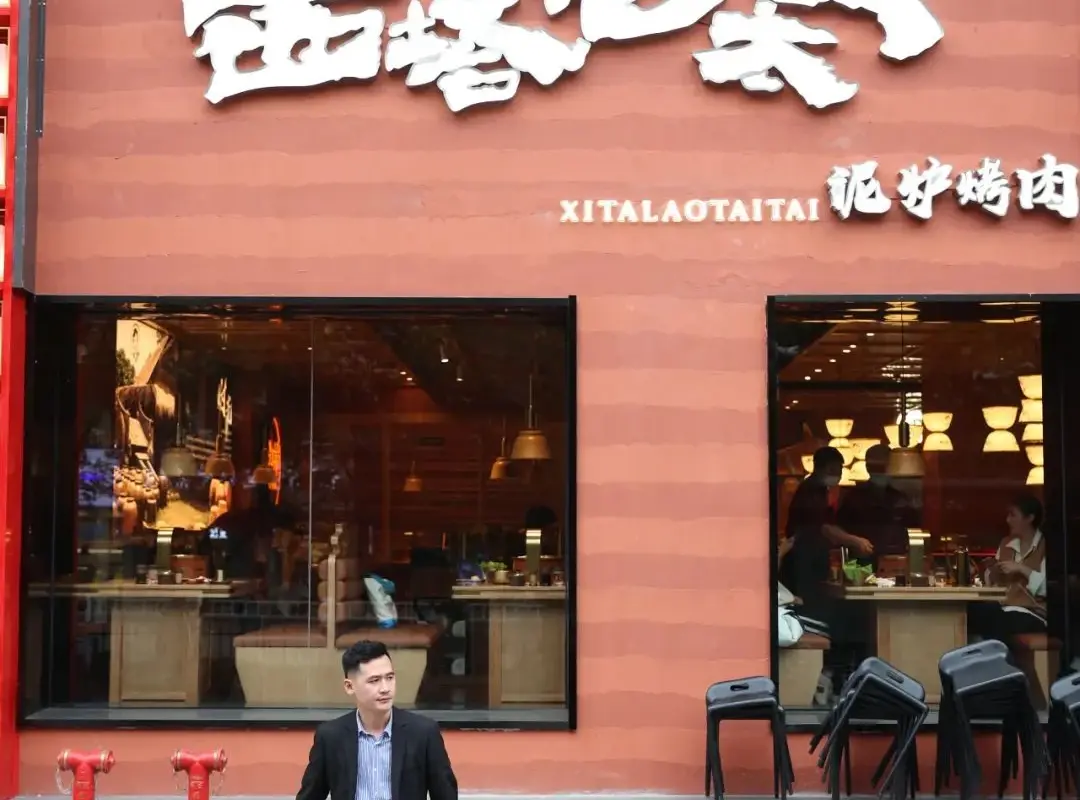
Night Snack Jianghu: The Zenith of Chinese Barbecue — Xita Granny | Operations Boss Fu Jiajun: Our Meat Slicers Are the Cream of the Crop
[ Barbecue]
When barbecue season comes, I find myself missing Xita, the birthplace of 'Xita Granny' — the undisputed summit of Chinese barbecue. Right now, if you put a plate of Xita grilled meat and a handsome guy on the table and asked me to choose, guess what I’d pick... When most people meet Fu Jiajun, the operational mastermind behind Xita Granny, all they can think is 'hunk,' but my mind is far less ambitious — all I can think about is Xita’s barbecue.
Anyone who’s been to Xita will understand my affliction. As lanterns flicker on at dusk, the glistening fat on the meat awakens in the smoky twilight haze, catching tiny sparks in the air and dancing a sultry dance. That’s Xita’s unique perfume, seducing every carnivorous heart that beats for meat.
If I were a clickbait writer, I’d pen 'The Carnal Tales of Xita,' but the true stories that unfold here aren’t lurid — just maddeningly aromatic.
Old Xita (image source: Internet)
“A decade or so ago, back when my father was young, Koreans would spend their weekends in Xita. Xita had everything — food, drink, entertainment. It was a Korean hub. Even with flights and accommodation, it was cheaper than back home. The Northeast has always been big on meat; in the South, people don’t eat as much beef, but here, beef and lamb are the easiest to find. Barbecue is convenient to make, and in the early days of the Northeast’s development there was plenty of labor. Barbecue is quick and perfect — the Northeast is cold, and you need protein to keep warm,” said General Manager Fu.
Surrounding old Shenyang were four pagodas, each with a Lama temple beside it. Yanshou Temple, located in the west, earned the name Xita (West Pagoda). Shenyang’s unspoken rule of hospitality isn’t the drinking toast Southerners might expect, but an age-old custom where the first and last meals must be Xita barbecue. Otherwise, as locals say, 'You haven’t treated your friends right.' Behind-the-scenes investor Zhang Yifan laughs: 'That’s exactly how I was looked after, and I fell hard for barbecue. Now, whenever I’m in the Northeast, I do the same for every out-of-towner. As a Hangzhou native, I have to say, Northeast barbecue culture is even more bewitching than the accent!'
“Most of us don’t know much about North Korean culture. Xita has a large Korean-Chinese population, and many were originally defectors. Like that night — it was windy and snowing heavily, and a man rode his bike here and ordered 20 skewers. Auntie asked, ‘It’s past eleven, who’s eating?’ He said, ‘Poor Auntie, I’m buying these for you.’ Hardship is the fortune of the future, the transformation from bitter to sweet.” I recalled a book I read long ago, *Nothing to Envy*, about North Korean defectors, and only then did the subtext dawn on me. Many defectors live under new names, giving everything to start over.
There’s a saying: ‘For Chinese barbecue, look to Shenyang; for Shenyang barbecue, look to Xita.’ Ever since I visited the original Xita Granny in Shenyang, anytime I hear that seemingly boastful claim, all I can do is nod.
Fu Jiajun says, 'The first episode of the food documentary *Late Night Bites* was all about Shenyang — they filmed at Xita Granny’s BBQ joint.' True beauty never fades! Every time I think of Xita in Shenyang, my gaze sizzles with a Maillard reaction, crackling and fragrant!
Her name is Li Lianhua, of Korean descent, the living icon of Xita Granny BBQ. Now almost 80, the old lady still tends her shop in Shenyang’s Xita district.
“Granny set up in Xita selling her homemade skewers. She started doing barbecue in her late 40s. While other night stalls packed up at seven or eight, hers kept going till midnight. Many customers came just for Granny Li, eating by the roadside for decades. Back then it was mostly Koreans and ethnic Koreans; now all kinds of barbecue lovers make the pilgrimage. Granny’s gone from a roadside stall to a cozy late-night spot that seats nearly ten.”
Fu Jiajun’s parents ate there through their courtship and even after he was born; now it’s become family tradition. A few years ago, by chance, he connected with Xita’s founder and they talked about spreading ‘that taste’ far and wide. And so, Xita Granny, with her grill and aroma, journeyed across the country to the south — first Shanghai, now Hangzhou.
I later realized that if barbecue is a delicious art, then Xita’s artists turn the ingredients into finished works before you ever take a bite.
Slicing beef has its subtleties. For tougher cuts, experienced chefs use a meat mallet or the back of a knife to tenderize the fibers, or sever the sinews with the tip of a blade. Cutting at a right angle can make the beef softer on the palate.
Even the seemingly foolproof ‘steak’ cuts require careful handling! Usually, the steaks we eat come from rib eye (rib eye roll), tenderloin (also called fillet), and strip loin (also called sirloin) — the top three premium cuts. Rib eye comes from the back behind the shoulder; its fine grain and excellent marbling make it the tenderest cut, which is where most steaks come from.
Strip loin sits right next to the rib eye, in the middle of the back. The marbled beef we call ‘snowflake’ comes from here; it was once knighted by a British king — the ultimate cut. Because it’s so fatty, steaks from this part should be sliced thinner. Our metabolic and exercise habits differ from Westerners’, so without proper wine pairing, too much fat can leave a greasy mouthfeel and upset stomach.
Tenderloin is lean but still finely textured, ideal for grilling or frying — a favorite among the Japanese. The thickest part of the tenderloin, sliced thick and pan-fried, becomes the Chateaubriand steak celebrated by French novelists. Asian gourmands who’ve tried it swear it’s the finest cut.
Xita Granny’s premium snowflake beef
Cuts go by different names in different places, but Xita Granny’s premium snowflake beef actually refers to that Chateaubriand cut. It’s low in fat, tender, and sweet. I watched the deft Mr. Fu grill it gently, then whisk it off the fire saying, ‘Quick, eat!’
In Japan, I eat Wagyu; in Korea, Hanwoo is the top choice. But in Xita, I go for the local Northeast yellow beef. Fu says his discerning family has eaten through generations and found that the water buffalo common in the south simply isn’t as good as Northeast yellow beef. ‘With modern logistics, we can get fresh Shenyang beef right away, which meets our barbecuing standards.’
Just like in Chaoshan beef shops, Fu says the highest-paid staff at Xita Granny’s are the meat cutters. They use a slicer for thin-sliced beef belly and pork belly, but everything else is hand-cut. ‘And even with the same cut, ours is better — because our cutting technique is more professional. The principle is: for any given piece of beef, even if everyone starts with the same cut, we maximize its potential through the slicing. Take beef rib fingers — our butchers know to cut along its unique grain, ensuring satisfaction in both texture and chew.’
House-special rolled beef ribs
The diaphragm is the best cut for charcoal grilling. It’s attached inside the abdominal cavity; chefs gently break up the connective tissue with an angled knife. Considered part offal, thicker sections can even be steak. With just the right amount of fat, it’s soft and tender. It looks like beef belly, but is lower in calories.
Xita Granny’s heavyweight diaphragm
Charcoal burns at high temperatures — 300°C instantly denatures the surface proteins, locking in the meat’s rich juices.
What sets it apart from ordinary meat: the stove and the dipping sauce
“Personally, my own tastes are quite light. I don’t use dipping sauces for hotpot. At home, I only cook steak — good beef seared on both sides, I like it medium-rare or medium. I only add salt.”
“It’s a matter of taste. Some places think that serving the meat as-is is best, but our job is to bring out the best flavor. That’s what marinating does — it’s not about masking. Xita’s seasoning first preserves the beef’s flavor, then melds with it, ultimately enhancing the overall taste. We position ourselves as Korean-Chinese barbecue. To me, barbecue is barbecue, no matter how grand; the form is the same. There’s no real distinction between Japanese or Korean styles — Mexican is something else entirely. What matters is good meat, and the key is flavor: different sauces and seasonings.” In response to my slightly impertinent question, Fu answered without missing a beat.
Investor Zhang Yifan adds: ‘When I was very young, my father wanted to open a barbecue restaurant in Hangzhou. He was worried whether Southerners would take to it. But after we opened, we found that good food wins everyone over. The key is the sesame paste. Southern guests have all been happy with it so far — they like our flavors.’
As Mr. Fu grilled like a gentleman, unhurried, he explained the dipping sauce details: ‘Nearly all of Xita Granny’s seasonings and products are proprietary, from the marinade to the dry dipping mix. Sesame paste is a time-honored staple in the Northeast.’
‘To make our sesame paste, Xita uses white sesame from Pingyu County, toasted until fragrant and then ground. That’s the premier sesame-producing area in the country — sparse population, plenty of land, abundant sunshine. The northern black soil is uniquely blessed for growing white sesame.’
The distinctive Northeast-style sesame paste is mixed with soy sauce and white vinegar — the soy sauce adds umami, the white vinegar dissolves the congealed sesame paste. The aroma is instantly intoxicating!
‘The sesame paste is specially paired with the Granny series. The barbecue sauce is an all-purpose sauce, and our dry seasoning isn’t your usual spicy. The chili is different — not just plain dried chili, but a complex blend.’
Granny’s special fatty-lean
Granny’s special fatty beef
‘More than twenty years ago, Granny Li Lianhua faced the wave of layoffs. Just as the stories say, she was already over seventy and kept on grilling. Since this place has always been about Korean-Chinese skewers, they pile on the chili — so red — but when you eat it, it’s not that harsh heat, it’s a fragrant, savory spiciness.’
Local Xita chilis (image source: Internet)
Only then did I learn that the foundation of Granny’s Korean-Chinese flavor is a long-kept secret chili blend. Xita grows many varieties — mildly hot, very hot, and even non-spicy — with different aromas, tastes, and aftertastes, ground together in a secret ratio. The resulting powder is fragrant more than fiery. A sprinkle during grilling brings out a toasty aroma; a final sprinkle before serving seals the deal.
‘Another crucial point is the clay stove. Chinese Koreans share similar eating habits with those in both Koreas, and the clay oven was passed down from Korean culinary tradition. The oldest Korean method is exactly this — the earliest Korean-Chinese barbecue culture used stoves made of yellow clay. Even baked goods there came from clay ovens. In the earliest days, both in Northeast China and Korea, food was cooked over fire in clay stoves, which hold heat exceptionally well.’
I’ve traveled to many countries that cook with earthen ovens — Greece, Italy... even Arabic naan tastes best from a clay oven. The magic is that food in the fire pit heats quickly and evenly, all while being wonderfully energy-efficient!
Xita Granny’s stoves are all custom-made, surprisingly equipped with an air damper. When closed, the lack of oxygen makes the temperature drop; when opened, the stove maintains a constant heat. Traditional clay ovens are yellow, bright or dull, but Xita Granny’s are enamel-finished. This tradition, elevated, quietly transforms the aroma, crispness, moisture, grilling time, and how the stove works. ‘It’s different from the earliest stoves — there’s design and ingenuity in it, and the meat comes out exceptionally delicious,’ Fu says.
‘Actually, Korean-Chinese people aren’t as conservative as the stereotype says. With technological progress, we’ve absorbed a lot of modern trends and hope to change perceptions through these small design touches.’
Candied strawberries (image source: Internet)
After polishing off the barbecue, I fell for Xita’s signature dessert, ‘Iced Sugar Strawberries’ — strawberries steeped in sweet yellow peach syrup. Northern kids love cracking open a can: after canned yellow peaches, canned strawberries are the second holy grail.
That icy, crisp sweetness gives the tongue a little rest between sizzling bites of meat — like a deep-winter night in old Xita, Shenyang, when a traveler on the street pulls his coat tight and hurries along, and just then, a warm red glow shines his way.
Do you love barbecue?
— from 'Ximen Xing' by Han Yuefu
Food bless you!
Advisor, China International Food Expo
Producer, 'A Divine Table'


