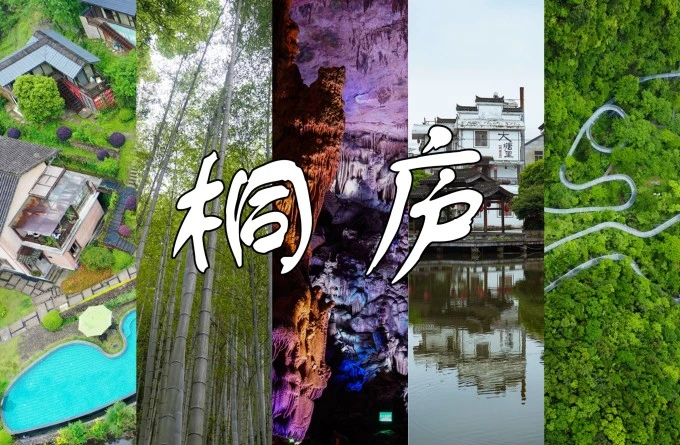
Tonglu Trip: Three Days and Two Nights of Poetic Landscapes Reminiscing Jiangnan
[Preface] Poetic Landscapes, Carefree Tonglu
Just over an hour's drive from Hangzhou lies a place whose landscapes are second to none, renowned since ancient times for its 'verdant mountains, clear waters, long history, and secluded beauty.' It is hailed as the 'real-life Dwelling in the Fuchun Mountains' and the 'Maldives of China.' Dubbed by overseas visitors as a 'My Neighbor Totoro-style pastoral world,' this is one of China's most beautiful counties. It even served as a filming location for the second season of the popular reality show Back to Field. Tonglu is the only Chinese destination named by National Geographic in its '25 Best Travel Destinations in the World for 2021' list. Before we could fully savor the romance of spring, summer has already hurried in. Pack your good mood and step into this charming small county for three days and two nights, to seek poetic landscapes and embrace a carefree, romantic journey~
[Itinerary Preview]
Day 1: Hangzhou – Dipu Flower Sea – Lunch (Xiaoyi Dipu Farmhouse) – Yan Ziling Diaoyutai – Accommodation (Luci Village)
Day 2: Luci Village – Qinglongwu – Tongjun Mountain – Lunch – Yaolin Wonderland – Dalu Village Fenshui Yincong Rural Resort Hotel
Day 3: Fenshui Yincong Rural Resort Hotel – Baijiang Town – Lunch (Tianzi Di) – Tianzi Di Scenic Area – Return
[Day 1] A Colorful Tonglu – Visit Dipu Flower Sea
Spring is the season for flowers, so how can you miss the vibrant world of blooms on this trip? The first stop on our Tonglu journey: Dipu Flower Sea. Dipu Flower Sea showcases the unique pastoral scenery of this beautiful countryside, complementing the thousand-year charm of the ancient village. Together, they paint a beautiful picture where classical village elegance and modern life, stunning natural beauty and profound cultural heritage, blend seamlessly.
Around the May Day holiday, it’s just the best time to admire the flowers at Dipu Flower Sea. Corncockles, corn poppies, Roman chamomile, calendulas, and baby’s breath are all in full bloom this season.
Entering Dipu Flower Sea, a kaleidoscope of colorful flowers stretches dreamily for several kilometers. In this idyllic, painting-like countryside, you can soak in the unique charm of the flower sea—every snapshot turns into a stunning photo.
It was also here that the 'Remembering Jiangnan: Tonglu Fuchun Mountain Residence' self-driving tour convoy officially set off, kicking off a poetic, carefree journey through Tonglu.
This year's People's Day event was packed with highlights, with waves of people-benefiting policies. Among them, the 'Remembering Jiangnan Blind Box Opera Week' series became the most delightful cultural feast.
The ancient villages of Jiangnan—comprising Shen’ao, Huanxi, and Dipu—each have their own character, yet all share an antique charm: ancient stages, ancient water systems, ancient architecture, exuding a natural artistic ambiance.
Tonglu is known as the 'cradle of Yue Opera talent,' having nurtured five winners of the China Theatre Plum Blossom Award: Xie Qunying, Shan Yangping, Chen Xiaohong, Chen Xueping, and Wang Hangjuan. Ancient villages need art to draw crowds, and art needs settings to come alive. An immersive ancient village Yue Opera performance found its perfect intersection here.
The 'Remembering Jiangnan • Blind Box Opera Week' used the ancient Jiangnan villages as an immersive experience setting, turning each old building into a blind box. These enclosed buildings are opera blind boxes infused with Tonglu’s Yue Opera culture. Tourists could purchase an opera blind box, then follow a map to unlock each box one by one, with a chance to win a 2,888-yuan cultural tourism grand prize.
The prizes included homestay vouchers, cultural tourism product coupons, etc. Through the creative concept and modern expression of opening blind boxes, the event aimed to make more young people fall in love with traditional culture, attract more visitors to check in and spend, and help cultural tourism businesses recover and grow.
— Xiaoyi Farmhouse
For lunch, we chose Xiaoyi Dipu Farmhouse near Dipu Flower Sea. The owner was very welcoming, and the place was bustling with customers who came by reputation. The restaurant was converted from an old house, a typical Hui-style building with white walls and grey tiles, mostly wooden structures inside, with tables, chairs, and windows full of a sense of history.
The farmhouse mainly serves rustic country dishes. The presentation might not compare to city restaurants, but the flavors are genuinely authentic. From divine chicken, braised pork, oil-braised shrimp, steamed fish, wild bamboo shoots, broad beans with minced meat, crispy fried Ding-fish with salt and pepper, vegetable soup, stir-fried lettuce, sautéed garlic scapes with cured meat, dry-pot cauliflower, and bittern tofu… every dish was a delight for the taste buds.
— Yan Ziling Diaoyutai
In the afternoon, we headed to Yan Ziling Diaoyutai Scenic Area, a 40-minute drive from Dipu Flower Sea. Yan Ziling Diaoyutai is located on the banks of the Fuchun River, 15 kilometers southwest of Tonglu county seat. Legend has it that this was where Yan Ziling, a reclusive scholar of the Eastern Han Dynasty, lived in seclusion and fished. The main activities in the scenic area include a boat tour through the Longmen Gorge section from Qililong to Yan Ziling Diaoyutai, and visiting the hill where the Diaoyutai stands to see historic sites and overlook the picturesque Fuchun River from the top.
After entering the scenic area, we first bought tickets at the visitor center, right next to the boat dock. The boat ride on the river was delightful, with lush green peaks on both banks and mist-wreathed clouds. This is the very essence of the most poetic Jiangnan.
Getting off the boat, there were some historical sites at the foot of the hill, the most famous being the ancient archway inscribed with 'Yan Ziling Diaoyutai,' which is the most photographed spot by visitors. There were also other sights like the Yan Ziling Memorial Temple and the 'Nineteen Springs of the World' to explore.
In addition to these, the scenic area now offers an immersive landscape theater performance as part of the tour. Check-in points such as 'Forest of Steles Welcoming Guests,' 'Lu Yu Asking about Tea,' and 'Ancient and Modern Words at the Shrine' were set up. Actors played roles like scholars and woodcutters along the route, creating immersive experiences with scenes like poets reciting, sages playing chess, fishermen fishing, woodcutters carrying firewood, and herb gatherers collecting herbs. Through their dialogues, visitors could 'unlock' these carefully performed 'mini-plays' step by step while climbing the mountain, personally experiencing the reclusive culture of 'fishing, woodcutting, farming, and reading,' and learning more about the stories behind Yan Ziling Diaoyutai.
— Artistic Luci Village
The artistic allure of Luci Village has never been unfounded. It has poetry, as Tang Dynasty poet Fang Gan wrote: 'A crane circles far, casts itself toward a lonely isle; cicadas drag fading sounds past other branches.' It has paintings, like the one Li Keran painted over 60 years ago titled Every Household in a Picture Screen…
Luci Village is nestled in the scenic Jiangnan Longmen Bay, facing Yan Ziling Diaoyutai across the river. It was originally called Luci Bay because cormorants once fished here, hence the name 'Cormorant Village,' which later evolved to Luci Village. Also known as Longmen Bay, it is where the upper reaches of Luci Stream and Dayuan Stream merge into the Fuchun River, with a small island jutting out from the water, resembling two dragons playing with a pearl.
Walking into Luci Village presents a splendid scene of a beautiful new countryside. Numerous elegant homestays are built by the water, with carved beams and painted rafters, lush flowers and plants, overflowing with poetry.
Luci Old Street lies at the heart of the village, less than 200 meters long, paved with bluestone slabs crisscrossing, slightly yellowed and shiny, giving off a faint gleam. Along the old street, grand Ming and Qing dynasty buildings huddle together, mostly two-story tiled houses with blue bricks and black tiles, arranged in an orderly rhythm, emanating an ancient aura.
The root carving gallery, pottery workshop, and assembly hall all stand on this old street, narrating the prosperity of the past and the slow-paced life of today’s beautiful countryside.
Luci has a long history and is a place of exceptional talent. It is the hometown of Tang Dynasty poet Fang Gan and has produced eighteen jinshi (imperial scholars). From the Northern and Southern Dynasties to the Qing Dynasty, famous scholars and poets like Xie Lingyun, Li Bai, Su Dongpo, Lu You, and Li Qingzhao visited, leaving behind thousands of well-loved poems. Fan Zhongyan, the renowned Northern Song statesman and writer, visited twice and penned famous works such as Leaving an Inscription for the Former Residence of Recluse Fang Gan, Presented to Scholar Fang (Kai), and Lodging at the Former Residence of Recluse Fang Gan, expressing his deep affection for this place.
[Day 2] Fresh Tonglu – Mountain Dwelling in Qinglongwu
Qinglongwu is a cluster of ancient hamlets hidden deep in the mountains and forests of Tonglu, Zhejiang. It gets its name from a stream that flows through the area. Many enjoy driving here to stay for a few days and quietly relish the slow mountain life.
The essence of mountain living lies in going to bed early and rising early to reclaim a rhythm of life that city holidays often lack. The morning sunlight is gentle, and the scenery outside is impatiently brimming with the joy of nature’s revival. Floor-to-ceiling windows blend the living space with the natural environment, letting sunlight pour in unobstructed from all angles.
Qizhu Boutique Homestay is one of the most experiential accommodations in Qinglongwu, quietly secluded at the source of the Fuchun River, possessing its own peaceful corner. Amidst mountain birdsong, pine fragrance, forest brooks, it presents urbanites with everything they imagine about pastoral life.
Qinglongwu also houses a trendy countryside book bar transformed from an old house – Yan Ji You.
With its unique design, layered bookshelves, and a dazzling array of books, find a quiet corner, grab a cup of coffee, open a good book, and a gentle turn of a page leads to an afternoon of leisure.
— National Heritage Site: Tongjun Mountain
Legend has it that during the Yellow Emperor’s time, an old man built a hut here to make elixirs and provided free medical services to the people. Grateful villagers asked his name; the old man didn’t answer but pointed at a tung tree, so they called him 'Old Man Tongjun.' Later generations revered him as the father of traditional Chinese medicine, making this the sacred land of medicinal herbs. The mountain was named after him, and the county became Tonglu.
The sacred land of medicine, Tongjun Mountain, stands at the confluence of the Fuchun River and Tianmu Stream, rising abruptly by the riverside, separated from Tonglu town by just a strip of water. It is also known as Little Jinshan and Floating Jade Mountain, and is 60 meters high. With two rivers embracing it, a solitary peak jutting out, clear pools of deep green, lush and verdant woods, and groves of slender bamboo providing shade, it is one of the scenic spots of the Fuchun River. Behind it are deep valleys and rolling mountains; before it stretches the boundless plain; beneath its feet flows the mighty river. The terrain is both perilous and beautiful. From the summit of Tongjun Mountain, you can gaze far and see the misty rain scenery of the Fuchun River. In the late Qing Dynasty, Liang Qichao likened it to a corner of Mount Emei, while Kang Youwei declared that even all the peaks of Emei could not match this wonder.
Inside Tongjun Temple, a group of life-sized colored statues of famous doctors through the ages, measuring 25 meters long, 4.2 meters high, and 1.4 meters wide, venerates Elder Tongju as the originator of ancient Chinese medicine. Historical medical sages like Bian Que of the Spring and Autumn and Warring States periods, Zhang Zhongjing of the Eastern Han, Hua Tuo of the Three Kingdoms, Ge Hong of the Eastern Jin, Sun Simiao of the Tang, Wang Weiyi of the Song, Li Shizhen of the Ming, and Wang Qingren of the Qing gather in one hall. Thus, the baton of Chinese medicine has been passed down through the generations like a relay race. Hence, later generations revere Tongjun Mountain as the sacred land of medicine.
— Dining at Xinlong Fishery
For lunch, we chose a farmhouse restaurant near the river, Xinlong Fishery. It’s said to be quite well-known locally. The environment is very pleasant, and you can often see bamboo rafts plying the river right in front. Just thinking about the freshness of the catch, the food promises to be delicious.
Stir-fried chicken, local pork, river shrimp, braised creek fish, starch dumplings, vegetable-stuffed fried tofu rolls, ham with green peppers, stir-fried small potatoes, broad beans, river snails, young bamboo shoots, steamed fermented tofu… All prepared in authentic farmhouse style, it was the truest taste of the countryside.
— Visiting Yaolin Wonderland
According to the Records of Tonglu County during the Qianlong reign of the Qing Dynasty: 'Yaolin Cave, forty-five li northwest of the county. The cave mouth is over two zhang wide. Descending steps for more than five zhang, there are cliffs, ground, pools, and chambers. The walls have five-colored patterns resembling clouds and brocade. The springs produce eight distinct sounds like drums, qin, and sheng. Human voices and sounds of dogs are startling and strange. Truly a place where immortals gather…' It shows that as early as long ago, Yaolin Wonderland was already a top destination for travelers.
Entering the scenic area, above the downward-sloping cave entrance, four large characters are engraved: 'Yao Lin Xian Jing' (Yaolin Wonderland). Inside the cave, it’s warm in winter and cool in summer, lit by colorful lights, deep and long.
Yaolin Wonderland consists of seven cave halls. After passing through a fluorescent corridor, you first enter the antechamber. Not large, it is elegant and gentle, much like a Jiangnan water town. Following this is the grand 'Lion and Elephant Greeting Guests' naked-eye 3D light show. In this vast underground world, modern technology projects the evolution of Yaolin Wonderland over ten thousand years onto the colossal rock surfaces, creating an immensely shocking visual.
Yaolin Wonderland, hailed as the 'Crown of All Caves in the Country,' features bizarrely shaped and exquisitely crafted stalactites. Characterized by its 'seclusion, depth, strangeness, and beauty,' it stands out uniquely among the nation’s karst caves. The 'Four Landmarks of Yaolin Wonderland,' each with its own distinctive features, are the treasures of the cave.
The entire walking tour takes over an hour. Of course, the most spectacular part is the naked-eye 3D stalactite light show in Yaolin Wonderland. Employing modern high-tech sound, light, and electrical technologies, it leverages the cave’s unique topography and historical cultural clues, weaving in a storyline that lets visitors travel from the prehistoric Yaolin Cave to the modern Yaolin Wonderland, experiencing the wondrous sensation of 'a day in the cave, a millennium in the human world.'
After exiting the cave, we encountered a thematic creative installation scene called 'A World of Trees and Forest.' The displays here all have cute names: 'All the Way with You,' 'Fish Searching for Water,' 'Angel’s Wings,' 'Rainbow Tunnel,' 'Everything Can Be Chess'… Adorably lifelike animals, stylish and avant-garde creative ornaments, and toys full of 'rural flavor' are so delightful you can’t help but take a photo with them. Oh, and don’t forget to grab a Yaolin Wonderland cultural ice cream, available in three different flavors. Besides visual and experiential memories, leave with a sweet taste of this place.
— Slow Time at Yincong
Arriving in Tonglu, you realize this is a place where there’s never a shortage of poetic mountain-and-water scenery. In Fenshui Town, stay amid poetic landscapes at the Yincong Rural Resort Hotel and enjoy slow living. The hotel has 78 guest rooms, situated on the meandering Bagu Mountain along the Fenshui River.
The pure white exterior design enhances the building’s clean lines, appearing understated yet sophisticated, hidden among the green mountains and waters. With a restaurant, bar, coffee shop, children’s play area, and a river-view infinity pool, it meets almost all your expectations of ideal mountain living.
The rooms feature extensive use of linen and natural wood tones, with quilts carrying the reassuring scent of sun-drying. As soon as you walk in, a warm, cozy comfort envelops you.
Every corner of the hotel is a photo spot, whether it’s the minimalist spatial lines of the stairway corridor or the warm-toned infinity pool at sunset, you can snap vacation-worthy pictures in no time.
[Day 3] Carefree Tonglu – Colorful Baijiang Town
Driving from Fenshui Town to Baijiang Town, the road is filled with lush spring scenery. In Fengjia, Baijiang Village, we encountered the 'Colorful Homestay Cluster.' Buildings painted in blue, white, mint green, cream, and light blue contrast beautifully with the vibrant green pastoral valleys, creating a vividly colored 'rainbow dreamscape.'
Once a shabby, backward mountain village, it has now transformed into a beautiful colorful homestay area—a dream and expectation for many. Today, strolling through the Colorful Homestay Cluster, clean, bright colored paths wind along the Luofo Stream. A childlike shared vegetable garden lets visitors relive childhood farming memories. A former garbage dumping ground has been turned into a green, low-carbon 'Instagrammable' parking lot. Courtyards once messy have become relaxing, beautiful gardens for tourists.
— Dining at Tianzi Di
From Baijiang Town, it’s a 10-minute drive to Tianzi Di Scenic Area, the last stop of our three-day, two-night trip to Tonglu. Lunch was at the scenic area’s restaurant. Stone-pot chicken, cured meat and bamboo shoots stew, sizzling shrimp with garlic, special roasted cured sausages, fish head and tofu stew… the ingredients were fresh and flavors delicious. I never expected such a sumptuous meal inside a scenic spot. Satiated, we officially kicked off our eco-adventure at Tianzi Di.
— Eco Tianzi Di
Tianzi Di, as the name implies, is tied to the folk legend of a young emperor. It originates from the birthplace of Liu Yu, Emperor Wu of the Southern Song Dynasty over 1,600 years ago, and its name has remained unchanged for millennia. It is praised as 'embodying all the beauty of Tonglu’s Fuchun River landscapes.' This place is outwardly elegant and inwardly intelligent—outside, lush forests, dense foliage, and babbling streams; inside, magnificent karst caves and murmuring underground rivers. A step back leads to an earthly paradise; a step forward, to a vast world~
Taking the unique 'magic carpet' conveyor belt up the mountain, we ventured deeper into the beauty of Tianzi Di. Compared to cable cars, the magic carpet is not only easy and convenient but also safer.
Tianzi Di's mountains are lush and the air fresh. Walking along the popular 'Purple Silk in Delicate Hands' skywalk, the picturesque beauty broadens the mind, sweeping away fatigue. Snow-white, slender hands seemingly hold up the walkway, allowing visitors to traverse through dense forests and mist, as if in a fairyland.
The Bauhinia Cliff Glass Viewing Platform is a newly built popular attraction at Tianzi Di. Like a lotus flower, the viewing platform stands between heaven and earth, with ten-thousand-foot cliffs below and overlapping peaks beneath. Stepping onto the transparent glass, your whole body seems suspended mid-air. In the distance, poetic landscapes; up close, refreshing nature.
The most fun activity at Tianzi Di is the Zilong Gorge High-altitude Glass Drifting, currently recognized as the world’s longest drift of its kind. High-speed gliding and 360-degree loops are guaranteed to make you scream uncontrollably.
Spring fades and early summer lengthens; the breeze warms the world with the fragrance of plants. Time flies so quickly; summer is almost here. Pack your cheerful heart and embark on a carefree trip to the magnificent Tonglu. In three days and two nights, discover poetic landscapes~


