Forget Fickle Hearts: China's Traditional Flower Pastries
[ Fancy pastry ]
Traditional flower pastries, adorned simply with red and green candied winter melon, are already seductive enough to be called the Ximen Qing and Pan Jinlian of pastries. With roses, osmanthus, or pine pollen, they become even more extraordinary, worthy of the title 'queen of flowers'.
Ancient flower pastries fell into two categories: those for nourishing the body and those for nourishing the heart. As for pleasing the eye—by today's hyper-competitive aesthetic standards, the ancients weren't quite capable of that.
In fact, in Tao Gu's 'Qing Yi Lu', which excerpts the Sui dynasty text 'Shi Jing' by Xie Feng, we find items like 'Flower-shaped Goose Cake', 'Purple Dragon Cake', and 'Added Butter Cold White Hanju'. The first two are pictorial; the last, 'Hanju', is perplexing.
Actually, during the Sui and Tang periods, people commonly called deep-fried dough twists 'hanju', and 'chewing hanju can startle people ten li away'.
The 'Ju Sheng Nu' at the imperial 'Shaowei' banquets during the Tang dynasty's Jinglong era sounded more enticing than 'Crystal Dragon-Phoenix Cake', but we later learned it was simply fried dough twists.
My personal view: just enjoy the wordplay and don't take it too seriously.
Tangyuan (sweet rice balls) weren't invented until the Song dynasty. Pastries before the Qing dynasty were straightforward folk 'flowering up' in name, function, and symbolism. That fits perfectly with the subtle sensuality of Eastern culture!
Even the Qing dynasty might not measure up. The great gourmand Yuan Mei swore only by Liu Fangbo's mooncakes and the Ming family's flower-edged mooncakes. He praised them thus: 'You pinch the edges into a water-chestnut flower shape, leave the jujube skin on for freshness, and don't pre-cook the oil for its raw essence. It melts in your mouth, sweet but not greasy, light yet not crumbly—the artistry lies entirely in the pinching, the more the better.' In plain terms: all hand-made flower mooncakes are delicious.
Wang Shixiong's 'Suixiju Diet Manual' from the Qing dynasty records two typical flowers used in pastries: osmanthus and pine pollen. Fine food tangled up with medicine is like courting a beauty by saying, 'I love you because I need to continue the family line.'
Osmanthus is 'acrid and warm; eliminates odors, awakens the stomach, and resolves phlegm.' Pine pollen 'mainly nourishes blood and calms wind; overconsumption can cause heat. Taken alone, it treats chronic diarrhea, adjusted with a decoction according to symptoms.'
Now when I pass Hangzhou's venerable pastry shop Jiangnanchun and see the golden pine pollen cake, two words flash in my mind: 'blood tonic'—just like seeing pork liver or date paste.
名称:松花糕
品牌:江南春
Jiangnanchun's owner told me: Hangzhou folks believe eating pine pollen reduces inflammation (good for the stomach). Pine pollen cake is made with rice flour and slightly sweet, but it's still popular because pine pollen tastes unappealing without sweetness.
Eighteen years ago, I was that kid glued to the pastry shop window, unable to leave. My love for flower pastries was far deeper than for the flowery hair ribbons my mother tied for me.
I've long known that pastries split into northern and southern schools. The 'Northern School,' with its rugged look, is typified by Beijing-style treats. The one I can't get enough of is the 'Jujube Flower Pastry'—jujube paste filling, wrapped in a flower-shaped flour dough made with lard and water, baked until crisp, fragrant, and utterly satisfying.
名称:枣花酥
品牌:采芝斋
Caizhizhai's jujube flower pastry is a classic: the shell is crisp and flaky, the jujube paste rich and intense. They've sold it for decades. Caizhizhai was the place in Hangzhou twenty years ago with the widest array of pastries. Before Chinese New Year, my family always brought me here to buy their watermelon seeds, but I was far more obsessed with their sweets and snacks, tasting everything through tears and tantrums.
品牌:采芝斋
Their New Year Cake is special, studded with rose petals. This pastry has been around since Caizhizhai's founding in 1928. It's called 'niangao', but it's actually a fermented rice cake, not the glutinous rice niangao typical of Jiangnan. Quite sweet, with red rose juice and rose petal garnish on top.
In truth, Huaiyang-style flower pastries are the epitome of vibrant, aromatic beauty. Originating from Ming and Qing dynasty 'boat banquets,' their allure surpasses even the imagined bed of Ximen Qing. When writer A Cheng visited Venice, he carried a copy of 'Yangzhou Huafang Lu' (Records of the Painted Boat of Yangzhou)—the romance of this 'Eastern Venice' had flown to Italy.
Inviting traders in the Wu region for business discussions, boat cuisine became a social tool. A Wu-style banquet began with cold dishes and wine appetizers, followed by stir-fried courses, interspersed with exquisite dim sum, and finally the grand dish, often fish, for a lucky 'surplus' wish. The chefs, understanding diners' psychology, made pastries ever more delicate, as if carving beams and painting eaves.
During the Ming and Qing, not only merchants and officials, but also scholars and artists enjoyed banquets on pleasure boats. Pastries not only needed to be delicious, but also fragrant, soft, glutinous, smooth, fresh, and shapely, to perfectly reflect the host's refined taste. In 'Dream of the Red Chamber', the exquisite dim sum Granny Liu enjoys on her second visit to the Grand View Garden is precisely this boat-style pastry.
At that time, pastries finally had the chance to evolve into 'eye-pleasing' types. Like me, the late Ming literary giant Zhang Dai adored Hangzhou. In his 'Tao'an Meng Yi', he recorded 'hawthorn ding', 'hawthorn cake', 'pine nut candy', 'white balls', 'olive preserves', and 'bone-in abalone snails'—concrete proof of the exquisite categorization of flower pastries.
The hawthorn ding was originally for offerings or display. Ancient people took rituals around pastries seriously. Later, the divine hawthorn ding merged with the human hawthorn cake. I boldly speculate that a key element in Beijing's 'Eight Pieces' snack set traces back to this, often appearing as a plain hawthorn calzone with, at most, a little rouge-red flower stamp on top to hint at hidden delights. Suzhou's hawthorn cake, on the other hand, shed its armor entirely, a square, ruby-red jelly-like beauty, proving that in pastry-making, the south is far more uninhibited.
And the most over-the-top must be the 'bone-in abalone snail' from 'The Plum in the Golden Vase'—a flower pastry with a devilish allure. Cream blended with mutton fat and honey (for stickiness), drizzled into ice water and swirled into snail shapes, became the 'abalone snail.' In Lu You's poem 'Phoenix Hairpin', 'red crispy hands, yellow vine wine'—that 'red crispy hand' describes his lover Tang Wan's girlish hands, as delicate as rouge-tinted pink cream. In fact, a playboy like Zhang Dai was the original instigator, dipping his fingers in rouge to create a maidenly version of 'bone-in abalone snails.' The ostentatiousness in the mouth, in ancient times, could be a tribute to heaven, a display for grand occasions, or even a poetic tool for flirting.
Suzhou locals might just smile and say, 'Our history is long, and we draw clear distinctions.' Traditional Suzhou sugar niangao comes in two types: white sugar osmanthus niangao and brown sugar niangao. Lard niangao is typically large, in four flavors: rose, mint, jujube paste, and crystal. The most common are red rose and green mint, topped with osmanthus flowers, evoking 'Joyous Red and Pleasing Green' from 'Dream of the Red Chamber.' When making it, they mix in sugar-cured pork fat that has been marinated for at least three days, so the sugar fully penetrates. One bite and from the depths of your soul you'll cry: So fragrant!
名称:玫瑰酱蜜糕
品牌:江南春
Jiangnanchun's Rose Sauce Honey Cake is essentially the Suzhou-style lard niangao, studded with rose petals in every bite, intensely fragrant with roses.
On the eleventh lunar month (Winter Solstice Festival), Suzhou children, like those all over Jiangnan, eat winter solstice dumplings. In the twelfth lunar month (lead-up to Chinese New Year), little ones who get a piece of lard niangao consider it heaven. But no matter how eager, you can't eat it raw—the lard bits are cured raw leaf fat, so lard niangao is a semi-finished product. It looks the least 'flower-like,' yet it's the most flower-filled, with all those lard blossoms inside!
Slice the lard niangao. One way to eat it: beat an egg, coat the niangao slices with egg wash, and pan-fry. Another way: wrap it in a spring roll skin and fry. Suzhou people always have fried niangao for their afternoon snack on New Year's Day. You can also wrap lard niangao in spring roll wrappers and deep-fry until crispy outside and gooey inside. With different flavored niangaos, you get mint or rose spring rolls. Osmanthus dumplings, red bean dumplings, and fermented rice dumplings play supporting roles.
As early as the Song dynasty, the saying 'When Suzhou and Huzhou have a good harvest, the whole empire has enough' was common, and pastries were part of that grain-first thinking. In calligraphy, you have the Four Masters of the Song: Su Shi, Huang Tingjian, Mi Fu, and Cai Xiang. For pastries, the golden age came in the Qing dynasty. In the first year of Daoguang (1821), Huang Qiting from Cixi, Zhejiang, ventured to Suzhou. He settled in the bustling Changmen area, which Cao Xueqin praised as 'the most prosperous and romantic place in the mortal world,' and founded what became the oldest surviving pastry shop, 'Huangtianyuan.' At the time, Huangtianyuan, alongside Yanjufu, Lewanxing, Xiefuyuan, and Liudexing, were known as the 'Four Pillars and One Main Beam' of the trade, and famously 'Huang, Yan, Le, Xie plus a Liu.'
Though Jiangnan people love sweet and glutinous treats, they're also masters of wordplay. The 'Southern School' of pastries essentially originated in Suzhou. Suzhou people are meticulous in their 'flowering,' strictly following the seasonal rule: spring pancakes, summer cakes, autumn flaky pastries, winter candies. Whether it nourishes the body is debatable, but for the heart, the names at least carry 'beautiful wishes' or 'auspicious meanings.'
In 'Prosperous Suzhou', a painting by Qing court artist Xu Yang, you can see the refinement of Suzhou flower pastries. Locals preferred to eat and gift pastries according to special customs, as clear as 'Number One Scholar Fragrant Cake'. In the painting, near Mudu's Xiqiao Bridge, a tea snack shop hangs five signs: 'Milk Curd Crisp', 'Osmanthus Dew', 'Jade Dew Frost', 'Number One Scholar Cake', and 'Grand Historian Cake (also called Grand Tutor Cake)'—each pastry had its own specialty store, showing how advanced it was.
My good friend 'Little Sister' is a Suzhou foodie. She told me her childhood Chinese New Year memory is her mother slicing sugar niangao, dipping it in egg white, and frying it—so fragrant. Every first day of the lunar year (Spring Festival), Suzhou's 'Four Famous Pastries' take the spotlight: white (or brown) sugar osmanthus niangao, rose-mint lard niangao, eight-treasure rice, and small rice balls. Kids must have them all. Eating them symbolizes a year of happiness and prosperity (homophone with 'high'), reunion, and sweet togetherness.
Suzhou also has an interesting 'Waist-Supporting Cake' for the elderly, made from steamed glutinous rice flour, longer and thinner than sugar niangao. 'Sliced niangao cut into short strips, pan-fried in oil to a tender golden hue. Year after year, it supports the waist against the wind; no wonder Wu maidens have slim waists.' This refers to the 'oil-fried niangao' of the second day of the second lunar month. Suzhou seniors typically buy waist-supporting cake at century-old shops like Wanfuxing and Huangtianyuan. Qing scholar Cai Yun in 'Wu Yu' described: 'On the second day of the second month, spring is in full sway, we urge each other to eat flower cake to support the waist. To manage firewood and rice, rely on a strong body; don't begrudge a year's hard work.' 'Flower' here, like spring blossoms, signals life's vigor, and 'waist-supporting cake' rightly qualifies as a spring tonic.
Count on your fingers: Suzhou's calendar of pastries is long! First lunar month, day 15 (Lantern Festival): sugar soup rice balls. Third month, Qingming Festival: green rice balls. Fourth month, day 14, 'Squeezing with the Immortals': Immortal's Cake. Fifth month, day 5 (Dragon Boat Festival): zongzi. Sixth month: mung bean cake, mint cake, rice maple cake. Seventh month: cowpea cake, red bean cake. Eighth month, day 15 (Mid-Autumn Festival): osmanthus strip cake, mooncakes, osmanthus sweet potato, osmanthus taro, stewed lotus root. Ninth month, day 9 (Double Ninth Festival): Chongyang cake. Tenth month: pumpkin rice balls... When pastries reached Hangzhou, they just sold everything all at once!
名称:双酿团
品牌:江南春
Hangzhou's double-filling roll has always been the best-selling pastry. Very mild; the outer glutinous rice ball has no seasoning, with bean paste and sesame paste only at the core—hence 'double filling'. A hit for decades.
If you must name a seasonal flower pastry, 'Lotus Cake' only half counts—it's not necessarily eaten in summer, just generally meant for children and the elderly. The instructions say to soak it in cold boiled water (or drinking water) until it softens. I steamed it in a double boiler, but didn't see the paste spread into a lotus shape. In the end, it was just a mushy mess; I could only imagine 'Moonlight over the Lotus Pond' in my mind.
The texture is somewhat like the legendary Soft Fragrant Cake from Yuan Mei's 'Suiyuan Shidan': 'The best is from Dulin Bridge in Suzhou. Next is Tiger Hill Cake from Xishi's home. Third is from Bao'en Temple outside Nanjing's South Gate.'
名称:荷花糕
品牌:江南春
The instructions say: 'Then mix with minced meat, fish paste, carrot puree, etc., according to taste, and serve.' Seeing the amount of beef I added, it's clearly an overage baby's lotus cake. This over-a-century-old Hangzhou pastry is tastier than expected!
When I was little, what I ate most were red yeast-tinted bean paste 'Victory Cakes' (Dingsheng Gao). 'Suzhou people eat a lot of victory cakes for weddings, births, and house moves,' Little Sister said. Originally called 'Prosperity Cake' or 'Ding-Sun Cake'. Legend says during Emperor Gaozong's Jianyan era, when Jin general Wuzhu retreated from Lin'an and entered Suzhou, the Song army won a great victory, and the Ding-Sun cakes sent by Suzhou people played a big role. Because 'Ding-Sun' sounds like 'Ding Sheng' (sure victory), General Han Shizhong named it 'Victory Cake'. Since 'Victory' is an auspicious pun, Suzhou people ever since have used it for birthdays, graduations, celebrations, as gifts for relatives and friends, and for beam-raising ceremonies, and also as banquet fare.
名称:定胜糕
品牌:江南春
Jiangnanchun's victory cake is stamped with a calligraphy combination of 'longevity' and 'ding' (an ancient cauldron), with 'ding' above and 'longevity' below, preserving the ancient meaning while adding aesthetic innovation.
Growing up, I could eat two pieces of the pine cake at Taipei's Grand Hotel in a row—it turned out to be the traditional Suzhou red bean pine cake. The simple ratio of lard to rice flour is the secret to a paradise for the palate, yielding a texture both fine and airy. Suzhou elders go to Suzhou Guixiangcun for a simpler version, while someone like me, who loves red bean or pumpkin pine cake, can hit Zhou's pastry stall outside Jingwen Primary School on Pishi Street. Kids studying there are so lucky!
Happiness, at least in pastries, cannot be compared.
Victory cake is now a standard exam-day breakfast for many students. But in ancient times, scholars ate something better! 'Wu's Home Cooking' records that the dry rations scholar-officials brought to imperial exams were actually Five-Spice Cake: 'Top-grade white glutinous rice and regular rice in a 2:8 ratio (or 2:6 according to another text), one part dried foxnut, and a total of one part ginseng, white atractylodes, poria, and amomum.' Besides strengthening the spleen, stomach, and qi, the homophone of 'cake' (gao) and 'high' implies rising step by step.
And after passing the exam, the 'Great Endurance Cake' from 'Shanjia Qinggong' was popular among Song dynasty bureaucrats: 'Take large, fresh plums, peel and pit them, blanch in water with white plum and licorice, then stuff with a mixture of honey, pine nuts, olive kernels (peeled), walnut meat (peeled), and crushed melon seeds, fill full, and steam in a small pot until cooked. This is called Endurance Cake. If not fully cooked, it harms the spleen.'
One glance at the recipe tells you: before the exam, it's hurry-up cake; after, it's leisurely cake.
As fancy pastries spread from Suzhou to Hangzhou, they took on a style closer to Zhu Yizun's Qing dynasty 'Shi Xian Hong Mi'. For example, his rose cake is not as syrupy as today's Yunnan rose cakes: 'Crush roses, remove the juice, use the pulp with white sugar, and press into cakes. Rose and osmanthus, when juiced, still retain fragrance; other flowers won't work—chrysanthemum flowers and leaves can also be juiced. Osmanthus cake uses the same method.'
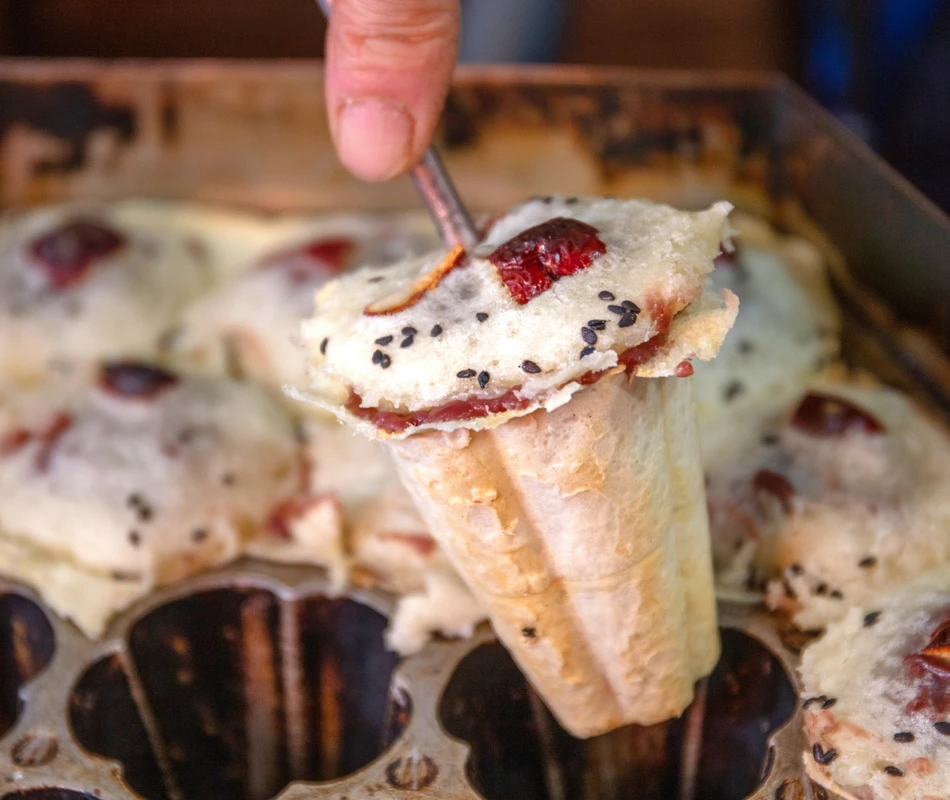
And inside, the 'Imperial Rose Fire Cake' seems to have been lost due to its complexity: 'One jin of flour, four liang of sesame oil, four liang of white sugar melted in hot water, mix well and make into cakes. Fill with prepared rose sugar, add walnut halves, hazelnuts, pine nuts, melon seeds, almonds boiled seven times and peeled, mint and fennel powder blended in as filling. Stick sesame seeds on both sides, cook until hot.' Actually, this style is closer to today's Suzhou crabapple cake, with nuts, and when fresh out of the oven, it's irresistible. It can have bean paste or pork filling, topped with candied winter melon, pine nuts, and melon seeds—incredibly sweet and fragrant. Crabapple cake is named for its flower shape, but like plum blossom cake, the shape is there but the flower is not.
Plum blossom cake is larger on top, smaller at the bottom, five-sided, with bright red and green candied threads on the surface and oily scallion bits embedded on the sides—whatever crabapple cake has, it does too. I remember eating them as a kid and getting my whole face messy!
名称:玫瑰鲜花饼
品牌:采芝斋
Caizhizhai's fresh rose petal cake has a relatively low moisture content in the filling, fairly dry. But the petals are pure and plentiful, with little syrup. The taste is quite light, perfect for those of us wary of sweetness.
名称:荷叶酥
品牌:采芝斋
The ancient 'burnt salt cake' with sesame oil, white sugar, salt, pepper powder, and fennel powder has morphed into today's 'Lotus Leaf Crisp'.
The savory lotus leaf crisp, with a hint of sesame and peanut fragrance, is full of nostalgia, yet remains plainly 'flowered' in a rustic way. During lean times, a new generation of pastry masters emerged, and Hangzhou's 'Zhiweiguan' rose to fame with cat-ear noodles, lotus pastries, Longjing tea pastries... becoming new favorites and even intangible cultural heritage.
Late at night, when hunger strikes, I still long for 'Plum Blossom Soup Noodles' from 'Shanjia Qinggong'—the only romantically inspired flower pastry in ancient texts. Sadly, it's lost; you'd have to make it yourself!
Listening to the story, you can almost smell the plum blossoms at Lin Hejing's home. 'A lofty hermit on Zimao Mountain near Quanzhou once prepared this dish. First soak white plum blossoms and sandalwood powder in water, mix with flour to make wonton wrappers, then use a five-petal iron mold to cut out plum blossom shapes from each stack. After boiling, transfer them into clear chicken broth. Each guest receives only two hundred-plus blossoms; imagine a meal where one never forgets the plum. Later, poet Yutang Yuangang wrote: "As if beneath Lonely Hill, flying jade floats on West Lake."'
Just thinking about this ethereal scene makes me hungry in a lofty way. I'd better go downstairs and buy a flower pastry to satisfy my craving. Beauty may lie in the distance, but eating comes first!
What's your favorite flower pastry?
"The perfect duty is to accept dreams."
—Borges
Food Bless You!
Consultant, China International Food Expo
Producer, 'The Divine Table'


