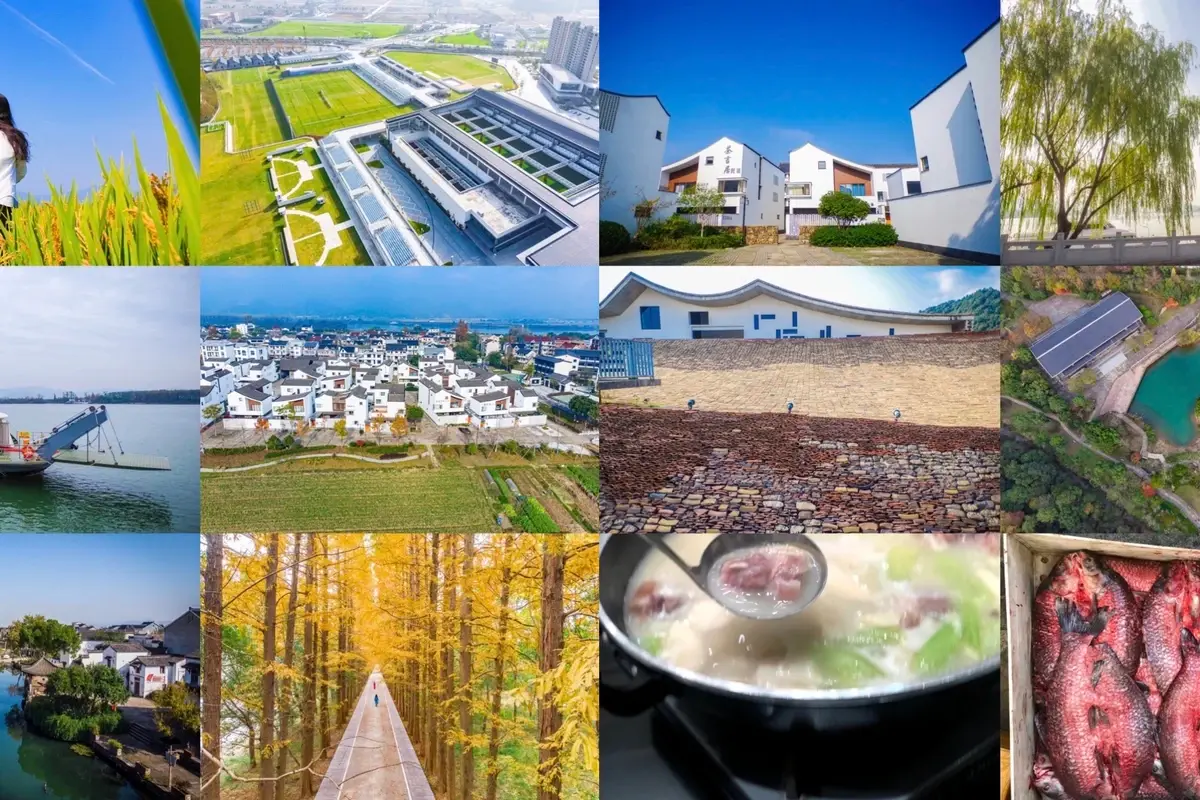
Fuyang in the New Asian Games Era: Tracing History and Admiring Wu Guanzhong's Most Beautiful Jiangnan
"Dongziguan is on the east bank of the Fuchun River. The Qiantang River takes a turn at Fuyang, and from there upstream it becomes the Fuchun River, the east-west current shifting to a north-south course..." In his 1932 short story "Dongziguan", Yu Dafu painted with a few strokes the picture of a once bustling ancient port with rows of shops and thriving trade.
Upon arriving at Dongziguan Village, you immediately sense something different. Ahead stretches a vast green field, and behind it rows of intriguing Chinese-style residences. Viewed from a drone, it's exceedingly spectacular. Dongziguan lies below Tongzhou Island, where two branches of the Fuchun River merge into one. By the riverbank, traces of the old dock and ancient post road remain vivid. One can imagine that in olden times, as a water checkpoint on the Fuchun River, Dongziguan might not have been bustling with noise and excitement, yet it must have enjoyed a self-sufficient and prosperous livelihood.
Here at the village entrance, these dwellings feature distinctive shapes yet maintain a sense of unity. Some have been converted into guesthouses. Dongziguan Village is an ancient settlement along the Fuchun River, once prosperous thanks to its river and wharf. In his story, Yu Dafu depicted an old port village brimming with shops and thriving commerce, and introduced readers to a life by the riverside: serene, leisurely, tranquil, and content.
After renovation, Dongziguan now shines as a beautiful village of Zhejiang-style folk houses. Crisp white walls, gray roofs with fish-scale tiles — these new residences blend seamlessly with the remaining ones from the 1980s and '90s and the ancient upturned-eave buildings from the Ming and Qing dynasties. The gently curving, elegant rooflines and bright white façades, rendered with minimal abstract strokes, evoke the grace of a Jiangnan home. Like a fresh, gentle ink-wash painting, they stand by vast yellowing rice paddies, as if nature itself had painted a 'Dwelling in the Fuchun Mountains'.
These dwellings are gentle and understated, simple yet grand. From afar they blend into the countryside; up close, they break free from conventional forms. Step inside — each house has three small courtyards: a front courtyard with pleasant greenery, a middle one for relaxation, and a back courtyard for storage. They are both pleasing to the eye and practical.
The village architecture resembles a Jiangnan garden — what you see from the left looks like something, from the right it's another view. No matter the angle, it's always a delight. This must be the ingenious ideas of the designers from Longkou.
Rooted in cultural tradition, the architecture embodies the spirit and character of Jiangnan folk houses. Following this line of thought, the "New Hangzhou-style dwellings" did not slavishly copy the typical Shikumen gates, gable roofs, and plank walls of Hangzhou houses. Instead, they drew inspiration from Wu Guanzhong's imagery of Jiangnan homes, skillfully blending the traditional slightly curved and upturned roof forms, then through abstraction and reconstruction created asymmetrical and continuous roof slopes. This is truly a path of its own, a unique creative idea.
This is the village cultural hall — isn't it especially unique, very different from ordinary halls? It has a two-story structure, and the entire building is designed based on ancient Chinese residential architecture, giving it a lasting appeal.
In the village's open ground, local Fuyang villagers dry their homemade vermicelli. It's said to taste fantastic, made purely from local sweet potatoes with no additives — none of that high-tech stuff — so you can eat it with complete peace of mind.
A building alone has no soul; its soul comes from people moving in, planting trees, raising flowers. Now and then, a blossom might brush your cheek. Whether it's bougainvillea or pomelo trees, they all thrive here. Against the blue sky and white walls, the sight lifts your spirits.
Every building is exceptionally distinctive, just like the poem says: 'Seen from the side, a range; from the end, a peak — differing in height, near and far.' You'll never tire of looking.
There's a local legend called 'Pleading for Fish by the River.' It tells of Xu Yu, the ancestor of the Xu clan in Dongziguan. Because his mother loved fish, he moved the family to settle by the Fuchun River in Dongziguan. Every day, Xu Yu ensured his mother's meals included fresh fish. One day, he was unwell and didn't catch any fish. Soon, his mother fell ill from not having fish for several days. It was deep winter, freezing and snowy, and fishermen could not go out. Xu Yu searched the whole village but found no fresh fish. So he went to the riverbank and wept facing the Fuchun River. As he wailed, suddenly two fish leaped onto the shore. He took them home and served them to his mother. Shortly after, she recovered. Word spread that Xu Yu's filial piety had moved heaven, thus he received the fish. Later, when his mother née Sun passed away, Xu Yu kept vigil at her grave for three years. The local magistrate reported this to the imperial court, and in the year 986 AD, Xu Yu received official commendation.
Every village has a pond, and this one lies on the west side. The water is so clear you can see the aquatic plants at the bottom, a sign that it's a living water source. An elderly woman washes vegetables here, a little dog wanders nearby — it's a scene brimming with the warmth of daily life.
To this day, Dongziguan Village has preserved nearly a hundred Ming and Qing-era buildings intact, such as the Xu Family Mansion, Anya Hall, and Yueshi Temple. It also boasts many valuable historical sites, like the remains of the official boat dock and the ancient post road.
An ancient camphor tree in the village is 800 years old, and the Yueshi Temple by the river was built in the 18th year of the Jiaqing reign. With water transport declining and land routes rising, plus ever-accelerating urbanization, Dongziguan gradually became a name few bothered to inquire about over the past three decades. The Fuchun River banks are never short of poetic, picturesque water towns. Compare with the ancient village of Shen'ao in Tonglu, just three kilometers away, where four distinct hamlets — Shen'ao, Dipu, Huanxi, and Xufan — vie for resources and tourists, a quiet rivalry. Dongziguan's quietness and desolation instead exude a sense of being above the fray.
The festive New Year atmosphere is already thick here, with pig heads, chickens, ducks, fish, and meat hung out — all goodies essential for the holiday. If you come on a rainy day, you'll feel the quaint tranquility; walking through the village in a drizzle, your mood settles into the calm of the old town. On a sunny day, the tranquility feels deep and far-reaching; long, drawn-out street cries echo around corners, and the green river surface seems to tell its own stories. Long alleyways and smooth, dark flagstone paths make you almost see the passersby of time.
The large salted black carp must be for making dried fish. The owner is very busy; if you ever get a chance to eat at his place, be sure to try the delicious dried fish.
Fuyang's specialty fermented-rice buns — they actually don't taste of alcohol at all, but the buns are wonderfully springy. You could easily eat three in a row. Pity I forgot to buy some on the way back.
Fuyang's stinky tofu differs subtly from other Jiangnan varieties. For someone like me who doesn't eat it often, it's hard to tell, but old-timers can distinguish whether it's from Fuyang, Shaoxing, or somewhere else. The slight difference in taste preserves their local character.
When I first saw the Fuchun Mountain Pavilion, its shape and structure closely resembled a museum I'd visited before — the Ningbo Museum. A quick online search confirmed they were designed by the same architect. The Fuchun Mountain Pavilion comprises three institutions: the Gongwang Art Museum, a museum, and an archive.
Backed by hills and facing the river, this architectural complex is the largest-scale work by Professor Wang Shu, Dean of the School of Architecture at the China Academy of Art, created after he won the Pritzker Prize. It's an iconic building in Fuyang District and a crucial piece in the unfolding poetry-and-painting tapestry of Jiangnan. Professor Wang Shu has more works in Fuyang, including a quaint, artsy Yi Ju Wen Village that's beautiful, fun, and livable.
The Fuchun Mountain Pavilion sits on the edge of a scenic area beyond the highly urbanized core of Fuyang City. To its east flows the Fuchun River, to the north rises Lu Mountain. Facing the water, the complex looks out over high-rise residential blocks behind and ahead, while farther west the green hills undulate, much as Huang Gongwang depicted a millennium ago. At the center, the 'main mountain' houses the museum and art museum; parallel to it, the 'secondary mountain' contains the archive. The depression between them becomes a 'valley' within the mountains. The office building behind forms a background mountain, its roofline echoing the distant hills, while directly ahead the rolling structure that holds the art museum and museum is the massive mountain. Blending the 'three distances' technique, the mountain contours compose a landscape imagery straight out of traditional painting.
Stretching unbroken from below — that is 'level distance'; separated yet facing from nearby — that is 'broad distance'; looking from outside the mountain to a distant view — that is 'high distance.' — Huang Gongwang, 'The Secret of Writing Landscapes'
Stepping inside, you feel as though you're 'in the mountains,' and gradually come to appreciate how 'seen from the side, a range; from the end, a peak.' In June 2011, the special exhibition 'A Perfect Conjunction: Huang Gongwang and the Dwelling in the Fuchun Mountains' was held at the Taipei Palace Museum. As the original location and the place where the painting was created, Fuyang organized a cultural delegation and witnessed the reunion of 'The Remaining Mountain' and 'The Master Wuyong Scroll.' That very evening, the Fuyang Artists Association suggested that Fuyang should have its own art museum. And so, Fuyang indeed built one — designed by a renowned master.
The architecture draws inspiration from the spatial treatments of 'distant mountains,' 'secondary mountains,' and 'close mountains' in 'Dwelling in the Fuchun Mountains' and 'The Secret of Writing Landscapes.' The stone blocks used for the facades and roofs are all locally sourced from Fuyang and hand-polished one by one by a team of professional craftsmen who have long collaborated with Wang Shu. Fuchun Mountain Pavilion combines the multiple functions of viewing, dwelling, and wandering, ultimately forming a unique composition: 'Beyond the streams and hills, another set of streams and hills; within a picture, another picture is added.' — Landscape brushwork at its finest.
You can actually climb onto the roof of the art museum and have a romp. A real-life 'Dwelling in the Fuchun Mountains' right by the Fuchun River. In Wang Shu's work, heaven is earth, and earth is heaven; the roof features tiles, stones, and bricks, embodying the I Ching's embrace of heaven and earth. What other architectural works by Wang Shu do you know?
Through the clever arrangement of artificial mountain volumes and houses, combined with extensive use of corridors and ramps, touring Fuchun Mountain Pavilion feels like unrolling a scroll — a landscape painting unfolds before your eyes. It's just like ancient China, where martial arts masters could fly over rooftops as if on flat ground; here too, our expectations and fantasies are realized.
It creates a set of artificial mountains and houses made of concrete and stone. Winding corridors weave inside and outside these mountain volumes, continuously presenting and linking the man-made mountains with the real scenery of the Fuchun River all around, forming a scroll of scenery that one can wander through.
Standing on the high terrace of the roof, leaning against the railing, you watch the Fuchun River flow gently by. Beyond the 'artificial mountain,' you see layers of mountain outlines in the distance; turning northeast, the close-up view is of lush, charming Lu Mountain. Pavilions for resting and viewing are indispensable in a garden. Without intricate flying eaves or ornate long windows, two extremely simple rectangular structures rest on the reverse-curved roof, called 'mountain pavilions,' perfect for a small gathering over drinks.
Whether it's the sudden brightness guided from dark spaces — a rising-falling technique ubiquitous in landscape poetry and painting — it is translated into architectural space, giving Fuchun Mountain Pavilion a delightful rhythm of opening and closing sequences.
Indoor ramps continue the flow of guidance and pause from the corridors, when suddenly you pass through a door, from the dim interior of the exhibition hall into a burst of light ahead, arriving unexpectedly outside the massive artificial mountain again.
The stone blocks of the facades and roofs are all locally quarried from Fuyang and hand-polished by the skilled craftsmen Wang Shu has collaborated with for years. The outer walls are textured 'wapan walls,' and a similar construction ascends to the roof. Warm-yellow small stone paving on the ground resembles ancient stone paving.
The design borrows from the mountain contours in the final section of 'Dwelling in the Fuchun Mountains,' abstracting the silhouette of a mountain as the outline for the artificial hills. Three massive mountain-shaped buildings occupy the northwest of the site. On the southeast side, an earthen embankment blocks direct visual contact with nearby residential blocks. A winding pool is excavated along the site's southeast boundary, while small structures like the 'Viewing Mountain Hall,' 'Viewing Mountain Pavilion,' and 'Water Pavilion' are placed along the edge and connected by corridors. The slightly recurved roof of the mountain pavilion cantilevers out on complex triangular components, faintly recalling the construction logic of traditional dougong brackets, yet in a completely different assembly.
Red clay is deliberately mixed into the rammed-earth wall of the 'Viewing Mountain Hall.' The faint red streaks in the layered rammed earth, along with the red sunset glow created by red machine-made shards on the main building's roof, eternally fix the fleeting beauty of the evening glow on the rooftop. This is a quotation and recreation of Huang Gongwang's 'The Secret of Writing Landscapes': 'Ascend a pavilion and look into the empty vastness; watch the clouds — that is the scenery of a mountain top.'
The interplay between introspective garden spaces and the external natural landscape draws on specific garden design techniques like 'borrowed scenery' and 'opposite scenery,' and because of the added vertical dimension, it far surpasses the two-dimensional brushwork of a painting.
Indoor ramps carry forward the corridor's guided flow and pauses, until suddenly you pass through a door and move from the dim exhibition hall into the sudden brightness outside.
Once inside, you find the interior completely different from what you saw outside, like a traditional Chinese fold-play, scene by scene. Each scene is like a leaf in an album. The album leaf is characterized by a lack of continuity, creating an arbitrary effect.
The architectural practice is devoted to craftsmanship, incorporating the concrete pouring skills of rural workers into the walls of the art museum. Gray walls, cast with bamboo and concrete, stretch for hundreds of meters, fashioning a unique architectural texture.
A calligraphy and painting exhibition happened to be on at the museum; if you have time, it's well worth a visit.
Within this architectural ensemble, time seems to flow more slowly, as if belonging to a different unit compared to the surroundings. This spatial experience that blends architecture and landscape is an augmented-reality masterpiece, immersing you in the virtual imagination of Huang Gongwang's 'Dwelling in the Fuchun Mountains' from a thousand years ago and the present reality. Amid the city's cacophony, it creates a peach-blossom paradise where one can chat with refined scholars or dwell in the mountains in spirit. It's like idly living in the hills and stepping into a painting with each move.
This is where Huang Gongwang lived in seclusion, a place of utmost historical and cultural value in Fuyang. A most renowned painter, he retreated here at age 70 and, at 81, created a masterpiece that shocked the world.
That is the world-famous 'Dwelling in the Fuchun Mountains.' Speaking of this painting, many stories have been told that still captivate people today. The most intriguing is: How did it split into two halves, one on the mainland and the other on the treasure island of Taiwan? And how did they one day get reunited and exhibited together?
The pool here is crystal clear and emerald green. Every summer, mist rises around it, giving it an ethereal, fairy-like aura.
We arrive at the Huang Gongwang Memorial Hall, where exhibitions unveil those long-buried stories. It turns out people can be so inspiring, drama can be so dramatic, and ultimately, broken mirrors can be mended.
'Dwelling in the Fuchun Mountains' is an ink wash painting on paper by Yuan-dynasty artist Huang Gongwang, created in 1350, one of China's ten greatest surviving masterpieces. Huang painted it for his junior fellow apprentice Zheng Chu (Master Wuyong). It changed hands several times and was severed into two pieces when it was almost burned as a burial sacrifice.
What is displayed here is one half of 'Dwelling in the Fuchun Mountains,' as the original is kept at the Zhejiang Provincial Museum. Yuan dynasty, Huang Gongwang, ink on paper. The first half is now in the Zhejiang Provincial Museum, and the second half in the Taipei Palace Museum.
Set against the backdrop of Zhejiang's Fuchun River, the painting uses light, elegant ink tones. The arrangement of mountains and water is properly spaced, with ink shades ranging from dark to light, dry to wet, rich in variation. 'Dwelling in the Fuchun Mountains' is hailed as the 'Orchid Pavilion of painting' and is a national treasure-level artifact.
The original 'Dwelling in the Fuchun Mountains' was painted on six sheets of paper, mounted together into a long scroll about 700 centimeters. Huang Gongwang did not plan the composition according to each sheet's dimensions but improvised freely, wandering leisurely among the landscape, offering views from afar and up close. This kind of browsing, shifting, overlapping perspective — sometimes a wide-angle depth, sometimes a close-up — allows for an extremely free and unrestrained visual experience with endlessly varying angles.
'The Remaining Mountain' begins with a towering, massive mountain. The peaks are subdued, rounded, and thick. Gradually upward earth mounds pile layer upon layer, then slowly tilt to the left. Huang Gongwang employs his signature 'long hemp-fiber texture stroke' technique, using the brush tip to powerfully sweep downward, creating a thick texture of soil. The misty white mountain vapors capture the unique humidity of the Jiangnan landscape.
Here stands a statue of Huang Gongwang — a spirited old gentleman, head high and chest out.
Continuing along the mountain path for about four or five kilometers, we finally reach the place where Huang Gongwang lived in seclusion. Gently pushing open the wicker gate, we enter what seems an immortal's abode — nestled in a mountain hollow beside a stream. Back then, when transportation was so underdeveloped, finding such a spot was a true paradise.
There are two houses here. One is a large bungalow for daily living, filled with the feel of life. Entering the main hall, there are no partitions: living quarters on the left, kitchen on the right, and a common room in the middle. The other house we see is devoted entirely to Huang Gongwang's writing and painting — a separate small building called the South Tower. This is where our national treasure, 'Dwelling in the Fuchun Mountains,' was completed by Huang Gongwang at the age of 81.
Getting to know Yu Dafu was quite dramatic, starting from a little story: When he was young, he once peeped at his landlady's daughter bathing. Well, that instantly etched into memory his uninhibited, bohemian character, so different from other literati. Of course, what matters most to us is the Yu Dafu who spoke out for the nation during the war of resistance against Japan.
'The protagonist secretly loved the innkeeper's daughter but didn't dare confess. Later he peeped at women bathing, visited brothels, and after each act was filled with remorse, yet he couldn't control himself or resist temptation.' This delicate novelistic description comes from Yu Dafu, one of the four great talents of the Republican era, and was perhaps a portrayal of himself.
In Fuyang, Hangzhou, Zhejiang, by the beautiful Fuchun River, there is a Yu Dafu Park, and beside it stands a small building.
The wharf is currently under repair; boat tickets are only available on weekends. This time, regrettably, we couldn't take a boat out on the Fuchun River to appreciate the real-life scenery of Huang Gongwang's painting.
This is the statue of the famous anti-Japanese fighter and one of the literary giants of the Republican era — Yu Dafu. His former residence is right behind it.
'My home lies below Yanling Beach, where the scenery still holds the Qin dynastic air and the Jin mountains. In March, the green peaches bloom like brocade; on the spring river, fishing boats come and go.' The Yu Dafu Former Residence is in Yu Dafu Park, Fuyang, Zhejiang. A two-story brick-and-wood structure with three bays, it was where the 'Two Martyrs of the Yu Family' set out for their missions and spent their childhood. Some of their belongings are preserved here. Opened to the public in December 1996 on the centenary of Yu Dafu's birth, it is one of Hangzhou's 'Patriotic Education Bases.' In 1945 Yu Dafu was killed by Japanese forces in the jungles of Sumatra. In 1952 the Central People's Government recognized him as a revolutionary martyr, and in 1983 the Ministry of Civil Affairs issued him a martyr's certificate.
This two-story wooden building has three south-facing rooms upstairs, all with balconies — very airy and bright by today's standards. Many of Yu Dafu's ancestors were traditional Chinese doctors, and such doctors often had a fondness for flowers, plants, and herbal medicines. The courtyard we are in largely preserves its original appearance from Yu Dafu's childhood. A cherry tree sheds its leaves late in winter, a pomelo tree stays green to the west, and beneath each tree stands a large water vat for keeping goldfish. Such vats were commonly seen in front of old houses, used for storing water to irrigate plants and for fire prevention.
The plaque inscribed 'Yu Dafu Former Residence' in the center of the first floor was written by the famous Guangdong calligrapher Huang Miaozi. Early period: Yu Dafu wrote twenty-six lyrical essays and sixty to seventy polemical essays, including 'Sinking' and 'Silver-gray Death,' expressing the hope he felt upon returning from Japan and his profound disappointment upon seeing his devastated motherland. His works convey both a sentimental pessimism about the revolution and a fervent, impassioned radicalism. Middle period: a low point in his thinking. Late period: Yu Dafu joined the anti-Japanese propaganda work of the Third Department of the Political Ministry; using his pen as a weapon, he wrote numerous political essays, inspiring people with his passionate voice to fight.
The side rooms downstairs serve as an exhibition area for Yu Dafu's biography and personal belongings — an excellent patriotic education base. Yu Dafu was a native of Fuyang, Zhejiang; one could call him a village worthy, a most respected local notable. Born Yu Wen, courtesy name Dafu, he was a modern Chinese writer and revolutionary martyr. He studied in Japan, graduating from Nagoya Eighth Higher School and Tokyo Imperial University. Yu Dafu was one of the founders of the 'Creation Society' literary group, a patriotic writer who died for the cause of national salvation. While creating literature, he actively participated in various anti-imperialist and anti-Japanese organizations, conducting propaganda activities in Shanghai, Wuhan, Fuzhou, and elsewhere. His major works include 'Sinking,' 'Autumn in the Old Capital,' 'Intoxicating Spring Nights,' 'The Past,' 'Late-flowering Cassia,' and 'In Memory of Lu Xun.'
In 1936, at the invitation of Chen Yi of the Nationalist Government in Fujian Province, Yu Dafu became a provincial councilor and director of the public information office. In Fuzhou, he called on the cultural circles to actively carry out anti-Japanese salvation activities. He also wrote 'In Memory of Lu Xun' that year. At the start of the Anti-Japanese War, Yu Dafu served as the editor of the supplement for the 'Fujian Min Bao.'
In 1937, the 'Fuzhou Cultural Circles Salvation Association' was established, with Yu Dafu elected as chairman. Together with Yang Sao, he edited 'Salvation Literature and Arts.' In just 47 days, Yu Dafu published twenty pieces. At his residence on Guanglu Lane, he inscribed for a young literary enthusiast, Cheng Lifu: 'Our generation should sacrifice itself for the war of resistance.' Subsequently, he indeed did just that, giving his precious life for the country and the fight against fascism, while also leaving us a rich body of literary work.
This is the master bedroom upstairs. There are also rattan cabinets, convenient for storing clothes, books, and such.
This large wooden chest not only stores things but also served as a place for the maid to rest. By day it's a chest, by night a bed.
The stairwell was also a frequent spot for household chores like grinding soybeans and repairing tools. Here, one can almost glimpse Yu Dafu's happy childhood.
One part of our itinerary this time is taking the ferry to Xinsha Island in the middle of the river. It's a trip I've been looking forward to, as I'd been to Xinsha Island twice long ago, the most recent being almost ten years back. Back then, a passenger ferry cost just three yuan, and a car ferry was fifteen yuan. With prices gone up, it surely costs more now.
This is a newly built wharf, looking very bright and spacious.
While motorcycles are banned in Hangzhou, Fuyang is open to them. So we often envy those with motorbikes — free to come and go, as happy as the wind. With a car, parking is a hassle, and there are all those traffic rules. On the back of a motorbike hangs a box of strawberries; I wonder if they'll be roasted by the time they arrive, but it's full of life's charm. I must say, country living is truly comfortable. Rural on the left, city on the right — just twist the throttle and go whenever you want.
This is a rather good-looking roll-on/roll-off ferry, though it can't carry cars — it takes motorbikes and tricycles. The lower deck is open, so motorcycles and scooters can park there, with seating along the sides. The top deck offers a wide panoramic view. Although crossing the river doesn't take long, just sitting there, feeling the river breeze and watching boats pass by, is simply delightful.
The screen to the captain's left is a satellite navigation system, showing exactly where you are and what boats are nearby. Though the crossing is only seven or eight minutes, safety remains paramount.
Last time I was here, I asked the captain to let me have a go. I can steer a boat too, you know!
On the island, houses span different eras — some are a century old, while more are from the 1980s and '90s, so you can see traces of several generations of change.
The island's residents are few, mostly running a restaurant or a homestay. Rows of ginkgo trees lift your spirits; only the eyes can express the yearning in one's heart — on camera, much is lost. These autumn hues are best understood by those who truly appreciate her beauty.
These are the rice paddies after the autumn harvest, already cut, though some greenery remains. That hand tractor, used for plowing, looks like its rear section has been removed.
Ginkgo trees are all over the island, delightful to behold. While praising autumn, one also feels a touch of melancholy — the desolate beauty of autumn, with its comings and goings. The cycle of the four seasons is what makes the experience richer, that interwoven feeling the season bestows upon you.
Pick up any fallen autumn leaf and it becomes the light in your eyes, the colors of dreams, hopes, harvest, and contentment.
This row of dawn redwoods was probably planted to protect the island from typhoon erosion. Now it has become a photo-shoot haven.
There are also various camping spots where you can drive in, stargaze, moon-watch, or have a barbecue. Since it's winter now, there are fewer tourists. Well, let's look forward to next year's spring blossoms and come back to Xinsha Island.
In high summer, the wind stirs waves of grain here, just like the song says: under the sun, beautiful waves of wheat surge...
Of course, there's also the joy of farmers harvesting. They grow a great variety of crops, much like on the mainland. Here we see farmers gathering red-head radishes — big and plump, a wonderful companion at the dining table.
Near the 'Mo Shang Sang' archway, there are many wooden cabins, reminding us that outdoor living was once very popular here.
Taking a set of artistic photos on the island is also a great idea, because the scenery truly is beautiful.
Fuyang Yinhu Sports Center — the shooting venue for the Asian Games. From Hangzhou, take National Highway 320 and you'll soon reach Yinhu Subdistrict in Fuyang. Approaching Jiulong Avenue, the distinctive 'A'-shaped roof comes into view.
On November 24, the 2022 National Shooting Championship (Trap event) was fired at Fuyang Yinhu Sports Center. This was the first time Fuyang hosted a national shooting competition, and the first national event held at the Asian Games venue since its completion.
Lifelike birds and mountains on the curtain wall, and beautiful night lights on the eaves — this is Fuyang Yinhu Sports Center. With a total floor area of about 83,000 square meters, it includes an integrated hall, a trap shooting range, an archery range, a modern pentathlon arena, and other blocks. It's the venue for shooting, archery, and modern pentathlon at the Hangzhou Asian Games.
Walkable, viewable, explorable, and competitive — Fuyang Yinhu Sports Center starts from a landscape aesthetic. From layout to architecture and landscaping, it exudes a strong 'Chinese style'.
The venue makes full use of its topographical advantage — surrounded by hills on three sides and facing water on one — tucking the buildings into nature. Winding corridors, steps that climb gently upward, graceful sloping land — every detail is rich in Jiangnan water-town style. It's no wonder it won the Cultural Heritage Award in last year's 'Top Ten Asian Games Venues' selection.
The venue design borrows from the mountain silhouette at the end of 'Dwelling in the Fuchun Mountains'. A 200-meter-long 'river lamp belt' fades from light to dark, making you feel by the Fuchun River. 34,000 louvers, using digital simulation and light-shadow play, bring the painting to life...
The venue includes a new comprehensive shooting hall (for shooting and modern pentathlon fencing), an outdoor trap range, archery field, laser run and equestrian areas for modern pentathlon, a press and security center, stables, and supporting facilities such as roads, landscaping, and parking. During the Hangzhou Asian Games, shooting, archery, and modern pentathlon events will be held here, expected to yield 47 gold medals (18 in rifle/pistol, 9 in trap, 6 in moving target, 10 in archery, 4 in modern pentathlon).
While ensuring readiness for major sports events and competitive training, Yinhu Sports Center has officially opened 10 table tennis tables, 1 basketball court, and 6 archery lanes for corporate team-building and family parent-child activities centered around table tennis, basketball, and archery.
The comprehensive shooting hall is the largest and most distinctive. Its 'A'-shaped roof echoes the surrounding hills; the building with eaves blends the Jiangnan water-town home style, integrating landscape and opening and closing gracefully. Since shooters need intense concentration while avoiding tension, the interior uses natural tones like white, wood, and blue to create a relaxing environment and maintain emotional stability.
Of all the buildings at Fuyang Yinhu Sports Center, the uniquely shaped comprehensive hall captured our attention the most. Its curtain wall is not flat but composed of tens of thousands of rotating louvers that form patterns of mountains. From a distance, it looks like a landscape painting with appropriate ink washes.
The outer wall uses 34,000 aluminum alloy rotating louvers to construct a 'Dwelling in the Fuchun Mountains.' Arranged at angles from 15 to 85 degrees, they form a dynamic version of the painting under natural light. First, each of the 34,000 louvers is numbered, then computer-programmed and assembled on-site. At night, embedded LED strips in the aluminum louvers are computer-controlled to illuminate the artwork.
Inside the comprehensive hall, the official Asian Games merchandise store is filled with mascot dolls, commemorative coins, cups of all styles — a dazzling array of Asian Games-themed paraphernalia that will give you a serious case of 'choice overload'.
The entrance lobby sells a wide variety of officially licensed Asian Games merchandise — pins, plush toys, stationery, and eco-friendly tote bags, all available for purchase. These are also the souvenirs many athletes will take home after the Games.
The exquisitely designed basketball court is on the third floor.
On the second floor of the comprehensive hall, there is also a shooting preliminary area. The semi-open space gives shooters clearer sight lines. The columns and part of the ceiling are surfaced with eco-wood, mainly to prevent ricochets. If a stray bullet hits the eco-wood, it embeds directly without bouncing off, preventing secondary injuries. In the 2023 Hangzhou Asian Games, let's look forward to China's shooting athletes achieving new successes at Fuyang Yinhu Sports Center.


